


Premier League Slides into the Grip of Radical Non-Possession

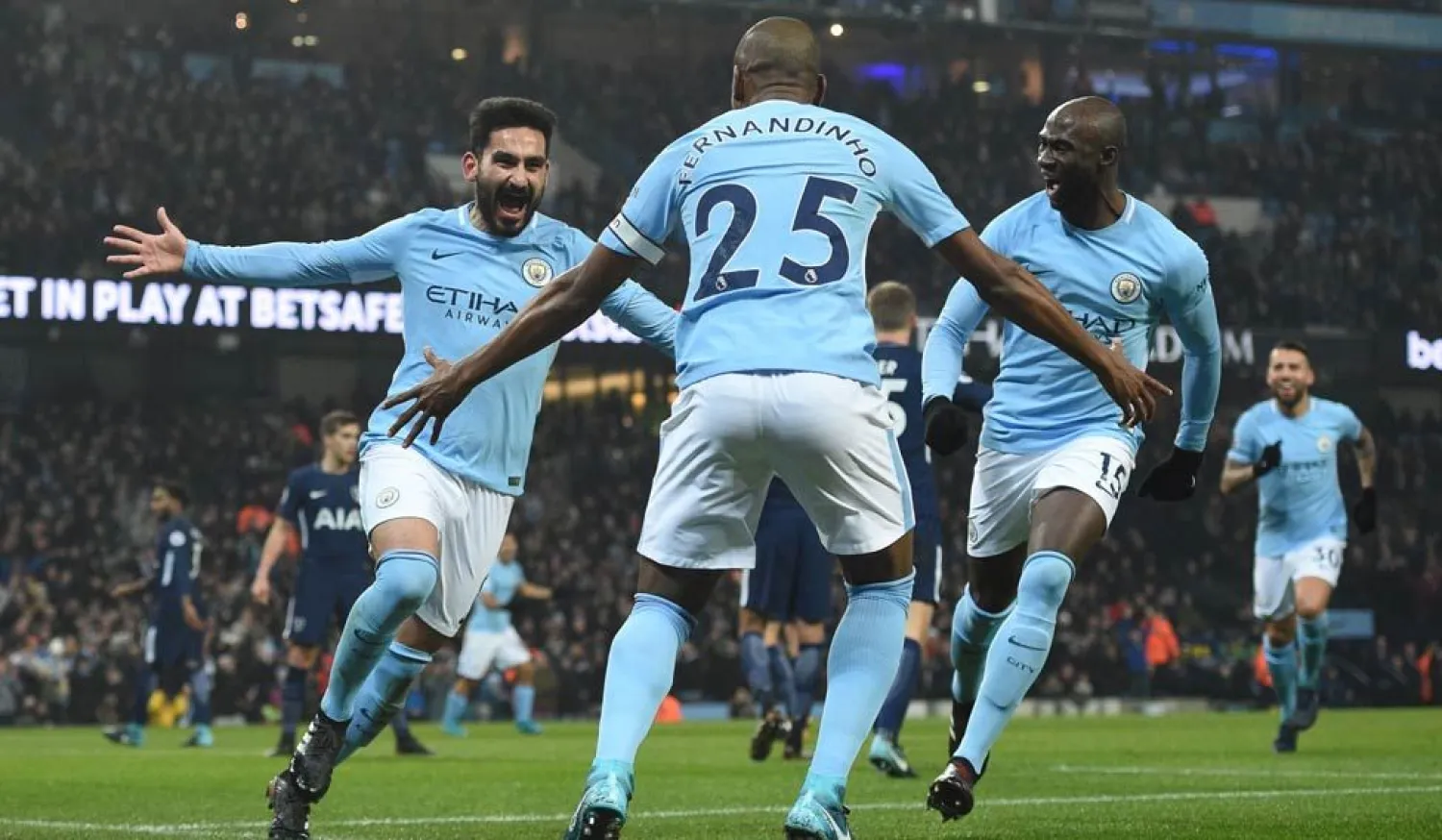
Manchester City's Ilkay Gundogan (left) celebrates after scoring a goal during their match against Tottenham Hotspur at the Etihad Stadium in December 2017. (AFP)
TT

Premier League Slides into the Grip of Radical Non-Possession

Manchester City's Ilkay Gundogan (left) celebrates after scoring a goal during their match against Tottenham Hotspur at the Etihad Stadium in December 2017. (AFP)

Manchester City’s dominance is increasing the trend towards one side dominating ball possession in games and that threatens to diminish the spectacle.

In 1970, when studying the effects of the appearance of robots, the Japanese robotics professor Masahiro Mori discovered something strange was going on. The more human a robot’s appearance became, the more people demonstrated empathy towards it up to a certain point at which they felt strong revulsion.

After that point, though, the more humanoid the robot became the more people began to respond positively again. There was a zone of resemblance, of almost‑humanness, that people found deeply disturbing: it was familiar enough for them to begin to engage on a human level only to find the robot deficient in all the usual points of reference. Mori called this the “uncanny valley”.

Last Wednesday Manchester City beat Newcastle United 1-0. It looked a lot like a football match but it somehow was not quite a football match. The mood in the stadium was, frankly, weird: City’s technical virtuosity was admirable and yet strangely uncompelling. Newcastle fans quickly accepted they were watching something to which the usual rules did not apply and began celebrating every time their side touched the ball in the City half. On Sky, Jamie Carragher called it “a joke” and said the Premier League was “becoming an embarrassment”.

Gary Neville described it as “not acceptable”. Social media were aflame. Something about that game repelled people; it had fallen into the uncanny valley, close enough to football to engage and yet so far from expected norms that it disgusted.

At half-time City had had 83 percent possession and were on course to break the Premier League record of 82.28 percent they had set in beating Queens Park Rangers on the final day of the 2011-12 season (by the end, though, City were down to 78 percent). Yet Newcastle survived, nearly snatched an equalizer on a couple of occasions and lost only 1-0. From that point of view Rafael Benítez’s tactics worked (while acknowledging City could have won 3-0 or 4-0 without anybody thinking there was anything outlandish about the scoreline).

Carragher’s wider point was that the joy of the Premier League is the sense of spectacle and that is diminished when the game essentially becomes a drill with a punchbag. The pattern of matches becoming attack against defense is increasingly prevalent.

In the first three seasons that Opta collected data, between 2003-04 and 2005-06, there were only three games in which one team had 70 percent or more of the ball. That figure rose gradually to 36 in 2016-17.

This season there have already been 37 instances. The number of games in which one team had 65 percent or more of possession has risen from 11 in 2003-04 to 94 last season (and 64 so far this); 60 percent or more is up from 63 in 2003-04 to 181 last season (and 100 so far this).

In part that is because it is easier to hold possession now. The liberalization of the offside law makes it much harder for teams to set their basic defensive line high up the pitch, increasing the effective playing area and so making the midfield less congested. With referees far more inclined to show cards, it is much harder now than it was even 15 years ago to bully creative players out of the game. The result is an era in which the likes of Xavi, Luka Modric and David Silva have thrived.

There is also perhaps a sense that Pep Guardiola’s Barcelona, and the way it was combated, changed perceptions of what was acceptable and, indeed, possible. Manchester United were panicked in the 2009 Champions League final by the fact they could not get the ball off Barcelona; it was not just that they were not used to playing without the ball, it was that it somehow felt unseemly for them to have so little of it. The examples of Inter and Chelsea in the semi-finals of 2010 and 2012, though, showed it was possible to prevail even with 20 percent of the ball, a lesson that swiftly passed down the leagues: against top sides, sit deep, keep the shape and worry about the ball later. Radical possession begat radical non-possession.

Many criticized Benítez for his set-up and perhaps, as Roy Hodgson showed four days later, a more proactive approach might have yielded a better result. Benítez, perhaps, would argue that he lacks anybody of the pace and quality of Wilfried Zaha to do that. The specifics matter less than the general point that a manager’s prime responsibility is to set up his team in the way that will best equip them to get the best result possible.

The beauty of football lies in the struggle and the fact that a weaker side can hold off a stronger one. It is not all about tricks and flicks and the “better” side winning. There is an extraordinary arrogance about those armchair viewers who demand a team should play in an ineffective way so that they may be entertained. But that is not to say that there is not a problem. As Carragher said, the sides at the top are now so far ahead of those at the bottom that increasingly teams feel their only option is radical non-possession.

That is a direct consequence of the iniquities of the game’s finance and it probably does diminish the spectacle. What may be enthralling in a Champions League semi-final against one of the greatest sides of all time palls when it happens a couple of times a week in the league.

The Premier League is walking in the shadow of the uncanny valley.

The Guardian Sport


Lindsey Vonn Back in US Following Crash in Olympic Downhill 

Milano Cortina 2026 Olympics - Alpine Skiing - Women's Downhill 3rd Official Training - Tofane Alpine Skiing Centre, Belluno, Italy - February 07, 2026. Lindsey Vonn of United States in action during training. (Reuters)
TT

Lindsey Vonn Back in US Following Crash in Olympic Downhill 

Milano Cortina 2026 Olympics - Alpine Skiing - Women's Downhill 3rd Official Training - Tofane Alpine Skiing Centre, Belluno, Italy - February 07, 2026. Lindsey Vonn of United States in action during training. (Reuters)

Lindsey Vonn is back home in the US following a week of treatment at a hospital in Italy after breaking her left leg in the Olympic downhill at the Milan Cortina Games.

“Haven’t stood on my feet in over a week... been in a hospital bed immobile since my race. And although I’m not yet able to stand, being back on home soil feels amazing,” Vonn posted on X with an American flag emoji. “Huge thank you to everyone in Italy for taking good care of me.”

The 41-year-old Vonn suffered a complex tibia fracture that has already been operated on multiple times following her Feb. 8 crash. She has said she'll need more surgery in the US.

Nine days before her fall in Cortina d'Ampezzo, Italy, Vonn ruptured the ACL in her left knee in another crash in Switzerland.

Even before then, all eyes had been on her as the feel-good story heading into the Olympics for her comeback after nearly six years of retirement.


Japan Hails ‘New Chapter’ with First Olympic Pairs Skating Gold 

Gold medalists Japan's Riku Miura and Japan's Ryuichi Kihara pose after the figure skating pair skating free skating final during the Milano Cortina 2026 Winter Olympic Games at Milano Ice Skating Arena in Milan on February 16, 2026. (AFP)
TT

Japan Hails ‘New Chapter’ with First Olympic Pairs Skating Gold 

Gold medalists Japan's Riku Miura and Japan's Ryuichi Kihara pose after the figure skating pair skating free skating final during the Milano Cortina 2026 Winter Olympic Games at Milano Ice Skating Arena in Milan on February 16, 2026. (AFP)

Japan hailed a "new chapter" in the country's figure skating on Tuesday after Riku Miura and Ryuichi Kihara pulled off a stunning comeback to claim pairs gold at the Milan-Cortina Olympics.

Miura and Kihara won Japan's first Olympic pairs gold with the performance of their careers, coming from fifth overnight to land the title with personal best scores.

It was the first time Japan had won an Olympic figure skating pairs medal of any color.

The country's government spokesman Minoru Kihara said their achievement had "moved so many people".

"This triumph is a result of the completeness of their performance, their high technical skill, the expressive power born from their harmony, and above all the bond of trust between the two," the spokesman said.

"I feel it is a remarkable feat that opens a new chapter in the history of Japanese figure skating."

Newspapers rushed to print special editions commemorating the pair's achievement.

Miura and Kihara, popularly known collectively in Japan as "Rikuryu", went into the free skate trailing after errors in their short program.

Kihara said that he had been "feeling really down" and blamed himself for the slip-up, conceding: "We did not think we would win."

Instead, they spectacularly turned things around and topped the podium ahead of Georgia's Anastasiia Metelkina and Luka Berulava, who took silver ahead of overnight leaders Minerva Fabienne Hase and Nikita Volodin of Germany.

American gymnastics legend Simone Biles was in the arena in Milan to watch the action.

"I'm pretty sure that was perfection," Biles said, according to the official Games website.


Mourinho Says It Won’t Take ‘Miracle’ to Take Down ‘Wounded King’ Real Madrid in Champions League

Benfica's coach Jose Mourinho reacts during a press conference on the eve of their UEFA Champions League knockout round play-off first leg football match against Real Madrid at Benfica Campus in Seixal, outskirts of Lisbon, on February 16, 2026. (AFP)
TT

Mourinho Says It Won’t Take ‘Miracle’ to Take Down ‘Wounded King’ Real Madrid in Champions League

Benfica's coach Jose Mourinho reacts during a press conference on the eve of their UEFA Champions League knockout round play-off first leg football match against Real Madrid at Benfica Campus in Seixal, outskirts of Lisbon, on February 16, 2026. (AFP)

José Mourinho believes Real Madrid is "wounded" after the shock loss to Benfica and doesn't think it will take a miracle to stun the Spanish giant again in the Champions League.

Benfica defeated Madrid 4-2 in the final round of the league phase to grab the last spot in the playoffs, and in the process dropped the 15-time champion out of the eight automatic qualification places for the round of 16.

Coach Mourinho's Benfica and his former team meet again in Lisbon on Tuesday in the first leg of the knockout stage.

"They are wounded," Mourinho said Monday. "And a wounded king is dangerous. We will play the first leg with our heads, with ambition and confidence. We know what we did to the kings of the Champions League."

Mourinho acknowledged that Madrid remained heavily favored and it would take a near-perfect show for Benfica to advance.

"I don’t think it takes a miracle for Benfica to eliminate Real Madrid. I think we need to be at our highest level. I don’t even say high, I mean maximum, almost bordering on perfection, which does not exist. But not a miracle," he said.

"Real Madrid is Real Madrid, with history, knowledge, ambition. The only comparable thing is that we are two giants. Beyond that, there is nothing else. But football has this power and we can win."

Benfica's dramatic win in Lisbon three weeks ago came thanks to a last-minute header by goalkeeper Anatoliy Trubin, allowing the team to grab the 24th and final spot for the knockout stage on goal difference.

"Trubin won’t be in the attack this time," Mourinho joked.

"I’m very used to these kinds of ties, I’ve been doing it all my life," he said. "People often think you need a certain result in the first leg for this or that reason. I say there is no definitive result."
