

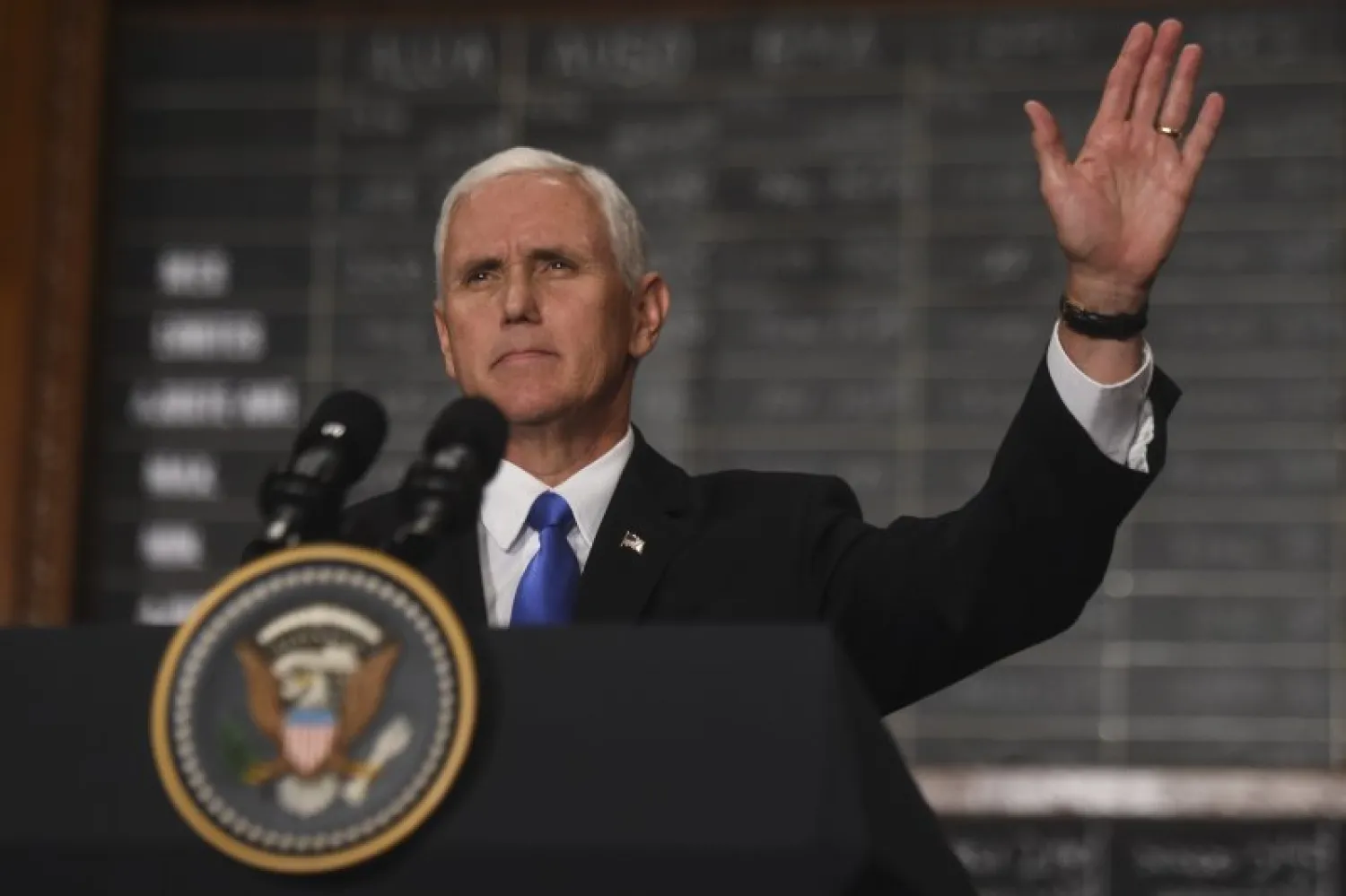

Pence Seeks to Ease Jerusalem Tensions

US Vice President Mike Pence. AFP PHOTO / Eitan ABRAMOVICH
TT

Pence Seeks to Ease Jerusalem Tensions

US Vice President Mike Pence. AFP PHOTO / Eitan ABRAMOVICH

US Vice President Mike Pence kicked off on Saturday his Middle East tour by first visiting Egypt where he met with President Abdel Fatah el-Sisi.

The visit is the first of a US official to the region since US President Donald Trump’s decision to recognize Jerusalem as Israel's capital last month, which was met with Arab and worldwide rejections.

In his regional tour, Pence seeks to ease tensions on the Jerusalem file.

On the eve of his arrival to Cairo, Press secretary Alyssa Farah said the trip was “integral to America’s national security and diplomatic objectives” and would go on as scheduled.

After spending a couple of hours in Cairo, the US VP left the Egyptian capital on Saturday evening heading to Amman, where he will meet with Jordan's King Abdullah. He is expected to visit Israel on Monday and Tuesday.

Palestinians are currently boycotting Pence’s visit, and they lean towards finding an international substitute to replace the US role, as a response to Trump’s decision to move the US embassy from Tel Aviv to Jerusalem.

The Palestinian leadership is therefore studying a Russian invitation to organize a meeting between Palestinian President Mahmoud Abbas and Israeli Prime Minister Benyamin Netanyahu.

Abbas is scheduled to visit Moscow next month to discuss the possibility of developing a new peace vision.

On Saturday, top Palestinian negotiator Saeb Erekat uncovered the peace plan formulated by the US administration in a document presented to Abbas and received by Asharq Al-Awsat.

In this document, Erekat told Abbas that the new peace plan formulated by the current US administration aims for “imposing and dictating” the American decisions.

Erekat also said that those who reject US dictations would be considered as terrorist or extremist forces.



US and Iran to Hold a Second Round of Nuclear Talks in Geneva

US and Iranian flags are seen in this illustration taken, September 8, 2022. REUTERS/Dado Ruvic/Illustration
TT

US and Iran to Hold a Second Round of Nuclear Talks in Geneva

US and Iranian flags are seen in this illustration taken, September 8, 2022. REUTERS/Dado Ruvic/Illustration

The US and Iran are expected to hold their second round of talks about Iran’s nuclear program Tuesday in Geneva as the United States ramps up its military presence in the Middle East and Iran holds large-scale maritime exercises.

US President Donald Trump has repeatedly threatened to use force to compel Iran to agree to constrain its nuclear program. Iran has said it would respond with an attack of its own. Trump has also threatened Iran over its deadly crackdown on recent nationwide protests, The Associated Press said.

The first round of talks Feb. 6 were held in Oman, a sultanate on the eastern edge of the Arabian Peninsula, and were indirect, with SUVs flying the American flag entering the palace venue only after it appeared the Iranian officials had left. The arrangements for Tuesday's round of negotiations were not clear.

Trump’s envoys Steve Witkoff and Jared Kushner were traveling for the new round of talks. US Secretary of State Marco Rubio, visiting Budapest, Hungary, said Monday that the US hopes to achieve a deal with Iran, despite the difficulties. “I’m not going to prejudge these talks,” Rubio said. “The president always prefers peaceful outcomes and negotiated outcomes to things.”

Iranian Foreign Minister Abbas Araghchi, who is leading the talks for Iran, met with the head of the UN nuclear watchdog agency Monday in Geneva.

“I am in Geneva with real ideas to achieve a fair and equitable deal,” Araghchi wrote on X. “What is not on the table: submission before threats.”

Last week, a top Iranian security official traveled to Oman and met with Omani Foreign Minister Badr al-Busaidi, the chief intermediary in the talks, in a meeting likely focused on updates from the first round and next steps.

“Regional peace and security is our priority, and we urge restraint and wise compromise,” al-Busaidi wrote on X after his meeting with Ali Larijani, a former Iranian parliament speaker who now serves as the secretary to the country’s Supreme National Security Council.

Iran has in the past communicated its positions in writing when dealing with the Americans. Famously, Japan’s then-Prime Minister Shinzo Abe tried to hand Iranian Supreme Leader Ali Khamenei a letter from Trump in 2019 that he refused to take.

Iran holds naval drills against the US military buildup

Iran announced that its paramilitary Revolutionary Guard started a drill early Monday morning in the Strait of Hormuz, the Arabian Gulf and the Gulf of Oman, waterways that are crucial international trade routes through which 20% of the world’s oil passes.

Separately, EOS Risk Group said sailors passing through the region received a radio warning that the northern lane of the Strait of Hormuz, in Iranian territorial waters, likely would see a live-fire drill Tuesday. Iranian state TV did not mention the live-fire drill.

It was Iran's second warning in recent weeks about a live-fire drill.

Last week, Trump said the USS Gerald R. Ford, the world’s largest aircraft carrier, was being sent from the Caribbean Sea to the Mideast to join other warships and military assets the US has built up in the region.

The Ford, whose new deployment was first reported by The New York Times, will join the USS Abraham Lincoln and its accompanying guided-missile destroyers, which have been in the region for over two weeks. US forces already have shot down an Iranian drone that approached the Lincoln on the same day last week that Iran tried to stop a US-flagged ship in the Strait of Hormuz.

Gulf Arab nations have warned any attack could spiral into another regional conflict in a Mideast still reeling from the Israel-Hamas war in the Gaza Strip.

Iran says any deal must include easing of punishing sanctions

The Trump administration is seeking a deal to limit Iran’s nuclear program and ensure it does not develop nuclear weapons. Iran says it is not pursuing weapons and has so far resisted demands that it halt uranium enrichment or hand over its supply of uranium.

Iran’s Deputy Foreign Minister Majid Takht-Ravanchi signaled that Tehran could be open to compromise on the nuclear issue, but is looking for an easing of international sanctions led by the United States.

“The ball is in America’s court. They have to prove they want to have a deal with us,” Takht-Ravanchi told the BBC on Sunday. “If we see a sincerity on their part, I am sure that we will be on a road to have an agreement.”

“We are ready to discuss this and other issues related to our program provided that they are also ready to talk about the sanctions,” he added.

The US and Iran were in the middle of months of meetings when Israel’s launch of a 12-day war against Iran back in June instantly halted the talks. The US bombed Iranian nuclear sites during that war, likely destroying many of the centrifuges that spun uranium to near weapons-grade purity. Israel’s attacks decimated Iran’s air defenses and targeted its ballistic missile arsenal as well.

Iran has insisted its nuclear program is for peaceful purposes. Before the June war, Iran had been enriching uranium up to 60% purity, a short, technical step away from weapons-grade levels.


Kremlin Rejects Claim it Poisoned Navalny with Dart Frog Toxin, Widow Says Truth is Out

A person lays flowers at the grave of Russian opposition leader Alexei Navalny while marking the first anniversary of his death at a cemetery in Moscow, Russia, February 16, 2025. REUTERS/Evgenia Novozhenina
TT

Kremlin Rejects Claim it Poisoned Navalny with Dart Frog Toxin, Widow Says Truth is Out

A person lays flowers at the grave of Russian opposition leader Alexei Navalny while marking the first anniversary of his death at a cemetery in Moscow, Russia, February 16, 2025. REUTERS/Evgenia Novozhenina

The Kremlin on Monday flatly rejected accusations from five European countries that the Russian state had killed Alexei Navalny two years ago using toxin from poison dart frogs, but his widow said the truth had finally been proven.

Navalny, President Vladimir Putin's most prominent domestic critic, died on February 16, 2024, in the "Polar Wolf" penal colony north of the Arctic Circle about 1,900 km (1,200 miles) northeast of Moscow. He was 47, Reuters reported.

His death, which the Russian state said was from natural causes, occurred a month before Putin was re-elected for a fifth term in a landslide vote which Western nations said was neither free nor fair due to censorship and a crackdown on opponents.

Britain, France, Germany, Sweden and the Netherlands said on Saturday that analyses of samples from Navalny's body had "conclusively" confirmed the presence of epibatidine, a toxin found in poison dart frogs in South America and not found naturally in Russia.

"Navalny died while held in prison, meaning Russia had the means, motive and opportunity to administer this poison to him," they said.

Kremlin spokesman Dmitry Peskov rejected the allegations.

"Naturally, we do not accept such accusations. We disagree with them. We consider them biased and not based on anything. And we strongly reject them," Peskov told reporters.

TEST RESULTS?

Maria Zakharova, a spokeswoman for the Russian Foreign Ministry, previously said Moscow would provide relevant comment if and when the countries making the allegations released and detailed their test results.

Until then, the state TASS news agency cited her as saying, the allegations were "merely propaganda aimed at diverting attention from pressing Western issues".

The British government on Saturday declined to respond to a Reuters query about how the samples from Navalny's body were obtained or where they were assessed.

The European joint statement referenced the 2018 Novichok poisoning in Salisbury, England, of former Russian agent Sergei Skripal and his daughter, suggesting that Moscow has form when it comes to using deadly poisons against its enemies.

Russia denies involvement in the Salisbury incident. It also rejects British allegations that Moscow killed dissident Alexander Litvinenko in London in 2006 by lacing his tea with radioactive polonium-210.

A group of 15 mostly European countries - but also including Australia, New Zealand and Canada - issued a fresh statement on Monday, reiterating their demands for Russia to conduct a transparent investigation into Navalny's death.

The statement, published on the German foreign ministry's website, said that Russian human rights defenders were continuing Navalny's legacy and called on Moscow to release "all political prisoners".

The dart frog toxin allegations were made at the Munich Security Conference ahead of the second anniversary of Navalny's death on Monday.

Yulia Navalnaya, his widow - who had alleged from the outset that her husband had been murdered by the Russian state - said on Monday that the findings provided the necessary proof to back her stance.

"Two years. We have attained the truth, and we will also attain justice one day," Navalnaya wrote on X above a photograph of her late husband smiling.


EU to Take Part in Trump’s ‘Board of Peace’ but Not as Member 

European Commissioner for the Mediterranean Dubravka Suica speaks during a debate on the “Situation in Northeast Syria, the violence against civilians and the need to maintain a sustainable ceasefire” as part of the European Parliament plenary session in Strasbourg, France, 10 February 2026. (EPA) 
TT

EU to Take Part in Trump’s ‘Board of Peace’ but Not as Member 

European Commissioner for the Mediterranean Dubravka Suica speaks during a debate on the “Situation in Northeast Syria, the violence against civilians and the need to maintain a sustainable ceasefire” as part of the European Parliament plenary session in Strasbourg, France, 10 February 2026. (EPA) 

The European Union will take part in this week's inaugural meeting of US President Donald Trump's "Board of Peace", but a spokesman insisted Monday that Brussels would not be joining as a member.

The European Commissioner for the Mediterranean, Dubravka Suica, will head to Washington to represent the EU at the meeting Thursday.

"She will participate in the meeting of the Board of Peace for the specific part dedicated to Gaza. Let me stress that the European Commission, it's not becoming a member to the Board of Peace," EU spokesman Guillaume Mercier said.

He added the EU executive was participating as part of its "long-standing commitment" to the implementation of the Gaza ceasefire and "to support the reconstruction and the post-recovery in Gaza", he added.

The Board of Peace, of which Trump is the chairman, was initially designed to oversee the Gaza truce and reconstruction after the war between Hamas and Israel.

But its purpose has since morphed into resolving all sorts of international conflicts, triggering fears the US president wants to create a rival to the UN.

Some EU member states have raised concerns about the board.

"We still have a number of questions regarding several elements in the Board of Peace: one concerning its scope, two concerning its governance, and three, its compatibility with the UN Charter," EU spokesman Anouar El Anouni said.