


Crosses Are Falling In The Premier League: Why The Focus On Target Men?

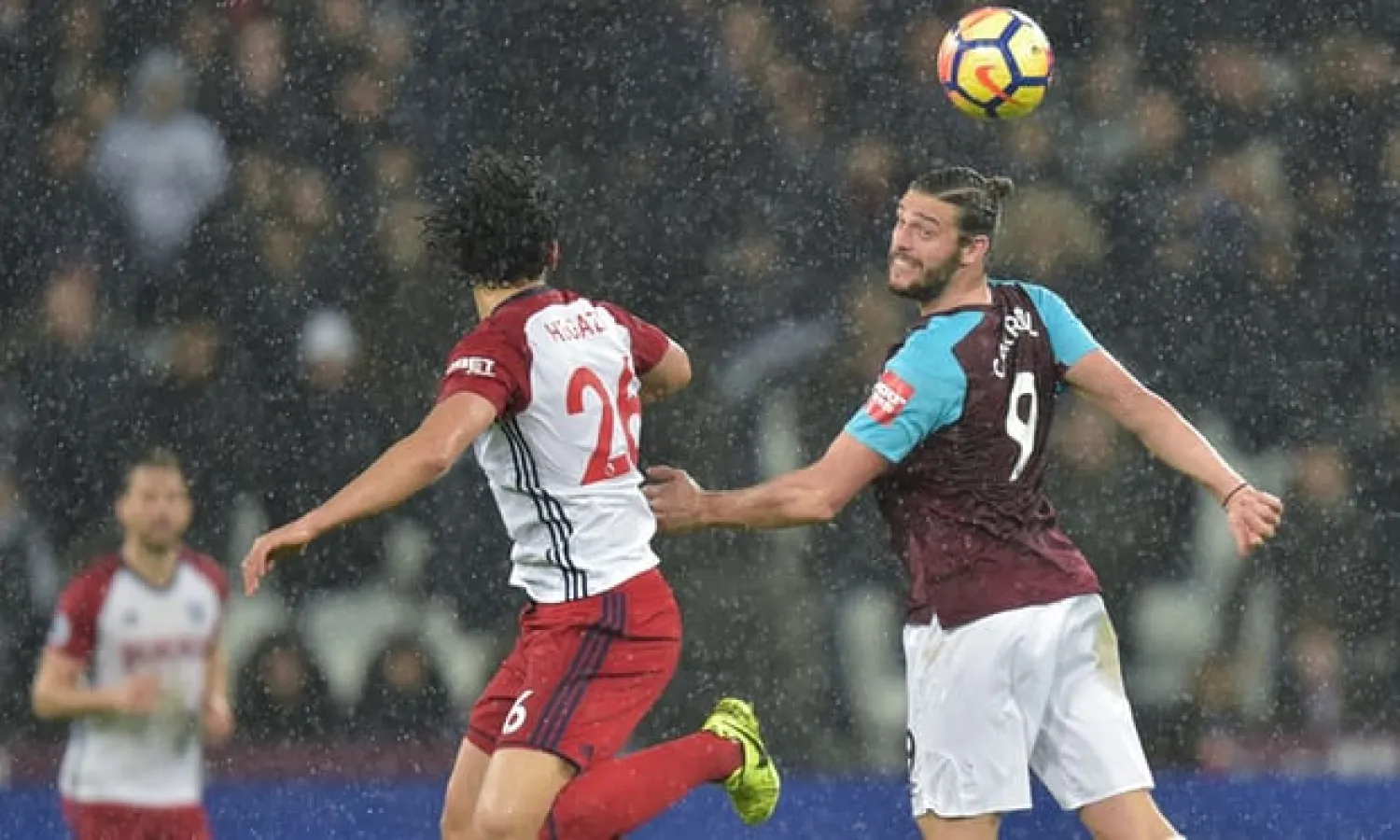
 Andy Carroll (right) in the air is a fearsome sight but his injuries and teams’ worse crossing makes him less effective than he once was. Photograph: Joe Toth/BPI/Rex/Shutterstock
Andy Carroll (right) in the air is a fearsome sight but his injuries and teams’ worse crossing makes him less effective than he once was. Photograph: Joe Toth/BPI/Rex/Shutterstock
TT

Crosses Are Falling In The Premier League: Why The Focus On Target Men?

 Andy Carroll (right) in the air is a fearsome sight but his injuries and teams’ worse crossing makes him less effective than he once was. Photograph: Joe Toth/BPI/Rex/Shutterstock
Andy Carroll (right) in the air is a fearsome sight but his injuries and teams’ worse crossing makes him less effective than he once was. Photograph: Joe Toth/BPI/Rex/Shutterstock

How times change. At the dawn of the Premier League the news that Chelsea wanted a rugged English striker to hurl himself at crosses, preferably after smashing through a centre-half in the brusque style of Kerry Dixon or Mick Harford, would barely have caused a ripple. Yet when it emerged last week that they were lining up a £20m bid for Andy Carroll – and then started making eyes at Peter Crouch – their fans were entitled to check their calendars to make sure it was not 1 April.

Reports on Sunday morning that Chelsea had turned their attention to the Roma striker Edin Dzeko suggested sanity had returned to the Stamford Bridge boardroom – until, that is, they were linked with Burnley’s journeyman forward Ashley Barnes hours later.

Carroll had eight injuries last season. Crouch turns 37 next week and has scored 10 league goals since the start of 2016-17. Barnes has 10 in 65 over the same period. They all have mixed records, to say the least. No wonder there has been bewilderment at Chelsea’s approach.

But perhaps there is something else here, beyond the players themselves – the question of why one of the world’s richest clubs seem hellbent on buying an ageing English meat-and-potatoes centre-forward to hold the ball up, create havoc, and get on the end of crosses speared into the mixer? Because in a game that gets faster and more fluid with every passing season, players such as Carroll – and to a lesser extent Crouch and Barnes – feel more of a curiosity than ever.

That narrative is reflected in the numbers. When Opta started collating records in 2003-04 there was an average of 51 crosses per Premier League game – a figure that was almost certainly much higher in previous decades. This season it is 38, the lowest on record. More intriguingly crossing accuracy, too, has plummeted to its lowest level. A 30% success rate in the Premier League used to be typical. This season it is below 22%.

One reason, as Opta’s Duncan Alexander points out, is that these figures include set pieces – and as teams increasingly play with only one, or even no, out-and-out striker, an increasing proportion of crosses will come from corners and free-kicks where defending teams have the opportunity to set themselves up.

But teams are more aware of the percentages, too. Data shows that only one out of 92 crosses on average leads directly to a goal – although, as Garry Gelade, a statistical consultant who works with Premier League sides has shown, it is a bit more complicated than that. After analysing 35,000 crosses in the Premier League between 2013 and 2015 in more depth – and, in particular, looking at what happened in the six seconds afterwards – he found that one in every 47 crosses leads to a goal.

Of course the location of the cross, along with a player’s delivery, will radically alter the chances of its success. Even so, when you compare the leading goalscorers in the 1992-93 Premier League with those this season, the difference is notable.

Twenty-five years ago, Les Ferdinand topped the scoring charts, with other big men such as Alan Shearer, Paul Wilkinson, Brian Deane, Mark Hughes, Lee Chapman, Ian Olney and Iain Dowie in the top 20. This season – with the honourable exceptions of Harry Kane, Romelu Lukaku, Wayne Rooney and Álvaro Morata – the list is dominated by nimble speed merchants.

So why have Chelsea considered Carroll, Crouch and Barnes? Most put it down to the need for a Plan B at the end of games, when necessity dictates that a more cultured approach gives way to caveman football. But, putting aside the question of whether a side as good as Chelsea need a Plan B if Plan A is executed well enough – look at Manchester City – would Carroll, Crouch or Barnes really make a difference?

Carroll has scored only six times in 64 substitute appearances for West Ham, while Crouch’s record of 15 goals in 146 is not much better. Both men are a long way behind Arsenal’s Olivier Giroud, who has scored a staggering 17 goals in 60 Premier League games as a sub – better than one in every four appearances off the bench.

There is another reason to be cautious about a crude Plan B. Gelade’s data shows that, while the chance of a goal from a cross climbs as the second half goes on, after about 85 minutes the success rate plummets. Arguably that is because teams protecting a lead defend deep and in numbers – while those attacking get more desperate.

Yet while Carroll’s and Crouch’s playing style is fading out of fashion, the numbers clearly show they improve West Ham’s and Stoke’s goals and chance creation when they play. The stats for Carroll, in particular, are startling. Since the start of the 2015‑16 season West Ham have averaged 1.51 goals per 90 minutes with Carroll in the team – but only 1.13 without him. That equates to better than one extra goal every three matches or more than 14 in the course of a Premier League season.

Yet it is one thing improving West Ham and Stoke – quite another doing it at Chelsea. And, while the switch to Dzeko over the past 24 hours is a clear upgrade, Chelsea should have been targeting players of the future, not throwbacks to a different era all along.

The Guardian Sport


Chelsea Injuries up 44% After Club World Cup but Report Says Event Has Had ‘Minimal’ Impact

Chelsea's Reece James, center, lifts the trophy following the Club World Cup final soccer match between Chelsea and PSG at MetLife Stadium in East Rutherford, N.J., Sunday, July 13, 2025. (AP)
TT

Chelsea Injuries up 44% After Club World Cup but Report Says Event Has Had ‘Minimal’ Impact

Chelsea's Reece James, center, lifts the trophy following the Club World Cup final soccer match between Chelsea and PSG at MetLife Stadium in East Rutherford, N.J., Sunday, July 13, 2025. (AP)

Chelsea suffered a 44% spike in injuries after competing in the supersized Club World Cup this year, according to findings published on Tuesday.

But the newly expanded tournament has so far had a “minimal impact” on injuries overall, the latest edition of the Men’s European Football Injury Index found.

There was fierce opposition to FIFA's new flagship club event when it was confirmed in 2023 that it would increase from seven to 32 teams, with players' unions warning of physical and mental burnout of players due to an ever expanding match schedule. But FIFA pressed ahead and staged the tournament in the United States in June-July.

Chelsea went on to win the inaugural competition, receiving the trophy from US President Donald Trump at MetLife Stadium and taking home prize money of around $125 million. But, according to the Index, from June-October, Chelsea picked up more injuries — 23 — than any of the nine clubs from Europe's top leagues that participated in the Club World Cup.

They included star player Cole Palmer, and was a 44% increase on the same period last year.

While Chelsea, which played 64 games over the entire 2024-25 season, saw an increase in injuries, the Index, produced by global insurance firm Howden, found that overall there was a decrease.

“In principle you would expect this increased workload to lead to an increase in the number of injuries sustained, as a possible rise in overall injury severity,” the Index report said, but added: “The data would suggest a minimal impact on overall injury figures.”

Despite the figures, the authors of the report accept it was too early to assess the full impact of the Club World Cup, with the findings only going up to October.

“We would expect to see the impact to spike in that sort of November to February period,” said James Burrows, Head of Sport at Howden. “What we’ve seen previously is that’s where the impact is seen from summer tournaments."

Manchester City has sustained 22 since the tournament, which is the highest among the nine teams from Europe's top leagues — England, Spain, Italy, Germany and France.

Those teams have recorded 146 injuries from June-October, which is down on the previous year's figure of 174.

From August-October that number is 121, the lowest for that three-month period in the previous six years of the Index.


Sunderland Worst Hit by Losing Players to African Cup of Nations 

14 December 2025, United Kingdom, London: Sunderland's Habib Diarra (L) and Leeds United's Gabriel Gudmundsson battle for the ball during the English Premier League soccer match between Brentford and Leeds United at the Gtech Community Stadium. (dpa)
TT

Sunderland Worst Hit by Losing Players to African Cup of Nations 

14 December 2025, United Kingdom, London: Sunderland's Habib Diarra (L) and Leeds United's Gabriel Gudmundsson battle for the ball during the English Premier League soccer match between Brentford and Leeds United at the Gtech Community Stadium. (dpa)

Premier League Sunderland will have to do without six players over the next few weeks and are the club worst hit as the Africa Cup of Nations takes its toll on European clubs competing over the holiday season.

Sunderland, eighth in the standings, had four of their African internationals in action when they beat Newcastle United on Sunday, but like 14 other English top-flight clubs will now lose those players to international duty.

The timing of the African championship, kicking off in Morocco on Sunday and running through to January 18, has long been an irritant for coaches, with leagues in Belgium, France, Germany, Italy, Netherlands, Portugal, and Spain also affected.

Hosting the tournament in the middle of the season impacts around 58% of the players at the Cup of Nations, though the Confederation of African Football did try to mitigate the impact by moving the start to before Christmas, so it is completed before the next round of Champions League matches.

The impact on European clubs was also lessened by allowing them to release players seven days, rather than the mandatory 14 days, before the tournament, meaning they could play for their clubs last weekend.

Sunderland's Congolese Arthur Masuaku and Noah Sadiki, plus full back Reinildo (Mozambique), midfielder Habib Diarra (Mali), and attackers Chemsdine Talbi (Morocco) and Bertrand Traore (Burkina Faso) have now departed for Morocco.

Ironically, Mohamed Salah’s absence from Liverpool to play for Egypt should lower the temperature at the club after his recent outburst against manager Arne Slot, but Manchester United will lose three players in Noussair Mazraoui, Bryan Mbeumo and Amad Diallo, who scored in Monday’s 4-4 draw with Bournemouth.

France is again the country with the most players heading to the Cup of Nations, and with 51 from Ligue 1 clubs. But their absence is much less impactful than previously as Ligue 1 broke after the weekend’s fixtures and does not resume until January 2, by which time the Cup of Nations will be into its knockout stage.

There are 21 players from Serie A clubs, 18 from the Bundesliga, and 15 from LaLiga teams among the 24 squads at the tournament in Morocco.


Rodgers Takes Charge of Saudi Team Al-Qadsiah After Departure from Celtic 

Then-Celtic head coach Brendan Rodgers greets supporters after a Europa League soccer match between Red Star and Celtic at Rajko Mitic Stadium in Belgrade, Serbia, Sept. 24, 2025. (AP)
TT

Rodgers Takes Charge of Saudi Team Al-Qadsiah After Departure from Celtic 

Then-Celtic head coach Brendan Rodgers greets supporters after a Europa League soccer match between Red Star and Celtic at Rajko Mitic Stadium in Belgrade, Serbia, Sept. 24, 2025. (AP)

Brendan Rodgers has returned to football as the coach of Saudi Arabian club Al-Qadsiah, six weeks after resigning from Scottish champion Celtic.

Al-Qadsiah, whose squad includes Italian striker Mateo Retegui and former Real Madrid defender Fernandez Nacho, is in fifth place in the Saudi Pro League in its first season after promotion.

Rodgers departed Celtic on Oct. 27 and has opted to continue his managerial career outside Britain for the first time, having previously coached Liverpool, Leicester and Swansea.

In its statement announcing the hiring of Rodgers on Tuesday, Al-Qadsiah described him as a “world-renowned coach” and said his arrival “reflects the club’s ambitious vision and its rapidly growing sporting project.”

Aramco, the state-owned Saudi oil giant, bought Al-Qadsiah in 2023 in a move that has helped to transform the club’s status.

“This is a landmark moment for the club,” Al-Qadsiah chief executive James Bisgrove said. “The caliber of his experience and track record of winning reflects our ambition and long-term vision to establish Al-Qadsiah as one of Asia’s leading clubs.”

Rodgers is coming off winning back-to-back Scottish league titles with Celtic, where he won 11 major trophies across his two spells. He also won the FA Cup with Leicester.

Al-Qadsiah's last two coaches were former Liverpool striker Robbie Fowler and former Spain midfielder Michel.
