
The Munich Disaster’s Long Shadow Still Falls On Us All, 60 Years On

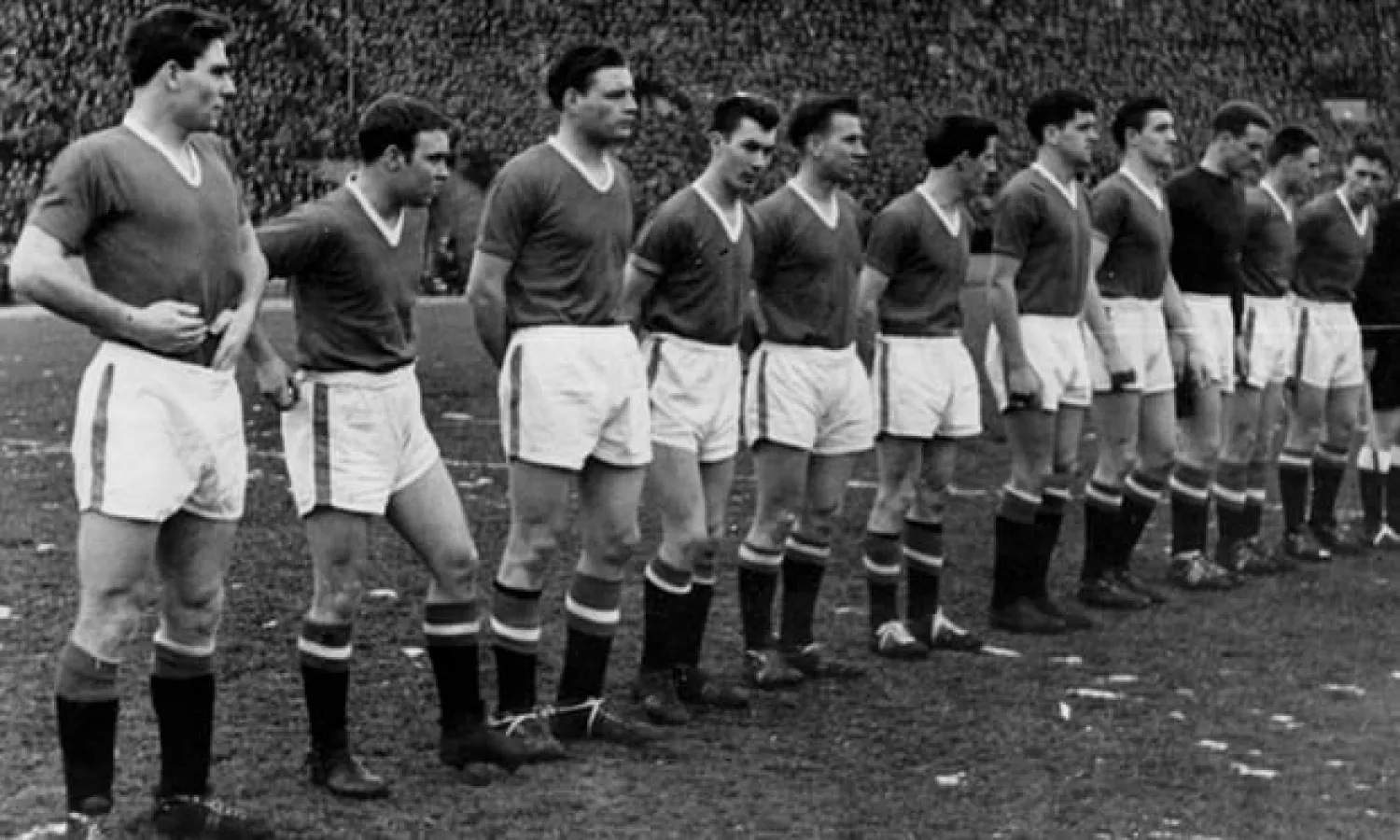
 Manchester United line up at Red Star Belgrade on 5 February 1958, the day before the plan crash. Photograph: Keystone/Getty Images
Manchester United line up at Red Star Belgrade on 5 February 1958, the day before the plan crash. Photograph: Keystone/Getty Images
TT

The Munich Disaster’s Long Shadow Still Falls On Us All, 60 Years On

 Manchester United line up at Red Star Belgrade on 5 February 1958, the day before the plan crash. Photograph: Keystone/Getty Images
Manchester United line up at Red Star Belgrade on 5 February 1958, the day before the plan crash. Photograph: Keystone/Getty Images

There are always moments in this job that you remember more than others. The trips abroad, the sweet-scented nights at all those fabulous old grounds where, even subconsciously, you find yourself quickening your step on the walk in. Or the occasions with the great football men from years gone by, when you know how lucky you are to be in their company, listening to their stories with the shackles off, and it feels like an education.

One of those times, in particular, will always stay with me. I remember how well turned out they all were, in their polished shoes and their smart blazers, and that first moment when Sir Bobby Charlton came up the stairs and brought the room to a respectful silence. He smiled politely but you could see, up-close, that it was going to be an ordeal.

On the next table, Bill Foulkes shook our hands, a generation of football writers who maybe didn’t know the story as well as we should have done, and started going through his own memories, half a century on, of that seminal, awful night on the runway of Munich‑Riem airport. Foulkes was one of the survivors who had pulled others from the wreckage but there was absolutely no way he was willing to portray himself as a hero. We were only a few minutes in before this formidable old centre‑half – “tough as teak”, Charlton remembered him – was struggling with his emotions and reaching for a glass of water.

Of all the memories of covering Manchester United, all the matches and trophies and air miles, it was certainly quite something to sit opposite these men at the club’s training ground 10 years ago, building up to the 50th anniversary of the Munich tragedy, and listen to their accounts of the day that changed their lives.

Harry Gregg, another of the heroes, had flown in from Belfast, where the walls of his house are adorned with pictures of Matt Busby’s team. Albert Scanlon, who escaped with a fractured skull and a broken leg, talked about the profound psychological scars that had stayed with him and Kenny Morgans, the youngest player involved in the crash, explained he did not usually like to talk too much about it.Morgans was the last survivor to be rescued from the burnt-out BEA Elizabethan after being found under the wheels five hours after the official search was called off. He spoke beautifully about the team‑mates who had been lost. All five of the men in our company did. We sat with them, listened and felt a little bit more connected with the club’s history.

Next weekend, a crowd will gather outside Old Trafford, as it always does before the home match nearest the anniversary, to remember the 23 people who died, 60 years since that European Cup tie against Red Star Belgrade. Eight of the dead belonged to the thrilling, youthful team that had won the league championship under Busby’s expert guidance the previous two seasons. Other victims included two members of the air crew (though the pilot, James Thain, survived), three club officials and eight journalists including one of my own predecessors, Donny Davies, of what was then the Manchester Guardian, writing with a pseudonym, as many football correspondents did in those days, of “An Old International”.

We live in an era when football seems obsessed with finding new ways to hold a minute’s silence, often when it has nothing whatsoever to do with the sport. But this one always resonates. Before José Mourinho’s team play Huddersfield there will be a rendition of Flowers of Manchester beneath the Munich plaque. Supporters will be given a commemorative pack, including a book, Remembering the Busby Babes, that has been written specially for the occasion by Ivan Ponting, a prolific author of United’s history.

A service will be held at Old Trafford the following Tuesday while, 80 miles south in Dudley, other events are taking place to remember the town’s most famous football son. An exhibition about the life of Duncan Edwards, the original boy wonder, opened two weeks ago and on 21 February the great and good will gather for a tribute dinner on the anniversary of his death.

Edwards, an England international by the age of 18, was so catastrophically damaged when the plane skidded off the runway the initial casualty list described him as “mortally injured”. Instead, it was another 15 days before his final breath, though not before he asked Jimmy Murphy, Busby’s assistant, what time kick-off would be against Wolves the following Saturday, and whether he was playing. “It was as though a young Colossus had been taken from our midst,” Frank Taylor wrote in The Day a Team Died.

Of the players who made it out of flight 609, only Charlton and Gregg are with us now and neither will ever lose sight of the fact that the miracle of life came at a terrible price. Everyone was affected in different ways but the people who know Charlton best, including his brother, Jack, say that was the day he “stopped smiling”. More than once, I have heard him described as a little stern, or difficult to approach, but what you have to remember is that Charlton was always “one of the boys” before the quarter-final in Belgrade and the stop, for refuelling, in the snow and ice of Munich. If he lost his sparkle on that runway, at the age of 20, who could ever be surprised?

His life since, he told us during that audience 10 years ago, had been accompanied by one unanswerable question: why me? Why, he wanted to know, was he able to run his hands over his body and realise he had nothing more serious than a bang on the head and a small cut? When he closed his eyes, he could still recall the awful noise of metal on metal, the smoke and carnage and the blare of sirens. He could recall coming to his senses, outside the wrecked plane but still strapped into his seat, and seeing so many stricken team-mates lying around him, some already beyond help.

Charlton found Busby lying on the runway and, in those catastrophic seconds, took off his overcoat to lay it across him. Then it was the following morning, in his bed at Rechts der Isar hospital, when the names of the dead were read out to him. “The names of all my pals. Friends I would go to the dance with at the weekend. Friends who would invite me to dinner at Christmas. It felt like my life was being taken away from me, piece by piece.”

He is 80 now, no longer so visible in everyday life at Old Trafford, but still feels it is his duty to educate the current squad. Ten years ago, Charlton requested Sir Alex Ferguson’s permission to speak to the players. His talk lasted an hour and each player was given a DVD about the Busby Babes. This time, he has written a letter that will be given to all the players. I hope they read it, take it in and realise, for all their riches, that Old Trafford is not just the giant fruit machine that is sometimes portrayed.

By pure coincidence, United’s under-19s will be in Belgrade to play in a Uefa Youth League tie. A reception will be held at the Majestic hotel, where Busby’s travelling party had stayed before that fateful game in 1958, and at least one surviving member of the Red Star Belgrade team is expected to be there.

A minute’s silence will be held at the old Stadion JNA and hopefully the latest products from United’s youth system will reflect what happened to their predecessors and understand a little better, perhaps, why there is the “Munich Tunnel” running beneath the stand at Old Trafford that is named after Charlton.

Our own audience with those men, as the football writers who cling to United’s coat-tails and lost some of our own on that flight, was certainly time to cherish. “We were the best team in the country,” Charlton wanted us to know before we left. “People don’t believe me sometimes when I tell them how good Duncan Edwards was. Tommy Taylor. David Pegg. Eddie Colman. Billy Whelan. All of them. You look at the old black-and-white footage and you think everything is slow and ponderous but, I tell you, they all had unbelievable talent – and I would hate for anyone to forget that.”

The Guardian Sport


Ukraine's Officials to Boycott Paralympics over Russian Flag Decision

Milano Cortina 2026 Winter Olympics - Skeleton - Interview with Ukraine Youth and Sports minister Matvii Bidnyi - N H Hotel, Milan, Italy - February 12, 2026 Ukraine Youth and Sports Minister Matvii Bidnyi speaks after the disqualification of Ukrainian skeleton racer Vladyslav Heraskevych from the Winter Games. REUTERS/Kevin Coombs
TT

Ukraine's Officials to Boycott Paralympics over Russian Flag Decision

Milano Cortina 2026 Winter Olympics - Skeleton - Interview with Ukraine Youth and Sports minister Matvii Bidnyi - N H Hotel, Milan, Italy - February 12, 2026 Ukraine Youth and Sports Minister Matvii Bidnyi speaks after the disqualification of Ukrainian skeleton racer Vladyslav Heraskevych from the Winter Games. REUTERS/Kevin Coombs

Ukrainian officials will boycott the Paralympic Winter Games, Kyiv said Wednesday, after the International Paralympic Committee allowed Russian athletes to compete under their national flag.

Ukraine also urged other countries to shun next month's Opening Ceremony in Verona on March 6, in part of a growing standoff between Kyiv and international sporting federations four years after Russia invaded.

Six Russians and four Belarusians will be allowed to take part under their own flags at the Milan-Cortina Paralympics rather than as neutral athletes, the Games' governing body confirmed to AFP on Tuesday.

Russia has been mostly banned from international sport since Moscow invaded Ukraine. The IPC's decision triggered fury in Ukraine.

Ukraine's sports minister Matviy Bidny called the decision "outrageous", and accused Russia and Belarus of turning "sport into a tool of war, lies, and contempt."

"Ukrainian public officials will not attend the Paralympic Games. We will not be present at the opening ceremony," he said on social media.

"We will not take part in any other official Paralympic events," he added.

Ukrainian Foreign Minister Andriy Sybiga said he had instructed Kyiv's ambassadors to urge other countries to also shun the opening ceremony.

"Allowing the flags of aggressor states to be raised at the Paralympic Games while Russia's war against Ukraine rages on is wrong -- morally and politically," Sybiga said on social media.

The EU's sports commissioner Glenn Micallef said he would also skip the opening ceremony.

- Kyiv demands apology -

The IPC's decision comes amid already heightened tensions between Ukraine and the International Olympic Committee, overseeing the Winter Olympics currently underway.

The IOC banned Ukrainian skeleton racer Vladyslav Heraskevych for refusing to ditch a helmet depicting victims of the war with Russia.

Ukraine was further angered that the woman chosen to carry the "Ukraine" name card and lead its team out during the Opening Ceremony of the Games was revealed to be Russian.

Media reports called the woman an anti-Kremlin Russian woman living in Milan for years.

"Picking a Russian person to carry the nameplate is despicable," Kyiv's foreign ministry spokesman Georgiy Tykhy said at a briefing in response to a question by AFP.

He called it a "severe violation of the Olympic Charter" and demanded an apology.

And Kyiv also riled earlier this month at FIFA boss Gianni Infantino saying he believed it was time to reinstate Russia in international football.

- 'War, lies and contempt' -

Valeriy Sushkevych, president of the Ukrainian Paralympic Committee told AFP on Tuesday that Kyiv's athletes would not boycott the Paralympics.

Ukraine traditionally performs strongly at the Winter Paralympics, coming second in the medals table four years ago in Beijing.

"If we do not go, it would mean allowing Putin to claim a victory over Ukrainian Paralympians and over Ukraine by excluding us from the Games," said the 71-year-old in an interview.

"That will not happen!"

Russia was awarded two slots in alpine skiing, two in cross-country skiing and two in snowboarding. The four Belarusian slots are all in cross-country skiing.

The International Paralympic Committee (IPC) said earlier those athletes would be "treated like (those from) any other country".

The IPC unexpectedly lifted its suspension on Russian and Belarusian athletes at the organisation's general assembly in September.


'Not Here for Medals', Nakai Says after Leading Japanese Charge at Olympics

Ami Nakai of Japan competes during the women's short program figure skating at the 2026 Winter Olympics, in Milan, Italy, Tuesday, Feb. 17, 2026. (AP Photo/Ashley Landis)
TT

'Not Here for Medals', Nakai Says after Leading Japanese Charge at Olympics

Ami Nakai of Japan competes during the women's short program figure skating at the 2026 Winter Olympics, in Milan, Italy, Tuesday, Feb. 17, 2026. (AP Photo/Ashley Landis)

Ami Nakai entered her first Olympics insisting she was not here for medals — but after the short program at the Milano Cortina Games, the 17-year-old figure skater found herself at the top, ahead of national icon Kaori Sakamoto and rising star Mone Chiba.

Japan finished first, second, and fourth on Tuesday, cementing a formidable presence heading into the free skate on Thursday. American Alysa Liu finished third.

Nakai's clean, confident skate was anchored by a soaring triple Axel. She approached the moment with an ease unusual for an Olympic debut.

"I'm not here at this Olympics with the goal of achieving a high result, I'm really looking forward to enjoying this Olympics as much as I can, till the very last moment," she said.

"Since this is my first Olympics, I had nothing to lose, and that mindset definitely translated into my results," she said.

Her carefree confidence has unexpectedly put her in medal contention, though she cannot imagine herself surpassing Sakamoto, the three-time world champion who is skating the final chapter of her competitive career. Nakai scored 78.71 points in the short program, ahead of Sakamoto's 77.23.

"There's no way I stand a chance against Kaori right now," Nakai said. "I'm just enjoying these Olympics and trying my best."

Sakamoto, 25, who has said she will retire after these Games, is chasing the one accolade missing from her resume: Olympic gold.

Having already secured a bronze in Beijing in 2022 and team silvers in both Beijing and Milan, she now aims to cap her career with an individual title.

She delivered a polished short program to "Time to Say Goodbye," earning a standing ovation.

Sakamoto later said she managed her nerves well and felt satisfied, adding that having three Japanese skaters in the top four spots "really proves that Japan is getting stronger". She did not feel unnerved about finishing behind Nakai, who also bested her at the Grand Prix de France in October.

"I expected to be surpassed after she landed a triple Axel ... but the most important thing is how much I can concentrate on my own performance, do my best, stay focused for the free skate," she said.

Chiba placed fourth and said she felt energised heading into the free skate, especially after choosing to perform to music from the soundtrack of "Romeo and Juliet" in Italy.

"The rankings are really decided in the free program, so I'll just try to stay calm and focused in the free program and perform my own style without any mistakes," said the 20-year-old, widely regarded as the rising all-rounder whose steady ascent has made her one of Japan's most promising skaters.

All three skaters mentioned how seeing Japanese pair Riku Miura and Ryuichi Kihara deliver a stunning comeback, storming from fifth place after a shaky short program to capture Japan's first Olympic figure skating pairs gold medal, inspired them.

"I was really moved by Riku and Ryuichi last night," Chiba said. "The three of us girls talked about trying to live up to that standard."


PSG’s Mental Strength Hailed as they Come from Behind to Win at Monaco

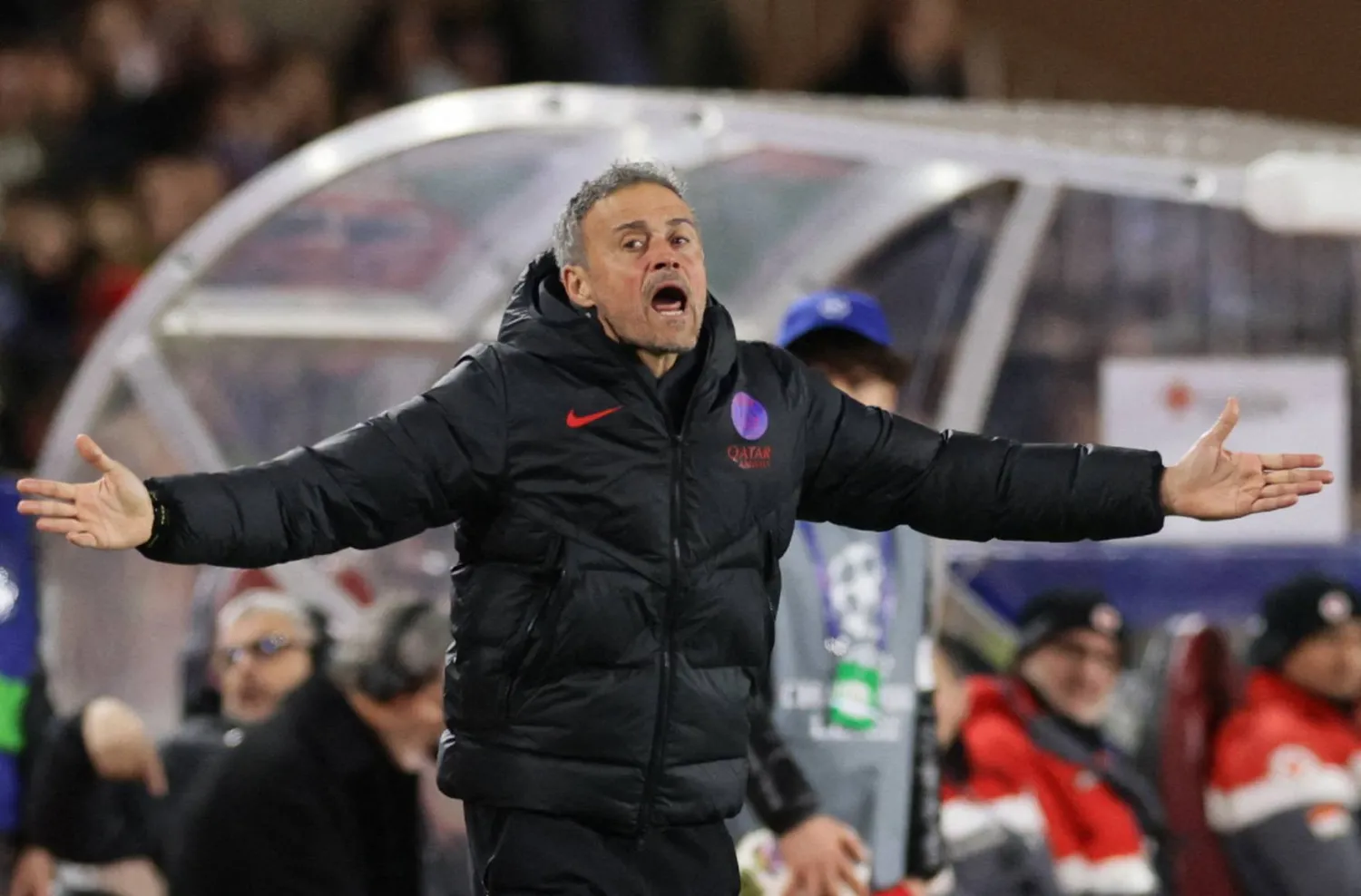
Soccer Football - UEFA Champions League - Play Off - First Leg - AS Monaco v Paris St Germain - Stade Louis II, Monaco - February 17, 2026 Paris St Germain coach Luis Enrique reacts REUTERS/Manon Cruz
TT

PSG’s Mental Strength Hailed as they Come from Behind to Win at Monaco

Soccer Football - UEFA Champions League - Play Off - First Leg - AS Monaco v Paris St Germain - Stade Louis II, Monaco - February 17, 2026 Paris St Germain coach Luis Enrique reacts REUTERS/Manon Cruz

Paris Saint-Germain coach Luis ‌Enrique hailed the mental strength of his side in coming from two goals down to win 3-2 away at Monaco in the Champions League on Tuesday, but warned the knockout round tie was far from finished.

The first leg clash between the two Ligue 1 clubs saw Folarin Balogun score twice for the hosts in the opening 18 minutes before Vitinha had his penalty saved to compound matters.

But after Desire Doue came on for injured Ousmane Dembele, the ‌match turned ‌and defending champions PSG went on to ‌secure ⁠a one-goal advantage ⁠for the return leg.

"Normally, when a team starts a match like that, the most likely outcome is a loss,” Reuters quoted Luis Enrique as saying.

“It was catastrophic. It's impossible to start a match like that. The first two times they overcame our pressure and entered our half, they scored. They ⁠made some very good plays.

“After that, it's difficult ‌to have confidence, but we ‌showed our mental strength. Plus, we missed a penalty, so ‌it was a chance to regain confidence. In the ‌last six times we've played here, this is only the second time we've won, which shows how difficult it is.”

The 20-year-old Doue scored twice and provided a third for Achraf Hakimi, just ‌days after he had turned in a poor performance against Stade Rennais last Friday ⁠and was ⁠dropped for the Monaco clash.

“I'm happy for him because this past week, everyone criticized and tore Doue apart, but he was sensational, he showed his character. He helped the team at the best possible time.”

Dembele’s injury would be assessed, the coach added. “He took a knock in the first 15 minutes, then he couldn't run.”

The return leg at the Parc des Princes will be next Wednesday. “Considering how the match started, I'm happy with the result. But the match in Paris will be difficult, it will be a different story,” Luis Enrique warned.