

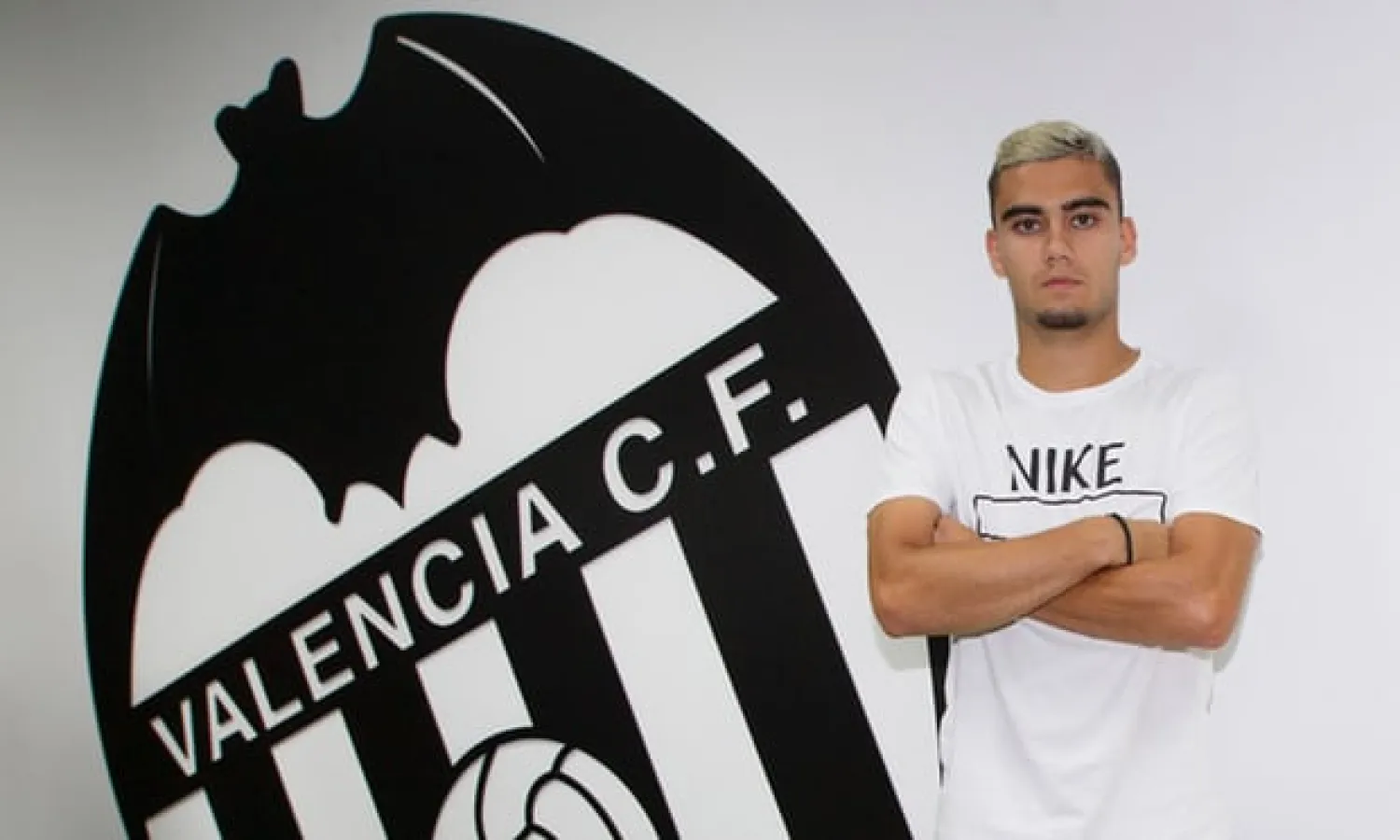

Andreas Pereira: ‘Alex Ferguson Said Hi In Portuguese. I didn’t Expect That’

 Andreas Pereira is on loan at Valencia, having spent last season on loan at Granada, but sees his future as very much at Manchester United. Photograph: Alberto Iranzo
Andreas Pereira is on loan at Valencia, having spent last season on loan at Granada, but sees his future as very much at Manchester United. Photograph: Alberto Iranzo
TT

Andreas Pereira: ‘Alex Ferguson Said Hi In Portuguese. I didn’t Expect That’

 Andreas Pereira is on loan at Valencia, having spent last season on loan at Granada, but sees his future as very much at Manchester United. Photograph: Alberto Iranzo
Andreas Pereira is on loan at Valencia, having spent last season on loan at Granada, but sees his future as very much at Manchester United. Photograph: Alberto Iranzo

“Bom dia.” It was only two words and it was not exactly poetry, but it was enough. Andreas Pereira was being shown around Carrington by Manchester United’s chief recruitment officer, Geoff Watson, with his dad when Sir Alex Ferguson appeared, which was probably always part of the plan, just as greeting him in Portuguese probably was too. A forward for PSV Eindhoven, the Brazilian had arrived as the outstanding player at the Nike Cup, a kind of youth world championship, but the people he passed had no idea who he was and he was not sure what he wanted to do next. Until, he says, the person he passed was the manager. And then his mind was made up.

“Suddenly we met Ferguson,” Pereira recalls. “He said ‘hi’ in Portuguese and that was very special to me. I didn’t expect that. I thought: ‘How does he know that?’ It was only a little detail but it made me want to go to United straight away. I wanted to sign immediately and stay there. So, I did stay. And from then I never wanted to go anywhere else.” It was 2011 and Pereira was 15; he is 22 now, and it has not quite worked out like that. Not just yet, anyway. But if he has gone somewhere else, it was because he wanted to – in fact, this summer he had to fight for his loan move to Valencia, arguing his corner in negotiations with José Mourinho – precisely because he believes it is the best way back.

Outstanding at youth and under-21 level, Pereira has played 13 senior games for United. His first was a League Cup defeat against MK Dons in August 2014. He forfeited matches this season for the future, pushing to go on loan. He sought minutes, development, and the decision was not taken lightly. Pereira is intelligent and articulate and the thought that went into it is clear, as is the personality it took.

If the reward is experience, he has had plenty. Last season he suffered relegation on loan at Granada, under Tony Adams, playing the role of footballer and translator too, proficient in English, Spanish, Portuguese, French and Flemish; on Thursday his Valencia team, revived under Marcelino García Toral and third in the league above Real Madrid, face Barcelona in the first leg of the Copa del Rey semi-final at the Camp Nou.

In the hours before the game Mourinho may message him; soon after it his dad will call. He always does. A former footballer, Marcos Pereira played in Belgium for eight different clubs, ending at Lommel United, where Andreas began, and retired a year before his son joined Manchester United.

“He showed me videos, how I had to play. When I was at PSV, I’d get home from training and we’d train there. I’d practise free-kicks and corners. After games he’d say: ‘You have to do this, you have to do that.’ Sometimes I was, like: ‘Ah, just shut up, I don’t want to speak about football.’ But I always listened and he would tell me: ‘No, it’s for your own good.’” The coaching continues now. “He watches the game on telly at home in England and calls: ‘Why did you do that?’

“My dad always tells me what to do and what not to do on the pitch. He always gives me advice. But coming to Spain again was my decision. I wanted to go somewhere and play a regular season and play every game because I think it was important for me. Last year I did it and I felt stronger for it. I felt good. The United staff recognised it and they saw that I came back a better player. And that’s why I made the same decision this year.

“[At first] I was thinking that I want to stay. But as the pre-season went on I had the feeling: ‘I don’t think I’m going to play enough, I’m not going to get a lot of minutes.’ I have to play, I have to continue developing. I knew I would get some game time at United but here I’m playing every week and being important for the team. It was a very difficult decision. I never want to leave United but I want to play as well. In the end it will make me a better player and I will still be a United player.”

Mourinho, though, had other ideas; he had mapped out a different path and going against his wishes, pushing for an exit, was risky. “That’s why it is difficult,” Pereira admits. “He told me I had to stay but I wanted to play and get more minutes. He wanted me to stay there and it was important [to him], but I needed to do this. This was important for me and my career. And I’m sure if it works out, next year I will be back there and it will be better for both of us. In the end I think he is happy because he is a very honest coach. I was talking to him right up to the very last minute when I came here.”

Although not a regular starter, Pereira has played 22 games, having played 37 times last season, and the level is high. Not that he sees a season of struggle as a waste. “For some players it can be difficult at a smaller club and they suffer; they don’t want to be at a club that’s going to get relegated, so they think: ‘Why am I here? What am I doing?’ But it was good for me to go to Granada. I felt the difference after a full season there and I wanted that again, just at a better team.

“I had that chance because Valencia wanted me; it’s a big club and we can do well, as we’re showing. It’s not like last season when we lost 10 games in a row. You can lose but you know you’ll bounce back and to get this club back into the Champions League alone would be a fantastic achievement, especially if you see last season how it was here. It will be very special. For sure, [Mourinho] is happy because Marcelino is a very, very good coach as well and we are doing great.” A very good coach and notoriously strict on nutrition. Pereira laughs. “We don’t eat a lot,” he says. “It’s a bit stressful but you see the positive results on the pitch: we run so much and we never get tired. It’s good. I feel leaner, fitter here this year.

“I can play high-level football and have a good year, all year, and then I am ready to be a starter for United. Instead of being on the bench, playing some cup games, where in the end I know my head will get frustrated and then everything will go around and go against me. So that’s why I took this decision. I’m sure Mourinho is happy because he knows at the end of the season I will go back to United.”

The Guardian Sport


Neymar Says He May Retire by End of 2026

Santos' forward Neymar #10 looks on during the Campeonato Paulista football match between Santos and Botafogo de Ribeirao Preto at the Urbano Caldeira Stadium in Santos, Sao Paulo state, Brazil on February 5, 2025. (AFP)
TT

Neymar Says He May Retire by End of 2026

Santos' forward Neymar #10 looks on during the Campeonato Paulista football match between Santos and Botafogo de Ribeirao Preto at the Urbano Caldeira Stadium in Santos, Sao Paulo state, Brazil on February 5, 2025. (AFP)

Brazil striker Neymar, ‌who extended his contract with his childhood club Santos last month, said that he may retire by the end of the year.

The 34-year-old forward returned to his boyhood club Santos in January 2025 and played a key role in their survival in the Brazilian top flight, scoring five times in their last ‌five matches.

But Neymar, ‌who has struggled with ‌injuries ⁠in recent seasons, ⁠remains doubtful for participation at the World Cup this year.

"I don't know what will happen from now on, I don't know about next year," he told Brazilian online channel Caze on Friday.

"It ⁠may be that when December comes, ‌I'll want to ‌retire. I'm living year to year now."

"This ‌year is a very important year, not ‌only for Santos, but also for the Brazilian national team, as it's a World Cup year, and for me too," Neymar said.

Neymar, ‌who recently underwent successful knee surgery, has scored 79 goals ⁠for ⁠Brazil, the highest by any player, but he has not featured for the national side since October 2023.

Brazil manager Carlo Ancelotti has made it clear over the past year that he will only include players who are fully fit for the World Cup, scheduled to take place from June 11 to July 19 in Canada, Mexico, and the United States.


Arteta Dismisses ‘Bottlers’ Talk Amid Title Wobble

Arsenal's Spanish manager Mikel Arteta applauds the fans following the English Premier League football match between Wolverhampton Wanderers and Arsenal at the Molineux stadium in Wolverhampton, central England on February 18, 2026. (AFP)
TT

Arteta Dismisses ‘Bottlers’ Talk Amid Title Wobble

Arsenal's Spanish manager Mikel Arteta applauds the fans following the English Premier League football match between Wolverhampton Wanderers and Arsenal at the Molineux stadium in Wolverhampton, central England on February 18, 2026. (AFP)

Arsenal manager Mikel ‌Arteta rejected the term 'bottlers' ahead of Sunday's Premier League visit to Tottenham Hotspur, as the title race heats up after their lead was cut short by successive Premier League draws at Brentford and Wolverhampton Wanderers.

Arsenal have won just two of their last seven league games, with second-placed Manchester City now five points behind with a game in hand.

Under ‌Arteta, the ‌North London club has finished as ‌the ⁠runners-up in their ⁠last three campaigns.

"It’s not part of my vocabulary and I don’t see it like this because I don’t think anybody wants to do that as an intention," Arteta told reporters on Friday, when asked about ⁠the term being used regarding their ‌latest wobble in ‌the title race.

"That’s individual opinion, perspective. You have to ‌respect that. That’s what I said after ‌in the press conference. You lose two points against Wolves in the manner that the game played out, you have to take it on ‌the chin. It's part of our role."

"What I’m very interested in ⁠is ⁠the next one, what we are made of, what we love about this and how we write our own destiny from here."

Arsenal have also reached the League Cup final and the round of 16 in the Champions League and the FA Cup.

Meanwhile, Tottenham, who are 16th in the Premier League, will enter into Sunday's game under newly appointed manager Igor Tudor, who replaced Thomas Frank last week.


IOC Boss Coventry Hails Milano Cortina Games a Success

 20 February 2026, Italy, Milan: President of the International Olympic Committee (IOC) Kirsty Coventry holds a press conference. (dpa)
20 February 2026, Italy, Milan: President of the International Olympic Committee (IOC) Kirsty Coventry holds a press conference. (dpa)
TT

IOC Boss Coventry Hails Milano Cortina Games a Success

 20 February 2026, Italy, Milan: President of the International Olympic Committee (IOC) Kirsty Coventry holds a press conference. (dpa)
20 February 2026, Italy, Milan: President of the International Olympic Committee (IOC) Kirsty Coventry holds a press conference. (dpa)

The Milano Cortina Olympics exceeded expectations despite a shaky build-up, IOC President Kirsty Coventry said on Friday, hailing the first spread-out Winter Games a success.

"These Games are truly ... successful in a new way of doing things, in a sustainable way of doing things, in a way that I think many people thought maybe we couldn't do, or couldn't be done well, and it's been done extremely well, and it's surpassed everyone's expectations," Coventry told a press conference.

It was the International Olympic Committee chief's clearest endorsement yet of a format that split events across several Alpine clusters rather than concentrating them in one host city.

Her assessment came after two weeks in which organizers sought to prove that a geographically dispersed Games could still deliver a consistent athlete experience.

The smooth delivery ‌comes after years ‌of logistical and political challenges, including construction delays at Milan’s Santagiulia Arena ‌and ⁠controversy over building ⁠a new sliding center in Cortina against IOC advice.

Organizers have also faced isolated disruptions during the Games, such as suspected sabotage on rail lines and protests in Milan over housing and environmental issues.

Transport concerns across the dispersed venues have been mitigated by limited cross-regional travel among spectators, though some competitors had to walk to the Cortina Curling Olympic Stadium in heavy snowfall that stopped traffic.

Central to the success of the Games, Coventry argued, was the effort to standardize conditions across multiple athlete villages despite the distances separating venues from Cortina d’Ampezzo to ⁠Livigno and Bormio.

Italian athletes’ performances also helped ticket sales, which amounted to ‌about 1.4 million.

"And the athletes are extremely happy. And they're happy ‌because the experiences that the MiCo (Milano Cortina) team and my team delivered to them have been the same," she ‌said.

Mixed relay silver medalist Tommaso Giacomel did, however, lament the fact there was no Olympic village near ‌the Antholz-Anterselva Biathlon Arena and that competitors were dotted around different hotels near the venue instead of in one place.

TWO OPENING CEREMONIES

Two opening ceremonies were held - the main one at Milan’s San Siro stadium and a more low-key parade on Cortina d’Ampezzo's Corso Italia, where athletes and spectators were within touching distance.

Feedback from competitors suggested the more intimate ‌settings had in some cases enhanced the Olympic atmosphere, Coventry said, taking the Cortina opening ceremony as an example.

The Zimbabwean, presiding over her first Games ⁠as IOC chief after elections in ⁠2025, framed Milano Cortina as proof of concept for future hosts grappling with rising costs and climate constraints, while acknowledging adjustments would follow.

"It allows us to really look at ourselves and look at the things that we have in place and how we're then going to make certain adjustments for the future," she said.

Beyond logistics, Coventry pointed to the broader impact of the Games, highlighting gender balance - with women making up 47% of competitors - and global engagement as marks of progress.

"But it's been an incredible experience and we're all very proud to have gender equity playing a big role in the delivery of the Games," she said, describing a "tremendous Games" in which athletes have "come together and shared in their passion".

With the closing ceremony in Verona approaching, Coventry said the focus would soon shift to a formal evaluation process, but insisted the headline conclusion was already clear.

"So we look forward to doing that and to learning from all the incredible experiences that I think all of the stakeholders have had across these Games, across these past two weeks," she said.
