


Why Italian Football Does Not Make Sense In The English Language

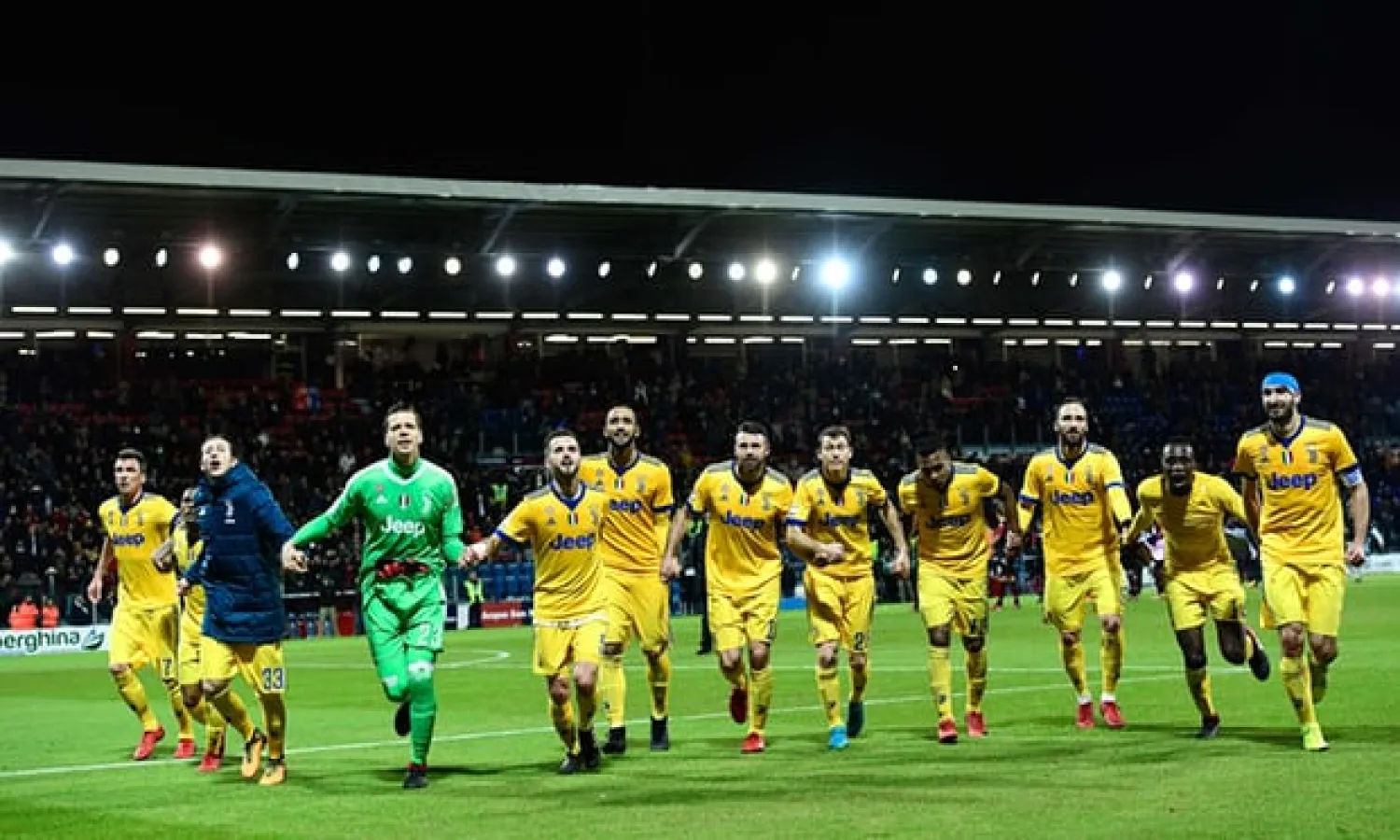
 Juventus players celebrate after beating Cagliari at the Sardegna Arena. Photograph: Miguel Medina/AFP/Getty Images
Juventus players celebrate after beating Cagliari at the Sardegna Arena. Photograph: Miguel Medina/AFP/Getty Images
TT

Why Italian Football Does Not Make Sense In The English Language

 Juventus players celebrate after beating Cagliari at the Sardegna Arena. Photograph: Miguel Medina/AFP/Getty Images
Juventus players celebrate after beating Cagliari at the Sardegna Arena. Photograph: Miguel Medina/AFP/Getty Images

As a football fan living in the US, I’m amazed at how many games are available on TV these days. On any Saturday or Sunday, I can choose from at least 10 games on my basic cable package. Football fans in the US tend to focus their attentions on the Premier League, which has as much to do with the crispness of its presentation as the action on the pitch. The periphery is perfect: the stadiums are beautiful, modernised and full, and the the fans are present and loud. But, more than anything, the games are so watchable because of the commentary.

NBC, who show all 380 Premier League matches live in the US, do not put out the exact same broadcast as the one shown in the UK, but they do employ commentators with British presenters, which lends everything immediacy and authenticity. This is what sets the Premier League apart from the rest of the big European leagues. When we watch games from Spain, Germany, France or Italy, we are watching something in translation.

I have followed Italian football intently for more than half of my life – especially during the three years I spent living there – but I increasingly find myself watching Serie A games without the sound as it almost feels like a contaminant. It’s not that the quality of the commentary in English is that bad – it is pretty bad, though – it’s more that the words used just don’t fit the game the way Italian commentary does. Rather than watching a Serie A game, I feel as if I’m listening to somebody else watching the game, with an added layer of detachment.

It’s not just that the observations are more astute and the passion is more intense, but the Italian language manages to mesh perfectly with the action it describes. Italians even have their own name for the game: calcio, literally “kick”, preferring not to Latinise the word “football” as the Spanish (fútbol), French (le foot) and Portuguese (futebol) all do. In my very first Italian class, a student asked the teacher why Italians do not just use a simple variation, like in Spain, and the teacher replied, without even the hint of a smile: “Because we are much better at soccer than the Spanish.”

Italian football is often criticised for being overly dramatic, with players spending too much time feigning injury, encircling the referee or dropping to the grass with their faces in their hands after they have missed opportunities. These criticisms carry weight but, given the language of the game in Italy, it is hard to see how the game could be any other way. An Italian match is more than just that; it is a performance in which the players are fighting not just to win but to win over the audience.

In Italian a player does not play a position (posizione), but rather their role (ruolo). Managers often speak in post-match interviews about how a player has “interpreted their role” or how the team has “interpreted the match” as a whole. The playmaker is called a regista, or “director”, while players who exchange passes are said to dialogare, literally “to dialogue”.

A goal is not scored, but rather “authored” (l’autore del gol). A player who is often at the centre of the action becomes the game’s protagonista, with the potential to risolvere la partita, or “resolve the match”. A particularly creative player may also be praised for his fantasia, while a true legend of the game, such as Roberto Baggio, is a maestro.

A team’s passing or possession may be referred to as its fraseggio, which means literally its “phrasing”, a term used to describe musical expression. A player’s individual move is a numero, his error or lapse in judgment is a pasticcio, or “pastiche”, while his shot on goal is a conclusione, which, should he miss, is considered fallita, or “failed”, the same word Italians use to describe bankruptcy.

A ball is not won from the opposing team, but conquistato, or “conquered”, and is not trapped but addomesticato, “domesticated”. A challenge from an opposing player is a contrasto, or “conflict”; a match-up is a duello; and a penalty-kick is a rigore, or “rigour”. All this drama plays out in front of the pubblico whose cori, or “choruses”, are as likely to be jeering the victorious team as celebrating them depending on the performance itself.

It’s hard to know whether the style of play adapted to suit the language of the stage or the lexicon was developed in response to the style of the action. Either way, this colourful commentary certainly lends Serie A matches gravitas. Suddenly the level of drama on the pitch makes sense. The highest praise a commentator can bestow upon a match is that of spettacolo, the word for both “spectacle” and a “play”. When an opposing coach lost to Napoli at the end of last year, he praised his opponents in wonder as una sinfonia, “a symphony”.

When looking to describe new trends in the game, Italian commentators often look abroad, incorporating many English terms such as pressing, tap-in, assist, cross, dribbling and stretching, which are appallingly pronounced and sometimes even carry a reimagined meaning. Dribbling, for instance, becomes a noun in Italian rather than a verb; so instead of a player beating an opponent with a dribble, he is said to have executed a “dribbling”. Similarly, an assist does not have to lead to a goal, just a goalscoring opportunity. Whether misunderstandings or not, these neologisms only add to the charm and idiosyncrasy of the calcio lexicon.

Serie A has other problems when presented on TV – including empty stands and outdated stadiums – but the language barrier is the biggest issue for me. Fans of the Bundesliga, Ligue 1 and La Liga probably have similar complaints and this may explain why English speakers flock to the Premier League. Having all these games on TV is amazing but, in the same way that the coffee from my Italian espresso maker never quite tastes as good at home, these football matches are lost in translation. Something is missing, so I watch and sip in silence.

The Guardian Sport


Reports: Liverpool Fear Isak Has Broken Leg

Liverpool's Swedish striker #09 Alexander Isak (C) is helped off the field by medical staff after picking up an injury during the English Premier League football match between Tottenham Hotspur and Liverpool at the Tottenham Hotspur Stadium in London, on December 20, 2025. (Photo by JUSTIN TALLIS / AFP)
TT

Reports: Liverpool Fear Isak Has Broken Leg

Liverpool's Swedish striker #09 Alexander Isak (C) is helped off the field by medical staff after picking up an injury during the English Premier League football match between Tottenham Hotspur and Liverpool at the Tottenham Hotspur Stadium in London, on December 20, 2025. (Photo by JUSTIN TALLIS / AFP)

Liverpool are awaiting scan results they fear will confirm record signing Alexander Isak has suffered a broken leg after he was injured in their win against Tottenham, reports said Monday.

The Sweden forward was hurt in the act of scoring the opening goal in Saturday's 2-1 victory in London after a sliding challenge from Spurs defender Micky van der Ven.

Isak, 26, who had come on as a second-half substitute, was unable to celebrate with his teammates and left the pitch in considerable distress.

Immediately after the game Liverpool boss Arne Slot admitted the injury was "not a good thing".

"If a player doesn't even try to come back, that is usually not a good thing but I cannot say anything more than that," AFP quoted him as saying.

"That is just gut feeling and nothing medical... let's not be too negative yet. We don't know yet. Let's hope he is back with us soon."

The Athletic and Sky Sports reported Monday that Liverpool fear Isak has broken his leg, which would mean a lengthy period on the sidelines.

Isak has had a disrupted start to his life at Anfield, making just 16 appearances and scoring three goals since his £125 million ($168 million) British record move from Newcastle on transfer deadline day.

A dispute with Newcastle meant he did not have a proper pre-season program and arrived at Anfield well behind his team-mates in terms of fitness. His season was then interrupted by a groin injury.

Any absence would be a major blow for Slot, with Mohamed Salah at the Africa Cup of Nations and Cody Gakpo not ready to return from a muscle injury until early in the yew year.

It leaves the Liverpool manager with Hugo Ekitike, who has five goals in his past four games, and the little-used Federico Chiesa as his only senior forwards.

Liverpool, whose Premier League title defense collapsed after a shocking run of results, have climbed to fifth in the table after extending their unbeaten league run to five games.


Three Talking Points from the Premier League Weekend 

Tottenham Hotspur's Argentinian defender #17 Cristian Romero is ushered off the pitch by Tottenham Hotspur's Danish head coach Thomas Frank after becoming the second Tottenham player sent off during the English Premier League football match between Tottenham Hotspur and Liverpool at the Tottenham Hotspur Stadium in London, on December 20, 2025. (AFP)
TT

Three Talking Points from the Premier League Weekend 

Tottenham Hotspur's Argentinian defender #17 Cristian Romero is ushered off the pitch by Tottenham Hotspur's Danish head coach Thomas Frank after becoming the second Tottenham player sent off during the English Premier League football match between Tottenham Hotspur and Liverpool at the Tottenham Hotspur Stadium in London, on December 20, 2025. (AFP)

Arsenal held off Manchester City to stay top of the Premier League at Christmas courtesy of a Viktor Gyokeres penalty in the 1-0 win at Everton.

Liverpool cashed in on nine-man Tottenham's lack of composure to extend their revival in the absence of Mohamed Salah.

Bottom of the table Wolves are setting unwanted records after a 10th straight league defeat against Brentford.

AFP Sports looks at three talking points from the weekend's action:

- Arsenal stay on top -

The Gunners will be top of the tree on Christmas Day for the third time in four years after grinding out a first Premier League away win in four games on Merseyside.

Being in first place at that landmark point of the campaign is usually a sign of future champions, but it has proved to be more of a curse for Arsenal.

In the four previous times they have led at Christmas in the Premier League era, they have not gone on to win the title.

That includes two recent examples as Mikel Arteta's men were reeled in by Manchester City in 2022-23 and 2023-24.

Indeed, the last five times the leaders at Christmas did not go on to become champions, City have won the title.

Arteta, though, is confident his side will finally get their reward for continuing to put themselves in pole position for a first league title in 22 years.

"What gives me belief and confidence is the level of performance and the consistency of that," the Spaniard told AFP. "That's very, very difficult to do in this league and that means that the team is constantly there."

- Tottenham seeing red -

Tottenham could not be accused of a lack of fight to save their under-pressure manager.

But indiscipline was their downfall as another home defeat, 2-1 against Liverpool on Saturday, left the increasingly beleaguered Thomas Frank in the firing line.

Frank tried to shift the blame onto referee John Brooks for not ruling out Liverpool's second goal for a push by Hugo Ekitike on Cristian Romero.

But by that point Tottenham forward Xavi Simons had already seen red for a wild lunge on Virgil van Dijk.

Romero was booked for his protests after Ekitike's goal and then got himself sent-off in stoppage-time for kicking out at Ibrahima Konate, just as Tottenham had the Reds on the ropes.

"To get involved right and kick out at someone right in front of the referee. If my four-year-old did that, I would say 'what are you doing?" Former Tottenham midfielder Jamie Redknapp said after the eighth red card of Romero's career.

Former Brentford boss Frank finds himself in a familiar position to many Spurs managers in recent years, unable to produce a team fit to match the club's world class stadium.

Only the bottom three have taken fewer points than Tottenham's eight from nine home league games this season.

- Abysmal Wolves -

With relegation already appearing inevitable, Wolves are in danger of becoming the worst side in Premier League history.

A meek 2-0 home defeat to Brentford on Saturday means they remain without a win and with just two points after 17 games.

The record books have already been rewritten during a miserable campaign for one of English football's oldest clubs.

A losing streak of 10 consecutive top-flight games is a first in Wolves' 148-year history.

Derby's record low points total of 11 from 2007-08 is under threat, with Wolves having the joint lowest points tally at Christmas in Premier League history alongside Sheffield United in 2020-21.

"Do we want to be remembered for fighting until the end of the season," asked vice-captain Matt Doherty after Saturday's latest defeat. "Or do we want to be remembered for being cowards?"


Amorim Fears United Captain Fernandes Will Be Out ‘a While’ 

Football - Premier League - Aston Villa v Manchester United - Villa Park, Birmingham, Britain - December 21, 2025 Manchester United's Bruno Fernandes reacts after sustaining an injury. (Reuters)
TT

Amorim Fears United Captain Fernandes Will Be Out ‘a While’ 

Football - Premier League - Aston Villa v Manchester United - Villa Park, Birmingham, Britain - December 21, 2025 Manchester United's Bruno Fernandes reacts after sustaining an injury. (Reuters)

Ruben Amorim fears Bruno Fernandes will be out for "a while" after the Manchester United captain was injured during Sunday's 2-1 defeat against Aston Villa.

Fernandes has started every Premier League game this season, but the Portugal midfielder is unlikely to extend that run any further following his injury setback at Villa Park.

The 31-year-old initially played on after pulling up with what appeared to be a hamstring issue just before the break, but he did not return for the second half.

Amorim ruled his influential star out of the Boxing Day clash against Newcastle, with severe doubts about his availability for the rest of the Christmas and New Year schedule.

"It's a soft tissue. I think he's going to lose some games. I don't know for sure, so let's see," Amorim said.

"You never control these things, so we'll see. He is a guy who is always fit so he can recover quite well, but I don't know."

Fernandes' fitness blow compounded Amorim's injury problems, with England midfielder Kobbie Mainoo missing the Villa game due to a calf issue.

The 20-year-old had dominated the build-up to Sunday's game after his half-brother wore a "Free Kobbie Mainoo" t-shirt to Monday's 4-4 draw with Bournemouth at Old Trafford.

Mainoo would have been in contention to make his first Premier League start of the season against Newcastle, but instead he is set to miss out.

"I will see what we are going to do," Amorim said. "I think Kobbie Mainoo is out, Bruno is out, so we will see. We are going to find solutions. No excuses.

"We need to win the next game and we will try to win the next game."

While Casemiro will return from suspension against Newcastle, Bryan Mbeumo, Amad Diallo and Noussair Mazraoui are at the Africa Cup of Nations and Matthijs de Ligt and Harry Maguire are also sidelined.

United's selection crisis has raised questions about the potential for new signings during the January transfer window, but Amorim won't panic.

"We need to deal with that," he said. "What we cannot do is to reach January and try to do everything in urgency and make mistakes and then 'here we go again' with a lot of mistakes.

"I'm not going to say 'we need a lot of players' because we have a plan. If we have to suffer, the club comes first.

"Of course, we are in a moment where we need points, but we need to find solutions and we are going to continue with our plan."
