


Exclusive: Yemeni National Army Says Taiz Territory is 85% Militia-Free

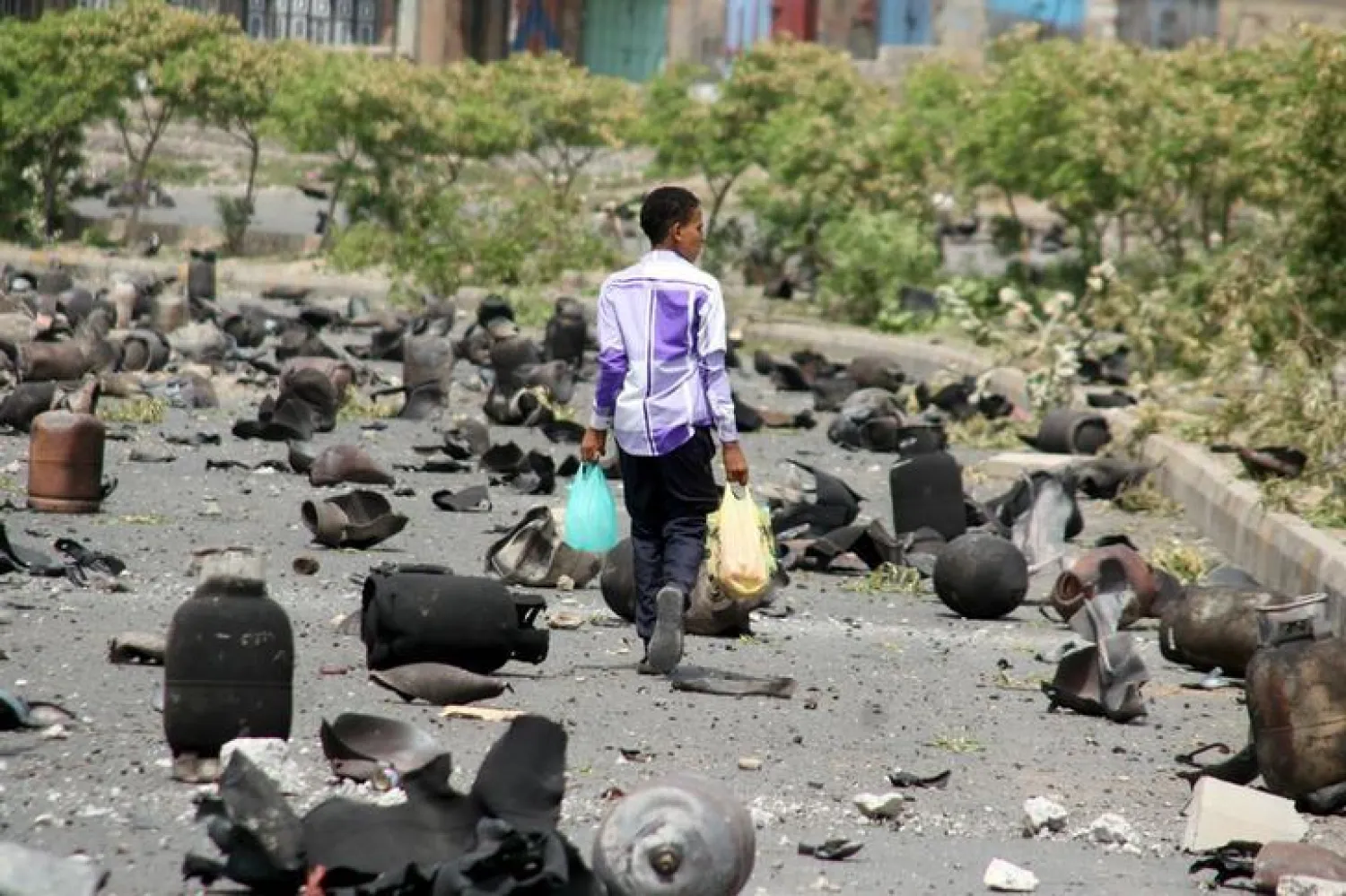
A boy walks on a street littered with cooking gas cylinders after a fire and explosions destroyed a nearby gas storage during clashes between fighters of the Popular Resistance Committees and Houthi fighters earlier today, in Yemen's southwestern city of Taiz in this July 19, 2015 file photo. REUTERS/Stringer
TT

Exclusive: Yemeni National Army Says Taiz Territory is 85% Militia-Free

A boy walks on a street littered with cooking gas cylinders after a fire and explosions destroyed a nearby gas storage during clashes between fighters of the Popular Resistance Committees and Houthi fighters earlier today, in Yemen's southwestern city of Taiz in this July 19, 2015 file photo. REUTERS/Stringer

The Yemeni National Army confirmed on Wednesday liberating 85% of the province of Taiz, 275 km south of Sana’a.

Al-Arabiya’s correspondent cited Saudi arms power destroying Houthi militias vehicles just off Al Khubah, a village situated near borders with Yemen in the Saudi Jizan region.

Saudi forces also stated aborting an attempted attack staged by Iran-aligned 25 Houthis who tried attacking villages in Jizan.

In its statement to Asharq Al-Awsat, the Yemeni national army said that the remaining 15% of Taiz province area is witnessing continued efforts by pro-government powers for clearing it fully from militia influence.

Most field advances are considered a result of national army forces joining forces with the Saudi-led Arab coalition backing Yemen’s internationally-recognized government headed by Abdrabbuh Mansur Hadi—especially as a result of the recently Riyadh-held meeting on military developments and joint strategies.

According to the official spokesman of the Yemeni National Army, other battlefronts taking place in the Sa’ada, Jawf and Al Bayda provinces have also registered rapid victories as militia ranks dissolved and retreated.

Gaining foothold on the coastal front was bolstered by new advances in Saada, Houthis’ first-taken stronghold, where over 30 coupists were killed in battles over the past two days. Dozens more were reported injured and a number of Houthi military vehicles demolished.

Coalition fighters launched 5 air raids targeting Houthi positions and outposts in Mahader and Maran districts in the Saada province.

On the western coast, militias responded to the loss of the Hays town by indiscriminate shelling of civilians. Militias also planted mines across large areas in Hays and on land routes leading to the Directorate of Al-Jarahi in an effort to slow the advance of the pro-government National Army and Popular Resistance Forces.

Field sources reported the bombing of the bridge linking Hays to Al-Jarahi.

Yemeni National Army Spokesman Brigadier General Abdu Majali said that the liberation of Hays and the defeat of Houthi militias led to cutting off major supply routes from several provinces, Taiz, Hodeidah and Ibb.

"Retaking Hays driving Iran-supplied militias by the aid and support of the Arab Coalition was important and decisive for West Coast battles,” said Brig.Gen. Majali.

The army spokesman added that army forces continue to inch into Hodeidah and its surrounding districts, and will do so over the upcoming few days.

Brig.Gen. Majali pointed out that the national army was able to control main roads and cut off supplies to militias, a move expected to hasten the liberation of Hodeidah province and its strategic harbor.

“It is important to liberate Hodeidah and its key port because of the continued smuggling of Iranian weapons and missiles through it— the liberation will aid in upholding the protection of land and sea from terrorist operations carried out by criminal militias.”



Syria Closes ISIS-linked al-Hol Camp after Emptying it

18 February 2026, Syria, Al-Hol: A view of al-Hol camp. Photo: Moawia Atrash/dpa
TT

Syria Closes ISIS-linked al-Hol Camp after Emptying it

18 February 2026, Syria, Al-Hol: A view of al-Hol camp. Photo: Moawia Atrash/dpa

Syrian authorities have closed al-Hol camp, which long housed relatives of suspected ISIS militants, after emptying the formerly Kurdish-controlled facility, a camp official told AFP on Sunday.

"All Syrian and non-Syrian families were relocated," Fadi al-Qassem, the official appointed by the government to manage al-Hol's affairs told AFP.

Al-Hol, located in a desert region of Hasakeh province, had been Syria's largest camp housing relatives of suspected ISIS fighters.

Last month, the government took over the camp from its Kurdish administrators, who had long run it, as Kurdish forces ceded territory and Damascus extended its control across swathes of Syria's northeast.

Since then, thousands of family members of foreign militants have left for unknown destinations.

The facility had housed some 24,000 people, mostly Syrians but also Iraqis and more than 6,000 other foreigners of around 40 nationalities.

Qassem said security forces were searching the tents for any remaining families.

Earlier this week, authorities had started evacuating the remaining residents, taking them to a camp in Akhtarin, in the north of Aleppo province.

Some of the families were taken elsewhere, Qassem said, without specifying the location.

"The camp's residents are children and women who need support for their reintegration," he added.

A source in a humanitarian organization that was active in the camp told AFP: "We evacuated all our teams working inside the camp, dismantled all our equipment and prefabricated rooms and moved them out of the camp".

Last week, the US military said it had completed the transfer of thousands of ISIS suspects, including many Syrians but also Westerners, to Iraq, after they were held in Kurdish-run prisons in northeast Syria for years.


Palestinian Foreign Ministry Condemns US Ambassador to Israel’s Statements

The Israeli settlement of Har Homa, seen from the West Bank city of Bethlehem, Tuesday, Dec. 17, 2024. (AP)
TT

Palestinian Foreign Ministry Condemns US Ambassador to Israel’s Statements

The Israeli settlement of Har Homa, seen from the West Bank city of Bethlehem, Tuesday, Dec. 17, 2024. (AP)

The Palestinian Ministry of Foreign Affairs and Expatriates condemned statements by the US ambassador to Israel, in which he claimed that Israel has the right to exercise control over the entire Middle East.

The ministry emphasized that these provocative statements constitute a blatant call for aggression against the sovereignty of states.

It added that they support the continuation of the occupation’s war of genocide and displacement, as well as the implementation of its annexation and expansionist plans against the Palestinian people, SPA reported.

The Palestinian foreign ministry pointed out that the statements contradict religious and historical facts and international law, SPA reported.

It called on the US administration to take a clear stance regarding its ambassador to Israel’s remarks, which are completely at odds with the US president’s position rejecting the annexation of the West Bank.


Israel Carries Out More Strikes in Lebanon amid Lack of Int’l Assurances on Wider Regional Escalation

People gather near a building damaged in an Israeli strike in the village of Bednayel in eastern Lebanon, 21 February 2026. EPA/WAEL HAMZEH
TT

Israel Carries Out More Strikes in Lebanon amid Lack of Int’l Assurances on Wider Regional Escalation

People gather near a building damaged in an Israeli strike in the village of Bednayel in eastern Lebanon, 21 February 2026. EPA/WAEL HAMZEH

Lebanese officials say the country has yet to obtain firm or decisive Western guarantees that it will be spared from a larger confrontation in the region as speculation grows over a potential US strike on Iran.

Chief concerns center on whether Hezbollah would be targeted as part of any large-scale strike, or whether the group might intervene militarily alongside Tehran.

Ministerial sources said Israeli airstrikes on Hamas in the Ain al-Hilweh Palestinian refugee camp in southern Lebanon, as well as overnight raids targeting Hezbollah in the eastern Bekaa Valley fall within the pattern of ongoing military operations Lebanon, particularly targeted assassinations against figures linked to both groups.

The sources told Asharq Al-Awsat Lebanon has not received explicit Western assurances that it would not be drawn into a wider confrontation if the conflict expands.

On Hezbollah’s position, the sources noted that the group has not offered a clear position on how it would respond to potential developments.

They pointed to behind-the-scenes efforts led primarily by Parliament Speaker Nabih Berri who believes “Hezbollah will not take any step if Iran is struck.”

Although Hezbollah has previously declared it “would stand idle” in case of escalation, the sources said the party has not announced any specific military plans.

Statements made by its officials have been vague, they added, citing remarks by head of Hezbollah’s parliamentary bloc Mohammad Raad, who stressed on Friday the party’s commitment to “the security and stability of the country and the continuation of normal life.”

In Lebanon’s official response, President Joseph Aoun strongly condemned the Israeli raids carried out overnight by land and sea, which targeted the Sidon area and towns in the Bekaa.

He described the continued attacks as “blatant aggression” aimed at sabotaging Lebanon’s diplomatic efforts with brotherly and friendly nations - foremost among them the United States - to consolidate stability and halt Israeli hostilities.

Aoun said the strikes were a renewed violation of Lebanon’s sovereignty and a clear breach of international obligations, particularly United Nations Security Council Resolution 1701, which calls for a cessation of hostilities and full implementation of its provisions.

The president renewed his appeal to countries supporting regional stability to assume their responsibilities by pressing for an immediate halt to the attacks and ensuring respect for international resolutions in a way that preserves Lebanon’s sovereignty, security, and territorial integrity, and prevents further escalation.