


Despite Israel Spat, Lebanon Signs First Offshore Gas, Oil Deals

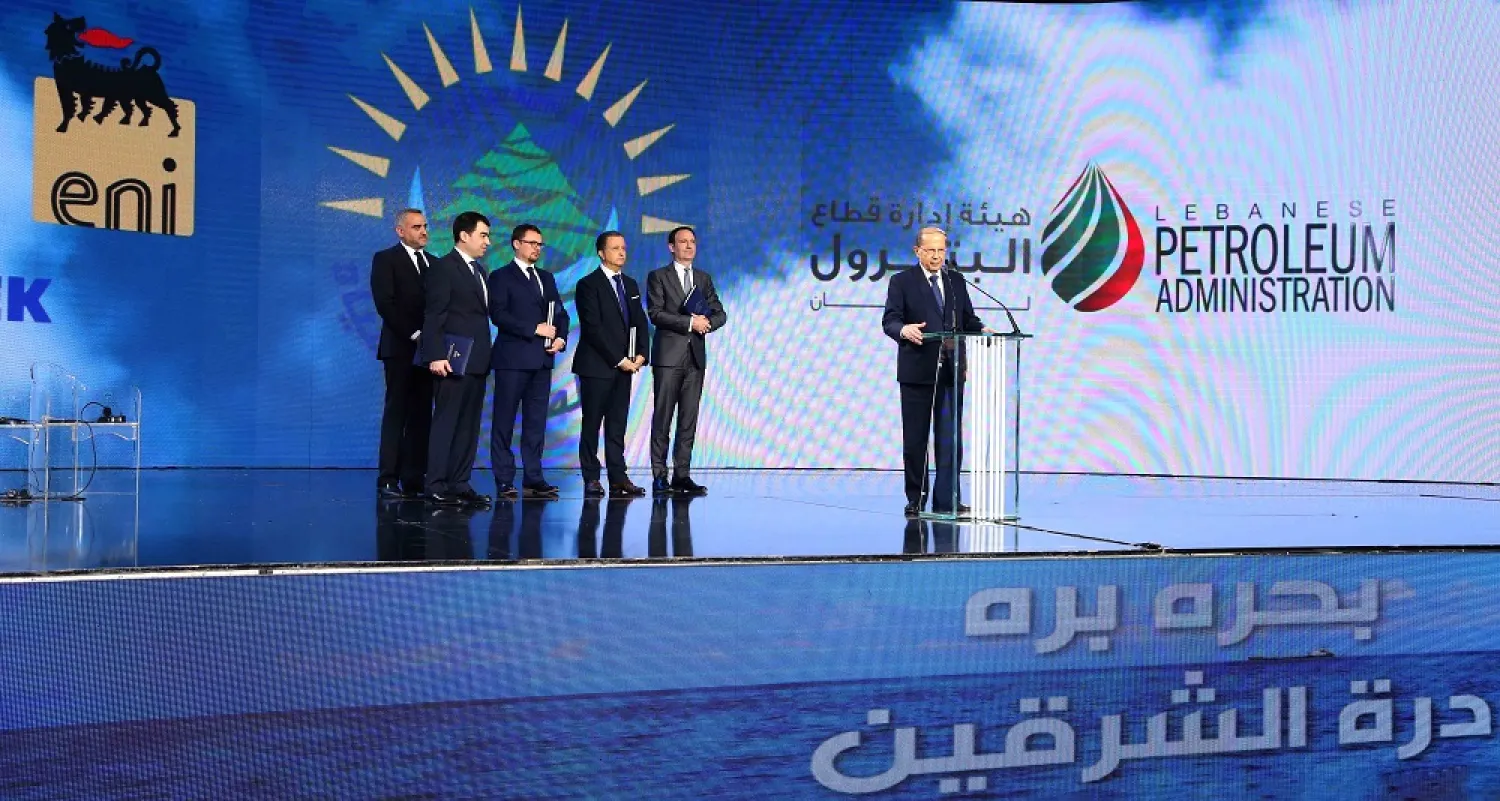
Lebanese President Michel Aoun speaks during a ceremony marking the signing of offshore oil and gas exploration deals. (Dalati & Nohra)
TT

Despite Israel Spat, Lebanon Signs First Offshore Gas, Oil Deals

Lebanese President Michel Aoun speaks during a ceremony marking the signing of offshore oil and gas exploration deals. (Dalati & Nohra)

Amid a simmering dispute with Israel over the demarcation of the shared marine border, Lebanon signed on Friday its first agreements for offshore oil and gas exploration.

The deal includes exploration in two blocks, including one that is contested with Israel.

The signing ceremony was held Friday afternoon in Beirut and was attended by President Michel Aoun.

"We have achieved a big dream and Lebanon has entered a new era today," Aoun said at the ceremony.

A consortium of France’s Total, Italy’s Eni and Russia’s Novatek signed the agreements for the two blocks, which are among five that Lebanon put up for tender in the country’s much-delayed first licensing round.

Lebanon’s energy minister said the dispute with Israel would not stop Lebanon benefiting from potential undersea reserves in the contentious Block 9, while consortium operator Total said it would not drill the block’s first well near the disputed zone.

Israel and Lebanon, which regard each other as enemy states, have exchanged threats and condemnation over the tender, amid rising tensions over territorial and marine boundaries between them.

“Today, we announce that we have started our petroleum path ... after signing the agreements and launching the exploration activities,” Lebanese Energy Minister Cesar Abi Khalil said at a ceremony in Beirut.

The contracts had already been signed on January 29.

Data suggests there are reserves in Lebanon’s waters, but no exploratory drilling has taken place to estimate their size.

Abi Khalil has said a second offshore licensing round will happen once the first commercially viable discovery is made.

The first exploratory well will be drilled in Block 4 in 2019, said Stephane Michel, Total’s head of exploration and production in the Middle East and North Africa.

The second well will be drilled in Block 9 more than 25 km (15 miles) from the maritime border claimed by Israel, he said at the ceremony. “There is no reason not to proceed in this way,” Michel added.

Lebanon has an unresolved maritime border dispute with Israel over a triangular area of sea of around 860 sq km (330 square miles) that extends along the edge of three of its total 10 blocks.

Total said in a statement the disputed waters comprise 8 percent of Block 9 and that its exploration well “will have no interference at all with any fields or prospects” in the disputed sliver of water.

Lebanese and Israeli officials said David Satterfield, acting assistant US secretary of state, was in Israel last week and in Lebanon this week on a mediation mission. US officials confirmed his travels without detailing his agenda.

Abi Khalil told Reuters the heightened tension between the two countries in recent weeks has “not had an effect” on the consortium’s plans to explore.

Lebanon's Foreign Minister Jebran Bassil warned Israel not to try to hinder the drilling on the Lebanese side saying that Beirut can also stop offshore development on the Israeli side.

Earlier this week, Israeli Defense Minister Avigdor Lieberman described Lebanon's exploration tender as "very provocative" and suggested that Lebanon had put out invitations for bids from international groups for a gas field "which is by all accounts ours."

His comments drew sharp condemnation from Prime Minister Saad Hariri, who described Lieberman's comments as a "blatant provocation that Lebanon rejects."

Lebanon is on the Levant Basin in the eastern Mediterranean where a number of big sub-sea gas fields have been discovered since 2009.

Eni reported the Mediterranean’s largest discovery in 2015: the Zohr field off Egypt which holds an estimated 30 trillion cubic feet of gas. On Thursday Eni said it and Total had discovered a promising natural gas field off Cyprus.

Fuad Krekshi, Eni’s executive vice president of the Middle East, said Eni’s entry into Lebanon’s market is a “natural consequence” of its existing role in the Mediterranean region.

Total, with 40 percent, heads the consortium drilling Lebanon’s first offshore well. Eni also holds 40 percent and Novatek 20 percent.

Vyacheslav Mishin, head of Novatek’s new Lebanon office, said the projected global growth in natural gas and LNG consumption was key to his company’s future growth.

“The Middle East market for LNG consumption is forecast to grow by more than 100 percent by 2030,” he said.

Potential reserves could be used domestically or exported.

Both are attractive for Lebanon which has been short of electricity since its 1975-90 civil war and has an anemic economy battered by war in neighboring Syria and political tensions. Lebanon has a debt of $80 billion or 145 percent of its gross domestic product making it one of the world's highest.

It is also hoped the developing oil and gas industry will create jobs and economic growth. To this end, the EPA contracts say 80 percent of people employed by the consortium should be Lebanese, with priority given to local suppliers and contractors.

But the commercial viability of potential reserves depends on energy market prices, the ability to secure customers and the cost and politics of building export infrastructure.

“For all the fields in the region, there are commercial, political, and technical challenges that hinder exploitation for the purposes of export,” Tareq Baconi, a European Council on Foreign Relations visiting fellow on MENA energy told Reuters.

“Many of the challenges for export will be faced by Lebanon as well when, and if, it discovers offshore reserves,” he said.



Syria Closes ISIS-linked al-Hol Camp after Emptying it

18 February 2026, Syria, Al-Hol: A view of al-Hol camp. Photo: Moawia Atrash/dpa
TT

Syria Closes ISIS-linked al-Hol Camp after Emptying it

18 February 2026, Syria, Al-Hol: A view of al-Hol camp. Photo: Moawia Atrash/dpa

Syrian authorities have closed al-Hol camp, which long housed relatives of suspected ISIS militants, after emptying the formerly Kurdish-controlled facility, a camp official told AFP on Sunday.

"All Syrian and non-Syrian families were relocated," Fadi al-Qassem, the official appointed by the government to manage al-Hol's affairs told AFP.

Al-Hol, located in a desert region of Hasakeh province, had been Syria's largest camp housing relatives of suspected ISIS fighters.

Last month, the government took over the camp from its Kurdish administrators, who had long run it, as Kurdish forces ceded territory and Damascus extended its control across swathes of Syria's northeast.

Since then, thousands of family members of foreign militants have left for unknown destinations.

The facility had housed some 24,000 people, mostly Syrians but also Iraqis and more than 6,000 other foreigners of around 40 nationalities.

Qassem said security forces were searching the tents for any remaining families.

Earlier this week, authorities had started evacuating the remaining residents, taking them to a camp in Akhtarin, in the north of Aleppo province.

Some of the families were taken elsewhere, Qassem said, without specifying the location.

"The camp's residents are children and women who need support for their reintegration," he added.

A source in a humanitarian organization that was active in the camp told AFP: "We evacuated all our teams working inside the camp, dismantled all our equipment and prefabricated rooms and moved them out of the camp".

Last week, the US military said it had completed the transfer of thousands of ISIS suspects, including many Syrians but also Westerners, to Iraq, after they were held in Kurdish-run prisons in northeast Syria for years.


Palestinian Foreign Ministry Condemns US Ambassador to Israel’s Statements

The Israeli settlement of Har Homa, seen from the West Bank city of Bethlehem, Tuesday, Dec. 17, 2024. (AP)
TT

Palestinian Foreign Ministry Condemns US Ambassador to Israel’s Statements

The Israeli settlement of Har Homa, seen from the West Bank city of Bethlehem, Tuesday, Dec. 17, 2024. (AP)

The Palestinian Ministry of Foreign Affairs and Expatriates condemned statements by the US ambassador to Israel, in which he claimed that Israel has the right to exercise control over the entire Middle East.

The ministry emphasized that these provocative statements constitute a blatant call for aggression against the sovereignty of states.

It added that they support the continuation of the occupation’s war of genocide and displacement, as well as the implementation of its annexation and expansionist plans against the Palestinian people, SPA reported.

The Palestinian foreign ministry pointed out that the statements contradict religious and historical facts and international law, SPA reported.

It called on the US administration to take a clear stance regarding its ambassador to Israel’s remarks, which are completely at odds with the US president’s position rejecting the annexation of the West Bank.


Israel Carries Out More Strikes in Lebanon amid Lack of Int’l Assurances on Wider Regional Escalation

People gather near a building damaged in an Israeli strike in the village of Bednayel in eastern Lebanon, 21 February 2026. EPA/WAEL HAMZEH
TT

Israel Carries Out More Strikes in Lebanon amid Lack of Int’l Assurances on Wider Regional Escalation

People gather near a building damaged in an Israeli strike in the village of Bednayel in eastern Lebanon, 21 February 2026. EPA/WAEL HAMZEH

Lebanese officials say the country has yet to obtain firm or decisive Western guarantees that it will be spared from a larger confrontation in the region as speculation grows over a potential US strike on Iran.

Chief concerns center on whether Hezbollah would be targeted as part of any large-scale strike, or whether the group might intervene militarily alongside Tehran.

Ministerial sources said Israeli airstrikes on Hamas in the Ain al-Hilweh Palestinian refugee camp in southern Lebanon, as well as overnight raids targeting Hezbollah in the eastern Bekaa Valley fall within the pattern of ongoing military operations Lebanon, particularly targeted assassinations against figures linked to both groups.

The sources told Asharq Al-Awsat Lebanon has not received explicit Western assurances that it would not be drawn into a wider confrontation if the conflict expands.

On Hezbollah’s position, the sources noted that the group has not offered a clear position on how it would respond to potential developments.

They pointed to behind-the-scenes efforts led primarily by Parliament Speaker Nabih Berri who believes “Hezbollah will not take any step if Iran is struck.”

Although Hezbollah has previously declared it “would stand idle” in case of escalation, the sources said the party has not announced any specific military plans.

Statements made by its officials have been vague, they added, citing remarks by head of Hezbollah’s parliamentary bloc Mohammad Raad, who stressed on Friday the party’s commitment to “the security and stability of the country and the continuation of normal life.”

In Lebanon’s official response, President Joseph Aoun strongly condemned the Israeli raids carried out overnight by land and sea, which targeted the Sidon area and towns in the Bekaa.

He described the continued attacks as “blatant aggression” aimed at sabotaging Lebanon’s diplomatic efforts with brotherly and friendly nations - foremost among them the United States - to consolidate stability and halt Israeli hostilities.

Aoun said the strikes were a renewed violation of Lebanon’s sovereignty and a clear breach of international obligations, particularly United Nations Security Council Resolution 1701, which calls for a cessation of hostilities and full implementation of its provisions.

The president renewed his appeal to countries supporting regional stability to assume their responsibilities by pressing for an immediate halt to the attacks and ensuring respect for international resolutions in a way that preserves Lebanon’s sovereignty, security, and territorial integrity, and prevents further escalation.