
Iraq Relies on Private Sector for Post-ISIS Reconstruction

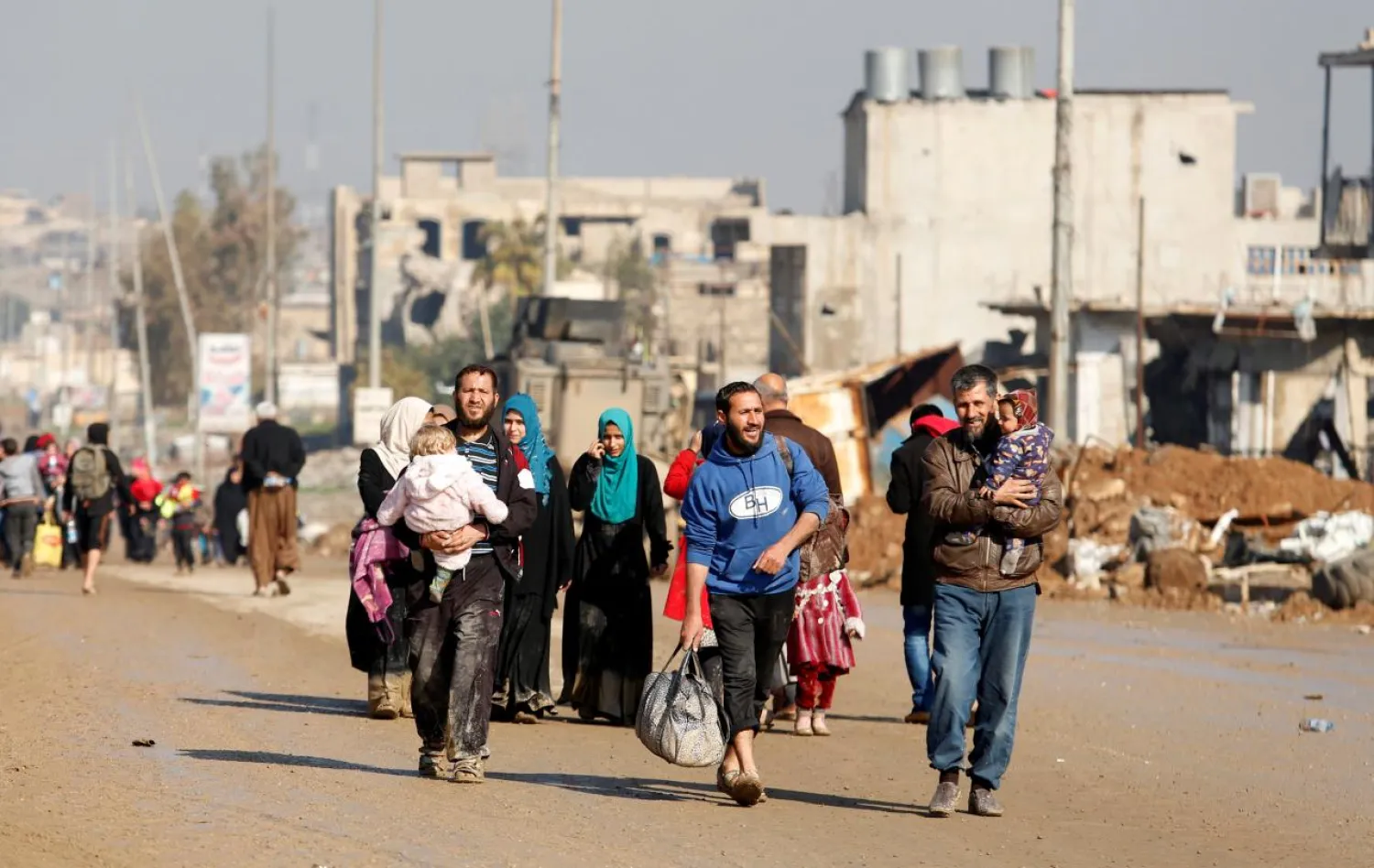
Displaced Iraqis flee their homes as Iraqi forces battle with ISIS militants, in western Mosul, Iraq March 24, 2017. REUTERS/Suhaib Salem
TT

Iraq Relies on Private Sector for Post-ISIS Reconstruction

Displaced Iraqis flee their homes as Iraqi forces battle with ISIS militants, in western Mosul, Iraq March 24, 2017. REUTERS/Suhaib Salem

Kuwait International Conference for Reconstruction of Iraq will take place in Kuwait city between February 12 and 14 and will be attended by political leaders and potential private sector investors. The conference comes months after Iraq declared its victory over ISIS.

The conference will be chaired by: Kuwait, Iraq, EU, UN, and World Bank and is considered a push towards better relations between Kuwait and Baghdad. Iraq hopes to attract billions of dollars from private investors as well as donors to fund its reconstruction.

Kuwait’s Under Secretary for Foreign Affairs, Khaled al-Jarallah announced that over 2,000 companies and businessmen due to attend the conference where the first day will be dedicated to international and civil organisations. The second day will be devoted to the private sector's role in rebuilding Iraq, while attending donor countries are expected to make announcements on the third.

US State Department said that rather than "direct contributions", Washington has "focused on the private sector. It has teamed up with the US Chamber of Commerce to organize a delegation of over 150 American companies to travel to Kuwait" for the conference.

German Defense Minister Ursula von der Leyen on Saturday said the role of Germany's armed forces in Iraq must evolve to meet the "needs of Iraq," which she said is in a "period of transition" after the military defeat of ISIS terrorist group.

After meeting with Iraqi Prime Minister Haider al-Abadi, von der Leyen said that everyone knows that ISIS has been beaten, but not completely defeated yet. She added that Iraqi partners expressed their desire for a "commitment from Germany" for "other forms of engagement," including training and logistics.

In January, PM Abadi announced that Iraq needs to raise $100 billion to rebuild the country after the fight against ISIS and decades of sanctions and war.

"It's a huge amount of money. We know we cannot provide it through our own budget," he told the World Economic Forum in Davos, Switzerland.

"That's why we now resorted to investment," because it is the only way to gather such an amount, Abadi insisted.

Representative for the UN children's fund in Iraq, Peter Hawkins, says reconstruction will be a mammoth task, not just in Mosul, retaken from ISIS last July after several months of fighting, but also elsewhere like al-anbar, Diyala, and Saladine.

Iraq representative of the UN Human Settlements Program, Erfan Ali reiterated there is huge destruction and a huge need to mobilize support for the country.

Ali said there are big hopes the private sector will play a major role in rebuilding, offering "innovative solutions" to tackle the country's problems.

Over 2.6 million people remain displaced across the country, the International Organization for Migration (IOM) said.

Satellite imagery shows some 26,000 houses are destroyed or seriously damaged, including more than 17,000 in Mosul.

Hawkins pointed out that though much of the battle against ISIS took place in northern Iraq, its southern governorates have also suffered from government budget cuts during the conflict.

Overstretched schools in the south teach children in two or three shifts, the UNICEF official said.

Hawkins insisted that major investment in health, education, social warfare and water resources are needed where nearly a quarter of the population survive on less than $2 a day.

"If we do not start to invest in children's education today, this generation will be lost and will not be able to contribute to the economy and the security of Iraq when they grow up," Hawkins warned.

Director of Gulf Center for Development Studies, Dr. Zafer al-Ajmi, said that Kuwait needs its neighbor to be stable, because stability in Iraq means stability for Kuwait, pointing to the consequences of instability in Iraq through ISIS and other dangers that threaten security in the region.

German DW reported Ajmi as saying: "Kuwait is trying to help Iraq overcome its obstacles, and we have seen Kuwait's honorable position in removing Iraq from the seventh item and postponing its payment of the Kuwaiti due compensations."

He pointed out that, through UN, Kuwait could have forced Iraq to pay, however, he pointed that no city in the world will host a huge conference for another country unless it really wants stability for this country.

In June 2014, through UN bodies and specialized humanitarian organizations, Kuwait decided to provide urgent humanitarian aid to displaced Iraqis as a result of the deterioration of security conditions in their country.

During the summer of 2014, Kuwait contributed $10 million to UN humanitarian agencies and IOM in response to the deteriorating humanitarian crisis in Iraq and donated $3 million to UNHCR in support of the organization’s operations in Iraq.

Indonesia Lays to Rest Peacekeepers Killed in Lebanon

The coffin containing the body of Indonesian soldier Farizal Rhomadhon is carried by soldiers at his home in Kulon Progo, Yogyakarta, on April 4, 2026, after being killed while serving with the United Nations Interim Force in Lebanon (UNIFIL) in southern Lebanon. (AFP)
TT

Indonesia Lays to Rest Peacekeepers Killed in Lebanon

The coffin containing the body of Indonesian soldier Farizal Rhomadhon is carried by soldiers at his home in Kulon Progo, Yogyakarta, on April 4, 2026, after being killed while serving with the United Nations Interim Force in Lebanon (UNIFIL) in southern Lebanon. (AFP)

Three Indonesian peacekeepers killed in two separate explosions in southern Lebanon last week were laid to rest in their hometowns on Sunday.

Peacekeeper Farizal Rhomadhon, 28, died when a projectile exploded on March 29 in southern Lebanon, where Israel and Hezbollah have been fighting since Lebanon was drawn into the Middle East war.

Two other blue helmets, Zulmi Aditya Iskandar, 33, and Muhammad Nur Ichwan, 26, died a day later when an explosion struck a logistics convoy of the UN Interim Force in Lebanon (UNIFIL), also in southern Lebanon.

The deadly incidents sparked calls from Indonesian authorities for an investigation and security guarantees for peacekeeping forces.

The soldiers were buried on Sunday in coffins draped in the Indonesian flag during military funerals with gun salutes.

Weeping family members scattered flower petals on their graves.

Zulmi was buried in a military cemetery in his hometown in Bandung, West Java, while Ichwan and Farizal were laid to rest in their respective hometowns in Central Java and Yogyakarta.

"I'm letting him go proudly. I accept it sincerely, even though it is not what I had hoped as a parent," Zulmi's father Iskandarudin told reporters after the funeral.

"I am certain that he's waiting for me in heaven."

Agus Subiyanto, the commander of the Indonesian National Armed Forces, told reporters that every fallen soldier will receive compensation in recognition of their service.

"We have prepared all the rights and entitlements that must be given to the fallen soldiers. Among these is compensation from the United Nations," Agus said after attending Zulmi's funeral.

The bodies of the three peacekeepers arrived in Jakarta on Saturday, received with honors in a ceremony attended by President Prabowo Subianto.

Prabowo said on Instagram that Indonesians "strongly condemn every heinous act that undermines peace and causes the deaths of our nation's soldiers".

Less than a week after the explosions that killed the three peacekeepers, another blast took place at a UN facility near Adeisseh on Friday, injuring three more Indonesian blue helmets.

Indonesia's Foreign Ministry called the attacks "unacceptable" and urged the UN Security Council "to immediately convene a meeting of troop-contributing countries to UNIFIL to conduct a review and take measures to enhance the protection of personnel serving with UNIFIL".

Foreign Minister Sugiono, who like many Indonesians only has one name, told reporters on Saturday that Indonesia wanted a thorough UN investigation, and demanded better security guarantees for peacekeeping soldiers.


Israel Says Will Strike Lebanon-Syria Border Crossing

A man walks near the closed Lebanese-Syrian border checkpoint amid escalating hostilities between Israel and Hezbollah, as the US-Israel conflict with Iran continues, near Masnaa, Lebanon, April 5, 2026. (Reuters)
TT

Israel Says Will Strike Lebanon-Syria Border Crossing

A man walks near the closed Lebanese-Syrian border checkpoint amid escalating hostilities between Israel and Hezbollah, as the US-Israel conflict with Iran continues, near Masnaa, Lebanon, April 5, 2026. (Reuters)

The Israeli military said on Saturday it would strike an area near the main crossing between Syria and Lebanon, urging residents to evacuate immediately as it continued its attacks across Lebanon.

Israel has carried out strikes across Lebanon and launched a ground invasion in the south since March 2, when Hezbollah entered the war in the Middle East on the side of its backer Iran.

"Due to Hezbollah's use of the Masnaa crossing for military purposes and smuggling of combat equipment, the (Israeli army) intends to carry out strikes on the crossing in the near future," said the military's Arabic-language spokesman, Avichay Adraee, urging people to leave the area.

A Lebanese security source at the Masnaa border crossing told AFP they were "currently evacuating the crossing following the Israeli threat".

In Syria, the General Authority for Borders and Customs public relations director, Mazen Aloush, said the crossing, known as Jdeidet Yabous on the Syrian side, was "exclusively for civilian use and is not used for any military purposes".

Aloush added that "in light of the circulating warnings and out of concern for the safety of travelers, traffic through the crossing will be temporarily suspended until any potential risks subside".

An AFP journalist on the Syrian side of the crossing said early Sunday it was empty, with only a few guards remaining.

Masnaa is the main crossing between Lebanon and Syria, making it a vital trade route for both countries and a key land gateway for Lebanon to the rest of the region.

Israel struck the crossing in October 2024, during its previous war with Hezbollah.

The crossing remained closed until Lebanese and Syrian authorities began repair works after a ceasefire the following month.


French Boats Set Sail to Join Gaza Aid Flotilla

Activists gather in l'Estaque, part of Marseille's harbor, southern France, on April 4, 2026, during a rally in support of a flotilla carrying activists from “Thousand Madleens to Gaza” movement as they prepare to set sail. (AFP)
TT

French Boats Set Sail to Join Gaza Aid Flotilla

Activists gather in l'Estaque, part of Marseille's harbor, southern France, on April 4, 2026, during a rally in support of a flotilla carrying activists from “Thousand Madleens to Gaza” movement as they prepare to set sail. (AFP)

Some 20 French boats set sail from Marseille on Saturday to join up with an international flotilla making a renewed effort to break an Israeli blockade and deliver aid to Gaza, AFP reporters saw.

"Gaza, Marseille is with you" shouted around a thousand people who had come to the docks to support the initiative.

The ships, mostly sailboats, set off to a round of applause and songs shortly after 5:00 pm (1500 GMT) to join the "Global Sumud Flotilla", named after a Gazan fisherman.

The international flotilla of some 100 boats, mostly setting sail from Barcelona on April 12, will head towards Gaza around April 20, according to the organizers. A week-long stopover is planned in southern Italy for "non-violence training."

"The goal is to give Palestine more visibility. We're not talking about it much right now, because of the international context," said Manon, a crew member who declined to give her full name.

In late 2025, an initial flotilla of about 50 boats, composed of political figures and activists such as Sweden's Greta Thunberg, was boarded by the Israeli navy -- illegally according to the organizers and Amnesty International.

The crew members were arrested and expelled by Israel.

The Gaza Strip, governed by Hamas, has been under an Israeli blockade since 2007. Israel and the Palestinian movement accuse each other of violating a ceasefire that came into effect on October 10, 2025, after two years of war.