

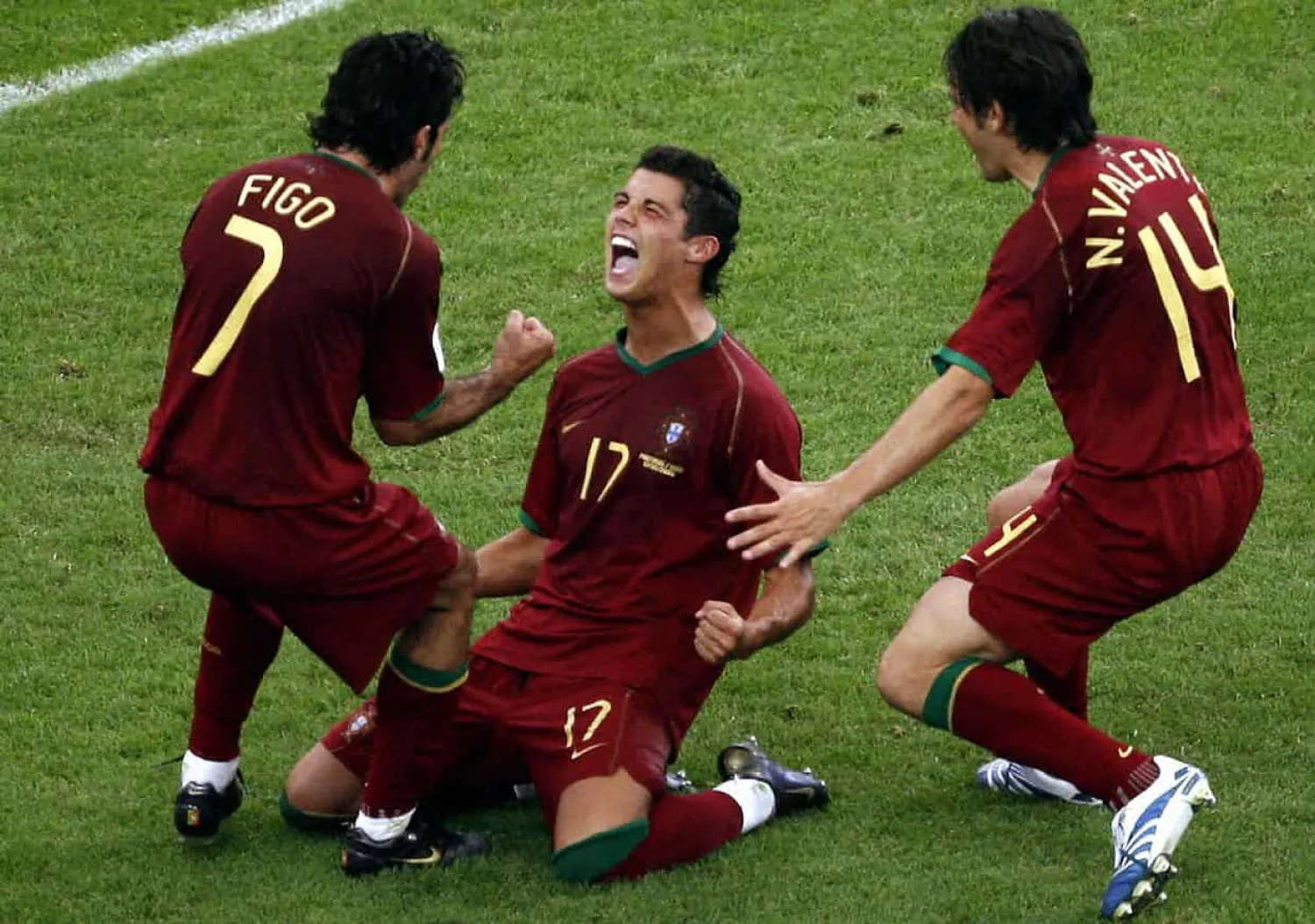

Inside the Sporting Lisbon Academy, where Ballon d'Or Winners are Made

Cristiano Ronaldo, Luís Figo and Nuno Valente all passed through the Sporting academy. (AFP)
TT

Inside the Sporting Lisbon Academy, where Ballon d'Or Winners are Made

Cristiano Ronaldo, Luís Figo and Nuno Valente all passed through the Sporting academy. (AFP)

“Effort, Dedication, Devotion, Glory.” Those are the first and last words the young hopefuls see as they enter and leave the Sporting Clube de Portugal academy. I had visited Benfica’s €15m complex the night before and was immediately struck by the contrasting values at this rural complex in Alcochete. Perhaps it was the €0.40 coffee served to me in the clubhouse by a bronzed pensioner who was wearing a permanent scowl. Without extravagances, this is a place for football.

As coaches gathered around a portable TV to watch Primeira Liga highlights and plan what the evening would have in store, I couldn’t help but daydream about the players who had walked these corridors and slept in the rooms next door, back when they owned nothing more than a pocketful of ambition. Sporting have produced Portugal’s two most capped players, Cristiano Ronaldo and Luís Figo, both of whom have won the Ballon d’Or, the Champions League and a shed-load of leagues and cups. There are signed pictures and murals of the pair plastered all around the facilities.

“Listen to me,” says Miguel Miranda, the goalkeeping coordinator at the academy. “Messi is a freak, a one-off and clearly the best ever, but what Cristiano has done to be anywhere near his levels speak volumes about the man. He came here from an island with nothing: a skinny boy with many bad habits who liked to run at defenders. Now he is a complete player: a beast. We use him as an example in every room here: from the gymnasium, to the psychology classrooms and the dressing rooms. He sacrificed himself to get everything he has now.”

While wandering around the six training pitches and talking to Miranda, I notice a theme: the ball is continuously zipped out to wingers who are encouraged to drive at isolated full-backs. “Cristiano, Figo, Nani, Quaresma – we’ve always specialized in wingers here,” he says. “Coaches limit touches for central players, who are encouraged to spread the ball wide into wingers, who have unlimited touches to create chances from wide.” Miranda says the country’s top wingers make their way to Alcochete as the academy has a history of producing “free-range players, not battery-caged ones”.

“Ten of our boys were in Portugal’s 23-man squad that won Euro 2016. Of the eight from here who started in the final, five are attackers. The other two came on as wingers! We like the boys to be free to express themselves on the pitch. We love creative kids.”

Sporting became the first Portuguese club to open an academy in 2002. Like both Benfica and Porto, a 4-3-3 template runs through the veins of the youth system. Yet, all of their coaches take “field trips” to different football cultures, such as Barcelona’s La Masia, Ajax’s De Toekomst and various hotbeds of youth talent in South America, to see how things are done elsewhere and absorb knowledge from other philosophies.

After witnessing an Under-16 player fail to control three 20-yard passes in a row just minutes after he had beaten three opponents and finished from 25 yards, I joke with Miranda that I cannot work out if he is the best or worst player I have ever seen. “He’s gone,” says Miranda with a cutting frown. “Look at his skin. Look at his legs. He’s finished. I’m serious. We do physical examinations on the boys every three months. This boy isn’t at the levels he needs to be and he’s finished maturing. We check players’ skin for acne, knees and other joints for growth.”

“If a player isn’t performing at the standard we require for their age and their body has stopped developing, then we will release them. We prefer skinny, awkward teens to the finished product at 15. Again, here, Cristiano is the perfect example. We don’t want them to be professional at 14. We want them to be professional at 20.”

Aurélio Pereira, the club’s long-serving director of youth recruitment, has overseen the discovery of Figo, Paulo Futre, Simão Sabrosa, João Moutinho, Cedric, Ricardo Quaresma and Nani, among others, but Ronaldo is the real darling for the club. The 70-year-old’s eyes light up when he reminisces about Ronaldo tying weights to his legs and racing past traffic in the streets outside the academy to gain strength and speed.

“As soon as we make contact with a player coming from far away, our objective is to bring them over to the Sporting Academy,” says Pereira. “We are responsible for a massive change in the lives of young players who could become greats one day. We find the strong and weak points of each individual and change their training to reflect that.”

Sporting insist they are interested in developing people, not just players. Eric Dier, who spent eight years with the club before signing for Tottenham, has testified to that. “They pride themselves on bringing you up as a polite and respectful person. They would never get angry with you if you missed a pass but they would do if you were disrespectful to someone. There was no shouting. A good player for them was someone who could understand when they made a mistake and correct it for themselves.

“When I first came to England to play I saw coaches having a go at players when they made mistakes. They would literally be talking them through the game. In Portugal, the coach would sit on the bench and not say a word. We’d just play. It was a matter of us making mistakes and learning from them by ourselves. You understand the game a lot better that way. For me, the sign of a bad player is someone who makes the same mistake twice.”

Miranda is adamant that making each player happy in his day-to-day life matters to the club. “Correct diets and sleeping patterns are of high importance here and having the correct lifestyle has an enormous effect on performance. When players perform well on the pitch, they find everything else easier, eventually becoming content with life’s challenges. The development of humans is of great importance.”

Ronaldo’s success tells its own story and so too does that of Figo, who has gone on to prosper in multiple avenues. He is fluent in five languages, runs bars and restaurants around Portugal, works for the Stop TB Partnership to serve people affected by tuberculosis, is on the board of a charity run by Internazionale, and even ran to be Fifa president.

As I said “boa noite” to the still scowling waiter at the end of the night and made my way out of the academy, I walked past a shirt signed by Ronaldo and the other youth graduates who helped Portugal win Euro 2016. The Ballon d’Or winners, European champions and professionals spread around the world are all a testament to the “effort, dedication, devotion, glory” motto that was instilled in them here.

The Guardian Sport


Shakhtar Boss Pays Ukrainian Racer $200,000 After Games Disqualification

Ukrainian President Volodymyr Zelenskiy holds helmet as he meets with a Ukrainian skeleton racer Vladyslav Heraskevych , who was disqualified from the Olympic skeleton competition over his "helmet of remembrance" depicting athletes killed since Russia's invasion and his father and coach, Mykhailo Heraskevych, amid Russia's attack on Ukraine, in Munich, Germany February 13, 2026. (Ukrainian Presidential Press Service/Handout via Reuters)
TT

Shakhtar Boss Pays Ukrainian Racer $200,000 After Games Disqualification

Ukrainian President Volodymyr Zelenskiy holds helmet as he meets with a Ukrainian skeleton racer Vladyslav Heraskevych , who was disqualified from the Olympic skeleton competition over his "helmet of remembrance" depicting athletes killed since Russia's invasion and his father and coach, Mykhailo Heraskevych, amid Russia's attack on Ukraine, in Munich, Germany February 13, 2026. (Ukrainian Presidential Press Service/Handout via Reuters)

The owner of ‌Ukrainian football club Shakhtar Donetsk has donated more than $200,000 to skeleton racer Vladyslav Heraskevych after the athlete was disqualified from the Milano Cortina Winter Games before competing over the use of a helmet depicting Ukrainian athletes killed in the war with Russia, the club said on Tuesday.

The 27-year-old Heraskevych was disqualified last week when the International Bobsleigh and Skeleton Federation jury ruled that imagery on the helmet — depicting athletes killed since Russia invaded Ukraine in 2022 — breached rules on athletes' expression at ‌the Games.

He ‌then lost an appeal at the Court ‌of ⁠Arbitration for Sport hours ⁠before the final two runs of his competition, having missed the first two runs due to his disqualification.

Heraskevych had been allowed to train with the helmet that displayed the faces of 24 dead Ukrainian athletes for several days in Cortina d'Ampezzo where the sliding center is, but the International Olympic Committee then ⁠warned him a day before his competition ‌started that he could not wear ‌it there.

“Vlad Heraskevych was denied the opportunity to compete for victory ‌at the Olympic Games, yet he returns to Ukraine a ‌true winner," Shakhtar President Rinat Akhmetov said in a club statement.

"The respect and pride he has earned among Ukrainians through his actions are the highest reward. At the same time, I want him to ‌have enough energy and resources to continue his sporting career, as well as to fight ⁠for truth, freedom ⁠and the remembrance of those who gave their lives for Ukraine," he said.

The amount is equal to the prize money Ukraine pays athletes who win a gold medal at the Games.

The case dominated headlines early on at the Olympics, with IOC President Kirsty Coventry meeting Heraskevych on Thursday morning at the sliding venue in a failed last-minute attempt to broker a compromise.

The IOC suggested he wear a black armband and display the helmet before and after the race, but said using it in competition breached rules on keeping politics off fields of play. Heraskevych also earned praise from Ukraine President Volodymyr Zelenskiy.


Speed Skating-Italy Clinch Shock Men’s Team Pursuit Gold, Canada Successfully Defend Women’s Title

 Team Italy with Davide Ghiotto, Andrea Giovannini, Michele Malfatti, celebrate winning the gold medal on the podium of the men's team pursuit speed skating race at the 2026 Winter Olympics, in Milan, Italy, Tuesday, Feb. 17, 2026. (AP)
Team Italy with Davide Ghiotto, Andrea Giovannini, Michele Malfatti, celebrate winning the gold medal on the podium of the men's team pursuit speed skating race at the 2026 Winter Olympics, in Milan, Italy, Tuesday, Feb. 17, 2026. (AP)
TT

Speed Skating-Italy Clinch Shock Men’s Team Pursuit Gold, Canada Successfully Defend Women’s Title

 Team Italy with Davide Ghiotto, Andrea Giovannini, Michele Malfatti, celebrate winning the gold medal on the podium of the men's team pursuit speed skating race at the 2026 Winter Olympics, in Milan, Italy, Tuesday, Feb. 17, 2026. (AP)
Team Italy with Davide Ghiotto, Andrea Giovannini, Michele Malfatti, celebrate winning the gold medal on the podium of the men's team pursuit speed skating race at the 2026 Winter Olympics, in Milan, Italy, Tuesday, Feb. 17, 2026. (AP)

An inspired Italy delighted the home crowd with a stunning victory in the Olympic men's team pursuit final as

Canada's Ivanie Blondin, Valerie Maltais and Isabelle Weidemann delivered another seamless performance to beat the Netherlands in the women's event and retain their title ‌on Tuesday.

Italy's ‌men upset the US who ‌arrived ⁠at the Games ⁠as world champions and gold medal favorites.

Spurred on by double Olympic champion Francesca Lollobrigida, the Italian team of Davide Ghiotto, Andrea Giovannini and Michele Malfatti electrified a frenzied arena as they stormed ⁠to a time of three ‌minutes 39.20 seconds - ‌a commanding 4.51 seconds clear of the ‌Americans with China taking bronze.

The roar inside ‌the venue as Italy powered home was thunderous as the crowd rose to their feet, cheering the host nation to one ‌of their most special golds of a highly successful Games.

Canada's women ⁠crossed ⁠the line 0.96 seconds ahead of the Netherlands, stopping the clock at two minutes 55.81 seconds, and

Japan rounded out the women's podium by beating the US in the Final B.

It was only Canada's third gold medal of the Games, following Mikael Kingsbury's win in men's dual moguls and Megan Oldham's victory in women's freeski big air.


Lindsey Vonn Back in US Following Crash in Olympic Downhill 

Milano Cortina 2026 Olympics - Alpine Skiing - Women's Downhill 3rd Official Training - Tofane Alpine Skiing Centre, Belluno, Italy - February 07, 2026. Lindsey Vonn of United States in action during training. (Reuters)
TT

Lindsey Vonn Back in US Following Crash in Olympic Downhill 

Milano Cortina 2026 Olympics - Alpine Skiing - Women's Downhill 3rd Official Training - Tofane Alpine Skiing Centre, Belluno, Italy - February 07, 2026. Lindsey Vonn of United States in action during training. (Reuters)

Lindsey Vonn is back home in the US following a week of treatment at a hospital in Italy after breaking her left leg in the Olympic downhill at the Milan Cortina Games.

“Haven’t stood on my feet in over a week... been in a hospital bed immobile since my race. And although I’m not yet able to stand, being back on home soil feels amazing,” Vonn posted on X with an American flag emoji. “Huge thank you to everyone in Italy for taking good care of me.”

The 41-year-old Vonn suffered a complex tibia fracture that has already been operated on multiple times following her Feb. 8 crash. She has said she'll need more surgery in the US.

Nine days before her fall in Cortina d'Ampezzo, Italy, Vonn ruptured the ACL in her left knee in another crash in Switzerland.

Even before then, all eyes had been on her as the feel-good story heading into the Olympics for her comeback after nearly six years of retirement.
