


Key Topics of International Petroleum Week: Saudi Gas, OPEC Deal, Shale Oil

The logo of the Organization of the Petroleum Exporting Countries (OPEC) is pictured at its headquarters in Vienna, Austria September 21, 2017. REUTERS/Leonhard Foeger
TT

Key Topics of International Petroleum Week: Saudi Gas, OPEC Deal, Shale Oil

The logo of the Organization of the Petroleum Exporting Countries (OPEC) is pictured at its headquarters in Vienna, Austria September 21, 2017. REUTERS/Leonhard Foeger

International Petroleum (IP) Week kicked off on Monday in London- an event where giant oil companies meet with traders and analysts.

There were three key points that were discussed on a wide-scope among a great number of analysts and traders, which are the Saudi plans to import liquefied natural gas, the future of OPEC agreement with exterior producers and the shale oil and its solidity and continuity, especially that it is expected to increase remarkably this year.

Several topics were discussed this year, mainly prices and trends of oil. Natural gas was also among the significant topics tackled, especially that the US has become a primary exporter of natural gas.

Everyone showed optimism towards the oil market and the future of prices. The majority of Platts London Oil & Energy Forum attendants expressed optimism that the oil prices will remain between $65 and $70 in the first quarter of next year, while more than half of the attendants expected the OPEC deal to extend after 2018.

Chris Midgley, head of the Analytics Content Division at S&P Global Platts, said that the demand on natural gas will come from three new markets in the coming years: China, India and Saudi Arabia.

On Tuesday, activities of the International Petroleum (IP) Week kicked off at InterContinental London Park Lane. UAE Energy Minister Suhail Al-Mazrouei took part in the event, and during a news conference on Tuesday he said that the deal to cut oil output contributed to reducing oil surplus in the market, but the mission isn’t completed yet.

Oil stocks in developed OECD economies, which were 340 million barrels above the five-year average in January 2017, were just 74 million barrels above that level last month, Ayed Al Qahtani, OPEC’s head of research, told a conference.



Iranian Gas to Iraq Resumes After South Pars Attack

An Iranian man walks along the phase 15-16 of the South Pars gas field facilities in the southern Iranian port of Assaluyeh on the shore of the Gulf on January 22, 2014. (AFP)
TT

Iranian Gas to Iraq Resumes After South Pars Attack

An Iranian man walks along the phase 15-16 of the South Pars gas field facilities in the southern Iranian port of Assaluyeh on the shore of the Gulf on January 22, 2014. (AFP)

Iranian gas supplies to Iraq have resumed at a rate of five million cubic meters per day, the Iraqi electricity ministry said on Saturday, according ‌to the state ‌news agency.

Flows had ‌been ⁠halted after Israel ⁠attacked Iran's main gas field, South Pars, on Wednesday.

The current five million cubic meters is a fraction ⁠of the contracted 50 ‌million ‌cubic meters.

Iraqi officials ‌say volumes will increase gradually, ‌but have provided neither a timeframe nor details of the damage to ‌the Iranian gas facilities.

"Following the resumption of ⁠Iranian ⁠gas supplies, the national grid has recorded stability in production at 14,000 megawatts," Ahmed Moussa, an electricity ministry spokesperson, was quoted as saying by the state news agency.


Trump to Be Guest of Honor at Saudi Arabia’s Future Investment Initiative Summit in Miami

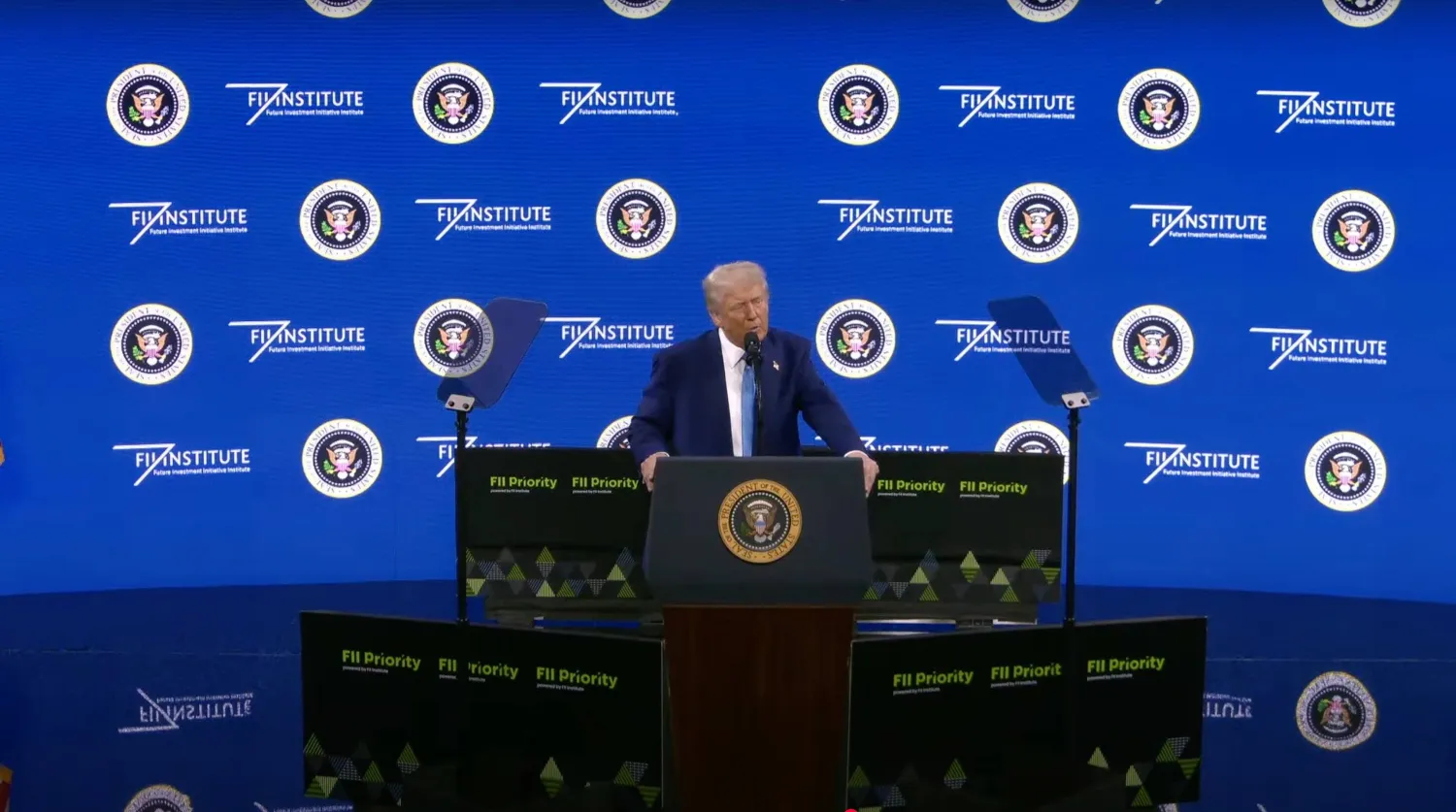
Trump delivers a speech at last year's edition of the event. (Asharq Al-Awsat)
TT

Trump to Be Guest of Honor at Saudi Arabia’s Future Investment Initiative Summit in Miami

Trump delivers a speech at last year's edition of the event. (Asharq Al-Awsat)

The Future Investment Initiative (FII) Institute announced that US President Donald Trump will participate as a guest of honor and speaker at the fourth edition of the “Priority Future Investment Initiative” summit in Miami, scheduled to be held from March 25 to 27.

Trump is scheduled to deliver a keynote speech in person during the summit's closing session on March 27. The appearance marks the second time Trump has addressed this international gathering of leaders, investors, and decision-makers on the platform, reflecting the growing strategic importance of this summit in global economic circles.

Trump's participation comes at a very sensitive time for the global economy, which is reeling under the weight of escalating energy crises and sharp jumps in oil prices that have exceeded the $100 mark.

The global audience in Miami will be waiting to see Trump's vision on how to manage these developments and his philosophy towards the movement of capital in light of current geopolitical conflicts.

In last year's edition, Trump reaffirmed that the golden age of the United States had officially begun, considering the economic progress that had occurred since he took office to be "amazing."

This year's summit is being held under the slogan "Capital in Motion," where it seeks to explore how capital moves, adapts, and leads in a rapidly fragmenting world.

The agenda focuses intensively on the role of investment, technology, and policies in achieving sustainable and inclusive growth, while highlighting Latin America region and the Americas as a center of the current global transformation.

The summit brings together an elite group of senior officials, investors, and innovators, and prominent from the Saudi side is a high-level presence that includes the Governor of the Public Investment Fund and Chairman of the Board of Directors of the Future Investment Initiative Foundation Yasir Al-Rumayyan, Minister of Finance Mohammed Al-Jadaan, Minister of Tourism Ahmed Al-Khateeb, and the Ambassador of the Custodian of the Two Holy Mosques to the United States, Princess Reema bint Bandar Al Saud.

The list of speakers also includes prominent names, such as Steve Witkoff, the US envoy to the Middle East, and Dina Powell McCormick, Vice President of Meta, in addition to the participation of Donald Trump Jr.

The slogan of the fourth edition, "Capital in Motion," reflects an accelerated global reality that knows no stillness, where resources, talents, and ideas flow across borders, industries, and technologies at an unprecedented pace. In light of slowing global growth, persistently high interest rates for longer, and sharp geopolitical rifts, the summit is redrawing the map of investment returns.

The summit is expected to attract more than 1,500 delegates from around the world, forming an economic bridge linking the Middle East, the United States, and the emerging Latin American markets.


IMF Says Gulf Buffers, Export Flexibility Can Absorb War Shock

IMF spokeswoman Julie Kozack speaks during a press conference. (Reuters file)
TT

IMF Says Gulf Buffers, Export Flexibility Can Absorb War Shock

IMF spokeswoman Julie Kozack speaks during a press conference. (Reuters file)

The International Monetary Fund said that the economic impact of the ongoing conflict on Gulf Cooperation Council (GCC) states will depend on its duration, scope and intensity, with strong financial buffers and export flexibility expected to limit the fallout.

IMF spokeswoman Julie Kozack noted that outcomes will vary by country, largely depending on geographic location and the ability to resume exports. She explained that higher oil prices could help some countries offset production losses either partially or fully, depending on how quickly export flows recover.

She pointed to the Gulf’s substantial sovereign buffers and solid economic foundations, built through years of structural reforms aimed at diversifying income and strengthening logistics infrastructure. These measures have improved the region’s resilience to external shocks.

The IMF’s assessment broadly aligns with recent analysis by ratings agency Standard & Poor’s, which highlighted Saudi Arabia’s East–West pipeline as a strategic alternative export route that reduces reliance on key maritime chokepoints.

Elevated oil prices may also compensate for declining output, while the region’s large financial reserves are expected to support a swift recovery once the conflict subsides.

Kozack also highlighted pressure on regional financial markets, with Gulf stock indices declining and bond spreads widening in line with global volatility driven by inflation concerns and rising geopolitical risks.

Economists broadly view the region’s ample financial assets and foreign reserves as a buffer that will support a quicker rebound. Lessons from past energy crises have also helped Gulf states develop more flexible financial and logistics systems.

Standard & Poor’s recently underscored Saudi Arabia’s strong fiscal position and stable credit rating, citing substantial financial buffers and prudent policies. It also noted that alternative export routes such as the East–West pipeline allow the Kingdom to bypass the Strait of Hormuz, reducing risks to trade and growth.

Inflation risk

At the global level, the IMF is closely monitoring disruptions to energy markets, warning that sustained price increases could drive inflation higher and slow economic growth.

Oil and gas prices have surged by more than 50 percent over the past month, with Brent crude rising above $100 per barrel. If maintained for a year, this could push global inflation up by about 40 basis points and reduce economic output by between 0.1 and 0.2 percent, according to the Fund.

The IMF has signaled it stands ready to support member states, although no requests for emergency financing have been received so far.

It remains in close contact with finance ministers and central bank governors as the conflict enters its third week with no clear end in sight.

Kozack added that central banks should closely monitor whether inflation pressures extend beyond energy prices and whether inflation expectations remain stable.

The Fund is expected to incorporate the impact of the conflict into its updated global economic forecasts, due in mid-April during its Spring Meetings with the World Bank.