




The Jules Rimet trophy went walkies in March 1966. Upon discovering that the most precious prize in world football had been snatched from under their hapless noses, the folk at the Football Association responded in a manner that couldn’t have been more English had their press release been soaked in weak milky tea. “The FA deeply regrets this most unfortunate incident,” began their clipped, haughty study in brazen understatement. “It inevitably brings discredit to both the FA and this country.”
They’d struck the right tone with that last bit, at least. The FA was way out of the good books for losing the cup. “I’m damned angry!” spluttered Erik von Frenckell, honorary president of the Finnish FA. Abrain Tebet of the Brazilian Sports Confederation was even more strident. “Even Brazilian thieves love football and would never commit this sacrilege! It would never have happened in Brazil.” Oh Abrain! No good will ever come of talk like this.
Still, you can understand the sentiment. In retrospect, security arrangements for the 12-inch solid-gold representation of Nike, Greek goddess of victory, perched delicately on a precious hunk of lapis lazuli, were not all they could have been. The FA had released the cup for display at a stamp exhibition in Central Hall, Westminster, on the “strict written understanding that it would be displayed in a glass showcase”. They also insisted that a guard would be posted alongside, night and day. No corners cut, what with England about to stage the eighth World Cup.
The stipulations were rigorously met. Sort of. Almost. “Our instructions were that the cup was to be kept under personal observation, certainly during the time the exhibition was open, during daylight,” explained exhibition chairman Cecil Richardson. “We had two guards standing by it all the time. The pressure of security was not considered quite so serious when the hall was closed to the public.”
Having reasoned that robbers were far less likely to attempt a heist when nobody was around to witness it, the guards kicked back on the morning of Sunday 20th. Though there was a Methodist service being held in another part of the building, the stamp exhibition itself was shut. Plus there was a wooden bar across the door at the rear of the hall and a little lock on the showcase, which was also covered at the back by a heavy hessian sheet. Hourly checks would suffice!
Somehow, the UK’s answer to Fort Knox was breached between the regular tour of inspection at 11am, when the cup was there, and the following tour at midday, when the cup was not. The wooden bar was found on the floor alongside two screws which had held it to the wall. The lock had been forced. And the burlap curtain showed signs of having been slightly ruffled. One of the guards had reportedly spotted a stranger with “greased black hair brushed back flat” and “thin lips” milling around the hall by a public phone just after 11, but he was on his way to the loo when he made the sighting, and potty takes precedence.
The head of Alsa-Guard Security Services, the firm hired by the exhibition to look after Nike, insisted with a Trumpian flourish that his guards had been positioned “alongside, very alongside” the showcase. However when pressed he became evasive. “Look lads, don’t try to tie me down to geographical details.” Richardson also worked a little wriggle room, on the one hand absurdly claiming that “nothing went wrong, it was just stolen” while also musing philosophically that “we all have room for human error, and perhaps a little human error may have crept in”.
The search to find the cup proved equally farcical. “In the Metropolitan police we have the most brilliant detectives,” claimed crime prevention officer chief inspector Paterson. “The World Cup organisers are hoping this is so.” Fingers were duly crossed. But just in case blind faith wasn’t enough, several rewards were offered for the trophy’s recovery. The Gillette razor company stumped up £500. City loss adjusters Toplis and Harding chipped in £3,000. Walter Max, a London osteopath who for more than a quarter of a century had treated many top footballers, contributed 150 guineas. Tommy Trinder, chairman of Fulham, promised to give £1,000 to any lucky person who returned the cup to him at the Latin Quarter nightclub on Wardour Street, where he was the resident comic.
In the meantime, FA chairman Joe Mears was contacted on Monday 21st by Jackson, a fidgety type who said a parcel was on its way and that enclosed instructions should be followed. Mears took delivery of a small part of the trophy, plus a note demanding £15,000 in used oncers in exchange for the rest of it. Jackson would pick up the cash at a Friday 25th rendezvous with Mears, then send Nike winging back to him the day after.
Sadly the stress got to Mears, who suffered from angina and repaired to bed on the day of the meet. Detective inspector Len Buggy of the Flying Squad went instead, and the operation quickly degenerated into Big Lebowski farce. Jackson didn’t notice that Buggy’s suitcase, supposedly full of banknotes, mainly contained scraps of old newspaper. But he did clock a nearby van, and correctly surmised it was full of peelers. He tried to make a break for it but was arrested and uncovered as Edward Betchley, a Camberwell “dealer” with a previous conviction for handling knock-off corned beef. Betchley was charged with stealing the cup but flatly denied all knowledge, claiming a man only known to him as The Pole had paid him £500 to act as go-between.
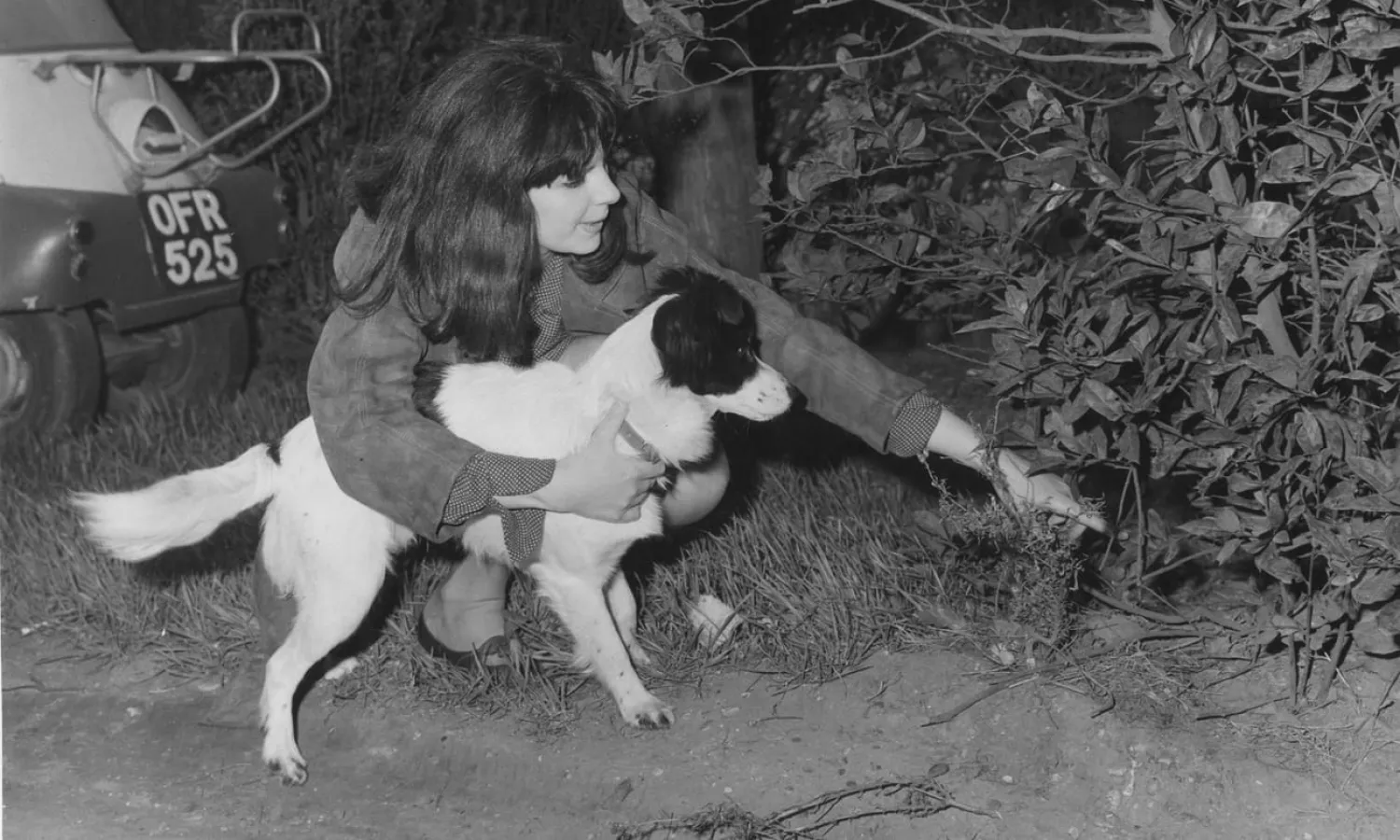
That same evening, a phone rang at the Times. A voice claimed that the World Cup was “in a brown suitcase in the left luggage office at Charing Cross”. But this proved a hoax. So where on earth was it? There were no leads … except the one 26-year-old Thames docker David Corbett was desperately trying to attach to his collie’s collar two nights later, Sunday 27th, lest the excitable little scamp sprint across Beulah Hill, a leafy road in Upper Norwood, south London.
As Corbett fiddled with the leash, Pickles stuck his snout under a nearby bush. “I was about to put his lead on when I noticed he was sniffing at something near the path,” Corbett explained. “I looked down and saw the parcel. It was wrapped in newspaper. I picked it up, it was very weighty. I tore one end off; a base. I tore the other end off: a gold figure! I still didn’t realise what it was. I went back to the base and turned it round. It said Brazil 1962, and it suddenly all came to me.” Corbett rushed inside to show it to his wife Jean, then took it to Gypsy Hill nick. He made sure to tell the astonished constables that “Pickles saw it first, the little darling!”
Pickles became a national hero overnight. He was awarded a solid silver medal by lieutenant-colonel Alexander Hendrick ‘Rosie’ Roosmalecocq, secretary of the National Canine Defence League – now the Dogs Trust – in a posh ceremony at a swish Kensington hotel. He also received a silver platter covered in cash totalling £53, the result of a whip-round by hotel staff, and a brown rubber bone to chew. A year’s supply of free dog food also came his way, plus a trot-on part in Galton and Simpson’s comic caper The Spy with the Cold Nose. His stardom ensured he was paid double the normal doggie rate.
Corbett had to wait a little longer for his treats. Mears had put his name forward for the rewards – “Why should Corbett claim it, when you have had all the worry?” his wife had argued – but withdrew his claim when it became clear Toplis and Harding weren’t going to recognise it. Corbett eventually trousered the best part of £6,000; by way of comparison, England’s players were paid £1,360 each in bonuses for winning the cup.
Mears never saw Bobby Moore lift the trophy Pickles rescued. He succumbed to his heart condition on the eve of the finals aged 61. It would be harsh to remember him solely for his unfortunate role in this fiasco: he was, after all, the man in charge of security for Winston Churchill’s underground operation room at Whitehall during the war, and that didn’t work out so badly. Poor Pickles also met a premature end, choking on his lead while chasing a cat in 1967. As for Nike herself? She was stolen in 1983 from the headquarters of the Brazilian FA, which had been given her to cherish for eternity after Brazil’s third win in 1970. The trophy was never seen again, presumably melted down. Oh Abrain! You had to say it, didn’t you!
The Guardian Sport


