Physicist Stephen Hawking Dies at 76

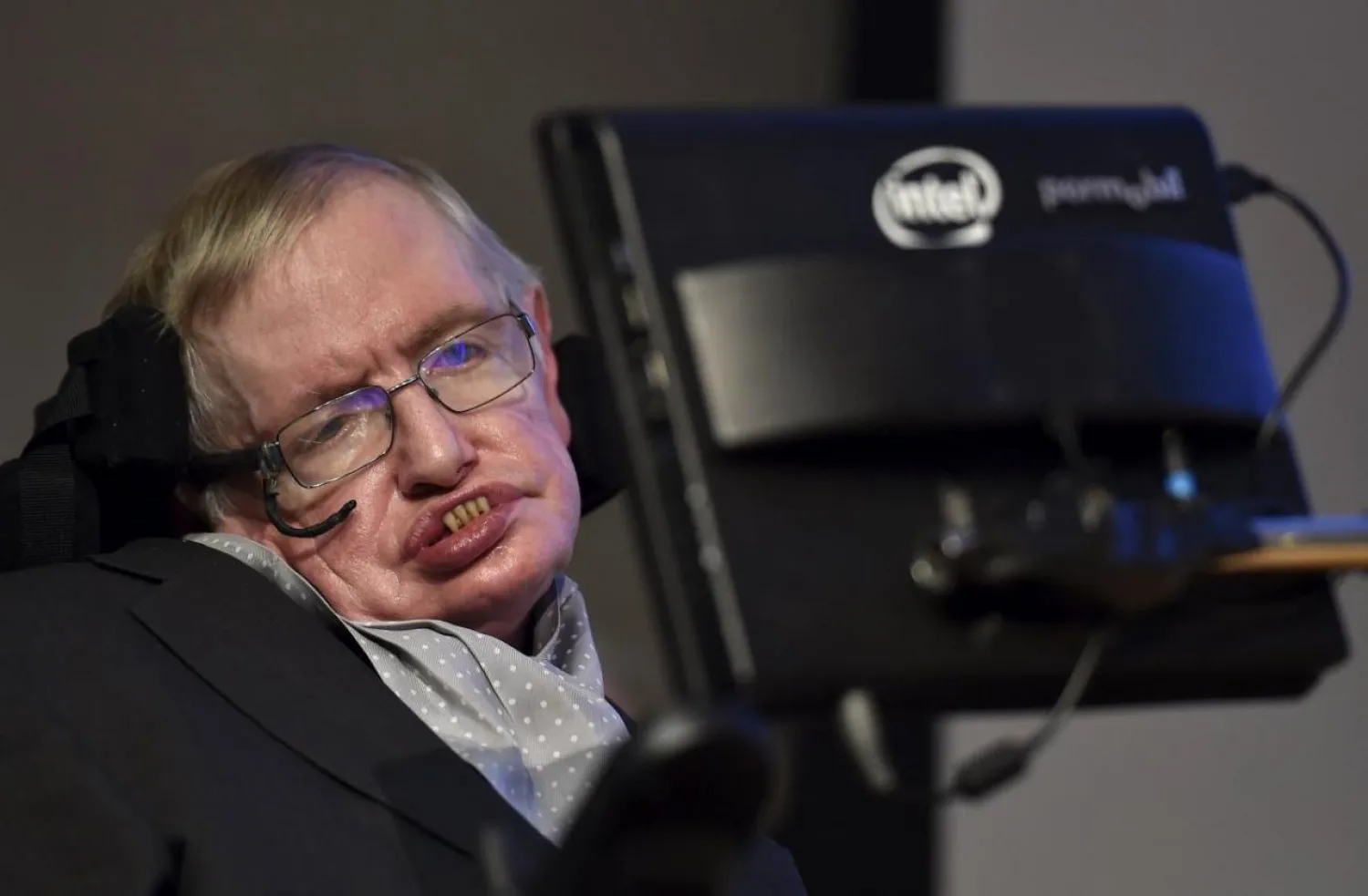
British physicist Stephen Hawking. (Reuters)
TT

Physicist Stephen Hawking Dies at 76

British physicist Stephen Hawking. (Reuters)

Renowned British physicist Stephen Hawking died on Wednesday at 76.

He gained worldwide fame trying to explain some of the most complicated questions of life while working under the shadow of a likely premature death.

He died peacefully at his home in the British university city of Cambridge in the early hours of Wednesday.

“We are deeply saddened that our beloved father passed away today,” his children Lucy, Robert and Tim said in a statement.

“He was a great scientist and an extraordinary man whose work and legacy will live on for many years,” his family said.

“His courage and persistence with his brilliance and humor inspired people across the world.”

Hawking’s formidable mind probed the very limits of human understanding both in the vastness of space and in the bizarre sub-molecular world of quantum theory, which he said could predict what happens at the beginning and end of time.

His work ranged from the origins of the universe, through the tantalizing prospect of time travel to the mysteries of space’s all-consuming black holes.

The power of his intellect contrasted cruelly with the weakness of his body, ravaged by the wasting motor neuron disease he developed at the age of 21.

Hawking was confined for most of his life to a wheelchair. As his condition worsened, he had to resort to speaking through a voice synthesizer and communicating by moving his eyebrows.

The disease spurred him to work harder but also contributed to the collapse of his two marriages, he wrote in a 2013 memoir “My Brief History.”

In the book he related how he was first diagnosed: “I felt it was very unfair - why should this happen to me,” he wrote.

“At the time, I thought my life was over and that I would never realize the potential I felt I had. But now, 50 years later, I can be quietly satisfied with my life.”

Hawking shot to international fame after the 1988 publication of “A Brief History of Time”, one of the most complex books ever to achieve mass appeal, which stayed on the Sunday Times best-sellers list for no fewer than 237 weeks.

He said he wrote the book to convey his own excitement over recent discoveries about the universe.

“My original aim was to write a book that would sell on airport bookstalls,” he told reporters at the time. “In order to make sure it was understandable I tried the book out on my nurses. I think they understood most of it.”

He was particularly proud that the book contains only one mathematical equation - relativity’s famous E=MC squared.

“We have lost a colossal mind and a wonderful spirit,” said Tim Berners-Lee, the inventor of the World Wide Web. “Rest in peace, Stephen Hawking.”

“His theories unlocked a universe of possibilities that we and the world are exploring. May you keep flying like superman in microgravity, as you said to astronauts on @Space_Station in 2014,” tweeted NASA.

“Hawking was a great scientist and an inspirational figure. The universe is better understood and more interesting because he was in it,” said Matthew Colless, professor of astronomy & astrophysics at The Australian National University.

Hawking’s popular recognition became such that he appeared as himself on the television show “Star Trek: Next Generation” and his cartoon caricature appeared on “The Simpsons”.

A 2014 film, The Theory of Everything, with Eddie Redmayne playing Hawking, charted the onset of his illness and his early life as the brilliant student grappling with black holes and the concept of time.

Since 1974 he worked extensively on marrying the two cornerstones of modern physics - Einstein’s General Theory of Relativity, which concerns gravity and large-scale phenomena, and quantum theory, which covers subatomic particles.

As a result of that research, Hawking proposed a model of the universe based on two concepts of time: “real time”, or time as human beings experience it, and quantum theory’s “imaginary time”, on which the world may really run.

In July 2002, Hawking said in a lecture that although his quest was to explain everything, a theory of determinism that would predict the universe in the past and forever in the future probably could not be achieved.

Another major area of his research was into black holes, the regions of space-time where gravity is so strong that nothing, not even light, can escape.

His health, and accidents involving his wheelchair, including one where he broke his hip after crashing into a wall in December 2001 - “the wall won,” he observed - led to his appearing in the news for reasons other than his work.

In 2004 he was admitted to hospital in Cambridge suffering from pneumonia and was later transferred to a specialist heart and lung hospital.

He was twice married and divorced.

He married undergraduate Jane Wilde in July 1965 and the couple had three children, Robert, Lucy and Timothy. But Hawking tells in his 2013 memoir how Wilde became more and more depressed as her husband’s condition worsened.

He divorced Wilde in 1990 and in 1995 married Mason, whose ex-husband David had designed the electronic voice synthesizer that allowed him to communicate.

“My marriage to Elaine was passionate and tempestuous,” he wrote in the memoir. “We had our ups and downs but Elaine’s being a nurse saved my life on several occasions.”

It also took its emotional toll on her, he noted, and the pair divorced in 2007.

Stephen William Hawking was born on January 8, 1942, to Dr. Frank Hawking, a research biologist in tropical medicine, and his wife Isobel. He grew up in and around London.

After studying physics at Oxford University, he was in his first year of research work at Cambridge when he was diagnosed with motor neuron disease.

“The realization that I had an incurable disease that was likely to kill me in a few years was a bit of a shock,” he wrote in his memoir.

But after seeing a boy die of leukemia in a hospital ward, he observed some people were a lot worse off than him and at least the condition didn’t make him feel sick.

In fact there were even advantages to being confined to a wheelchair and having to speak through a voice synthesizer.

“I haven’t had to lecture or teach undergraduates and I haven’t had to sit on tedious and time-consuming committees. So I have been able to devote myself completely to research,” he wrote in his memoir.

“I became possibly the best-known scientist in the world. This is partly because scientists, apart from Einstein, are not widely known rock stars, and partly because I fit the stereotype of a disabled genius.”

Hawking was Lucasian Professor of Mathematics at Cambridge University from 1979 to 2009 - a post held by Sir Issac Newton over 300 years earlier - wrote countless scientific papers and books, received 12 honorary degrees and was made a Companion of Honor by Queen Elizabeth in June 1989.

To celebrate turning 60, he satisfied a life-long ambition and traveled in a specially created hot air balloon.

He narrated a major segment of the opening ceremony of the London Paralympic Games in August 2012, the year he turned 70.

“I have had a full and satisfying life,” he said in his memoir. “I believe that disabled people should concentrate on things that their handicap doesn’t prevent them from doing and not regret those they can’t do.”

He added: “It has been a glorious time to be alive and doing research in theoretical physics. I’m happy if I have added something to our understanding of the universe.”


An Iconic Puzzle Comes Home as Production of the Rubik’s Cube Returns to Hungary

Hungarian architect and inventor Ernő Rubik attends the opening event of Rubik's Cube production line of the Jasz-Plasztik plastic processing company in Jaszbereny, Hungary, 10 November 2026. (EPA)
TT

An Iconic Puzzle Comes Home as Production of the Rubik’s Cube Returns to Hungary

Hungarian architect and inventor Ernő Rubik attends the opening event of Rubik's Cube production line of the Jasz-Plasztik plastic processing company in Jaszbereny, Hungary, 10 November 2026. (EPA)

More than half a century ago, a Hungarian architect, sculptor and professor invented what would become one of the world's most popular and beloved puzzles whose appeal has spanned generations: the colorful, mind-bending, six-sided Rubik's Cube.

Now, after selling more than half a billion units and becoming a worldwide cultural touchstone, production of the cube is returning to Hungary, where its inventor, Ernő Rubik, first conceived of the iconic object that bears his name.

Hungary “is the home of the cube. The cube was born here,” Rubik, 82, said on Tuesday at the opening of a new, fully automated Rubik's Cube production line in the Hungarian city of Jászberény.

The journey of the Rubik's Cube began in 1974, when Rubik was teaching design at the Academy of Applied Arts and Design in Budapest. Seeking to create a three-dimensional object that was “infinite,” he said, he completed a prototype — then made of wood — of a cube that could rotate on multiple axes and was made up of 27 blocks.

Recognizing its consumer value, Rubik soon began producing more of the puzzles. Beginning in 1977, an initial 5,000 units of what was then called the “Magic Cube” were sold at specialty shops in the Hungarian capital.

The invention — or what Rubik prefers to describe as a “discovery” — gained popularity, and after having difficulties procuring materials for the cubes in then-socialist Hungary, he realized: “We were not prepared for that size of production ... We can’t fulfill the needs of the market worldwide.”

The cube was licensed to a British and then a US toy company, and its production was moved abroad. By the early 1980s, its popularity had exploded in what Rubik called “the first big wave,” in which he said 200 million units were sold between 1980 and 1983.

While sales of the cube dipped after its initial success, it still attracts plenty of users eager to try their hand at solving the puzzle. Millions are sold every year.

At the new production line in Hungary, a series of robotic arms assembles the cubes and tests them for functionality and durability — a level of automation Rubik said was “very different” than in the early days when the cubes were assembled by hand.

The new line in Jászberény plans to produce 1 million cubes annually.

Steve Radewych, a senior vice president with Canadian toy company Spin Master, which owns the Rubik's Cube trademark, said at Tuesday's opening that the theme of the day was: “Back to its roots: The cube comes home.”

“Ernő, your discovery is more than a toy,” Radewych told Rubik. “It's a global social phenomenon.”

Radewych noted the “incredible staying power” of the Rubik's Cube, and the fact that the puzzle continues to hold the fascination of young people even today.

“The cube represents an intellectual journey, a symbol of intelligence, problem-solving and cognitive discipline,” he added, which “has brought joy — and frustration — to many generations.”

The cube has enjoyed another surge in popularity in recent years as global competitions have proliferated, measuring who can solve the puzzle the fastest.

The current record, set only last month in China by nine-year-old Xuanyi Geng, is 2.51 seconds, according to the World Cube Association, which organizes and certifies competitions across the world.

Rubik, who does not consider himself a speed competitor, said that for him, the cube represents a “transformable sculpture,” the place where art and engineering meet and users can manipulate and change the cube in nearly endless variations.

“If you are doing something, creating something, you have the chance to do something that is meaningful — that’s one part — and beautiful,” he said.


SpaceX Starship Test to Attempt First-Ever Spaceship ‘Catch'

SpaceX's mega rocket Starship is stacked and prepared for a test flight from Starbase, Texas, Thursday, Nov. 12, 2026. (AP)
TT

SpaceX Starship Test to Attempt First-Ever Spaceship ‘Catch'

SpaceX's mega rocket Starship is stacked and prepared for a test flight from Starbase, Texas, Thursday, Nov. 12, 2026. (AP)

Elon Musk's SpaceX was poised Friday to carry out its latest test of the world's biggest and most powerful rocket, the Starship, with plans for a groundbreaking "catch" of the spaceship following a day in orbit.

A successful capture of the Starship upper stage would mark a significant milestone in the space industry's decades-long pursuit of fully reusable spacecraft that can drastically reduce mission costs and make frequent travel possible.

"If successful, this will mark the first full recovery of an orbital launch system and a breakthrough moment in making Starship a reliable, rapidly reusable rocket," SpaceX said.

For the 15th Starship test flight Friday, SpaceX aims to recover both stages of the massive 124-meter (407-foot) launch vehicle.

The company has caught the booster, dubbed Super Heavy, on three previous occasions, with the first stage descending vertically back to the launch site shortly after blastoff and nestling into mechanical "chopstick" arms.

It will now attempt to do the same with the spaceship. Some versions of the vessel are designed to launch internet satellites and data centers into orbit, while others will be made to ferry people to the Moon and Mars.

A spacecraft that can be fully reused is the "Holy Grail" of the space industry, said Clayton Swope, an aerospace expert at the Center for Strategic and International Studies.

"No one's really been able to do that so far," he said. "People have been trying to do that since the (NASA) space shuttle. But the space shuttle ended up being kind of a compromise because a lot of the vehicle wasn't reusable."

Reusing the Starship spacecraft would require the vessel to withstand the extreme heat of reentering Earth's atmosphere and then return to service without extensive refurbishment.

- Refueling challenge -

Musk, the world's richest person, has already revolutionized the space sector with the partially reusable Falcon rockets, which are regularly employed to launch satellites and carry astronauts to the International Space Station.

The Starship project, however, has been plagued by years-long delays as SpaceX grapples with novel engineering challenges -- even as NASA is counting on the spaceship to serve as a lunar lander for its Artemis program.

Other technical challenges include transferring fuel to Starship in orbit -- a requirement for any journey to the Moon or Mars.

Following SpaceX's high-profile stock market debut in June, the company carried out the first orbital flight of Starship in September, though the mission was cut short due to an engine issue.

It is also investing heavily in additional launch sites for its mega-rocket in Louisiana and Florida.

- Complex capture -

Friday's launch is scheduled to take place at SpaceX's "Starbase" in southern Texas at 4:45 pm (2245 GMT).

Following liftoff and the mid-air separation of the two stages, SpaceX plans to bring Super Heavy back to Earth six and a half minutes later, catching it at the launch site on the Gulf of Mexico coastline.

The spaceship will continue to reach Earth's orbit, where it will deploy 26 satellites into Musk's Starlink satellite internet constellation that has become a major revenue stream for SpaceX.

It will then circle the planet 14 times, before returning 22 hours later and -- SpaceX hopes -- descending safely into the chopstick arms.

This capture attempt is more complex than that of the booster, as the spaceship will be descending much faster and from a much greater altitude.

SpaceX has said it would proceed with these maneuvers only if conditions are optimal, and in the past has made last-minute changes to test flights under Musk's "fail fast" strategy of learning through crashes, explosions and other mishaps.

As of late Thursday, the US Federal Aviation Administration had not yet given its final approval for the test flight.


Delhi Overtakes Lahore as World’s Most Polluted City as Air Quality Drops

Traffic moves on a smoggy morning as air pollution spikes in New Delhi, India, November 13, 2026. (Reuters)
TT

Delhi Overtakes Lahore as World’s Most Polluted City as Air Quality Drops

Traffic moves on a smoggy morning as air pollution spikes in New Delhi, India, November 13, 2026. (Reuters)

India's capital Delhi overtook Lahore in Pakistan to become the world's most polluted city on Friday, with air quality reaching hazardous levels and visibility dropping as smog blanketed the city of 20 million people.

Air quality index (AQI) in Delhi was "hazardous" at 334, making ‌it the ‌most polluted global major ‌city, ⁠according to Swiss group ⁠IQAir, which measures air quality levels based on the concentration of toxins.

An AQI reading up to 50 is considered good with little or no ⁠health risk.

India's official ‌Central Pollution ‌Control Board pegged the AQI higher at ‌403 and rated it "severe".

The ‌Swiss and Indian readings vary due to the different AQI scales and methodologies used to calculate and ‌classify air pollution levels.

Cars and motorcycles emerged from dense ⁠smog, ⁠which also appeared to obscure streetlights on the city's main roads, videos from news agency ANI showed.

Pollution is a seasonal problem in many parts of northern India and neighboring Pakistan, as the cold, heavy air of winter traps vehicle emissions, construction dust and smoke from agricultural burning.