


From Faster Decisions to Less Panic: Five Ways VAR could be Improved

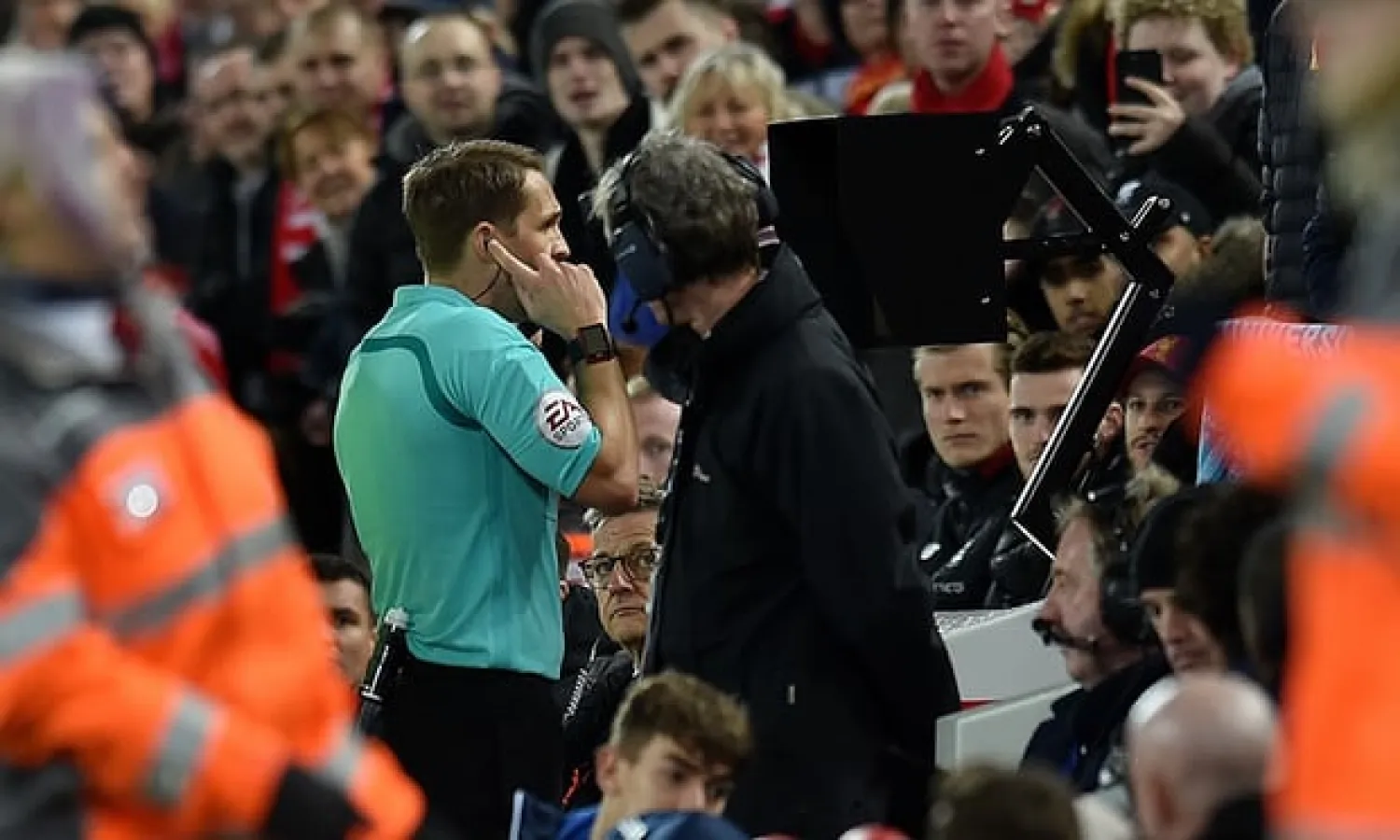
 Craig Pawson consults the VAR system during January’s FA Cup fourth round match between Liverpool and West Bromwich Albion at Anfield. Photograph: Andrew Powell/Liverpool FC via Getty Images
Craig Pawson consults the VAR system during January’s FA Cup fourth round match between Liverpool and West Bromwich Albion at Anfield. Photograph: Andrew Powell/Liverpool FC via Getty Images
TT

From Faster Decisions to Less Panic: Five Ways VAR could be Improved

 Craig Pawson consults the VAR system during January’s FA Cup fourth round match between Liverpool and West Bromwich Albion at Anfield. Photograph: Andrew Powell/Liverpool FC via Getty Images
Craig Pawson consults the VAR system during January’s FA Cup fourth round match between Liverpool and West Bromwich Albion at Anfield. Photograph: Andrew Powell/Liverpool FC via Getty Images

1) Speed the thing up

This is both the trickiest fix to effect and the most vital. On Wednesday night the Wembley crowd could have succumbed to hypothermia in the time it took Paul Tierney to resolve decisions. As Mauricio Pochettino pointed out, having to wait two minutes to know whether you can celebrate a goal is a bit of a buzzkill. VAR is supposed to check all “reviewable” decisions (goals, penalties, red cards, mistaken identity). Goals are particularly problematic because the game stops and cannot restart until a decision is confirmed. Quite simply, these confirmations need to be quicker. Greater experience may help but there is a feeling that some video assistant referees also need a sit down and a reminder of the rules.

2) Apply the bloody rules

Football is a simple game (regulations regarding feinting during a penalty run-up excepted). The rules of VAR are designed to match. “Mimimum interference – maximum benefit” is the motto. Any interjection by the video assistant is supposed to happen only in the case of a decision missed or a “clear” error having been made. At the Spurs-Rochdale match, Érik Lamela’s opening goal was ruled out by VAR. Yet no number of replay viewings reveals a clear and obvious error. A possible infringement? Yes. But not a clear error. There is perhaps a lesson here. If you cannot see an error at the first time of reviewing it, then it is not a clear error.

3) Tell people what is going on

We still do not know precisely which error caused the Lamela goal to be ruled out. This is because referees (never mind their video assistants) do not speak to the media after matches. It is also because there is an absence of communication from officials to fans in the ground. As it stands, nobody knows why VAR intercedes and on what grounds it is doing so. Half the time it is difficult to tell when VAR is being used at all. Again it is not as if there are no solutions to this: referees could wear microphones and relay information through the tannoy; screens inside the stadium could also pass on information. It does not even need to be a full explanation of the process. At this stage, any information at all would be nice.

4) Empower the referee

VAR is a two-way thing. If referees are worried about a decision they can ask the video assistant to check. If the assistant spots something the referee should be aware of, he or she can let them know. The dialogue is supposed to aid a referee, who will always have the final say. But at Wembley it did not feel as if Tierney was being empowered. There were several agonising periods during the game in which he was forced to stand still – finger in ear – as he waited for instructions that would allow him to carry on with his job. When the credibility of the referee is constantly being questioned such an experience is hardly reaffirming. Again, protecting the referee is a cornerstone of VAR in principle, but it needs to be worked out in practice.

5) Do not panic

Given that a single refereeing decision can spark a 24-hour media storm (traditional and social, by the way), a malfunctioning refereeing system is naturally proving catnip. The talk has now moved on from whether VAR would prove to be an omniscient panacea to whether it should be ditched for ever. The truth is that we remain in a trial period and, as of Wednesday, only half a dozen matches have taken part in it. At this stage some of the issues are glaring but technically solvable. Other issues to do with the culture of football (ie fans do not like breaks) may be more intractable but, again, are recognised in VAR’s own principles. The Premier League meets to vote on the technology next month. The clubs could approve or deny it but they could also seek to trial it further.

The Guardian Sport


Shakhtar Boss Pays Ukrainian Racer $200,000 After Games Disqualification

Ukrainian President Volodymyr Zelenskiy holds helmet as he meets with a Ukrainian skeleton racer Vladyslav Heraskevych , who was disqualified from the Olympic skeleton competition over his "helmet of remembrance" depicting athletes killed since Russia's invasion and his father and coach, Mykhailo Heraskevych, amid Russia's attack on Ukraine, in Munich, Germany February 13, 2026. (Ukrainian Presidential Press Service/Handout via Reuters)
TT

Shakhtar Boss Pays Ukrainian Racer $200,000 After Games Disqualification

Ukrainian President Volodymyr Zelenskiy holds helmet as he meets with a Ukrainian skeleton racer Vladyslav Heraskevych , who was disqualified from the Olympic skeleton competition over his "helmet of remembrance" depicting athletes killed since Russia's invasion and his father and coach, Mykhailo Heraskevych, amid Russia's attack on Ukraine, in Munich, Germany February 13, 2026. (Ukrainian Presidential Press Service/Handout via Reuters)

The owner of ‌Ukrainian football club Shakhtar Donetsk has donated more than $200,000 to skeleton racer Vladyslav Heraskevych after the athlete was disqualified from the Milano Cortina Winter Games before competing over the use of a helmet depicting Ukrainian athletes killed in the war with Russia, the club said on Tuesday.

The 27-year-old Heraskevych was disqualified last week when the International Bobsleigh and Skeleton Federation jury ruled that imagery on the helmet — depicting athletes killed since Russia invaded Ukraine in 2022 — breached rules on athletes' expression at ‌the Games.

He ‌then lost an appeal at the Court ‌of ⁠Arbitration for Sport hours ⁠before the final two runs of his competition, having missed the first two runs due to his disqualification.

Heraskevych had been allowed to train with the helmet that displayed the faces of 24 dead Ukrainian athletes for several days in Cortina d'Ampezzo where the sliding center is, but the International Olympic Committee then ⁠warned him a day before his competition ‌started that he could not wear ‌it there.

“Vlad Heraskevych was denied the opportunity to compete for victory ‌at the Olympic Games, yet he returns to Ukraine a ‌true winner," Shakhtar President Rinat Akhmetov said in a club statement.

"The respect and pride he has earned among Ukrainians through his actions are the highest reward. At the same time, I want him to ‌have enough energy and resources to continue his sporting career, as well as to fight ⁠for truth, freedom ⁠and the remembrance of those who gave their lives for Ukraine," he said.

The amount is equal to the prize money Ukraine pays athletes who win a gold medal at the Games.

The case dominated headlines early on at the Olympics, with IOC President Kirsty Coventry meeting Heraskevych on Thursday morning at the sliding venue in a failed last-minute attempt to broker a compromise.

The IOC suggested he wear a black armband and display the helmet before and after the race, but said using it in competition breached rules on keeping politics off fields of play. Heraskevych also earned praise from Ukraine President Volodymyr Zelenskiy.


Speed Skating-Italy Clinch Shock Men’s Team Pursuit Gold, Canada Successfully Defend Women’s Title

 Team Italy with Davide Ghiotto, Andrea Giovannini, Michele Malfatti, celebrate winning the gold medal on the podium of the men's team pursuit speed skating race at the 2026 Winter Olympics, in Milan, Italy, Tuesday, Feb. 17, 2026. (AP)
Team Italy with Davide Ghiotto, Andrea Giovannini, Michele Malfatti, celebrate winning the gold medal on the podium of the men's team pursuit speed skating race at the 2026 Winter Olympics, in Milan, Italy, Tuesday, Feb. 17, 2026. (AP)
TT

Speed Skating-Italy Clinch Shock Men’s Team Pursuit Gold, Canada Successfully Defend Women’s Title

 Team Italy with Davide Ghiotto, Andrea Giovannini, Michele Malfatti, celebrate winning the gold medal on the podium of the men's team pursuit speed skating race at the 2026 Winter Olympics, in Milan, Italy, Tuesday, Feb. 17, 2026. (AP)
Team Italy with Davide Ghiotto, Andrea Giovannini, Michele Malfatti, celebrate winning the gold medal on the podium of the men's team pursuit speed skating race at the 2026 Winter Olympics, in Milan, Italy, Tuesday, Feb. 17, 2026. (AP)

An inspired Italy delighted the home crowd with a stunning victory in the Olympic men's team pursuit final as

Canada's Ivanie Blondin, Valerie Maltais and Isabelle Weidemann delivered another seamless performance to beat the Netherlands in the women's event and retain their title ‌on Tuesday.

Italy's ‌men upset the US who ‌arrived ⁠at the Games ⁠as world champions and gold medal favorites.

Spurred on by double Olympic champion Francesca Lollobrigida, the Italian team of Davide Ghiotto, Andrea Giovannini and Michele Malfatti electrified a frenzied arena as they stormed ⁠to a time of three ‌minutes 39.20 seconds - ‌a commanding 4.51 seconds clear of the ‌Americans with China taking bronze.

The roar inside ‌the venue as Italy powered home was thunderous as the crowd rose to their feet, cheering the host nation to one ‌of their most special golds of a highly successful Games.

Canada's women ⁠crossed ⁠the line 0.96 seconds ahead of the Netherlands, stopping the clock at two minutes 55.81 seconds, and

Japan rounded out the women's podium by beating the US in the Final B.

It was only Canada's third gold medal of the Games, following Mikael Kingsbury's win in men's dual moguls and Megan Oldham's victory in women's freeski big air.


Lindsey Vonn Back in US Following Crash in Olympic Downhill 

Milano Cortina 2026 Olympics - Alpine Skiing - Women's Downhill 3rd Official Training - Tofane Alpine Skiing Centre, Belluno, Italy - February 07, 2026. Lindsey Vonn of United States in action during training. (Reuters)
TT

Lindsey Vonn Back in US Following Crash in Olympic Downhill 

Milano Cortina 2026 Olympics - Alpine Skiing - Women's Downhill 3rd Official Training - Tofane Alpine Skiing Centre, Belluno, Italy - February 07, 2026. Lindsey Vonn of United States in action during training. (Reuters)

Lindsey Vonn is back home in the US following a week of treatment at a hospital in Italy after breaking her left leg in the Olympic downhill at the Milan Cortina Games.

“Haven’t stood on my feet in over a week... been in a hospital bed immobile since my race. And although I’m not yet able to stand, being back on home soil feels amazing,” Vonn posted on X with an American flag emoji. “Huge thank you to everyone in Italy for taking good care of me.”

The 41-year-old Vonn suffered a complex tibia fracture that has already been operated on multiple times following her Feb. 8 crash. She has said she'll need more surgery in the US.

Nine days before her fall in Cortina d'Ampezzo, Italy, Vonn ruptured the ACL in her left knee in another crash in Switzerland.

Even before then, all eyes had been on her as the feel-good story heading into the Olympics for her comeback after nearly six years of retirement.
