


Egyptian Presidency: High Turnout at Elections Abroad

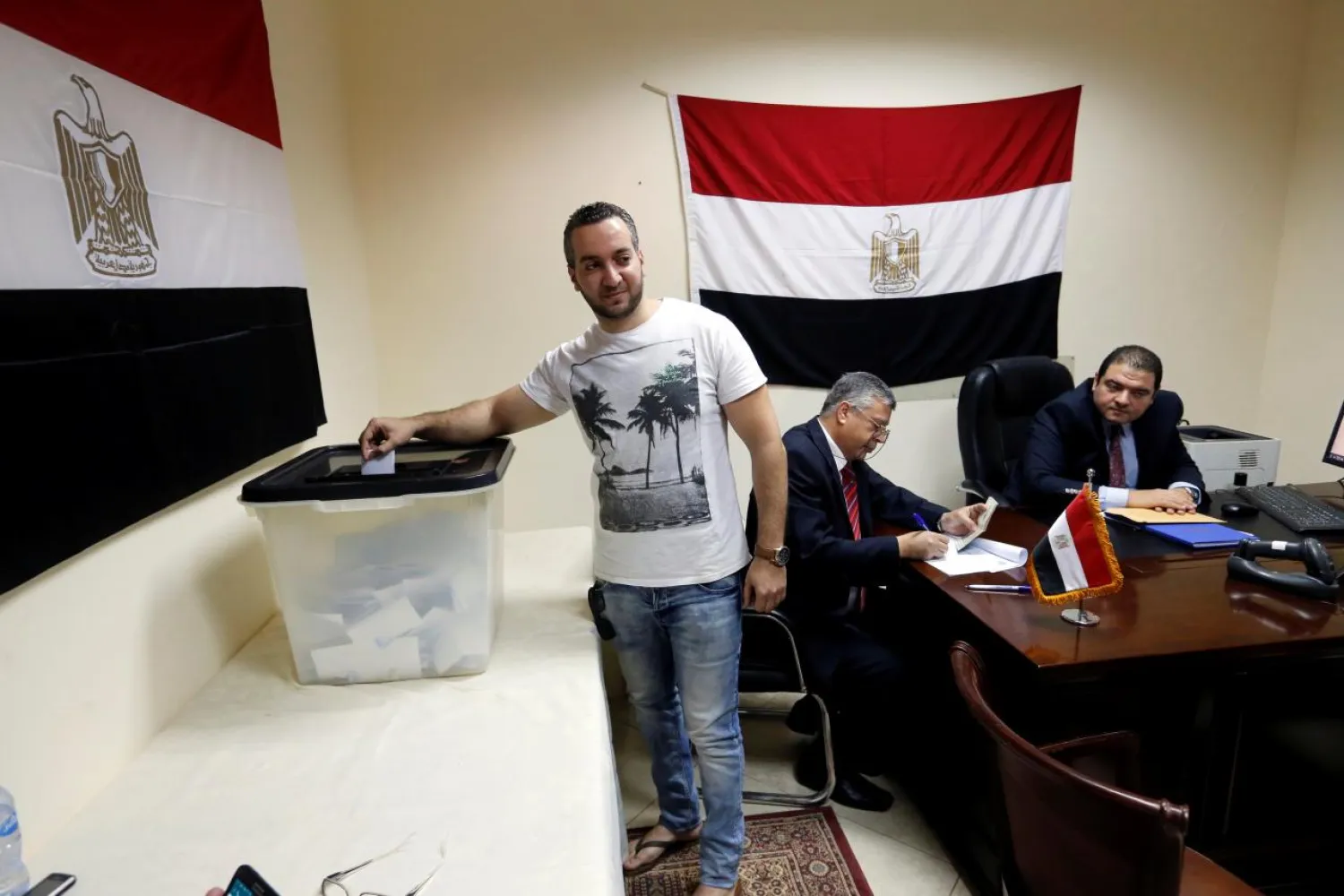
An Egyptian living in Sudan casts his vote at the Egypt Embassy in Khartoum, Sudan March 16, 2018. (Reuters /Mohamed Nureldin Abdallah)
TT

Egyptian Presidency: High Turnout at Elections Abroad

An Egyptian living in Sudan casts his vote at the Egypt Embassy in Khartoum, Sudan March 16, 2018. (Reuters /Mohamed Nureldin Abdallah)

Egyptians abroad will continue to vote for the presidential elections for the second day on Saturday and until Sunday, in 139 committees in consulates and embassies representing 124 Arab and foreign countries.

MP Tareq Radwan, chairman of the Foreign Relations Committee of the parliament told Asharq Al-Awsat there are positive indicators on the first day of the vote, adding the electoral process is proceeding normally without any obstacles or complaints, with heavy turnout of voters.

Voting will take place in Egypt over three days from March 26-28 with two candidates, current president Abdel Fattah el-Sisi and head of al-Ghad party Mousa Mustafa Mousa.

The government estimated the number of Egyptians living abroad to be at 9.4 million as the National Elections Authority (NEA) facilitated their process by approving voting via passport or national ID card to ensure wide participation.

Foreign Ministry Spokesman Ahmed Abu Zeid stated that Foreign Minister Sameh Shoukri thanked the National Electoral Authority for its support to facilitate the procedures of abroad elections.

"The Foreign Minister directed heads of diplomatic missions and consulates abroad to supervise the electoral committees and provide facilities for the elderly and people with special needs," added Abu Zeid.

Head of NEA Lashin Ibrahim assured that the authority has not received any complaints about the voting process abroad in the presidential election that kicked off earlier Friday.

Ibrahim said in a statement the percent of the participation of Egyptians expatriates in the presidential elections is good, adding: "Egyptians lined up in front of the doors of embassies and consulates to cast their votes."

NEA spokesperson Mahmoud el-Sherif said Egyptian embassies abroad witnessed a huge turnout from each country's respective Egyptian community.

He also stated that the voting process is currently taking place in 118 countries, adding that the NEA has provided the polling stations abroad with additional laptops because of the huge turnout. Adding, in a press conference he held on Friday, the Egyptian law did not require that the Egyptian resident abroad to vote, and that if there was an issue, the voter can still cast his vote as long as they are tied to the voter database based on the national ID card, whether valid or expired, or passport provided that it is in force.

He pointed out that the Riyadh Committee in Saudi Arabia is using 26 tablets, Jeddah is using 24 tablets, Kuwait Committee is using 32 tablets and 16 tablets in Dubai, UAE.

Deputy Minister of Foreign Affairs Ambassador Hamdi Loza confirmed there are no obstacles to the voters in Qatar and Turkey, as some say, noting the Egyptian mission is constantly contacting the Qatari authorities.

During his speech at the National Assembly, Loza said that the Egyptian mission is in a compound away from the embassy, and the Qatari authorities responded to the requests by opening a side door to allow citizens to enter the mission building directly.

He stressed: "elections in Qatar and Turkey are conducted in cooperation with the local authorities, and there are no obstacles to the voters, and there is no reason preventing them exercising their constitutional right."

Gulf countries witnessed a wide participation of Egyptians' voters.

At the headquarters of the Egyptian Embassy in Riyadh and the General Consulate in Jeddah, members of the Egyptian community came to cast their votes on Friday.

Egypt's Ambassador to Saudi Arabia, Nasser Hamdy Zaghloul voted at the Committee's headquarters at the Egyptian Embassy in Riyadh.

He stressed that there is a large turnout of Egyptians residing in Saudi Arabia to vote in the presidential elections.

He pointed out that the intensity of the turnout shows the Egyptians' keenness to participate in the elections. The Egyptian ambassador thanked the Kingdom for providing full and necessary support for holding the elections.

Media adviser and vice president of the Egyptian community in Jeddah Mohammed Abu el-Aish pointed out that the turnout exceeded all expectations.

In Dubai, Egyptian ladies participated in the presidential election, especially at the General Consulate in Dubai

Wael Abdel Rahman, an Egyptian teacher, told Asharq Al-Awsat that he made sure he went to vote along with his whole family and the turnout was great. He praised the well organized elections which contributed to the increase in the number of voters, especially among elderly and people with special needs.

In Kuwait, the Egyptian ambassador Tariq al-Kouni lauded the voters' behavior of voters and their compliance to the rules set by the embassy during the electoral process.

Similarly, Egyptian Ambassador to Austria, Omar Amer, stressed that the Egyptian citizens were keen to exercise their constitutional right and participate in the elections in spite of bad weather conditions, adding that the number of voters was more than expected. He pointed out that the Egyptian Embassy in Vienna provided all means that would facilitate the process of election to citizens.

MP Mahmoud Hussein noted that the large crowds of Egyptians who rallied to vote in the presidential elections is a clear message to the world that Egyptians do not accept defeat.



Meta's Zuckerberg Faces Questioning at Youth Addiction Trial

REUTERS/Francis Mascarenhas Purchase Licensing Rights
TT

Meta's Zuckerberg Faces Questioning at Youth Addiction Trial

REUTERS/Francis Mascarenhas Purchase Licensing Rights

Meta Platforms CEO and billionaire Facebook founder Mark Zuckerberg is set to be questioned for the first time in a US court on Wednesday about Instagram's effect on the mental health of young users, as a landmark trial over youth social media addiction continues. While Zuckerberg has previously testified on the subject before Congress, the stakes are higher at the jury trial in Los Angeles, California. Meta may have to pay damages if it loses the case, and the verdict could erode Big Tech's longstanding legal defense against claims of user harm, Reuters reported.

The lawsuit and others like it are part of a global backlash against social media platforms over children's mental health. Australia has prohibited access to social media platforms for users under age 16, and other countries including Spain are considering similar curbs. In the US, Florida has prohibited companies from allowing users under age 14. Tech industry trade groups are challenging the law in court. The case involves a California woman who started using Meta's Instagram and Google's YouTube as a child. She alleges the companies sought to profit by hooking kids on their services despite knowing social media could harm their mental health. She alleges the apps fueled her depression and suicidal thoughts and is seeking to hold the companies liable.

Meta and Google have denied the allegations, and pointed to their work to add features that keep users safe. Meta has often pointed to a National Academies of Sciences finding that research does not show social media changes kids' mental health.

The lawsuit serves as a test case for similar claims in a larger group of cases against Meta, Alphabet's Google, Snap and TikTok. Families, school districts and states have filed thousands of lawsuits in the US accusing the companies of fueling a youth mental health crisis.

Zuckerberg is expected to be questioned on Meta's internal studies and discussions of how Instagram use affects younger users.

Over the years, investigative reporting has unearthed internal Meta documents showing the company was aware of potential harm. Meta researchers found that teens who report that Instagram regularly made them feel bad about their bodies saw significantly more “eating disorder adjacent content” than those who did not,

Reuters reported

in October. Adam Mosseri, head of Instagram, testified last week that he was unaware of a recent Meta study showing no link between parental supervision and teens' attentiveness to their own social media use. Teens with difficult life circumstances more often said they used Instagram habitually or unintentionally, according to the document shown at trial.

Meta's lawyer told jurors at the trial that the woman's health records show her issues stem from a troubled childhood, and that social media was a creative outlet for her.


Israel Permits 10,000 West Bank Palestinians for Friday Prayers at Al Aqsa

Palestinians attend Friday prayers in a mosque following an attack that local Palestinians said was carried out by Israeli settlers, in the village of Deir Istiya near Salfit in the Israeli-occupied West Bank November 14, 2025. REUTERS/Sinan Abu Mayzer
TT

Israel Permits 10,000 West Bank Palestinians for Friday Prayers at Al Aqsa

Palestinians attend Friday prayers in a mosque following an attack that local Palestinians said was carried out by Israeli settlers, in the village of Deir Istiya near Salfit in the Israeli-occupied West Bank November 14, 2025. REUTERS/Sinan Abu Mayzer

Israel announced that it will cap the number of Palestinian worshippers from the occupied West Bank attending weekly Friday prayers at the Al-Aqsa Mosque in east Jerusalem at 10,000 during the holy month of Ramadan, which began Wednesday.

Israeli authorities also imposed age restrictions on West Bank Palestinians, permitting entry only to men aged 55 and older, women aged 50 and older, and children up to age 12.

"Ten thousand Palestinian worshippers will be permitted to enter the Temple Mount for Friday prayers throughout the month of Ramadan, subject to obtaining a dedicated daily permit in advance," COGAT, the Israeli defense ministry agency in charge of civilian matters in the Palestinian territories, said in a statement, AFP reported.

"Entry for men will be permitted from age 55, for women from age 50, and for children up to age 12 when accompanied by a first-degree relative."

COGAT told AFP that the restrictions apply only to Palestinians travelling from the West Bank, which Israel has occupied since the 1967 Arab-Israeli war.

"It is emphasised that all permits are conditional upon prior security approval by the relevant security authorities," COGAT said.

"In addition, residents travelling to prayers at the Temple Mount will be required to undergo digital documentation at the crossings upon their return to the areas of Judea and Samaria at the conclusion of the prayer day," it said, using the Biblical term for the West Bank.

During Ramadan, hundreds of thousands of Palestinians traditionally attend prayers at Al-Aqsa, Islam's third holiest site, located in east Jerusalem, which Israel captured in 1967 and later annexed in a move that is not internationally recognized.

Since the war in Gaza broke out in October 2023, the attendance of worshippers has declined due to security concerns and Israeli restrictions.

The Palestinian Jerusalem Governorate said this week that Israeli authorities had prevented the Islamic Waqf -- the Jordanian-run body that administers the site -- from carrying out routine preparations ahead of Ramadan, including installing shade structures and setting up temporary medical clinics.

A senior imam of the Al-Aqsa Mosque, Sheikh Muhammad al-Abbasi, told AFP that he, too, had been barred from entering the compound.

"I have been barred from the mosque for a week, and the order can be renewed," he said.

Abbasi said he was not informed of the reason for the ban, which came into effect on Monday.

Under longstanding arrangements, Jews may visit the Al-Aqsa compound -- which they revere as the site of the first and second Jewish temples -- but they are not permitted to pray there.

Israel says it is committed to upholding this status quo, though Palestinians fear it is being eroded.

In recent years, a growing number of Jewish ultranationalists have challenged the prayer ban, including far-right politician Itamar Ben Gvir, who prayed at the site while serving as national security minister in 2024 and 2025.


EU Exploring Support for New Gaza Administration Committee, Document Says

Palestinians push a cart past the rubble of residential buildings destroyed during the two-year Israeli offensives, in Gaza City, February 17, 2026. REUTERS/Mahmoud Issa
TT

EU Exploring Support for New Gaza Administration Committee, Document Says

Palestinians push a cart past the rubble of residential buildings destroyed during the two-year Israeli offensives, in Gaza City, February 17, 2026. REUTERS/Mahmoud Issa

The European Union is exploring possible support for a new committee established to take over the civil administration of Gaza, according to a document produced by the bloc's diplomatic arm and seen by Reuters.

"The EU is engaging with the newly established transitional governance structures for Gaza," the European External Action Service wrote in a document circulated to member states on Tuesday.

"The EU is also exploring possible support to the National Committee for the Administration of Gaza," it added.

European foreign ministers will discuss the situation in Gaza during a meeting in Brussels on February 23.