


International Football: Talking Points from the Latest Friendlies

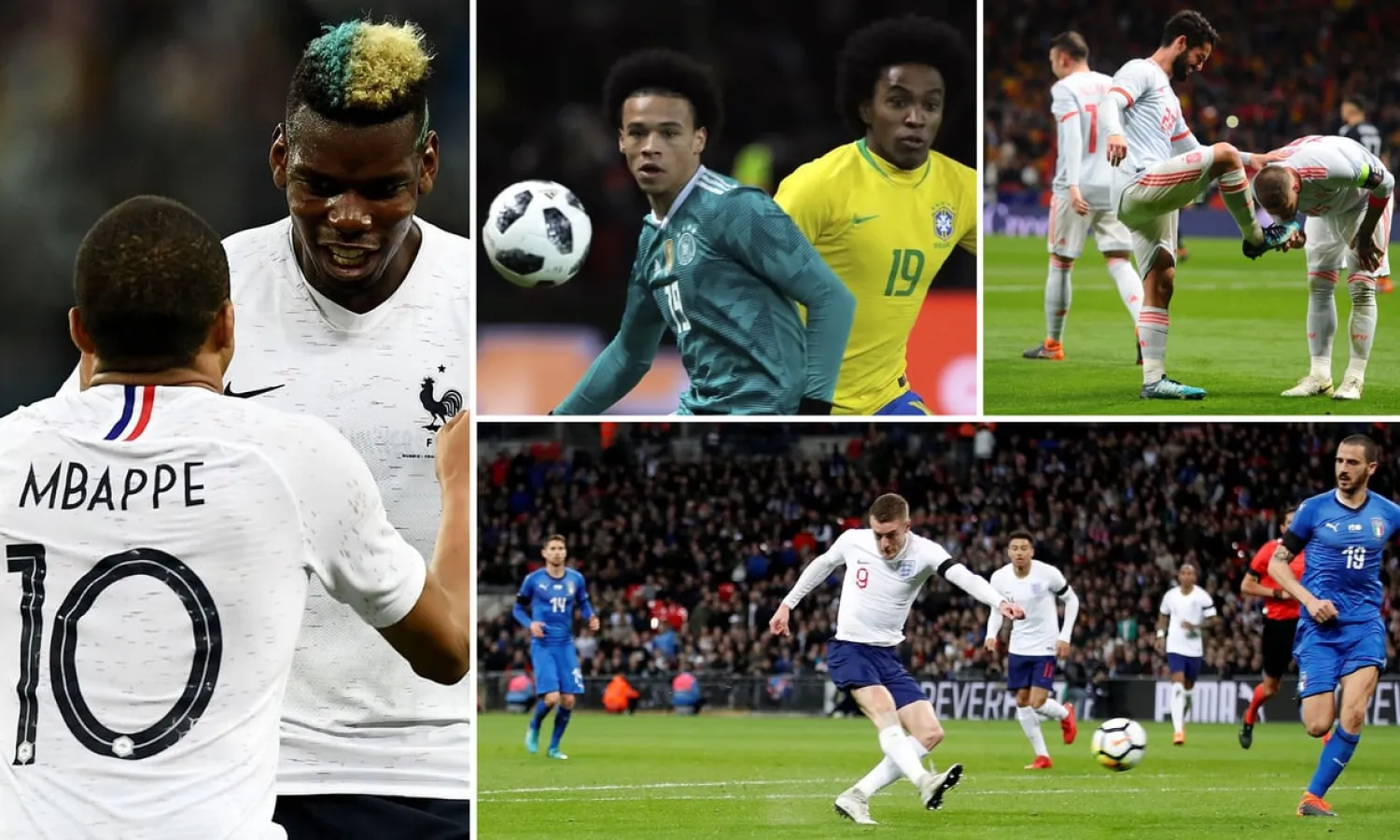
 Clockwise from left: Kylian Mbappé and Paul Pogba, Leroy Sané with Willian, Sergio Ramos kisses Isco’s boot and Jamie Vardy gives England the lead against Italy. Photograph: AFP/Getty/Action via Reuters/AP
Clockwise from left: Kylian Mbappé and Paul Pogba, Leroy Sané with Willian, Sergio Ramos kisses Isco’s boot and Jamie Vardy gives England the lead against Italy. Photograph: AFP/Getty/Action via Reuters/AP
TT

International Football: Talking Points from the Latest Friendlies

 Clockwise from left: Kylian Mbappé and Paul Pogba, Leroy Sané with Willian, Sergio Ramos kisses Isco’s boot and Jamie Vardy gives England the lead against Italy. Photograph: AFP/Getty/Action via Reuters/AP
Clockwise from left: Kylian Mbappé and Paul Pogba, Leroy Sané with Willian, Sergio Ramos kisses Isco’s boot and Jamie Vardy gives England the lead against Italy. Photograph: AFP/Getty/Action via Reuters/AP

1) Argentina increase pressure on Messi with woeful display
Before this game, Jorge Sampaoli had said that when it comes to the World Cup, Lionel Messi has a revolver pressed against his head. Far from removing it, on Tuesday night the Argentina manager and the rest of the team loaded it and took the safety off. Messi watched his team get taken to bits without him and it made for painful viewing, the pressure building: he didn’t even make it to the end, getting up and leaving before the final whistle. It may feel reductionist to make it all about Messi but it is unavoidable, not least because his manager does the same. There was something sad, almost needy, about the way Sampaoli insisted afterwards that Messi had shown his commitment by being with the team before the game, after the game and at half-time. It is during the game that they need him. Sid Lowe

2) England should go for all-out attack in Russia
That five-game, 624-minute streak without conceding was mighty flattering, because England – specifically John Stones – can’t afford to defend at a World Cup like they did against Italy. Not everyone will be as ponderous as Ciro Immobile when presented with such generous gifts. Thing is, this problem isn’t going to be fixed in time for the summer – even Pep Guardiola hasn’t got to the bottom of it – so better to accentuate the positives. Raheem Sterling and Jesse Lingard were clever and effervescent; Jamie Vardy scored a screamer; Kyle Walker, Alex Oxlade-Chamberlain and Ashley Young don’t half look dangerous when they’re at full pelt; Harry Kane is coming back. England may as well opt for reckless all-out attack, and to hell with the consequences, because attempting to keep things tight can only be an exercise in futility. At least this way they’ll have a puncher’s chance ... and whatever happens, it’ll be a blast finding out how the story unfolds. Scott Murray

3) A missed opportunity for Sané
There was praise this week for Leroy Sané, with the Germany coach, Joachim Löw, saying how much the youngster has improved at Manchester City. On Tuesday night he started against Brazil but was the least impressive of the three attacking midfielders (Julian Draxler and Leon Goretzka being the other two), failing to make an impact against Dani Alves and being replaced on the hour. He should make the squad for Russia but did nothing on the night to suggest he will start Germany’s first game at the World Cup. Marcus Christenson

4) Carrasco remains a weak link for Belgium

Although Kevin De Bruyne, Eden Hazard and Romelu Lukaku sparkled in Belgium’s 4-0 victory over Saudi Arabia, the balance of Roberto Martínez’s defence was less convincing. Toby Alderweireld, Vincent Kompany and Jan Vertonghen are three of the best centre-backs around, so it makes sense for Belgium to use a 3-4-3 system, but Martinez’s persistence with Yannick Carrasco as a left wing-back could cause problems in Russia. Carrasco is not a defensive player and he left space for Saudi Arabia to exploit. Belgium got away with it but better opponents are likely to capitalise on Carrasco’s naivety. Jacob Steinberg

5) Spain show world champion identity
Sometimes it is tempting to strip it all down to something a little simpler. To cut through the nuance and the analysis and ask something a bit more basic: how good are your players? And Spain’s players are very, very good. This talking point is supposed to 100 words long. That target could be nearly met just by listing them: Sergio Busquets and David Silva were not there on Tuesday night but there in Madrid were Francisco Alarcón “Isco”, Marco Asensio, Andrés Iniesta, Thiago Alcântara, Jorge Resurrección “Koke”, Saúl Ñíguez and Diego Costa. And, yes, Iago Aspas too. There, that’s 100 words, and without mentioning Jordi Alba, Gerard Piqué, Dani Carvajal or Sergio Ramos. But it’s not just that: it’s that they share an idea, that they fit together, that they play together, combine, that there’s an identity. The identity that made them world champions. Sid Lowe

6) Mbappé performance papers over French cracks
Low intensity, little rhythm and a lack of cohesion – it was clear on Tuesday in St Petersburg that this is a France side still in preparation mode. Save for a few sparks of individual skill, the front three were unable to create much, while lapses in concentration from the defence kept Russia constantly within touching distance. Kylian Mbappé’s dynamic two-goal performance papered over many cracks. A much-improved Paul Pogba impressed with a string of precise through-balls and a goal from a free-kick but, despite a 3-1 win, Didier Deschamps will not be able to rely on individuals to drag the team out of these situations against better opposition in a few months’ time. Raphaël Jucobin, Get French Football News

7) Who needs Neymar?
Brazil continued their remarkable recovery under Tite with a 1-0 win in Berlin against Germany and, following Friday’s 3-0 victory in Russia, the team showed that they can cope without the injured Neymar. Gabriel Jesus played up front against Germany and scored the only goal of the night but Willian was arguably the team’s outstanding performer. Playing to the right of the attacking three, he provided the cross for the goal, nearly scored and helped the right-back Dani Alves with some impeccable tracking back. Marcus Christenson

8) Immobile’s number may be up for Italy
Ciro Immobile has played 32 matches for Italy, scoring seven goals. A record which suggests that, at 28, he’s not going to get any better. Which is an awful shame, because he really needs to: a top-class striker would have polished off a hat-trick within the first 16 minutes at Wembley. To be scrupulously fair, his sly movement led to chances one and three, and his harrying skills carved chance two out of nothing. But it’s equally fair to point out that tucking such chances away is the whole point, and it’s this sort of carry-on that cost Italy a place at the World Cup. They looked instantly sharper once he was hooked midway through the second half and replaced with younger models. It may be time for them to move on and give others a chance. Scott Murray

9) McLeish quietens dissenters in Hungary
We may be in the midst of the most significant set of friendlies in Scotland’s international history. Those vocally unconvinced by the return of Alex McLeish as manager found sentiments endorsed by the on Friday. Scotland were booed off. With testing fixtures against Peru, Mexico and Belgium to come before the onset of the Nations League, McLeish had to buy some goodwill in Hungary. Amid experimentation and despite the dismal nature of the opposition, victory really was an important one as McLeish seeks to turn public opinion. The unsatisfactory circumstances by which McLeish succeeded Gordon Strachan continues to grate with many; Tuesday marked a necessary step towards dousing dissenting voices. Ewan Murray

10) Netherlands embrace change against Ronaldo and co
“With Koeman, we now have a national team coach who will lead Dutch football into a brighter future,” Louis van Gaal said after Ronald Koeman’s second match in charge. For his first match, at home against England, Koeman used a 3-4-3 with Bas Dost up front, which did not work well. he switched to a more mobile 3-5-2 with Ryan Babel and Memphis Depay in attack, and oddly, the central midfielder Tonny Vilhena at left wing-back. The result? They won 3-0. Depay and Matthijs de Ligt in particular have hit the ground running along with the new captain Virgil van Dijk, while Davy Pröpper and Nathan Aké have also made good impressions. Priya Ramesh

11) Russia heading for potential disaster
Nine goals conceded in three games, no wins in five. Russia are a record low 65th in the Fifa rankings and most would agree that reflects the state of the World Cup hosts. To add to their troubles Russia have lost to injury this year three players who would normally start and none is likely to recover for the tournament. The centre-backs Georgi Dzhikiya and Viktor Vasin tore knee ligaments and one of the team’s best attacking players, Aleksandr Kokorin, got badly injured, too. Strained relations between the coach, Stanislav Cherchesov, and Igor Denisov, Artem Dzyuba, the Berezutski brothers and Sergei Ignashevich mean players who would improve an (at best) mediocre team are out of the picture. Russia risk being the biggest disappointment of their own World Cup. Artur Petrosyan



Maliki Can Withdraw as Candidacy as Iraq PM the Easy or Hard Way

Members of the Coordination Framework hold a meeting. (Iraqi News Agency)
TT

Maliki Can Withdraw as Candidacy as Iraq PM the Easy or Hard Way

Members of the Coordination Framework hold a meeting. (Iraqi News Agency)

Iraqi Former Prime Minister Nouri al-Maliki declined at the last minute to attend a meeting of the pro-Iran Coordination Framework on Monday night that was aimed at settling the crisis over his nomination as prime minister.

Instead of declaring that he was pulling out as candidate, as had been expected, Maliki informed his close circle that he is “following through with his nomination to the end,” trusted sources told Asharq Al-Awsat.

Iraq has come under intense pressure from the US to withdraw the nomination. In January, President Donald Trump warned Baghdad against picking Maliki as its PM, saying the United States would no longer help the country.

“Last time Maliki was in power, the Country descended into poverty and total chaos. That should not be allowed to happen again. Because of his insane policies and ideologies, if elected, the United States of America will no longer help Iraq,” Trump wrote on Truth Social.

Maliki also dismissed as “extortion and intimidation” talks of renewed US sanctions on Iraq, added the sources.

However, circles within the Coordination Framework have started to “despair” with the impasse over naming a new prime minister and are weighing the possibility of taking “difficult” choices, they revealed. Maliki has become a prisoner of his own nomination.

The Sunni Progress Party (Takadum) had voiced its reservations over Maliki’s nomination before Trump made his position clear and which has since weighed heavily on Iraq.

‘Indefinitely’

Maliki’s decision to skip the Framework’s meeting on Monday forced the coalition to postpone it “indefinitely”, exposing more differences inside the alliance that have been festering for months. The dispute over the post of prime minister is threatening to evolve into one that threatens the unity of the coalition itself.

Several sources told Asharq Al-Awsat that Maliki had sent the Framework a written message on Monday night informing them that he will not attend the meeting because “he was aware that discussions will seek to pressure him to withdraw his candidacy.”

Maliki was the one to call for the meeting to convene in the first place, they revealed.

Reports have been rife in Iraq that Shiite, Sunni and Kurdish political leaderships have all received warnings that the US would take measure against Iraq if Maliki continued to insist on his nomination.

Former Foreign Minister Hoshyar Zebari told Dijlah TV that “Shiite parties” had received two new American messages reiterating the rejection of Maliki’s nomination.

Necessary choice

Maliki and the Framework are now at an impasse, with the latter hoping the former PM would take it upon himself to withdraw his candidacy in what a leading Shiite figure said would help protect the unity of the coalition.

Leading members of the coalition were hoping to give Maliki enough time to decide himself to withdraw, but as time stretches on, the coalition may take matters into its own hands and take “necessary” choices, said the figure.

Other sources revealed, however, that Maliki refuses to voluntarily withdraw from the race believing that this is a responsibility that should be shouldered by the Framework. This has effectively left the alliance with complex and limited choices to end the crisis.

Sources close to Maliki said he has made light of US threats to impose sanctions, saying that if they were to happen, Iraq will emerge on the other side stronger, citing other countries that came out stronger after enduring years of pressure.

Moreover, he is banking on an American change in position, saying mediators have volunteered to “polish his image before Trump and his team.” Members of Maliki’s State of Law coalition declined to comment on this information.

Sources inside the Framework said the coalition may “ultimately withdraw Maliki’s nomination if he becomes too much of a burden on an already weary alliance.”

Doing so may cost them a strong ally in Maliki and force the Framework to yield to Washington’s will, said the Shiite figure. “Maliki may come off as stubborn and strong, but he is wasting his realistic options at this critical political juncture,” it added.

The Framework is divided between a team that is banking on waiting to see how the US-Iran tensions will play out to resolve the crisis and on Maliki voluntarily withdrawing his nomination. The other team is calling for the coalition to resolve the crisis through an internal vote.

Leading Shiite figures told Asharq Al-Awsat that opponents of Maliki’s nomination in the coalition have no choice but to apply internal pressure inside the Framework, which is on the verge of collapse.


French Designer Threads a Path in London Fashion Week

This photo taken on February 6, 2026 shows French fashion designer Pauline Dujancourt posing for a photograph in her studio in south London. (Photo by Ben STANSALL / AFP)
TT

French Designer Threads a Path in London Fashion Week

This photo taken on February 6, 2026 shows French fashion designer Pauline Dujancourt posing for a photograph in her studio in south London. (Photo by Ben STANSALL / AFP)

Just days before her third runway show, French designer Pauline Dujancourt was riding a wave of excitement and nerves.

The 31-year-old admitted she had begun having strange, nightmarish dreams ahead of her big moment at London Fashion Week on Sunday.

The British capital will once again host its Autumn/Winter fashion week from Thursday to Monday, after New York's bonanza and before the catwalk carousel moves to Milan and Paris.

London, known for its raw creative energy and rising talents, is where Dujancourt launched her label in April 2022 after training at the renowned arts and design school Ecole Duperre in Paris, and fashion hub Central Saint Martins in London.

She and her team began work in November on her autumn-winter 2026/27 collection to be unveiled before some 450 guests -- journalists, buyers and VIP clients.

For designers, everything comes down to those few precious minutes on the catwalk. It's no wonder nervousness mixes with the creative buzz.

"I go through every emotion," Dujancourt told AFP with a smile. "Some days I'm super excited, full of ideas, and others I'm like: why did I pick this color, this fabric?"

The questions and worries snowball: "Will everyone be on time? Will there be last-minute hitches on the day?"

In recent weeks, she has been running her daily schedule with military precision.
Dujancourt works year-round with four assistant designers, but the team swells to around 50 people ahead of the show.

And she works with a community of knitters in Lima, Peru, with handknitting -- "something that my grandmother taught me as a child" -- being a hallmark of her garments.

"She was so skillful and so humble about it. And no one really realized how much work it takes and how much technique it takes," she said.

Known for her sensual, airy knitwear, Dujancourt was a finalist for the LVMH Prize, won Elle UK's young talent award, and is supported by the British Fashion Council.

Her clients span the globe from Japan to the United States, France and the UK, with regular requests for wedding dresses.

Her new collection pays tribute to women persecuted during historical witch hunts.

"I really want to celebrate the fact that there are so many women around the world who are working so humbly on domestic skills ... like sewing, hand knitting," she said.

Two weeks before the show, young seamstresses were crocheting floral motifs in mohair and Japanese metallic thread at a south London studio overlooking the Thames river and Big Ben.

Workers were hunched over their desks pouring over designs, with the looks still "in pieces".

Then comes the moment when everything is assembled. "It's the magical stage, when the clothes start to come alive," she said, her blue eyes lighting up her face framed by long dark hair.

Less than a week before the show, fittings begin with an in-house model, followed by the castings to find the right models.

On the eve of the show come final fittings, hair and make-up tests. And finally, on Sunday morning, the full rehearsal.

Show day always brings surprises. At Dujancourt's last catwalk in September, several models arrived extremely late, held up by another show.

"They turned up still wearing the other show's make-up. We had to dress them and redo everything ... I nearly died," she recalled.

What is her worst nightmare? A model tripping or garments ripping in front of the cameras.

"I once dreamt I'd forgotten to get dressed before coming out to greet the audience -- that would be a bit embarrassing," she joked.

Around 25 outfits will strut the catwalk on Sunday, a moment that "goes by in a flash".
Afterwards comes the crash.

"We barely see it happening ... because we are backstage in the madness and the chaos of it," she said.

But then it's finished "and there's a bit of baby blues afterwards," as she comes down off the adrenaline rush.

Dujancourt heads to Paris after London Fashion Week to meet buyers, before work begins again for her next show, in September.


ECB President Lagarde Reportedly Plans to Quit Before Macron's Term Ends

FILE PHOTO: European Central Bank (ECB) President Christine Lagarde addresses the press following the ECB's Governing Council meeting, at the ECB headquarters in Frankfurt, Germany, February 5, 2026. REUTERS/Jana Rodenbusch/File Photo
TT

ECB President Lagarde Reportedly Plans to Quit Before Macron's Term Ends

FILE PHOTO: European Central Bank (ECB) President Christine Lagarde addresses the press following the ECB's Governing Council meeting, at the ECB headquarters in Frankfurt, Germany, February 5, 2026. REUTERS/Jana Rodenbusch/File Photo

European Central Bank President Christine Lagarde plans to leave her job before next year's French presidential election to allow Emmanuel Macron to have an input into picking her successor, the Financial Times reported on Wednesday.

Lagarde's term is due to end in October 2027 but some fear that the far right may win the French presidential race ‌in the spring of ‌2027, complicating the selection for the ‌new ⁠leader of Europe's most ⁠important financial institution.

Citing a person familiar with the matter, the FT said Lagarde has not yet decided on the exact timing of her departure but was keen on Macron and German Chancellor Friedrich Merz to be the key deciders in who succeeds her. Macron cannot run again for a third term.

"President Lagarde is ⁠totally focused on her mission and has not ‌taken any decision regarding the end ‌of her term," Reuters quoted an ECB spokesperson as saying.

The FT report comes only ‌a week after Bank of France Governor Francois Villeroy de Galhau ‌said he would step down in June this year, more than a year before the end of his term, allowing Macron to name his replacement before the presidential election that the far-right could win.

While it ‌will be up to all leaders from the 21-nation euro zone to pick Lagarde's successor, ⁠past practice ⁠suggests that any successful candidate must have both German and French support to clinch the role.

There are no formal candidates for the job yet but several names have been floating among ECB circles as potential ECB presidents. The most prominent among these are former Dutch central bank chief Klaas Knot and Bank for International Settlements General Manager Pablo Hernandez de Cos.

Lagarde's non-renewable term at the ECB runs until October 31, 2027. Prior to heading the ECB, she was managing director of the International Monetary Fund from 2011 to 2019 and before that, the French finance minister.