
'I Feel So Blessed': Mo Eisa on His Journey from Sudan to the Football League

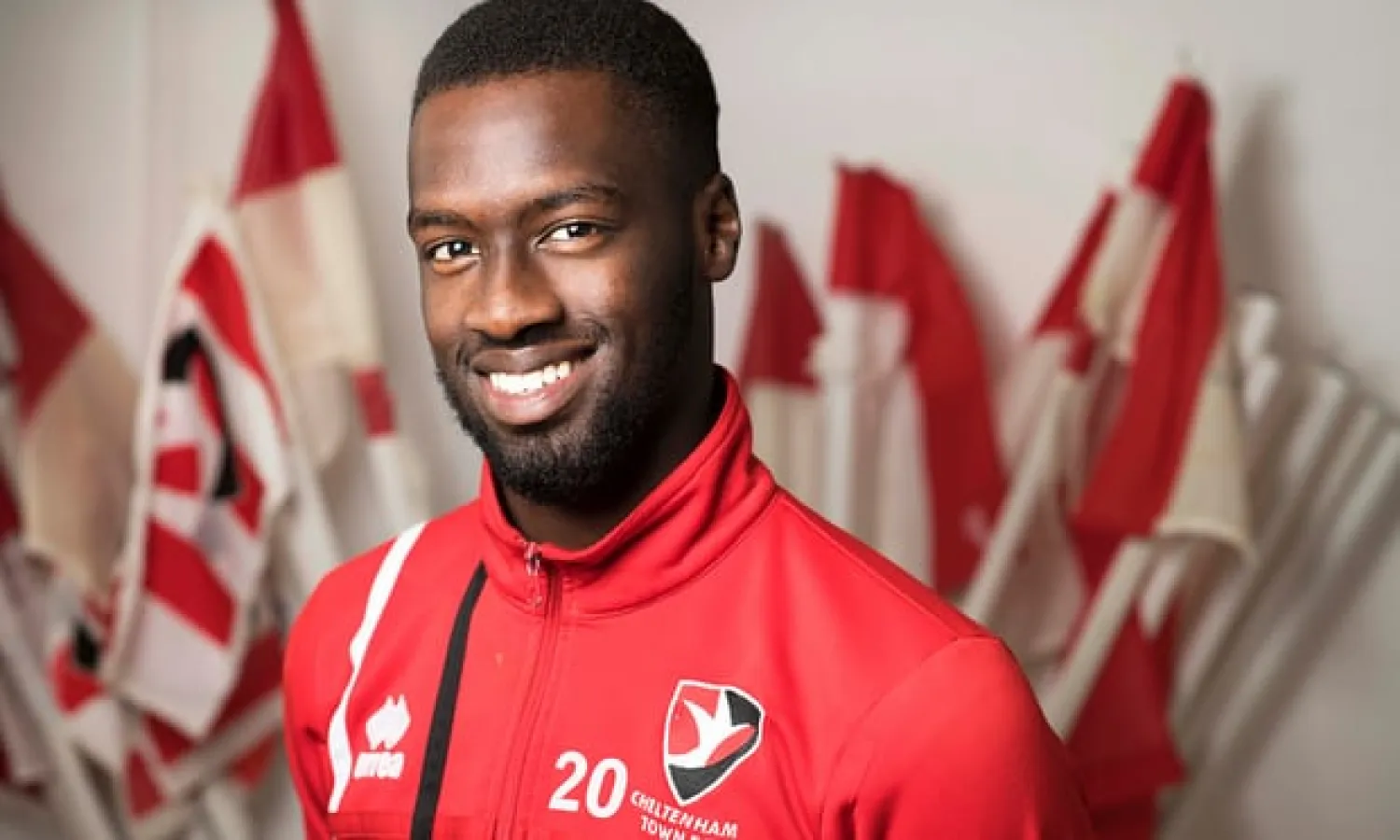
 Mo Eisa left Sudan for London as a child. He remembers playing in Khartoum on ‘grass pitches with not a lot of grass on. But that was home.’ Photograph: Adrian Sherratt for the Guardian
Mo Eisa left Sudan for London as a child. He remembers playing in Khartoum on ‘grass pitches with not a lot of grass on. But that was home.’ Photograph: Adrian Sherratt for the Guardian
TT

'I Feel So Blessed': Mo Eisa on His Journey from Sudan to the Football League

 Mo Eisa left Sudan for London as a child. He remembers playing in Khartoum on ‘grass pitches with not a lot of grass on. But that was home.’ Photograph: Adrian Sherratt for the Guardian
Mo Eisa left Sudan for London as a child. He remembers playing in Khartoum on ‘grass pitches with not a lot of grass on. But that was home.’ Photograph: Adrian Sherratt for the Guardian

On the edge of the Cotswolds there is another Mohamed making waves in red and white. Unlike Mo Salah, though, this is Mo Eisa’s first taste of professional football after swapping the Ryman South for League Two with Cheltenham Town last summer. Eisa is making history in his maiden season, all the more impressive given that 12 months ago he was at eighth-tier Greenwich Borough, giving Godalming Town the runaround in front of 156 spectators.

Finding the net is in the family; Eisa’s younger brother, Abobaker, signed for Shrewsbury Town in January after impressing at Wealdstone. At 3.13pm last Saturday Mo and Abo scored in the same minute, the latter getting his first for the club, an eerie oddity and another step on an extraordinary journey for brothers who left Khartoum, the capital of Sudan, for Camden at the age of nine.

“Some people may not have got out of that situation that I was in, so I feel blessed,” Mo Eisa says. “They have obviously had a few issues and civil wars. My family was there last summer actually but now it is more settled down and everything’s better in a way. Coming to London and to do what I am doing now compared with a few years ago, I wouldn’t have thought it was possible.

“Growing up, from a young age I was playing football with just friends, not for a proper team and that’s a different experience. We used to play every day and I got a couple of skills from one of my cousins because he was pretty good. The facilities were way different; it’s not like how it is here. When we moved to London we had astroturfs and in Sudan we didn’t really have that. It was just normal pitches, grass pitches with not a lot of grass on. But that was home.”

He joined ProTouch, an academy based in Islington, at 14 and had trials at Norwich City and Southend United before joining Oxford United as an apprentice. But via Dartford, Corinthian and a loan spell at Leatherhead, it was at Greenwich, managed by the former Millwall striker Gary Alexander, that his prolific form – 57 goals across two seasons – more than pricked the ears of Pete Johnson, Cheltenham’s chief scout and the manager Gary’s brother, who offered Eisa a day’s trial. Not that it went to plan. “I was probably just trying too hard,” Eisa says at the club’s training pavilion. “Everything was going wrong; I didn’t score, I didn’t do anything. I was nervous but luckily they invited me back for three days and I did well.”

Eisa earned a 12-month contract but after four goals in his first three games he signed fresh terms until 2020. His 22 Football League goals this season are a club record in a Football League campaign.

On leaving Greenwich in search of full-time football he was rejected by league clubs worried about his strength and slender frame. He trained with Boreham Wood and says he would “probably have played in the Conference with them this season” if Cheltenham had not come calling.

Twenty-four goals later it has been a fairytale first season for Eisa, who lives round the corner from the training ground with three of his team-mates, Jamie Grimes, Jaanai Gordon and Emmanuel Onariase, in a flat owned by the chairman, Paul Baker.

His success has not gone unnoticed by supporters at Cheltenham Lido either. “I went to the pool after a game with Nige [Atangana] and Ilias [Chatzitheodoridis] for a recovery session and we saw a bunch of kids shouting: ‘Mo, Mo, Mo!’ I like all of that interaction. It was good. It’s a totally new thing for me but it’s a nice feeling to have, people recognising you on the streets and stuff like that.”

For Eisa, who spoke little English on arrival in London, turning professional has brought many challenges. He has risen to most, referencing a shift in training intensity, learning how to deal with a nine-game goal “drought” and shaking those nerves.

“In non-league there were sometimes 50 fans maybe, and now it’s around a couple of thousand, some games even more – like against Coventry it was 7,000,” the 23-year-old says. The watershed moment was seemingly when West Ham United came to town in the EFL Cup, a month after he signed. “That was live on TV as well,” he says. “I had never been on TV. I’ve recorded that and sometimes I’ll go back and watch that again. If I am having a bad spell, I go back and remind myself of what I was doing before.”

The Eisas, like the Sessegnons or Ayews, are one of few pairs of siblings in professional football and they are immensely proud of each other’s journey. Mo went to Wembley to support Abo in the Checkatrade Trophy final this month and they often play Fifa on Xbox together. At the same time they are very different; Abo finishes his biomedical science degree at Brunel University after exams next month. “My brother’s very smart; I wasn’t smart,” he says. “He always wanted to do football but he had to do education as well and I was just focused on football.”

As kids, they shared a competitive edge. “Funnily enough every position I was, and I started off in centre midfield, he would then be in centre midfield,” he says, smiling. “I would move out to left wing, then so would he, and I’d go to striker, and he’d be a striker. But now he is a winger. On our summer breaks in London we would have kickabouts and we used to play with and against each other. He wasn’t as good then if I’m being honest but I have seen him rise up and that’s why he’s got his move. I knew I was going to get my chance eventually and he knew he was going to get his.”

The Guardian Sport


Search Teams in Türkiye Recover Recorders after Plane Crash that Killed Libyan Military Officials

Turkish army soldiers stand guard as rescue teams search for the remains of a private jet carrying Libya's military chief and four others that crashed after taking off from Ankara, killing everyone on board, in Ankara, Turkey, early Wednesday, Dec. 24, 2025. (AP Photo/Efekan Akyuz)
TT

Search Teams in Türkiye Recover Recorders after Plane Crash that Killed Libyan Military Officials

Turkish army soldiers stand guard as rescue teams search for the remains of a private jet carrying Libya's military chief and four others that crashed after taking off from Ankara, killing everyone on board, in Ankara, Turkey, early Wednesday, Dec. 24, 2025. (AP Photo/Efekan Akyuz)

Search teams in Türkiye on Wednesday recovered the cockpit voice and flight data recorders from a jet crash that killed eight people, including western Libya’s military chief, while efforts to retrieve the victims' remains were still underway, Türkiye's interior minister said.

The private jet carrying Gen. Muhammad Ali Ahmad al-Haddad, four other military officials and three crew members crashed on Tuesday, after taking off from Türkiye's capital, Ankara, killing everyone on board. Libyan officials said that the cause of the crash was a technical malfunction on the plane.

The high-level Libyan delegation was on its way back to Tripoli after holding defense talks in Ankara aimed at boosting military cooperation between the two countries.

Turkish Interior Minister Ali Yerlikaya told journalists at the site of the crash that wreckage was scattered across an area covering three square kilometers (more than a square mile), complicating recovery efforts. Authorities from the Turkish forensic medicine authority were working to recover and identify the remains, he said.

A 22-person delegation — including five family members — arrived from Libya early on Wednesday to assist in the investigation, he said.

Tripoli-based Libyan Prime Minister Abdul-Hamid Dbeibah confirmed the deaths on Tuesday, describing the crash on Facebook as a “tragic accident” and a “great loss” for Libya.

Turkish President Recep Tayyip Erdogan held a telephone call with Dbeibah, during which he conveyed his condolences and expressed his sorrow over the deaths, his office said.

The Turkish leader later also offered his condolences during a televised speech, voicing solidarity with Libya.

"An investigation has been launched into this tragic incident that has deeply saddened us, and our ministries will provide information about its progress,” Erdogan said.

Al-Hadad was the top military commander in western Libya and played a crucial role in the ongoing, UN-brokered efforts to unify Libya’s military, which has split, much like the nation's other institutions.

The four other military officials who died in the crash were Gen. Al-Fitouri Ghraibil, the head of Libya’s ground forces, Brig. Gen. Mahmoud Al-Qatawi, who led the military manufacturing authority, Mohammed Al-Asawi Diab, adviser to the chief of staff, and Mohammed Omar Ahmed Mahjoub, a military photographer with the chief of staff’s office.

The identities of the three crew members weren't immediately released.

Turkish officials said that the Falcon 50-type business jet took off from Ankara’s Esenboga airport at 8:30 p.m. and that contact was lost around 40 minutes later. The plane notified air traffic control of an electrical fault and requested an emergency landing. The aircraft was redirected back to Esenboga, where preparations for its landing began.

The plane, however, disappeared from radar while descending for the emergency landing, the Turkish presidential communications office said.

The Libyan government declared a three-day period of national mourning. Flags would be flown half-staff at all state institutions, according to the government’s announcement on Facebook.

The wreckage was found near the village of Kesikkavak, in Haymana, a district about 70 kilometers (45 miles) south of Ankara.

At the crash site, search and recovery teams intensified their operations on Wednesday after a night of heavy rain and fog, the state-run Anadolu Agency reported. Gendarmerie police sealed off the area while the Turkish disaster management agency, AFAD, set up a mobile coordination center. Specialized vehicles, such as tracked ambulances, were deployed because of the muddy terrain.

Türkiye has assigned four prosecutors to lead the investigation, and Yerlikaya that said the Turkish search and recovery teams included 408 personnel.

While in Ankara, al-Haddad had met with Turkish Defense Minister Yasar Guler and other officials.


China's LandSpace Hopes to Complete Rocket Recovery in Mid-2026

Zhuque-3 rocket by China’s private rocket firm LandSpace, takes off from the Jiuquan Satellite Launch Center, China, December 3, 2025, in this screengrab taken from handout drone footage provided by LandSpace. LandSpace/Handout via REUTERS
TT

China's LandSpace Hopes to Complete Rocket Recovery in Mid-2026

Zhuque-3 rocket by China’s private rocket firm LandSpace, takes off from the Jiuquan Satellite Launch Center, China, December 3, 2025, in this screengrab taken from handout drone footage provided by LandSpace. LandSpace/Handout via REUTERS

Chinese rocket developer LandSpace plans to successfully recover a reusable booster in mid-2026, a company executive said in an interview, underscoring the Beijing-based firm's ambition to become China's answer to SpaceX.

The ability to return, recover, and reuse a rocket's engine-packed first stage, or booster, after launch is crucial to reducing costs and making it easier for countries to send satellites into orbit, and to turn space exploration into a commercially viable business similar to civil aviation, Reuters reported.

Earlier this month, privately-owned LandSpace ‌became the first ‌Chinese entity to conduct a full reusable rocket ‌test, when ⁠Zhuque-3 ​blasted off ‌from a remote area in northwest China for its maiden flight, drawing comparisons to US aerospace giant SpaceX.

SECOND ATTEMPT PLANNED

While LandSpace failed to complete the crucial final step of landing and recovering the rocket's engine-packed booster, it hopes to clear this challenge in mid-2026 with a second test flight, Zhuque-3 deputy chief designer Dong Kai told Chinese podcast Tech Early Know in an interview published on Tuesday.

"If the second flight's recovery (stage) succeeds, we ⁠plan that on the fourth flight we will use a reused first stage to launch," Dong said.

So far, ‌the only company that has mastered reusable rocket technology is ‍SpaceX, founded by the world's richest ‍person Elon Musk. SpaceX's Falcon 9 launches around 150 times a year, or roughly ‍three times per week, with its booster reused dozens of times if necessary.

Musk said in October that LandSpace's Zhuque-3 design could allow it to beat the Falcon 9, but went on to state that the Chinese challenger's launch cadence would take more than five years to ​reach that of SpaceX's workhorse model, at which point the US firm would have transitioned to its heavier, new-generation model Starship and "doing over ⁠100 times the annual payload to orbit of Falcon".

INITIAL PUBLIC OFFERING

LandSpace's Dong said that, while the company was already building an engine for a future Starship-like model, he was not optimistic that in five years Falcon 9's work rate could be surpassed, noting that all rocket models in China combined this year totalled only around 100 launches.

"It's very difficult for a single company to reach that kind of frequency. It requires the support of an entire ecosystem," Dong said, adding that LandSpace had 10 launches planned next year for all its models.

Other executives have previously said that the financial cost of a high-frequency testing and launch regimen was crucial to SpaceX's success, and that LandSpace's only ‌hope of amassing enough funds to sustain a similar programme would be by tapping China's capital markets, pointing to plans for an initial public offering next year.


Netanyahu: Israel to Spend $110 billion to Develop Independent Arms Industry in Next Decade

Two Israeli soldiers inside Gaza (AFP)
TT

Netanyahu: Israel to Spend $110 billion to Develop Independent Arms Industry in Next Decade

Two Israeli soldiers inside Gaza (AFP)

Israeli Prime Minister Benjamin Netanyahu said ​on Wednesday Israel would spend 350 billion shekels ($110 billion) on developing an independent arms to reduce ‌dependency on other ‌countries, AFP reported.

"We ‌will ⁠continue ​to ‌acquire essential supplies while independently arming ourselves," Netanyahu said at a ceremony for new pilots.

"I ⁠don't know if ‌a country can ‍be ‍completely independent but we ‍will strive ... to ensure our arms are produced as ​much as possible in Israel," he said.

"Our ⁠goal is to build an independent arms industry for the State of Israel and reduce the dependency on any party, including allies."