Kuwait, Philippines Move to Defuse Domestic Worker Row
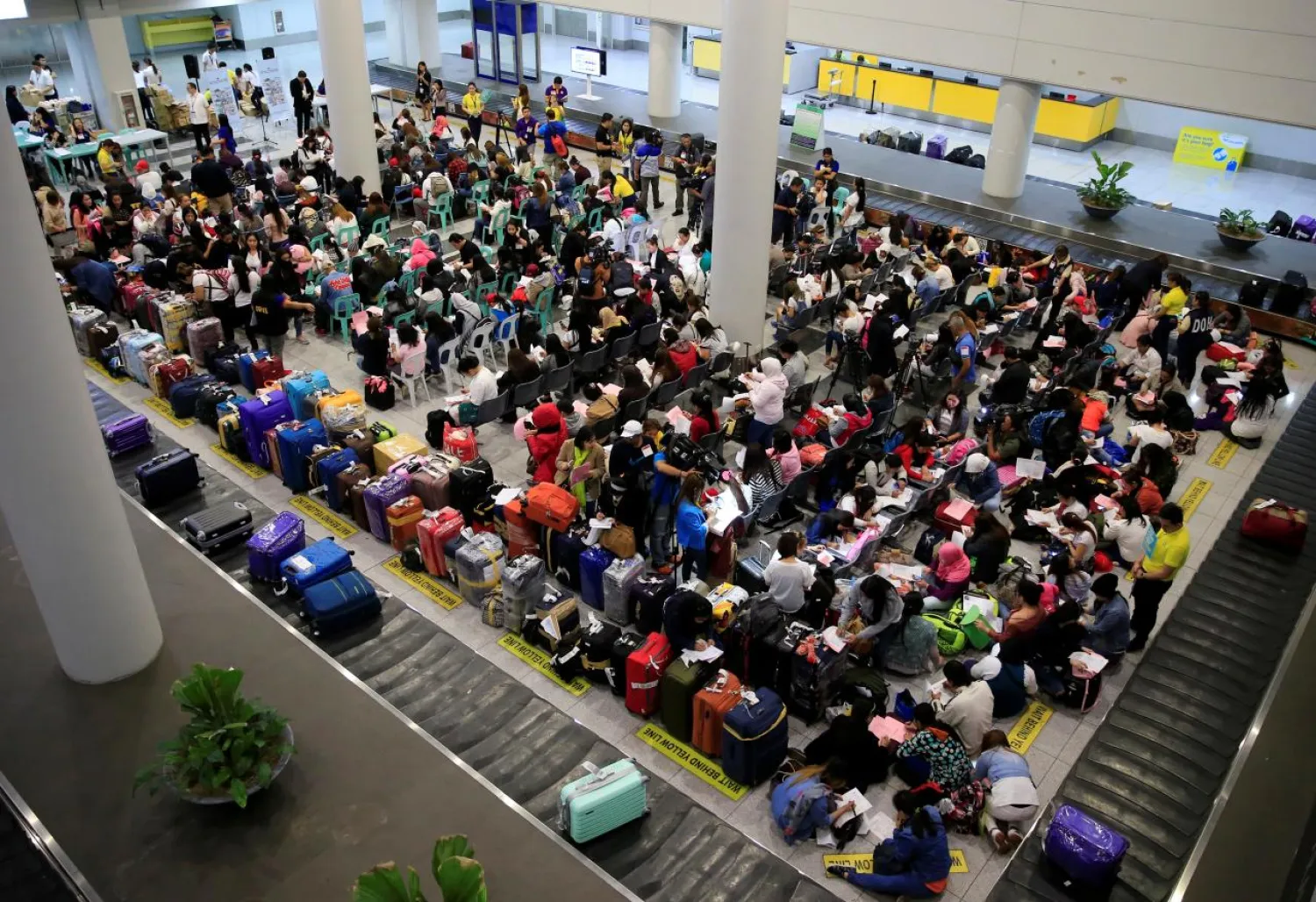
Overseas Filipino Workers from Kuwait gather upon arrival at the Ninoy Aquino International Airport in Pasay city, Metro Manila, Philippines in February. (Reuters)
Kuwait, Philippines Move to Defuse Domestic Worker Row
Overseas Filipino Workers from Kuwait gather upon arrival at the Ninoy Aquino International Airport in Pasay city, Metro Manila, Philippines in February. (Reuters)
Kuwait announced on Monday that it will set up a special commission to address the employment of housemaids in the Gulf state, in what was interpreted as an olive branch extended to the Philippines over the migrant labor row.
Manila announced on Monday that it was prepared to dispatch a delegation to Kuwait to contain the escalating dispute over domestic foreign workers in Kuwait.
The development stood in stark contrast to President Rodrigo Duterte’s announcement over the weekend that Manila’s ban on sending domestic workers to Kuwait was permanent.
Duterte in February prohibited workers heading to Kuwait following the murder of a Filipina maid whose body was found stuffed in her employer's freezer.
The resulting row deepened last week after Kuwaiti authorities ordered Manila's envoy to leave the country over videos of Philippine embassy staff helping workers in Kuwait flee their employers.
During its weekly meeting, the Kuwaiti government on Monday said it was opposed to any move "aimed at undermining its sovereignty and its laws", the official KUNA news agency reported.
The government added however that it will set up a special commission chaired by the minister of social affairs and labor to follow up "on cooperation with friendly states" on the employment of housemaids in Kuwait.
"This is largely a misunderstanding and exaggeration of some minor or one-off cases," Deputy Foreign Minister Nasser al-Subaih told reporters in Kuwait City.
"We have taken a serious stance ... but we do not believe in escalation and want to remain in direct communication to resolve the problem," Subaih added.
Kuwait and the Philippines had been negotiating a labor deal that could have resulted in the lifting of the ban on Filipinos working in the Gulf state.
The Philippines on Tuesday welcomed Kuwait’s olive branch in the migrant labor row.
Foreign Secretary Alan Peter Cayetano said: "This gesture on the part of Kuwait, a country with which we have a shared history and strong people-to-people ties, will allow us to move forward.”
"We affirm our friendship with the government of Kuwait and its people. The strength of that friendship will withstand this misunderstanding," he added.
Around 262,000 Filipinos work in Kuwait, nearly 60 percent of them domestic workers, according to the Philippines' foreign ministry.
Duterte said workers returning from Kuwait could find employment as English teachers in China, citing improved ties with Beijing.
The Philippines has sent millions of its people to work abroad, seeking salaries they cannot get in their relatively impoverished nation.
The money they send back home accounts for about 10 percent of the Philippine economy.
Saudi FM Attends Meeting with Egyptian and Turkish Counterparts and US Adviser in Cairohttps://english.aawsat.com/gulf/5286607-saudi-fm-attends-meeting-egyptian-and-turkish-counterparts-and-us-adviser-cairo
Saudi FM Attends Meeting with Egyptian and Turkish Counterparts and US Adviser in Cairo
Saudi Minister of Foreign Affairs Prince Faisal bin Farhan bin Abdullah.(SPA)
Saudi Minister of Foreign Affairs Prince Faisal bin Farhan bin Abdullah took part in a meeting in Cairo with Egypt’s Minister of Foreign Affairs, International Cooperation, and Egyptian Expatriates Badr Abdelatty, Türkiye's Minister of Foreign Affairs Hakan Fidan, and Senior Advisor to the US President for Arab and African Affairs Massad Boulos, the Saudi Press Agency reported on Sunday.
The participants discussed a range of regional developments, with a particular focus on the situations in Sudan and Libya, and reviewed ongoing joint efforts to promote security, stability, and political solutions in both countries.
The meeting was also attended by Prince Musab bin Mohammed Al Farhan, Adviser to the Saudi Foreign Minister for Political Affairs, and Saudi Ambassador to Egypt Saleh bin Eid Al-Husseini.
Lebanese Exports to Saudi Arabia Resume as First Containers Head to Jeddahhttps://english.aawsat.com/gulf/5286439-lebanese-exports-saudi-arabia-resume-first-containers-head-jeddah
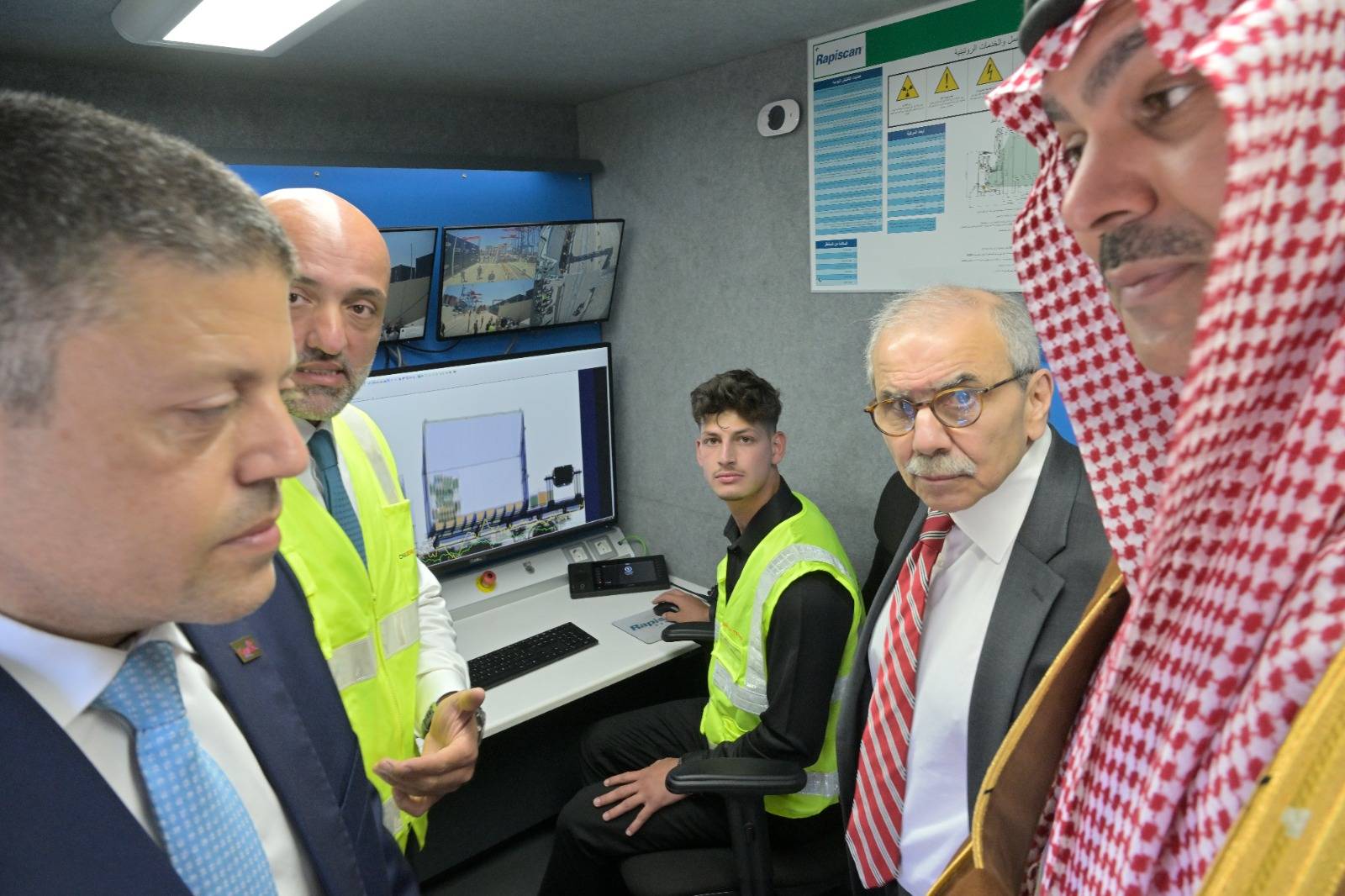
Lebanese Prime Minister Nawaf Salam and Saudi Ambassador Fahd Al Dossari inspect security and logistical procedures at the Port of Beirut ahead of the departure of the first shipments to Jeddah Port following Saudi Arabia's decision to lift the ban on Lebanese exports (Asharq Al Awsat).
Lebanese Exports to Saudi Arabia Resume as First Containers Head to Jeddah
Lebanese Prime Minister Nawaf Salam and Saudi Ambassador Fahd Al Dossari inspect security and logistical procedures at the Port of Beirut ahead of the departure of the first shipments to Jeddah Port following Saudi Arabia's decision to lift the ban on Lebanese exports (Asharq Al Awsat).
The first shipments of Lebanese exports to Saudi Arabia have departed from Beirut, marking the resumption of trade after a five year suspension imposed because of large scale smuggling of illicit goods into the Kingdom. Saudi Arabia reversed its decision last week in light of the positive results achieved through Lebanon's stricter security measures at ports, airports, and land border crossings.
Lebanese Prime Minister Nawaf Salam pledged on Saturday that Lebanon "will never again allow itself to become a launching point for any harm against our Arab brothers. Rather, it will be a partner in their security, stability, and prosperity."
Saudi Ambassador to Lebanon Fahd Al Dossari reaffirmed his country's support for "Lebanon's stability, its sovereignty over all its territory, the well being of its people, and the prevention of its use as a platform to harm its brothers."
His remarks came during a ceremony marking the departure of the first Lebanese exports to Jeddah Port following the Saudi decision to lift the ban on Lebanese imports.
Asharq Al-Awsat learned from Lebanese sources that Beirut is moving toward tighter oversight of exports and is preparing a mechanism expected to be launched soon that will enable direct cooperation with Saudi authorities to detect and prevent smuggling operations. Under the mechanism, scanning devices operating at ports, airports, and land crossings will be directly linked to their counterparts at Saudi entry points, allowing Saudi authorities to monitor incoming shipments and verify them in real time.
Once implemented, the system will allow officials at Jeddah Islamic Port to review scanner results immediately after cargo passes through inspection. Saudi authorities will be able to intervene to halt suspicious shipments or request manual inspections whenever concerns arise. The same data will also be available directly to Lebanese customs officials, who monitor the information on large screens in Beirut.
Lebanese authorities hope to expand the system in the future to other countries, including states that export goods to Lebanon, enabling Lebanese customs officials to monitor shipments bound for Lebanon in a similar manner.
Crown Prince Mohammed bin Salman directed on June 10 that Lebanese exports to the Kingdom be resumed in light of the "positive steps" taken by the Lebanese government to rebuild state institutions. The decision came in response to a request from Lebanese President Joseph Aoun and Prime Minister Nawaf Salam.
Lebanese Prime Minister Nawaf Salam and Ambassador Fahd Al Dossari inspect security procedures at the Port of Beirut (Asharq Al Awsat).
The first container bound for Jeddah Islamic Port departed on Saturday following the lifting of the ban on Lebanese exports to Saudi Arabia. The event was attended by Salam, several ministers, and Saudi Arabia's new ambassador to Beirut, Fahd bin Abdulrahman Al Dossari.
In his remarks, Ambassador Al Dossari said: "Based on the positive steps taken by the Lebanese state, we gather today to witness the relaunch of the first Lebanese exports to the Kingdom."
He added: "This step confirms Saudi Arabia's support for Lebanon's stability, its full sovereignty over all its territory, and the well being of its people. It also reflects the Kingdom's confidence in the Lebanese state's ability to take the necessary measures to prevent its territory from being used as a platform to harm its brothers."
A Moment Lebanon Has Long Awaited
Speaking from the Port of Beirut as the first container departed, Prime Minister Salam said Lebanon was "witnessing a moment it has awaited for a long time, namely the departure of the first containers bound for Jeddah Port after the lifting of the ban on Lebanese exports to the Kingdom."
He added: "I recall standing in this very place on November 25 last year. At that time, I said frankly that Lebanon had been used as a transit point for the export of illicit goods to a number of Arab countries, with the Kingdom, unfortunately, at the forefront. I also said that our ability to control our exports was a fundamental condition for lifting the ban, and that the installation of scanning equipment meant that the lifting of restrictions on Lebanese exports was drawing near."
Salam continued: "But we did not stop at installing modern scanning equipment at the ports of Beirut and Tripoli to monitor everything entering and leaving Lebanon. After appointing a new port administration composed of experienced and qualified professionals, and later a new customs administration, we worked to tighten border control measures with Syria and strengthened efforts to combat smuggling in all its forms."
Salam reiterated: "We will never again allow Lebanon to become a launching point for any harm against our Arab brothers. Rather, it will be a partner in their security, stability, and prosperity."
A Return of Hope for Thousands of Farmers
Salam noted that Saudi Arabia "was, before the ban, by far the largest market for our exports. Today, with the departure of this container, we are returning to those markets. I hope not only that we regain the level of exports we had before the ban, but that we surpass it."
He stressed that "our return to Saudi markets means the return of hope to thousands of farmers in the Bekaa, the South, and the North, to factories that survived the most difficult circumstances, and to all exporters who have waited a long time for this day."
He added that "this decision does not revive just one sector. It activates an entire economic chain, helps create job opportunities, and ensures an inflow of hard currency."
Salam pointed out that "this decision comes at a stage when Lebanon needs every possible measure to stimulate its economy and strengthen the capabilities of its productive sectors."
He added: "We hope this step will be followed by further measures that strengthen cooperation and facilitate travel between our two countries."
Salam continued: "From this platform, in the name of the Lebanese state and in my personal name, I renew my thanks and appreciation to His Royal Highness Prince Mohammed bin Salman bin Abdulaziz Al Saud for his generous decision to lift the ban on exports from Lebanon. Lebanon values its deep historical ties with Saudi Arabia and highly appreciates the role played by its leadership over decades in supporting Lebanon, its stability, and its institutions."
Five Year Ban
The Saudi ban began in 2021 on agricultural imports before being expanded to include all goods. It was linked to the smuggling of the narcotic Captagon after smugglers and criminal networks used Lebanon as a platform for trafficking drugs into the Kingdom.
The move increased pressure on Lebanon's already collapsing economy, which had been struggling with a severe financial crisis since 2019, particularly as agricultural exports lost access to their traditional Gulf markets. Lebanese exports to Saudi Arabia totaled approximately $240 million in 2020.
Lebanese Prime Minister Meets with Saudi Ambassador to Lebanonhttps://english.aawsat.com/gulf/5286435-lebanese-prime-minister-meets-saudi-ambassador-lebanon
Lebanese Prime Minister Meets with Saudi Ambassador to Lebanon
The Lebanese prime minister extended his best wishes for the ambassador’s success in his duties - SPA
Prime Minister of Lebanon Nawaf Salam met Saudi Ambassador to Lebanon Fahd Al-Dosari in Beirut on Sunday during a courtesy visit following the presentation of his credentials.
Ambassador Al-Dosari conveyed to the Lebanese prime minister the greetings of Custodian of the Two Holy Mosques King Salman bin Abdulaziz Al Saud and His Royal Highness Prince Mohammed bin Salman bin Abdulaziz Al Saud, Crown Prince and Prime Minister, SPA reported.
The Lebanese prime minister extended his best wishes for the ambassador’s success in his duties, emphasizing the importance of continuing efforts to strengthen the fraternal relations between Lebanon and Saudi Arabia.
لم تشترك بعد
انشئ حساباً خاصاً بك لتحصل على أخبار مخصصة لك ولتتمتع بخاصية حفظ المقالات وتتلقى نشراتنا البريدية المتنوعة