


How Manchester City Became Gigantic in 10 Years?

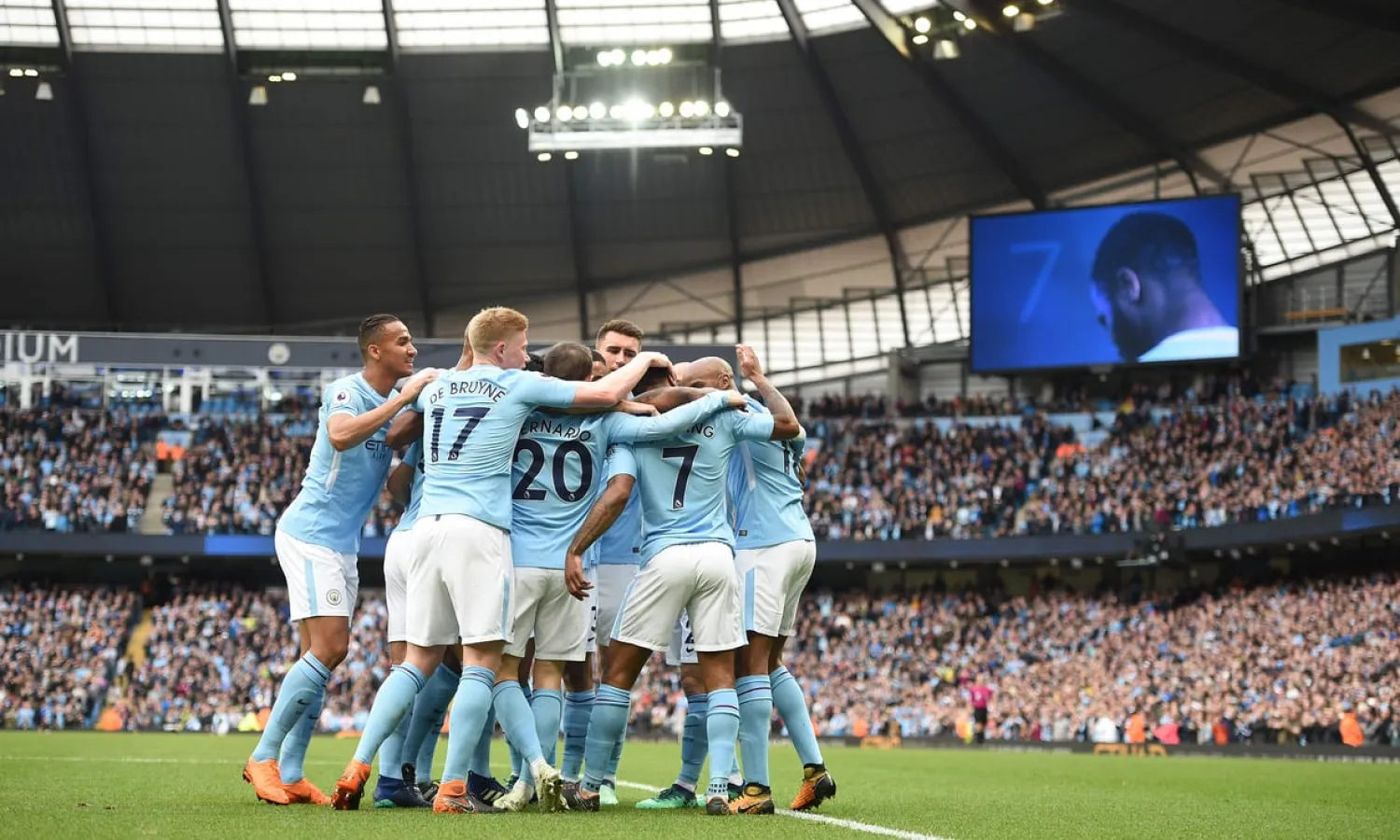
Raheem Sterling is mobbed by his team-mates after scoring Manchester City’s second goal in the 5-0 thrashing of Swansea at the Etihad Stadium in April. Photograph: Oli Scarff/AFP/Getty Images
TT

How Manchester City Became Gigantic in 10 Years?

Raheem Sterling is mobbed by his team-mates after scoring Manchester City’s second goal in the 5-0 thrashing of Swansea at the Etihad Stadium in April. Photograph: Oli Scarff/AFP/Getty Images

When Liverpool went to the Etihad Stadium for their smash-and-grab victory over Manchester City in the Champions League quarter-final second leg it was odd to hear their fans sing the straight version of We Shall Not Be Moved – “just like a team that’s going to win the European Cup”.

City fans’ version of that anthem was lyrically adjusted 19 years ago, when supporters who grew up on a team of internationals in the early 1970s found themselves trailing around League One while Manchester United were on their way to the treble. Watching in disbelief defeats that 1998-99 season by Lincoln City, York City and Wycombe Wanderers, standing in Blackpool’s Bloomfield Road, which had two sides condemned, some City wags reworked the words to: “We’re not really here.”

It is still sung every game, the same statement of disbelief, but now at the spectacle of a world-class team in sky blue, the most expensively assembled squad in football, and the sport’s most coveted coach actually managing Manchester City. Sheikh Mansour bin Zayed al-Nahyan, a senior son in Abu Dhabi’s ruling dynasty, bought the club 10 seasons ago, nine years after City squeaked up from League One on penalties following Paul Dickov’s 94th-minute equalizer in the Wembley play-off final against Gillingham.

On Sunday, in the stadium built with public money for the 2002 Commonwealth Games, then handed to City the year after and now sponsored by the Abu Dhabi state airline, Pep Guardiola’s team will be handed their third Premier League trophy since Mansour landed. In 116 years before that – the club was formed in 1880 as a form of social work by Anna Connell, the vicar’s daughter at St Mark’s Church – City won the league title twice. They won the League Cup twice after it began in 1960, first in 1970 during the 1968-70 era that was previously the club’s best ever, then in 1976, Dennis Tueart’s dashing overhead kick winner having to sustain a generation for 35 years of loyalty and, mostly, cock-ups.

The new incarnation of Manchester City have won the League Cup three times in the past five seasons, a triumph now barely registered. This season’s third was picked up on the way to winning the Premier League but Guardiola’s specified target of succeeding in Europe was challenged by losing to Liverpool.

So this decade of Abu Dhabi mega-investment has not been a reclamation of past supremacy – as Liverpool’s resurgence now feels – but rather a whole new ball game.

When the takeover was announced in August 2008, there was understandable wariness about whether it was real and there were guffaws at first about the idea that Manchester City were going to buy the world’s best players and be rebuilt along the lines of Barcelona. The seriousness of that intention has been inexorably accepted over the decade, with £1.2bn invested from Abu Dhabi, the players recruited, trophies attained, stadium expanded to 55,000 capacity, the power-projecting academy and “Etihad campus” built next to it – and Barcelona’s former chief executive, director of football and coach working for City on Ashton New Road.

When Mark Hughes was sacked as manager in December 2009, news of Roberto Mancini’s pending appointment having leaked before Hughes’s final game in the sleet against Sunderland, there was widespread ridicule of City’s official explanation that Hughes had failed to reach his “targets”. There were fewer sneers by 2013 when City said the same about targets as they sacked Mancini, who the previous season had delivered their first Premier League title with Sergio Agüero’s 94th-minute winner against Hughes’s QPR.

he club’s hierarchy plays down the apparent conclusion that this is an Abu Dhabi state project, expanded now to City-owned clubs in New York and Melbourne, and ownership too of Girona, Yokohama Marinos and the Uruguayan club Atlético Torque, as well as partnerships to polish young players from the Netherlands to Venezuela.

City, the hierarchy maintains, is a private investment by Mansour – they present the holding company City Football Group as the owner, not Abu Dhabi itself. They point to the emirate not being overtly promoted in this most globally broadcast of its ventures, although its tourist authority, Visit Abu Dhabi, is a sponsor on the City billboards and the Etihad name is hardly hidden under a bushel.

Students of football history have always learned that a key achievement of Herbert Chapman’s visionary building of Arsenal in the 1930s was having the Gillespie Road tube station renamed after the club. Now the Etihad campus has its own Metrolink station taking supporters to the ground, so in modern football Manchester City have secured a transport stop named after the club’s sponsor.

The very start of the takeover was different. It did look like a private purchase then, even something of a whim by Mansour, who already owned a football club in Abu Dhabi. The City deal was fronted by Sulaiman al-Fahim, a Dubai property developer, who boasted about the stars City were going to sign and the “very deep pockets” of the club’s new owner.

This vulgarity did not play at all well in Abu Dhabi, whose ruling family has sought to marry the windfall of oil billions to a dignified national style. Fahim was moved aside in days and a senior figure in the country’s business and government institutions, Khaldoon al-Mubarak, assigned to chair the City investment and its reputation-shaping implications.

It is a testament to how carefully Mubarak and his executives have approached it that, while there have been persistent objections, particularly in Europe, to their claiming football success by vast spending of a country’s resources, they have also won friends at home.

They understood that, for all its new money, English football is still rooted in supporters’ loyalty and expected to be a community activity and that the stadium and Commonwealth Games were intended as catalysts for economic revival in post-industrial east Manchester. The Abu Dhabi investors donated 5.5 acres of the 80 cleaned up for the campus, valued at £18m, and contributed a further £3m towards an excellent new public leisure centre and swimming pool next to it. A new sixth-form college named after Anna Connell also sits on the land, next to the new Manchester Institute of Health and Performance, which is used by the club and community and in the rehabilitation of some victims of the Arena terror atrocity last year.

At the end of 10 seasons that began with the then barmy-seeming aspiration to be “Barcelona plus” Guardiola, given £200m to spend on players last summer and £57m for Aymeric Laporte in January, is expected to be further furnished this summer with a central midfield player, centre-back and forward. The aim over the next 10 years is to become “Barcelona plus plus” and nobody doubts anymore the seriousness of that, however improbable it still feels at Manchester City, for all of this to be really here.

(The Guardian)


Shakhtar Boss Pays Ukrainian Racer $200,000 After Games Disqualification

Ukrainian President Volodymyr Zelenskiy holds helmet as he meets with a Ukrainian skeleton racer Vladyslav Heraskevych , who was disqualified from the Olympic skeleton competition over his "helmet of remembrance" depicting athletes killed since Russia's invasion and his father and coach, Mykhailo Heraskevych, amid Russia's attack on Ukraine, in Munich, Germany February 13, 2026. (Ukrainian Presidential Press Service/Handout via Reuters)
TT

Shakhtar Boss Pays Ukrainian Racer $200,000 After Games Disqualification

Ukrainian President Volodymyr Zelenskiy holds helmet as he meets with a Ukrainian skeleton racer Vladyslav Heraskevych , who was disqualified from the Olympic skeleton competition over his "helmet of remembrance" depicting athletes killed since Russia's invasion and his father and coach, Mykhailo Heraskevych, amid Russia's attack on Ukraine, in Munich, Germany February 13, 2026. (Ukrainian Presidential Press Service/Handout via Reuters)

The owner of ‌Ukrainian football club Shakhtar Donetsk has donated more than $200,000 to skeleton racer Vladyslav Heraskevych after the athlete was disqualified from the Milano Cortina Winter Games before competing over the use of a helmet depicting Ukrainian athletes killed in the war with Russia, the club said on Tuesday.

The 27-year-old Heraskevych was disqualified last week when the International Bobsleigh and Skeleton Federation jury ruled that imagery on the helmet — depicting athletes killed since Russia invaded Ukraine in 2022 — breached rules on athletes' expression at ‌the Games.

He ‌then lost an appeal at the Court ‌of ⁠Arbitration for Sport hours ⁠before the final two runs of his competition, having missed the first two runs due to his disqualification.

Heraskevych had been allowed to train with the helmet that displayed the faces of 24 dead Ukrainian athletes for several days in Cortina d'Ampezzo where the sliding center is, but the International Olympic Committee then ⁠warned him a day before his competition ‌started that he could not wear ‌it there.

“Vlad Heraskevych was denied the opportunity to compete for victory ‌at the Olympic Games, yet he returns to Ukraine a ‌true winner," Shakhtar President Rinat Akhmetov said in a club statement.

"The respect and pride he has earned among Ukrainians through his actions are the highest reward. At the same time, I want him to ‌have enough energy and resources to continue his sporting career, as well as to fight ⁠for truth, freedom ⁠and the remembrance of those who gave their lives for Ukraine," he said.

The amount is equal to the prize money Ukraine pays athletes who win a gold medal at the Games.

The case dominated headlines early on at the Olympics, with IOC President Kirsty Coventry meeting Heraskevych on Thursday morning at the sliding venue in a failed last-minute attempt to broker a compromise.

The IOC suggested he wear a black armband and display the helmet before and after the race, but said using it in competition breached rules on keeping politics off fields of play. Heraskevych also earned praise from Ukraine President Volodymyr Zelenskiy.


Speed Skating-Italy Clinch Shock Men’s Team Pursuit Gold, Canada Successfully Defend Women’s Title

 Team Italy with Davide Ghiotto, Andrea Giovannini, Michele Malfatti, celebrate winning the gold medal on the podium of the men's team pursuit speed skating race at the 2026 Winter Olympics, in Milan, Italy, Tuesday, Feb. 17, 2026. (AP)
Team Italy with Davide Ghiotto, Andrea Giovannini, Michele Malfatti, celebrate winning the gold medal on the podium of the men's team pursuit speed skating race at the 2026 Winter Olympics, in Milan, Italy, Tuesday, Feb. 17, 2026. (AP)
TT

Speed Skating-Italy Clinch Shock Men’s Team Pursuit Gold, Canada Successfully Defend Women’s Title

 Team Italy with Davide Ghiotto, Andrea Giovannini, Michele Malfatti, celebrate winning the gold medal on the podium of the men's team pursuit speed skating race at the 2026 Winter Olympics, in Milan, Italy, Tuesday, Feb. 17, 2026. (AP)
Team Italy with Davide Ghiotto, Andrea Giovannini, Michele Malfatti, celebrate winning the gold medal on the podium of the men's team pursuit speed skating race at the 2026 Winter Olympics, in Milan, Italy, Tuesday, Feb. 17, 2026. (AP)

An inspired Italy delighted the home crowd with a stunning victory in the Olympic men's team pursuit final as

Canada's Ivanie Blondin, Valerie Maltais and Isabelle Weidemann delivered another seamless performance to beat the Netherlands in the women's event and retain their title ‌on Tuesday.

Italy's ‌men upset the US who ‌arrived ⁠at the Games ⁠as world champions and gold medal favorites.

Spurred on by double Olympic champion Francesca Lollobrigida, the Italian team of Davide Ghiotto, Andrea Giovannini and Michele Malfatti electrified a frenzied arena as they stormed ⁠to a time of three ‌minutes 39.20 seconds - ‌a commanding 4.51 seconds clear of the ‌Americans with China taking bronze.

The roar inside ‌the venue as Italy powered home was thunderous as the crowd rose to their feet, cheering the host nation to one ‌of their most special golds of a highly successful Games.

Canada's women ⁠crossed ⁠the line 0.96 seconds ahead of the Netherlands, stopping the clock at two minutes 55.81 seconds, and

Japan rounded out the women's podium by beating the US in the Final B.

It was only Canada's third gold medal of the Games, following Mikael Kingsbury's win in men's dual moguls and Megan Oldham's victory in women's freeski big air.


Lindsey Vonn Back in US Following Crash in Olympic Downhill 

Milano Cortina 2026 Olympics - Alpine Skiing - Women's Downhill 3rd Official Training - Tofane Alpine Skiing Centre, Belluno, Italy - February 07, 2026. Lindsey Vonn of United States in action during training. (Reuters)
TT

Lindsey Vonn Back in US Following Crash in Olympic Downhill 

Milano Cortina 2026 Olympics - Alpine Skiing - Women's Downhill 3rd Official Training - Tofane Alpine Skiing Centre, Belluno, Italy - February 07, 2026. Lindsey Vonn of United States in action during training. (Reuters)

Lindsey Vonn is back home in the US following a week of treatment at a hospital in Italy after breaking her left leg in the Olympic downhill at the Milan Cortina Games.

“Haven’t stood on my feet in over a week... been in a hospital bed immobile since my race. And although I’m not yet able to stand, being back on home soil feels amazing,” Vonn posted on X with an American flag emoji. “Huge thank you to everyone in Italy for taking good care of me.”

The 41-year-old Vonn suffered a complex tibia fracture that has already been operated on multiple times following her Feb. 8 crash. She has said she'll need more surgery in the US.

Nine days before her fall in Cortina d'Ampezzo, Italy, Vonn ruptured the ACL in her left knee in another crash in Switzerland.

Even before then, all eyes had been on her as the feel-good story heading into the Olympics for her comeback after nearly six years of retirement.
