Defeated Malaysian Leader, Wife Barred from Leaving Country

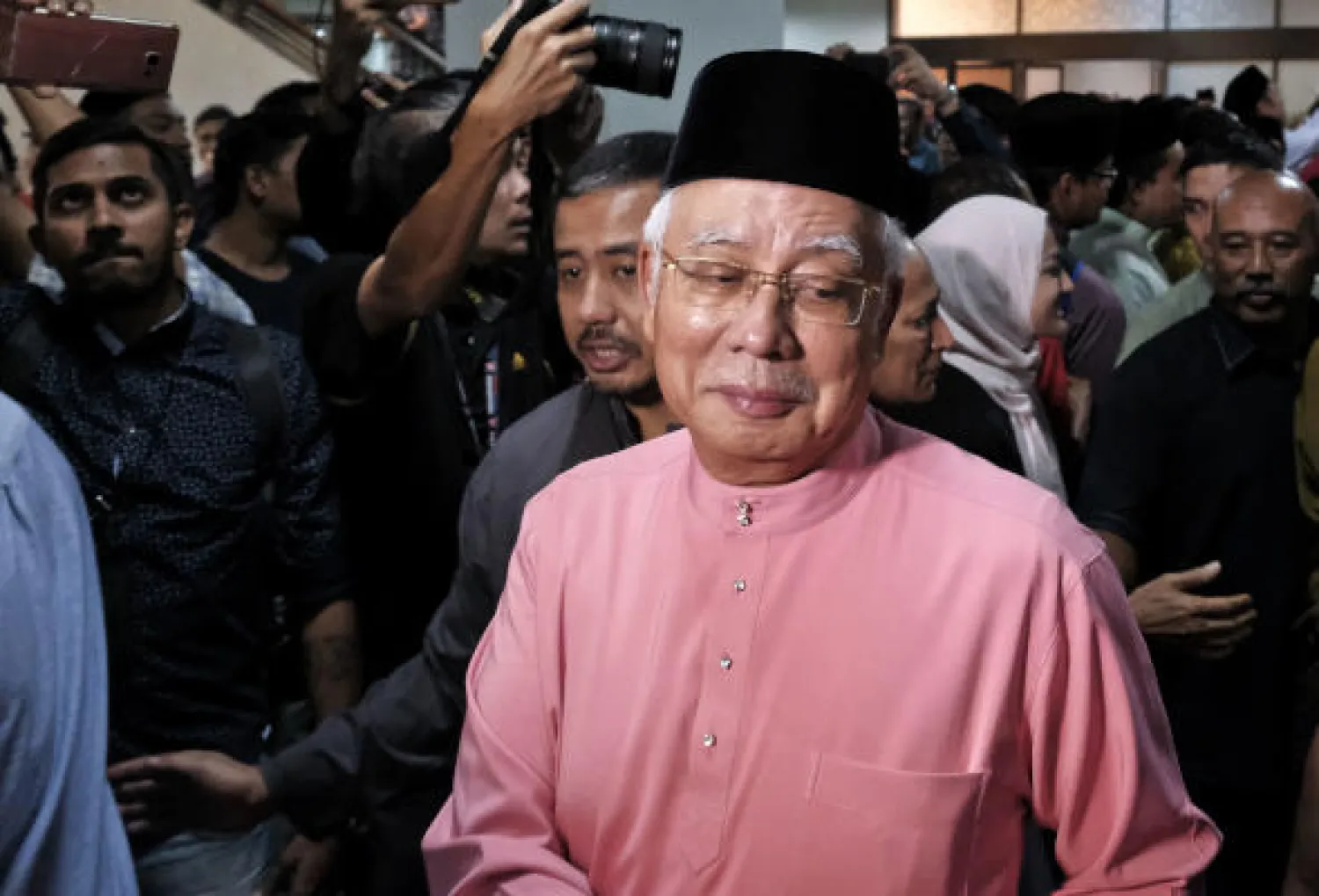
In this Friday, May 11, 2018, photo, Malaysia's former Prime Minister Najib Razak attends an event of the United Malays National Organization's 72nd anniversary in Kuala Lumpur, Malaysia. REUTERS
TT

Defeated Malaysian Leader, Wife Barred from Leaving Country

In this Friday, May 11, 2018, photo, Malaysia's former Prime Minister Najib Razak attends an event of the United Malays National Organization's 72nd anniversary in Kuala Lumpur, Malaysia. REUTERS

Malaysia's Immigration Department said Saturday that former Prime Minister Najib Razak and his wife are barred from leaving the country, media reported.

This came shortly after Najib announced plans for a short holiday with family.

Malaysian authorities barred ousted Najib and his wife from leaving the country on Saturday, amid reports that the government was reopening investigations into a multi-billion-dollar graft scandal at a state fund he founded, according to Reuters.

Najib's coalition suffered a shocking electoral defeat this week that ended its 60 year-rule.

Following strong calls from the party for him to step down, Najib told a news conference that he was stepping down with immediate effect as president of the United Malays National Organization as well as chairman of the National Front coalition, AP reported.

The Immigration Department issued a statement banning Najib from leaving the country without giving further details.

"The Malaysian Immigration Department would like to confirm that Najib Razak and Rosmah Mansor have just been blacklisted from leaving the country," the agency said on its official Facebook page. It gave no .

Najib responded instantly in Twitter by confirming that he respected the department's decision and will stay with his family in the country.

In a Twitter message on Friday, Najib said he was praying that, "after this divisive period", Malaysia would unite.

"I apologise for any shortcomings and mistakes, and I thank you, the people, for the opportunity to lead our great nation," he tweeted.


French Delegation in Algeria to Mend Ties, Rebuild Trust

Chairman of the Algerian Economic Renewal Council, center
TT

French Delegation in Algeria to Mend Ties, Rebuild Trust

Chairman of the Algerian Economic Renewal Council, center

A delegation from the Mouvement des Entreprises de France (Medef) is set to visit Algeria on Thursday, with its president Patrick Martin leading around 40 senior company executives, in an economic push aimed at repairing trade relations strained by political tensions over the past two years.

According to sources within the French diplomatic network based in Algeria, the mission seeks to inject new momentum into direct economic dialogue between the two sides and to restore the position of French companies in the Algerian market.

The visit is also seen as a practical step toward rebuilding trust between economic stakeholders, with the goal of moving past a period of stagnation and reviving trade and investment flows.

Reports cited by Algerian daily El Watan on Wednesday, quoting sources close to the Algerian Economic Renewal Council - the country’s largest employer body - said Medef’s visit will last two days.

The trip comes after a prolonged period of tension in bilateral relations that has affected economic exchanges. Observers say the move is not merely a protocol visit but an attempt to relaunch dialogue between business communities on both sides.

The main objective is to resume talks within the framework of the Algeria-France Economic Relations and Friendship Council, chaired by businessman Kamel Moula, who also heads the Algerian Economic Renewal Council, at a time when French economic presence in Algeria has significantly declined in recent years.

Sources from the Algerian Economic Renewal Council told Asharq Al-Awsat that the planned meetings in Algiers will be limited to bilateral sessions focusing on priority sectors, notably food security and energy - through projects linked to solar power and green hydrogen - as well as healthcare, digitalization and construction.

The mission offers French companies an opportunity to reaffirm their presence and reassure partners of their long-term commitment, the same sources said. It also aims to address certain obstacles, including lengthy administrative procedures, which are estimated to have tripled since 2024.

Observers consider the visit a key test of prospects for reviving economic relations between the two countries.

The Medef visit comes amid signs of a gradual political thaw in relations between Algiers and Paris. A visit by French Interior Minister Laurent Nunez to Algeria in February, during which he was received by President Abdelmadjid Tebboune at the presidential palace, helped pave the way for a measured easing of tensions.

In recent media comments, Michel Bisac, head of the Algerian-French Chamber of Commerce and Industry, warned of the potential fallout from the political crisis between Algeria and France, fueled by political and media circles close to the far right. The crisis erupted in summer 2024 after Paris recognized Moroccan sovereignty over Western Sahara.

“We are in a very delicate situation,” Bisac said, expressing regret over threats “not only to political ties but also economic relations between the two countries.”

He added that if Algeria were to apply to France the same trade measures it previously imposed on Spain after Madrid backed Morocco’s autonomy plan for Western Sahara in 2022, “the bill would be costly for the French economy, with losses approaching 4.8 billion euros.”

That figure reflects the value of French exports to Algeria, a key pillar for several industrial sectors’ foreign trade. Bisac noted that around 6,000 French companies currently operate “for and with Algeria,” supplying goods and services or engaging in industrial partnerships.

“These companies would face serious difficulties if the situation worsens,” he warned, stressing the growing fragility of bilateral economic exchanges. “Until recently, I had great hope ... but today I want to clearly stress the need to avoid escalation.”


Lebanon Sets Ceasefire as Condition for Talks with Israel

A child stands on the rubble of a building destroyed by an Israeli air strike in the southern Lebanese town of Kfarsir (AFP)
TT

Lebanon Sets Ceasefire as Condition for Talks with Israel

A child stands on the rubble of a building destroyed by an Israeli air strike in the southern Lebanese town of Kfarsir (AFP)

Lebanon will not enter negotiations with Israel until a ceasefire is firmly in place, President Joseph Aoun said, calling for a unified national stance.

He also stressed the need to prioritize the return of displaced residents to their villages, alongside a crackdown on weapons stockpiles and any armed presence.

A second meeting between Lebanon’s ambassador to Washington, Nada Hamadeh Moawad, and Israeli ambassador Yechiel Leiter is scheduled for Thursday at the State Department. The talks are expected to focus on extending the truce and setting a framework for negotiations, including timing and venue.

Ahead of the meeting, Israeli Foreign Minister Gideon Saar described Lebanon as a “failed state effectively run by Iran through Hezbollah,” adding that the group was “a common enemy of Israel and Lebanon”

He said disputes such as border demarcation could be resolved, but called Hezbollah the main obstacle and urged Beirut to cooperate against it.

Aoun has been working to close ranks among political factions and build backing for the negotiating track. Contacts are ongoing to extend the ceasefire, he said, pledging efforts to end what he described as the country’s “abnormal conditions.”

He insisted any talks would proceed without compromising sovereignty, saying there would be no concessions “except in what serves Lebanon’s interests and those of all its people.”

The planned negotiations would hinge on a full halt to Israeli attacks, a complete withdrawal from Lebanese territory, the return of detainees and deployment of the army along the international border, alongside the launch of reconstruction efforts. The return of displaced residents remains a central priority, he underlined.

The president chaired a security meeting focused on maintaining stability. He called for stricter enforcement of government measures, stronger deployment of security forces and closer coordination among agencies.

He also ordered raids on suspected arms depots. “No one will be allowed to obstruct security measures or undermine stability,” he said, calling the preservation of civil peace a “red line.”

Separately, discussions with a parliamentary committee focused on documenting damage caused by Israel, with the aim of presenting evidence - including photos and videos - to international bodies. Legal files are also being prepared in cooperation with the Beirut Bar Association.

Committee members praised efforts to shore up the ceasefire and push for lasting stability, particularly in the south, as well as moves to bring Lebanon’s case to regional and international forums.

Hezbollah has rejected the prospect of direct talks. MP Hassan Ezzedine said such calls were “rejected and condemned,” describing them as a departure from Lebanon’s national principles and Arab identity.

He also called for “genuine national unity” to face external pressure, adding that the group would not accept imposed boundaries or buffer zones.


Israeli Strikes in Southern Lebanon Kill Lebanese Journalist

This photo released by the Lebanese Civil Defense, show Lebanese Red Cross volunteers and Civil Defense workers carrying the body of the Lebanese journalist Amal Khalil killed in an Israeli airstrike, in al-Tayri village, south Lebanon, Wednesday, April 22, 2026. (Lebanese Civil Defense via AP)
TT

Israeli Strikes in Southern Lebanon Kill Lebanese Journalist

This photo released by the Lebanese Civil Defense, show Lebanese Red Cross volunteers and Civil Defense workers carrying the body of the Lebanese journalist Amal Khalil killed in an Israeli airstrike, in al-Tayri village, south Lebanon, Wednesday, April 22, 2026. (Lebanese Civil Defense via AP)

Israeli strikes on southern Lebanon on Wednesday killed Lebanese journalist Amal Khalil and wounded a photographer while they were working near the border with Israel, according to a senior Lebanese military official.

Earlier, the Israeli military said in a statement it had received reports that two journalists were injured as a result of its strikes.

The death of Khalil, 43, brought the death toll on Wednesday to five people. It was the deadliest day since a 10-day ceasefire was announced on April 16 to halt hostilities between Israel and Hezbollah.

Khalil and freelance photographer Zeinab Faraj were covering developments near the town of al-Tayri when an Israeli strike hit the vehicle in ⁠front of them.

⁠They ran into a nearby house, which was then also targeted by an Israeli strike, Lebanon's health ministry, the senior Lebanese military official and press advocates said.

Lebanese rescuers were able to retrieve Faraj, who had suffered a head wound.

When rescuers returned to help Khalil, the Israeli military dropped a sound grenade, blocking their access to the damaged building, the senior military official said.

Lebanon's Prime Minister Nawaf Salam said the targeting of journalists and the ⁠obstruction of relief efforts constituted "war crimes."

"Lebanon will spare no effort in pursuing these crimes before the relevant international bodies," he said on X.

Information Minister Paul Morcos said Khalil "was targeted by the Israeli army while carrying out her professional duty"

"The targeting of journalists is a grave crime and a blatant violation of international humanitarian law," he added on X.

The health ministry said Israel's military "prevented the completion of the humanitarian mission by firing a sound grenade and live ammunition at the ambulance."

Rescuers were able to return to the site about four hours after the initial strike. After another three hours of searching through the rubble, they were able to retrieve her lifeless body, the senior military official said.

Two people were killed in the first strike on the car, Lebanese state media reported.

The ⁠Israeli military said it ⁠identified two vehicles that left a military structure used by Hezbollah and crossed the "forward defense line," the term Israel's military uses to refer to the delineation of the zone of southern Lebanon that Israeli troops are occupying.

It said the cars "approached the troops in a manner that posed an immediate threat to their safety" and that it struck one of the vehicles, then a nearby building.