Maduro Wins Venezuela Vote amid Outcry

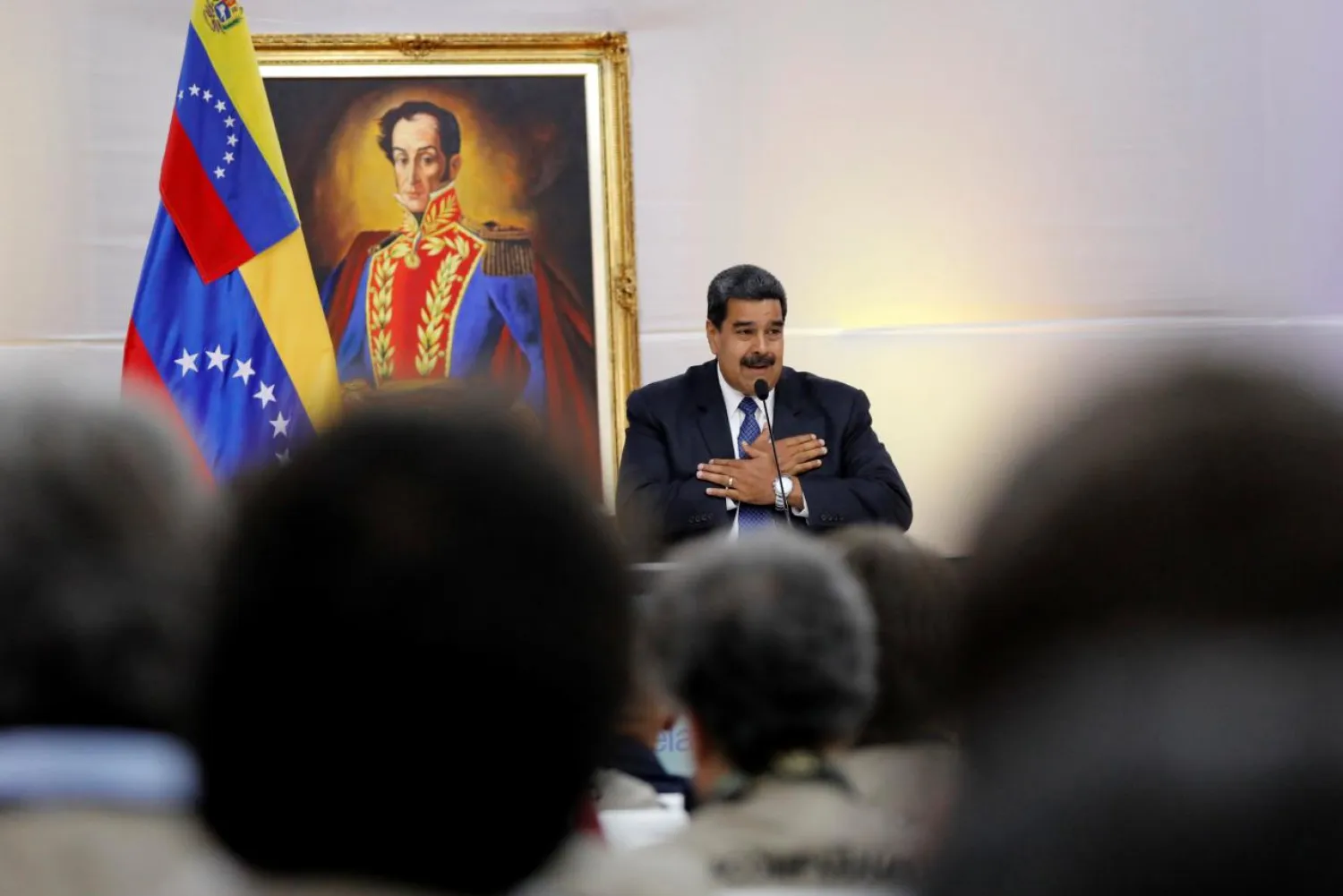
Venezuela's President Nicolas Maduro great the International observers for the May 20 election at the presidential palace in Caracas, Venezuela May 18, 2018. REUTERS/Carlos Jasso
TT

Maduro Wins Venezuela Vote amid Outcry

Venezuela's President Nicolas Maduro great the International observers for the May 20 election at the presidential palace in Caracas, Venezuela May 18, 2018. REUTERS/Carlos Jasso

Venezuela's leader Nicolas Maduro unsurprisingly won a new six-year term on Sunday, but his main rivals disavowed the election alleging massive irregularities.

Reeling under a devastating economic crisis, only 46 percent of voters turned out to cast ballots in an election boycotted by the opposition and condemned by much of the international community, but one that hands Maduro a second term until 2025.

Victory for the 55-year-old may trigger a new round of western sanctions against the socialist government as it grapples with a ruinous economic crisis.

Reeling from a fifth year of recession, falling oil production and US sanctions, Venezuela is seeing growing levels of malnutrition and hyperinflation, and mass emigration.

"We do not recognize this electoral process as valid, as true," his main rival Henri Falcon told a news conference, even before the result was announced. 

"For us, there were no elections. We have to have new elections in Venezuela." 

Maduro hailed his victory for another six-year term as a "historic record" in a speech to thousands of cheering supporters outside the official Miraflores Palace in Caracas.

"Never before has a presidential candidate taken 68 percent of the popular vote," he said, to applause.

"We won again! We triumphed again! We are the force of history turned into a permanent popular victory," said Maduro.

The official result gave Maduro 67.7 percent of the vote, with Falcon a distant second at 21.2 percent. In the last opinion polls before the vote, the pair were running neck-and-neck.

Third-placed Javier Bertucci, an evangelist preacher who polled around 11 percent, joined in the call for new elections.

Hundreds of Venezuelans took to the streets in several Latin American capitals, including Bogota, Buenos Aires and Lima -- as well as in Madrid -- to denounce the vote.

The biggest protest was in Chile's capital Santiago, where more than 1,000 demonstrated against the election. Chile granted 73,000 visas to Venezuelans fleeing the country last year.

Falcon said fresh elections could be held in November or December, when they are traditionally contested, but they were moved up this year by the country's all-powerful and pro-government Constituent Assembly, catching the divided and weakened opposition off-guard.

The Democratic Unity Roundtable (MUD) opposition coalition has won support from the United States, the European Union and 14 countries of the Lima Group who called for the vote to be postponed.


Trump Says to ‘Soon’ Take Decision on Whether to Resume Iran War

A hat reading "VETO" sits on the Resolute Desk as US President Donald Trump speaks in the Oval Office of the White House, Washington, DC, on November 5, 2026. (AFP)
TT

Trump Says to ‘Soon’ Take Decision on Whether to Resume Iran War

A hat reading "VETO" sits on the Resolute Desk as US President Donald Trump speaks in the Oval Office of the White House, Washington, DC, on November 5, 2026. (AFP)

US President Donald Trump said on Thursday that he would decide “soon” on whether to resume the war on Iran following a meeting with his top national security advisers.

"Now we will make a decision," Trump told reporters in the Oval Office.

"Do we want to go further" with strikes to ensure Iran's nuclear program is over and that "it will never happen again?" he added.

"I would rather not destroy the rest of the country if possible, but maybe I will have to. You'll know soon enough."

Trump held meetings at the White House on Wednesday and Thursday to discuss the resumption of military operations, according to senior officials who spoke to US media.

While the US Central Command continues its military preparations, Qatari mediators are advancing a draft agreement aimed at fostering confidence between Washington and Tehran.

The president, at least for now, is considering three options: launch new strikes, continue to strangle Iran's regime economically, or cut a deal that includes significant concessions to the Iranians, reported Axios.

Trump on Thursday said Iran could not do ‌anything regarding ‌its nuclear program ‌without ⁠US approval.

"They're not ⁠doing anything without our approval," ⁠Trump told reporters ‌in ‌the Oval ‌Office ‌in response to a question regarding a ‌set of proposals made ⁠to ⁠Iran by mediators about the future of its nuclear program.


European Air Traffic Targeted by New Threats in at Least 3 Incidents

Police officers work at Copenhagen Airport on November 6, 2026, in connection with new threats directed at air traffic. (AFP)
TT

European Air Traffic Targeted by New Threats in at Least 3 Incidents

Police officers work at Copenhagen Airport on November 6, 2026, in connection with new threats directed at air traffic. (AFP)

Police in Denmark and the Czech Republic investigated threats to air traffic on Friday, while a Romanian plane received a bomb threat following a string of hoaxes that have targeted flights and disrupted travel across Europe this week.

A flight from Prague to Bucharest operated by Romanian carrier Tarom received a bomb threat. The plane landed at its intended destination, and airport administration officials said the bomb threat proved to be false.

In the Danish capital, Copenhagen, police said Friday they were present at the airport for a second consecutive day “in connection with threats directed at air traffic.”

They said their immediate assessment was that there had been no danger to passengers or to others at the airport. It added that air traffic was proceeding safely and without disruption.

Czech police also said they were again dealing with threats against planes on Friday. They said necessary security measures have been taken in cooperation with Prague’s Vaclav Havel Airport that have “a minimal impact on the normal operations at the airport.”

Meanwhile in Ireland, the Dublin headquarters of national broadcaster RTE was evacuated Friday after a bomb threat, and live broadcasts were replaced with pre-recorded programs.

Ireland’s police force, An Garda Síochána, said it was “aware of a threat made against media organizations here and in Europe.” It said that it has been liaising with Irish media organizations and the threat will be investigated.

More than two dozen flights were affected by threats earlier in the week, with some diverted as authorities scrambled to rule out any danger.

Europe has experienced a slew of other disruptions recently, such as attacks on supermarket refrigeration systems, drone incursions and mysterious triggers to alert apps.

Fake bomb threats are relatively common, but it is unusual to see so many in such a short period. They come at a time of increased geopolitical tensions and warnings from authorities that Russia may be ramping up so-called hybrid threats in Europe.


Satellite Images Reveal New Construction Near Iran Missile Sites

A satellite photo shows suspected tunnel expansion (in the upper-right quadrant of the picture) at Shahid Modarres Garrison, near Tehran, Iran, in this handout image obtained by Reuters on July 5, 2024. (Planet Labs PBC/Handout via Reuters)
TT

Satellite Images Reveal New Construction Near Iran Missile Sites

A satellite photo shows suspected tunnel expansion (in the upper-right quadrant of the picture) at Shahid Modarres Garrison, near Tehran, Iran, in this handout image obtained by Reuters on July 5, 2024. (Planet Labs PBC/Handout via Reuters)

Iran appears to be undertaking significant new construction near at least two of its major missile sites and repairing bases damaged by months of US and Israeli air strikes, analysis of satellite images suggests, reported the BBC on Friday.

Evidence of digging and new buildings are visible in satellite imagery taken in November at the Garmdareh military base in Karaj near the capital Tehran and the Shahroud base in the north, analysts at British intelligence company MAIAR, who reviewed the photos, told BBC Verify.

At least 12 other military sites, including missile complexes and air bases, appear to show signs of repairs. New roofs have been built on destroyed buildings at the Kermanshah missile base in western Iran, near the border with Iraq, while damaged buildings and debris have been cleared at the Parchin military complex east of the capital.

"The excavations near Shahroud could potentially be related to the production of missiles," said Jim Lamson, a former CIA analyst who focused on Iran.

"Because the nearby air base at Shahroud has been targeted multiple times in recent years, Iran's Revolutionary Guards Corps (IRGC) is probably trying to find ways to move its production facilities underground," he explained.

At Karaj and Shahroud, satellite images appear to show significant excavation. At Karaj, multiple vehicles were visible in satellite images, while improvements appear to have been carried out to the nearby airbase.

The images from Karaj appear to show "a new portal for an underground facility", said Sam Lair, research analyst at the Foreign Policy Research Institute (FPRI), which has looked extensively into recent developments at Iranian sites, reported the BBC.

A MAIAR analyst also identified new construction and excavations outside tunnel entrances near the city of Qom, close to the Fordo underground uranium enrichment complex, which has been bombed by both the US and Israel multiple times.

Washington has repeatedly asserted that the strikes have severely degraded Iran's military capabilities. Tehran maintains that it holds substantial missile reserves, with state television broadcasting footage purporting to show dozens of missiles at the entrance of an underground facility.

Activity related to military assets would show that Tehran is bracing itself for further attacks by the US and Israel, said Mark Cancian, a military analyst with International Security Program at the Center for Strategic and International Studies (CSIS).

"The purpose is to better defend itself against future attacks," he said, according to the BBC. "It also indicates a priority on rebuilding military capability rather than rehabilitating the economy."