

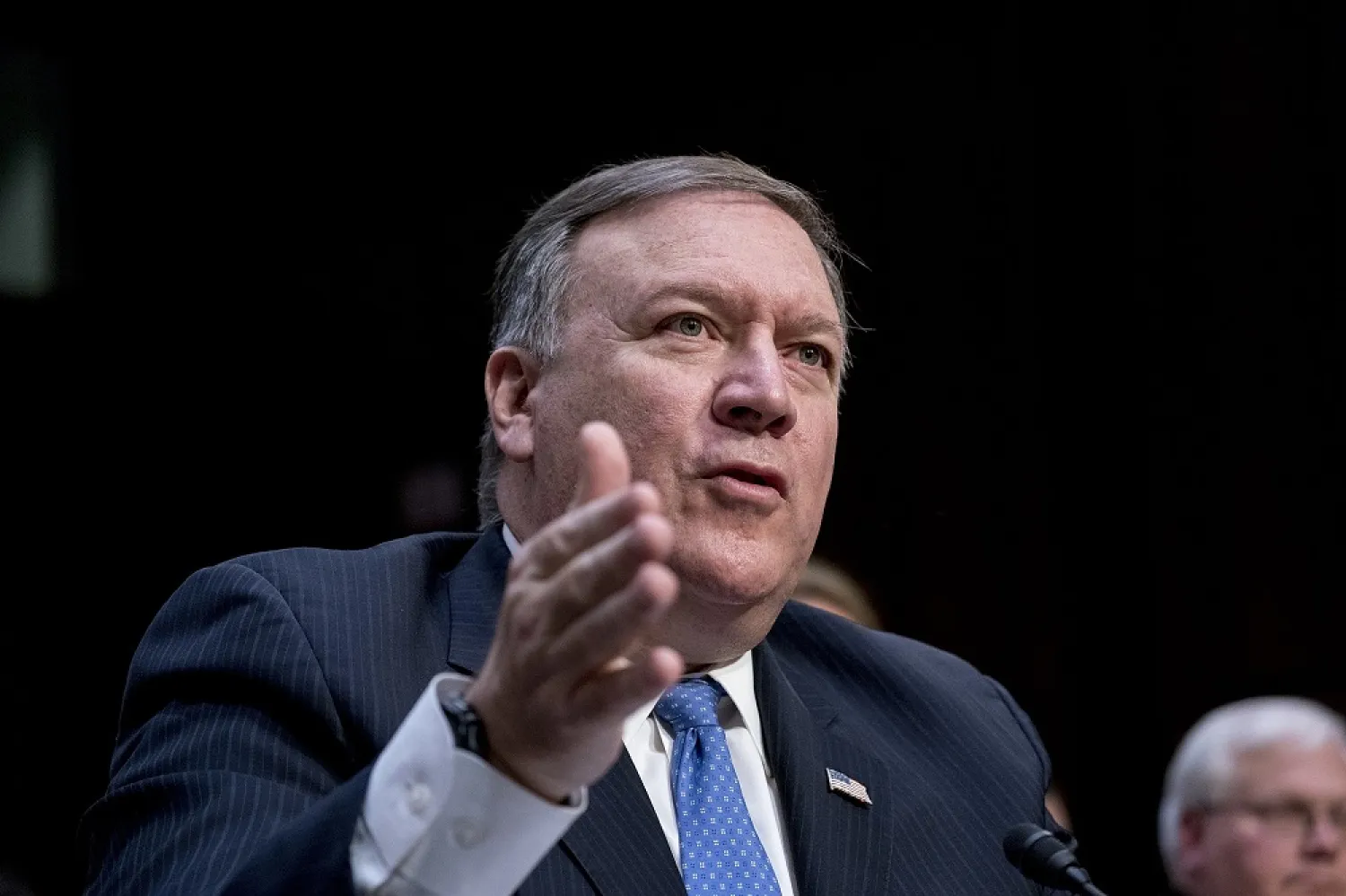

US Vows to Hit Iran with ‘Strongest Sanctions in History’

US Secretary of State Mike Pompeo. (AP)
TT

US Vows to Hit Iran with ‘Strongest Sanctions in History’

US Secretary of State Mike Pompeo. (AP)

US Secretary of State Mike Pompeo issued a severe warning to Iran on Monday, saying Washington would be ready to impose the “strongest sanctions in history” if it does not alter its regional policies.

In his first major foreign policy address since moving to the State Department from the CIA, the longtime Iran hawk and ardent opponent of the 2015 nuclear pact outlined an aggressive series of moves designed to counter Tehran, which he called the world's top sponsor of terror.

"Iran's leaders saw the deal as a starting gun for the march across the Middle East," Pompeo said.

Pompeo said the bet the deal would increase Middle East stability had been a bad one for America, Europe, the Middle East "and indeed for the entire world."

"We will apply unprecedented financial pressure on the Iranian regime. The leaders in Tehran will have no doubt about our seriousness," Pompeo said in a speech at the conservative Heritage Foundation think tank.

"This sting of sanctions will be painful if the regime does not change its course from the unacceptable and unproductive path it has chosen to one that rejoins the league of nations."

Pompeo said if Iran were to abide by the stricter terms, including ending its ballistic missile program and its interventions in regional conflicts from Yemen to Syria, the United States would lift its new sanctions.

"Iran will be forced to make a choice: either fight to keep its economy off life support at home or keep squandering precious wealth on fights abroad. It will not have the resources to do both," he said.

Pompeo also cautioned European firms against continuing to do business in Tehran, toughening up Washington's policy line after its withdrawal from the nuclear pact.

President Donald Trump has long said the original 2015 deal with Iran -- also signed by Britain, China, France, Germany and Russia -- did not go far enough, and now wants the Europeans and others to support his hardline strategy.

The deal was designed to prevent Iran from developing a nuclear weapon. The international community, including top US officials, have said Tehran had been in compliance.

But Trump despised the deal, pointing to other aspects of Iranian behavior not covered in the pact, and on May 8 he pulled America out despite intense diplomatic efforts by European allies who had beseeched him to stick with it by adding tougher new elements.

Instead of suggesting a re-negotiation of the Iran deal, Pompeo outlined 12 tough conditions from Washington for any "new deal" with Tehran to make sure it "will never again have carte blanche to dominate the Middle East."

These essentially address every aspect of Iran's missile program and what the US calls its "malign influence" across the region, including support for Syrian regime leader Bashar al-Assad, Lebanon’s “Hezbollah” and Houthi militias in Yemen.

"It must cease its threatening behavior against its neighbors," Pompeo said.

"This certainly includes its threats to destroy Israel, and its firing of missiles into Saudi Arabia" and the United Arab Emirates, he added.

He said Iran must "stop enrichment" of uranium and never preprocess plutonium. Iran must also allow nuclear "unqualified access to all sites throughout the country."

Iran must also "release all US citizens" missing in Iran or being held on "spurious charges," he added.

Laying out Trump's new approach, Pompeo said he could not put a timeline on how long the strategy might take.

"At the end of the day, the Iranian people will get to make their choice about their leadership," Pompeo continued. "If they make the decision quickly, that would be wonderful. If they choose not to do so, we will stay hard at this until we achieve the outcomes that I set forward today."

"It is America's hope that our labors toward peace and security will bear fruit for the long-suffering people of Iran," Pompeo stressed.

European allies heard how he expects their support for the new US plan -- but he offered nothing in return, and threatened economic fallout for anyone still dealing with Iran.

"We understand that our re-imposition of sanctions and the coming pressure campaign on the Iranian regime will pose financial and economic difficulties for a number of our friends," he said.

"We want to hear their concerns. But you know, we will hold those doing prohibited business in Iran to account."

The re-establishment of the US sanctions will force European companies to choose between investing in Iran or trading with the United States.

In reality, there is no choice -- European companies cannot afford to forsake the US market.

For now, the European Union is trying to persuade Iran to stay in the 2015 agreement, even without Washington's participation.



US Judge Blocks Deportation of Columbia University Palestinian Activist

Mohsen Mahdawi at a press conference in Vermont last year - Photo by Alex Driehaus/AP
TT

US Judge Blocks Deportation of Columbia University Palestinian Activist

Mohsen Mahdawi at a press conference in Vermont last year - Photo by Alex Driehaus/AP

A US immigration judge has blocked the deportation of a Palestinian graduate student who helped organize protests at Columbia University against Israel's war in Gaza, according to US media reports.

Mohsen Mahdawi was arrested by immigration agents last year as he was attending an interview to become a US citizen.

Mahdawi had been involved in a wave of demonstrations that gripped several major US university campuses since Israel began a massive military campaign in the Gaza Strip.

A Palestinian born in the occupied West Bank, Mahdawi has been a legal US permanent resident since 2015 and graduated from the prestigious New York university in May. He has been free from federal custody since April.

In an order made public on Tuesday, Judge Nina Froes said that President Donald Trump's administration did not provide sufficient evidence that Mahdawi could be legally removed from the United States, multiple media outlets reported.

Froes reportedly questioned the authenticity of a copy of a document purportedly signed by Secretary of State Marco Rubio that said Mahdawi's activism "could undermine the Middle East peace process by reinforcing antisemitic sentiment," according to the New York Times.

Rubio has argued that federal law grants him the authority to summarily revoke visas and deport migrants who pose threats to US foreign policy.

The Trump administration can still appeal the decision, which marked a setback in the Republican president's efforts to crack down on pro-Palestinian campus activists.

The administration has also attempted to deport Mahmoud Khalil, another student activist who co-founded a Palestinian student group at Columbia, alongside Mahdawi.

"I am grateful to the court for honoring the rule of law and holding the line against the government's attempts to trample on due process," Mahdawi said in a statement released by his attorneys and published Tuesday by several media outlets.

"This decision is an important step towards upholding what fear tried to destroy: the right to speak for peace and justice."


Fire Breaks out Near Iran's Capital Tehran, State Media Says

Smoke rises from a fire caused by an explosion in Tehran (File photo - Reuters)
TT

Fire Breaks out Near Iran's Capital Tehran, State Media Says

Smoke rises from a fire caused by an explosion in Tehran (File photo - Reuters)

A fire broke out in Iran's Parand near the capital city Tehran, state media reported on Wednesday, publishing videos of smoke rising over the area which is close to several military and strategic sites in the country's Tehran province, Reuters reported.

"The black smoke seen near the city of Parand is the result of a fire in the reeds around the Parand river bank... fire fighters are on site and the fire extinguishing operation is underway", state media cited the Parand fire department as saying.


Pakistan PM Sharif to Seek Clarity on Troops for Gaza in US Visit

US President Donald Trump looks at Pakistan's Prime Minister Shehbaz Sharif speaking following the official signing of the first phase of the Gaza ceasefire agreement between Israel and Hamas, during a world leaders' summit on ending the Gaza war, in Sharm El-Sheikh, Egypt, October 13, 2025. REUTERS/Evelyn Hockstein/File Photo
TT

Pakistan PM Sharif to Seek Clarity on Troops for Gaza in US Visit

US President Donald Trump looks at Pakistan's Prime Minister Shehbaz Sharif speaking following the official signing of the first phase of the Gaza ceasefire agreement between Israel and Hamas, during a world leaders' summit on ending the Gaza war, in Sharm El-Sheikh, Egypt, October 13, 2025. REUTERS/Evelyn Hockstein/File Photo

Before Pakistan commits to sending troops to Gaza as part of the International Stabilization Force it wants assurances from the United States that it will be a peacekeeping mission rather than tasked with disarming Hamas, three sources told Reuters.

Pakistan's Prime Minister Shehbaz Sharif is set to attend the first formal meeting of President Donald Trump's Board of Peace in Washington on Thursday, alongside delegations from at least 20 countries.

Trump, who will chair the meeting, is expected to announce a multi-billion dollar reconstruction plan for Gaza and detail plans for a UN-authorized stabilization force for the Palestinian enclave.

Three government sources said during the Washington visit Sharif wanted to better understand the goal of the ISF, what authority they were operating under and what the chain of command was before making a decision on deploying troops.

"We are ready to send troops. Let me make it clear that our troops could only be part of a peace mission in Gaza," said one of the sources, a close aide of Sharif.

"We will not be part of any other role, such as disarming Hamas. It is out of the question," he said.

Analysts say Pakistan would be an asset to the multinational force, with its experienced military that has gone to war with arch-rival India and tackled insurgencies.

"We can send initially a couple of thousand troops anytime, but we need to know what role they are going to play," the source added.

Two of the sources said it was likely Sharif, who has met Trump earlier this year in Davos and late last year at the White House, would either have an audience with him on the sidelines of the meeting or the following day at the White House.

Initially designed to cement Gaza's ceasefire, Trump sees the Board of Peace, launched in late January, taking a wider role in resolving global conflicts. Some countries have reacted cautiously, fearing it could become a rival to the United Nations.

While Pakistan has supported the establishment of the board, it has voiced concerns against the mission to demilitarize Gaza's militant group Hamas.