


Guantanamo Detainee Population Quietly Ages

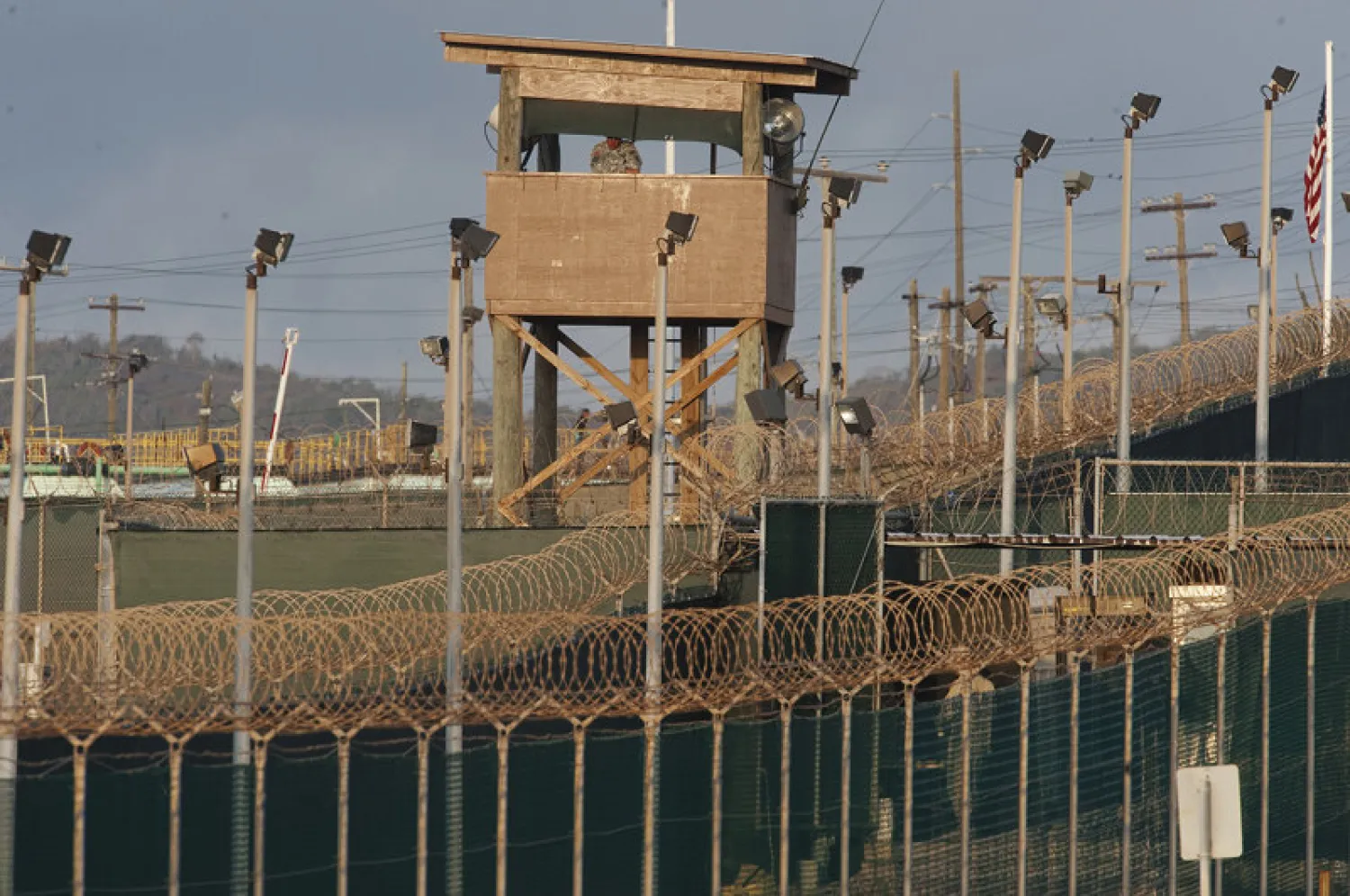
A US military member mans one of the watch towers at Camp Delta at the US Detention Center in Guantanamo Bay, Cuba Paul J. Richards/ AFP
TT

Guantanamo Detainee Population Quietly Ages

A US military member mans one of the watch towers at Camp Delta at the US Detention Center in Guantanamo Bay, Cuba Paul J. Richards/ AFP

They arrived at Guantanamo Bay as young men, captured on the battlefields of Afghanistan and elsewhere early in America's war on terror, following the September 11, 2001 attacks. 

More than 15 years later, most of the inmates at the notorious US military prison have reached middle age. 

This week, the White House seemed to acknowledge the obvious: with no plan or political will to do anything with Guantanamo's 40 remaining inmates, some of them could be stuck there for the rest of their lives.

"The current facility for high value detainees is experiencing structural and system failures that, if unaddressed, could in the future pose life and safety risks to our guard forces and the detainees being held there," the White House said in a policy statement to lawmakers.

"It also does not meet the requirements of the aging detainee population."

The Pentagon does not release any information about Guantanamo inmates, but leaked files published by WikiLeaks and the New York Times offer some insight.

On average, Guantanamo Bay's inmates are now about 46.5 years old.

The eldest, Pakistani national Saifullah Paracha, will turn 71 in August.

The youngest is Saudi citizen Hassan Mohammed Ali Bin Attash, who was born in 1985. He was just 16 or 17 when he was captured in 2002. The documents do not always provide a precise date of birth.

Neither the Pentagon nor Guantanamo Bay immediately responded to requests for comment for this story by Agence France Presse.

Perhaps the most notorious inmate, alleged 9/11 mastermind Khalid Sheikh Mohammed, is 53. 

The black moustache he sported when he was captured in 2003 has long since grown out into a voluminous grey beard that he now dyes orange.

James Connell, the attorney for Ramzi Binalshibh, who is charged as one of Mohammed's co-conspirators, said he'd noticed some accommodations for aging prisoners. 

"Some of attorney-client visiting spaces now have wheelchair ramps," he told AFP, adding that he'd also spotted handles to help inmates get up from the toilet.  

But, he stressed, there is "a lot of need for treatment that has not been given."

The International Committee of the Red Cross (ICRC) visits Guantanamo about four times a year to make sure the prison is complying with detention standards and to assess detainees' treatment.

"It is important to ensure that their health requirements can be adequately met, and we are actively engaged in dialogue with the US authorities on this matter," Marc Kilstein, an ICRC spokesman in Washington, told AFP.

Though the White House statement provided no details on what it envisions the changing needs of the Guantanamo population to be, older prisoners often suffer from chronic, age-related diseases that can be exacerbated by being locked up.

These can include heart failure, diabetes, cognitive problems and liver disease.

It already costs US taxpayers more than $450 million a year to keep the prisoners at Guantanamo Bay.

That figure will only rise as they age, Amnesty International security expert Daphne Eviatar told AFP, as the US is "required under international law to give them medical treatment."

"The US government by keeping them at Guantanamo Bay is essentially committing to taking care of them for the rest of their lives."

Some inmates already suffered poor health when they arrived at Guantanamo, whether through torture, conflict or poor living conditions, she noted.

Exacerbating the situation, Congress won't permit sick inmates to travel to the United States for treatment.

The Pentagon had to send a mobile MRI scanner to Guantanamo last year which cost $370,000 to rent, according to the Miami Herald. Initially, it didn't even work -- though it was later fixed.

As memories of the 9/11 attacks fade somewhat, many Americans are unaware the US still keeps prisoners locked up at Guantanamo. 

Five have been charged in the conspiracy to pull off the attacks and are being prosecuted through a special military commissions process that has been beset with legal challenges and seemingly interminable delays.

Among the rest of the population, two more have been charged with other crimes, two have been convicted and five were cleared for release under president Barack Obama but are now stuck under President Donald Trump, who has said he wants to send ISIS captives to Guantanamo.

But the largest contingent -- 26 inmates -- have never been charged with anything, yet were deemed too dangerous to be released. 

Nine detainees have already died at Guantanamo since it opened in early 2002, mainly through what the military said were suicides.

The way things are going, they are unlikely to be the last.


US Denies Iran Struck a Military Vessel during New Effort to Reopen Strait of Hormuz

Vessels in the Strait of Hormuz near Bandar Abbas, Iran, May 4, 2026. Amirhosein Khorgooi/ISNA/WANA (West Asia News Agency) via REUTERS
TT

US Denies Iran Struck a Military Vessel during New Effort to Reopen Strait of Hormuz

Vessels in the Strait of Hormuz near Bandar Abbas, Iran, May 4, 2026. Amirhosein Khorgooi/ISNA/WANA (West Asia News Agency) via REUTERS

The US military on Monday denied claims that Iran struck a Navy vessel as US forces now offer to guide commercial ships through the Strait of Hormuz, where hundreds have been stuck since the Iran war began. Tehran over the past two months has attacked some vessels and blocked others that don’t receive its authorization.

The US military’s Central Command also said two American-flagged merchant ships have “successfully transited through the Strait of Hormuz" and that that Navy guided-missile destroyers in the Arabian Gulf are helping to restore commercial shipping traffic.

The statement on X said the destroyers transited the Strait of Hormuz “in support of Project Freedom” and that the merchant ships are "safely headed on their journey." It did not say when the Navy ships arrived or when the merchant vessels departed.

Meanwhile, Iranian news agencies had earlier claimed that Iran struck a US vessel near an Iranian port southeast of the strait, accusing it of “violating maritime security and navigation norms.” The reports said the vessel was forced to turn back.

Also, Iran's state television reported that the Iranian navy fired cruise missiles, rockets and combat drones near US destroyers crossing the Strait of Hormuz on Monday,

It said the navy had identified US destroyers in the Strait of Hormuz and fired multiple warning shots, adding, "following the Zionist American destroyers' disregard for the initial warning, the Navy issued a warning shot by firing cruise missiles, rockets, and combat drones around the aggressor enemy vessels".


Top EU, US Trade Officials to Meet in Paris after Trump Threat

FILE PHOTO: US President Donald Trump takes questions from media at a press briefing at the White House - April 25, 2026. REUTERS/Jonathan Ernst/File Photo
TT

Top EU, US Trade Officials to Meet in Paris after Trump Threat

FILE PHOTO: US President Donald Trump takes questions from media at a press briefing at the White House - April 25, 2026. REUTERS/Jonathan Ernst/File Photo

The European Union's trade chief Maros Sefcovic will hold talks with his US counterpart on Tuesday in Paris, an EU spokesman said, following President Donald Trump's latest tariffs threat.

Trump said Friday that he will hike US levies on EU cars and trucks from this week to 25 percent, accusing the bloc of not complying with a tariff agreement reached last summer.

US Trade Representative Jamieson Greer told CNBC on Monday that EU officials have not adjusted their tariffs or rules yet despite the pact: "They've moved a tariff bill along in the European Parliament. It's been very slow."

He noted the move also had some amendments that would "limit the deal".

"After discussing this with our European colleagues over many, many months, the president decided that if the Europeans aren't implementing the deal right now, then we don't have to implement all of it either at this time," Greer added.

The EU dismissed the claim and insisted it remained committed to the deal.

"Since day one, we are implementing the joint statement, and we're fully committed to delivering on our shared commitments," EU spokesman Thomas Regnier said.

Sefcovic will meet Greer on the margins of a G7 ministerial meeting in Paris on Tuesday, the spokesman added, as he noted talks between the two sides continued at different levels.

The trade deal struck last summer lowered the US tariff on EU autos to 15 percent, which is below the 25-percent duty that Trump imposed on vehicles from many other trading partners.

The European Parliament has given its conditional approval to the EU-US trade pact, but under EU procedures, before the deal is implemented by the bloc, a final version still needs to be negotiated with member states.

Regnier said the EU kept Washington "fully informed throughout the process" and sought to "reassure the other side of the Atlantic, work is ongoing. Progress is being made".

While the EU has warned it is keeping its options open, Regnier refused to speculate on how the EU would act if the tariffs kick in.

"We will not escalate any threats. We focus on the implementation phase," he said.


Pakistan Facilitates Return of Iranian Crew from US-Seized Ship

 Ships and boats in the Strait of Hormuz, Musandam, Oman, May 1, 2026. (Reuters)
Ships and boats in the Strait of Hormuz, Musandam, Oman, May 1, 2026. (Reuters)
TT

Pakistan Facilitates Return of Iranian Crew from US-Seized Ship

 Ships and boats in the Strait of Hormuz, Musandam, Oman, May 1, 2026. (Reuters)
Ships and boats in the Strait of Hormuz, Musandam, Oman, May 1, 2026. (Reuters)

Pakistan said Monday it had facilitated the transfer of 22 Iranian crew members from a US-seized vessel, describing the move as a "confidence-building measure" amid fragile diplomatic contacts between Washington and Tehran.

The sailors, who had been held aboard the container ship Touska, were flown into Islamabad late Sunday and were due to be handed over to Iranian authorities, according to a statement from Pakistan's foreign ministry.

The handover follows a tense maritime standoff in the Gulf of Oman, where US forces intercepted the Iranian-flagged vessel.

President Donald Trump said the ship carried "a gift from China", an allegation Beijing rejected, insisting it opposed "any malicious association and speculation".

Iran has condemned the seizure as "piracy" and a violation of an April ceasefire, urging the United Nations to intervene.

Pakistan has positioned itself as a mediator for the war in the Middle East, hosting talks aimed at reducing friction between the United States and Iran.

The transfer of the crew was coordinated with both sides, Pakistan said, reflecting a rare instance of practical cooperation despite wider tensions over sanctions, shipping routes and regional security.

The vessel itself is expected to be returned after repairs.

Islamabad said it would continue to facilitate dialogue and diplomacy in pursuit of regional stability, as the Strait of Hormuz remains volatile and indirect US-Iran engagement politically sensitive.
