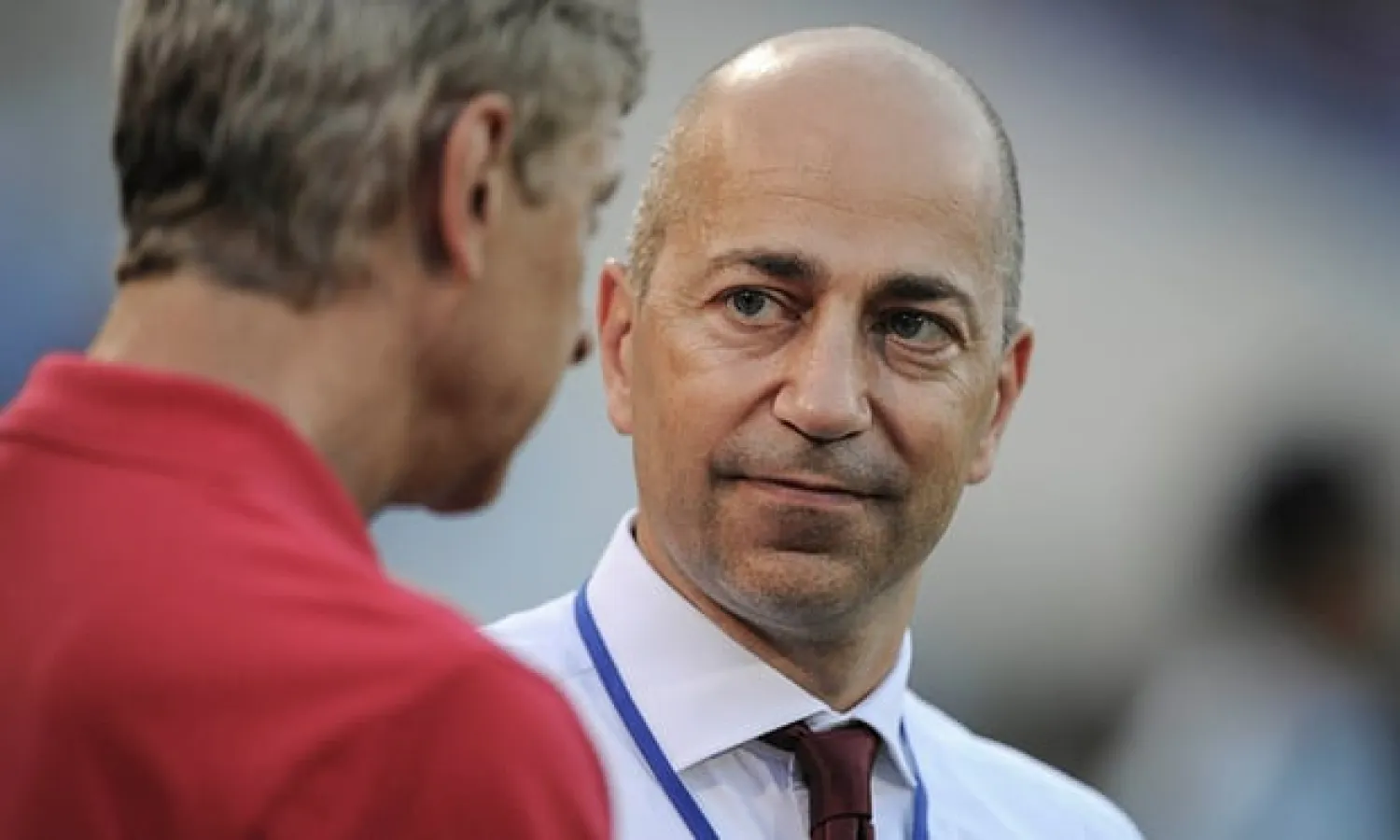
Ivan Gazidis Has Won Arsenal Power Battle but Arteta was a Gamble Too Far

 Ivan Gazidis has been able to overhaul Arsenal’s managerial structure while showing due respect to the departing Arsène Wenger. Photograph: Stuart MacFarlane/Arsenal FC via Getty Images
Ivan Gazidis has been able to overhaul Arsenal’s managerial structure while showing due respect to the departing Arsène Wenger. Photograph: Stuart MacFarlane/Arsenal FC via Getty Images
TT

Ivan Gazidis Has Won Arsenal Power Battle but Arteta was a Gamble Too Far

 Ivan Gazidis has been able to overhaul Arsenal’s managerial structure while showing due respect to the departing Arsène Wenger. Photograph: Stuart MacFarlane/Arsenal FC via Getty Images
Ivan Gazidis has been able to overhaul Arsenal’s managerial structure while showing due respect to the departing Arsène Wenger. Photograph: Stuart MacFarlane/Arsenal FC via Getty Images

Ivan Gazidis met the higher-ups at Real Madrid in August 2013 with the intention of signing one player – Ángel Di María. The Spanish club would not sell and, what was more, they told the Arsenal chief executive he could not have anybody.

Then Gazidis’s stars aligned. Over at the Real training pitches the club’s new manager, Carlo Ancelotti, told Mesut Özil he would not be assured of a starting place. Özil threw his toys and, rather abruptly, Gazidis was told he could take the Germany superstar, which he did.

Gazidis is fond of telling the story because it has plenty of zesty ingredients, not least football’s everlasting capacity to surprise. But he tells it, more than anything, because it was a cool thing to have been a part of and, at times like these, even men in his position and with his icy temperament can be touched by a childlike excitement.

Gazidis is, first and foremost, a football lover. Born in Johannesburg, he moved to Manchester at the age of four where he supported City and was an outstanding schoolboy player. Having obtained a masters in law, he pursued his career as a lawyer but the bug did not leave him. Gazidis was one of the founder members of Major League Soccer in the United States, and he worked there until 2008.

The Özil deal has been one of the high points of Gazidis’s nine and a half years at Arsenal and yet the opportunistic element to it did not seem to fit with his personality. Gazidis is not an off-the-cuff operator. He is a contemplator, a deep thinker, who will calmly consider each decision from every conceivable angle. Perhaps he quickly concluded that Özil was a no-brainer; he did not have to over-analyse this one.

Gazidis is primed to announce the most significant signing of his career and, as the process to appoint a managerial successor to Arsène Wenger approached its endgame last week, there was the temptation to wonder, once again, whether he was about to act out of character. The 53-year-old is, by nature, risk-averse and not inclined to roll the dice. And yet he looked set to go for Mikel Arteta – a man with zero experience of being a manager.

Gazidis sounds like a marketing executive when he describes Arsenal’s determination to do things their way, even if it means going against the grain. “We zig where others zag,” he once said. They were ready to zig and then some.

Something changed over the weekend and, rather than Arteta, Gazidis is now putting the finishing touches to the appointment of Unai Emery, the former Paris Saint-Germain and Sevilla manager – an altogether safer bet, despite his often volatile touchline manner. Many will say the Arsenal squad, so indulged by Wenger, need an iron-fist-in-an-iron-glove kind of guy.

The club have attempted a piece of revisionism and who can blame them? There was from the outset only one outstanding candidate for the job, they say, and he is about to get it. Why, then, were discussions so advanced with Arteta that the conversation had turned to his backroom staff? On Sunday night he still expected to be offered the post.

Maybe it was a fiendish attempt by Gazidis and his inner circle to throw people off the scent, to use Arteta as a smokescreen for Emery, before dashing his hopes at the last. Or maybe not. It is simply not Gazidis’s style.

More likely is that, when push came to shove, Gazidis played the percentages. Emery has experience, pedigree. He is an outstanding candidate because of his body of work over 14 seasons in management, particularly at Sevilla, where he won three Europa Leagues in a row.

Why is there still the feeling that Gazidis has somehow copped out; that he has taken the middle ground? Emery does not have the cachet of Ancelotti, Max Allegri or Luis Enrique while, at the other end of the spectrum, neither does the appointment fire the imagination in the same way that Arteta or Patrick Vieira might have done. Arsenal had an interest in Thomas Tuchel but he chose PSG. Now they have the man supplanted by him in Paris.

The broader context to the decision-making process has been shaped by Gazidis’s experience of working alongside, or underneath, everybody’s favourite benevolent dictator, Wenger.

Gazidis has long advocated a management structure that does not rest on a single point or employee because, when it fails, there is the potential for the whole thing to collapse. He has wanted a broader coalition of talented specialists greater than the sum of its parts and, for so long, his efforts were frustrated by Wenger, to whom the club’s majority shareholder, Stan Kroenke, was in thrall.

Wenger had a hotline to Kroenke and he could shape or veto Gazidis’s ideas. Gazidis wanted a director of football but Wenger pushed his friend Dick Law into a position of executive-level authority. Gazidis wanted greater expertise in data and contracts and hired Hendrik Almstadt only for Wenger to say he did not want him. Almstadt ended up going to Aston Villa.

Gazidis oversaw the purchase of the data analytics company, StatDNA, but Wenger was not a fan. Gazidis wanted to find a role for Arteta after he retired as a player at the club in 2016 but Wenger had warned that “you cannot create artificial positions”.

A criticism of Gazidis is that he picks his battles so carefully he avoids having them at all; that he did not do enough to fight Wenger for so many years and, consequently, the club was allowed to drift. There was the sense he feared that to fall out with Wenger would be to lose his job.

But, as the writing came to be writ larger on the wall for Wenger, Gazidis made his move. He said at the end of the 2015-16 season that the on-field under-achievement had to serve as the “catalyst for change” and, since then he has manoeuvred a clutch of new hires into position.

Gazidis has overhauled the structures at the club, with the most important appointments being those of Raúl Sanllehí, the director of football in all but name, and Sven Mislintat, the head of recruitment. Huss Fahmy has come in to handle player contracts and Gazidis has finally realised his vision – the creation of a bespoke support system around the manager, whose role is purely to coach the first team. Emery is merely the final piece in the jigsaw, albeit the pivotal one.

It was a meticulously orchestrated coup and Gazidis carried it off while showing all the respect in the world to Wenger, who has watched virtually all of his people leave the club. It has felt like a plot-line from Gomorrah, the Neapolitan mafia drama. Gazidis was not always the favourite to outlast Wenger. Now, his position looks stronger than ever.

With power comes public profile and Gazidis has never been comfortable with that. He made the decision to step out of the spotlight soon after his appointment at Arsenal, fearing that no good would come from being in the headlines and he very rarely agrees to media interviews.

However, when Wenger’s end-of-season departure was announced on 20 April, it was Gazidis who faced the cameras and journalists. By doing so he put himself front and centre of the club’s new era and he has stepped into the line of fire. Gazidis desperately needs Sanllehí and Mislintat to deliver, let alone Emery. Will it work? Will the various cogs click?

Gazidis was always going to be judged on The Succession and he has handled part one well enough, even if it was difficult to ease Wenger out and sell it as a mutual decision. The outpouring of love for the Frenchman came to hold sway. Now, part two looms. This is where it gets really interesting.

The Guardian Sport


Irish Boxer Lee Reeves Dies at Age 31, Three Months after Dublin Title Fight Injury

Irish boxer Lee Reeves. Reuters
TT

Irish Boxer Lee Reeves Dies at Age 31, Three Months after Dublin Title Fight Injury

Irish boxer Lee Reeves. Reuters

Irish boxer Lee Reeves has died more than three months after being injured during a fight in Dublin, promoter Queensberry said Tuesday. He was 31.

"Everyone at Queensberry is devastated to learn of the passing of Lee Reeves," Queensberry Promotions said in a statement.

Reeves was hospitalized after being knocked out by compatriot Gary Cully in the 10th and final round of their Boxing Union of Ireland Celtic super-lightweight title fight on Aug. 1.

Reeves was carried from the ring on a stretcher after receiving initial treatment.

Queensberry had said after the fight that his condition was critical but stable.

“Lee was an immensely talented boxer, as well as a true role model and inspiration to his community,” the statement added Tuesday, according to The Associated Press. “Our deepest condolences go to Lee’s family, friends and all those who loved him. We ask that their privacy be respected at this incredibly difficult time. Rest in peace, Lee.”


Alonso to Enter Dakar Rally with Loeb and Aston Martin Team

November 5, 2026 Aston Martin's Fernando Alonso during a press conference ahead of the F1 Sao Paulo Grand Prix. (Reuters)
TT

Alonso to Enter Dakar Rally with Loeb and Aston Martin Team

November 5, 2026 Aston Martin's Fernando Alonso during a press conference ahead of the F1 Sao Paulo Grand Prix. (Reuters)

Double Formula One champion Fernando Alonso will compete in next January's Dakar Rally in an Aston Martin Dreadnought entry run by engineering partner Prodrive.

The 45-year-old Spaniard, a 32-time Grand Prix winner and two-time Le Mans 24 Hours winner, will be racing in the annual event for the second time after competing with Toyota in 2020, finishing 13th.

France's nine-time world rally champion Sebastien Loeb and Brazil's reigning world rally-raid champion Lucas Moraes will be his teammates in a three-car entry.

The 49th edition of the Dakar Rally will ‌be held in ‌Morocco from January 9 to 23, with a prologue and first ‌stage ⁠in Portugal, after ⁠being moved from Saudi Arabia due to security concerns.

The 24-round Formula One season is due to start in Bahrain in March after testing in late February.

Alonso, who will again have compatriot and five-time motorcycle Dakar winner Marc Coma as co-driver, is racing in the Las Vegas Grand Prix this weekend. He said he had turned his thoughts to Dakar after deciding to continue in Formula One with Aston Martin.

“In the end, the decision became simple. I wanted to embrace ⁠the challenge completely and take on both Formula One and the ‌Dakar Rally in the same year," he explained in ‌a statement.

"In 2020, Dakar was one of the most challenging and enjoyable experiences of my career. ‌I have enormous respect for this race and the specialists who have mastered it.

"Formula One ‌remains my priority. But I am a racing driver, and challenges like this are why I love competing. I’m looking forward to seeing what we can achieve."

LOEB CHASES FIRST DAKAR WIN

In October, Alonso told reporters at the Singapore Grand Prix that he felt the desert endurance race would be physically ‌incompatible with his Formula One commitments.

Loeb, 52, will also be chasing a first Dakar win after 10 previous attempts that have brought ⁠him 28 stage ⁠wins to date.

“Winning the Dakar is very important to me,” said the Frenchman, who will be partnered by Belgian Fabian Lurquin. “We have come close several times, and the motivation is there to keep working until we achieve it."

The Dreadnought is a digital-only tactical SUV created exclusively for gamers playing "Call of Duty: Modern Warfare 4" that will now be brought into the real world by Prodrive, Aston Martin's partners in endurance GT racing.

The Dakar will be Aston Martin Racing’s debut in the world rally-raid championship.

"Aston Martin's ambition for this program has been clear from the outset: to create a car capable of competing at the front of the world's toughest motorsport event," said Prodrive Chairman David Richards.

"By combining Aston Martin's vision with Prodrive's experience in rallying, endurance racing and Dakar competition, we have built a strong foundation. With an exceptional driver line-up and a highly capable engineering team, we look forward to seeing Dreadnought take on this remarkable challenge."


Owono Does Not Deserve 12-Match Ban Over De Miguel Death, Says Andorra Owner Pique

Equatorial Guinea's goalkeeper #01 Jesus Owono leaves the pitch at half time during the Africa Cup of Nations (CAN) Group E football match between Equatorial Guinea and Algeria at Moulay Hassan Stadium in Rabat on December 31, 2025. (AFP)
TT

Owono Does Not Deserve 12-Match Ban Over De Miguel Death, Says Andorra Owner Pique

Equatorial Guinea's goalkeeper #01 Jesus Owono leaves the pitch at half time during the Africa Cup of Nations (CAN) Group E football match between Equatorial Guinea and Algeria at Moulay Hassan Stadium in Rabat on December 31, 2025. (AFP)

FC Andorra owner Gerard ‌Pique said goalkeeper Jesus Owono did not deserve the 12-match suspension he received following the challenge that led to the death of Tenerife forward Jesus de Miguel.

Owono and De Miguel collided during a Spanish second-tier match on November 2. De Miguel was taken to intensive care and died the following day.

The disciplinary committee of the Spanish football federation (RFEF) banned Owono for violent conduct which resulted in serious ‌injury last week.

"Players, ‌former players, coaches, goalkeepers, everyone has ‌called ⁠it an accident," ⁠Pique said in a video posted on social media late on Monday.

"I truly believe that imposing the maximum sanction on Jesus for this action puts him in a situation he does not deserve, because he is not to blame for all of ⁠this having happened."

Former Barcelona player Pique ‌pointed to the three-match ‌ban handed to Albacete's Jose Corpas for accidentally kicking Sabadell ‌player Quadri Liameed in the head during a ‌recent match in Spain.

"Fortunately Quadri is fine, the consequences in this case were not fatal, and the committee decided to sanction Corpas with three matches," Pique added.

"With ‌all this, my reflection is: what is being sanctioned, the action or the ⁠consequences?"

The RFEF ⁠did not immediately respond to a request for comment outside regular business hours in Spain.

Owono, 25, has withdrawn from Equatorial Guinea's squad for Africa Cup of Nations qualifiers against Zimbabwe this month and Pique said it was unlikely the goalkeeper would return to action as soon as his suspension is up.

"Jesus is going to need far more than 12 matches before he is available and able to compete," he added. "No sanction is going to bring Demi (De Miguel) back to us."