

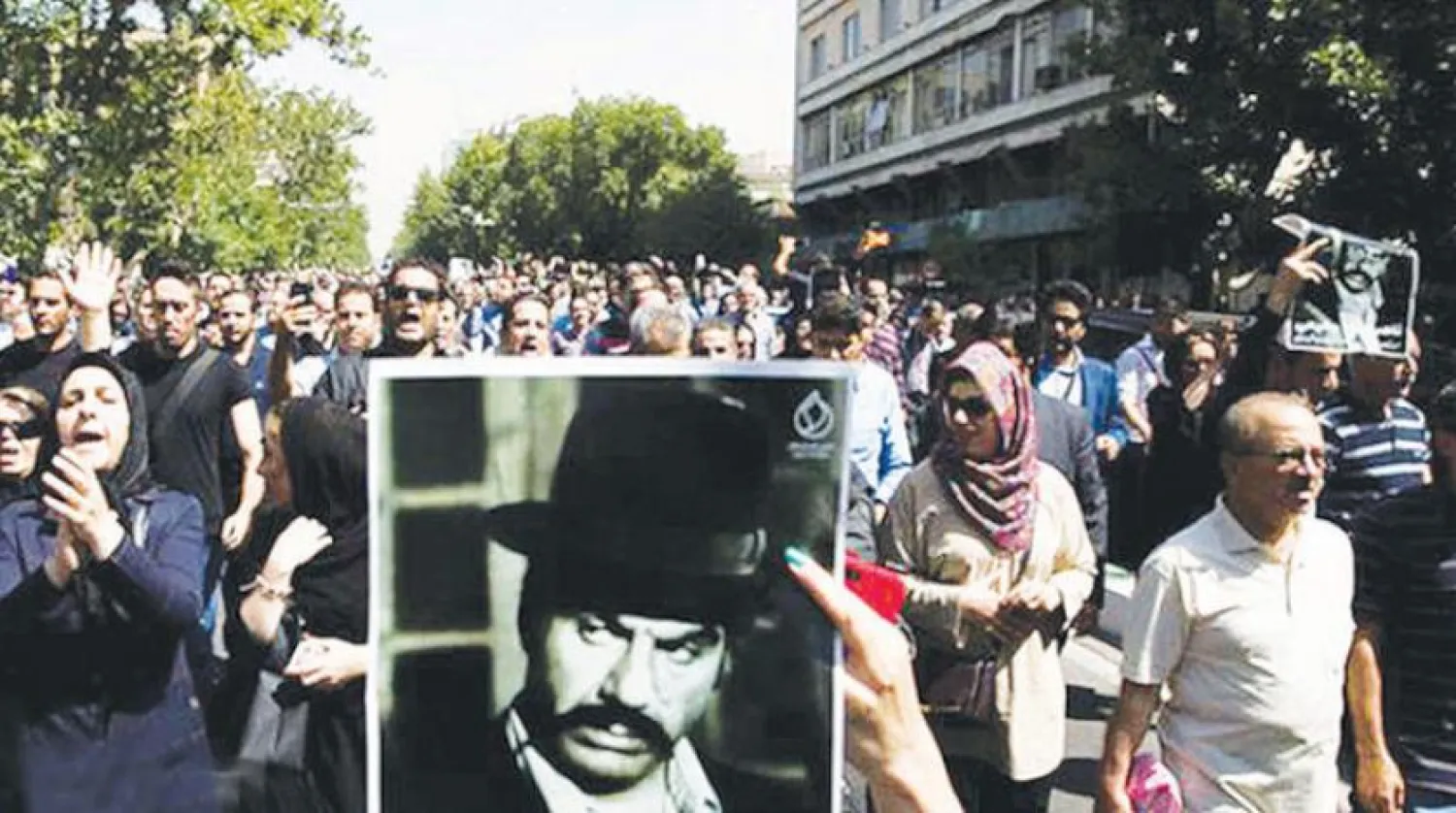

Malek-Motiee: The Regime Hated him, Iranians Loved him

Part of the funeral procession
TT

Malek-Motiee: The Regime Hated him, Iranians Loved him

Part of the funeral procession

“Qaysar, where are you? They’re killing your people!” This was one of the slogans chanted by thousands of mourners in Tehran on Sunday as they joined the funeral procession of one of Iran’s top film stars who died last week aged 88.

“Qeysar” was the name of one of the more the galaxy of top film stars.

Islamic zecurity had forbidden any eulogies in Sunday’s ceremonies to honor the star and there were fears that some marchers might transform the day into another anti-regime occasion.

However, the procession right to the graveyard where the star was buried went relatively peacefully.

The procession started in front of the House of Cinema and was attended by a “who-is-who” of Iranian cinema, theatre and artistic elite. But the bulk of the estimated 30,000 people who turned up were ordinary citizens, people of all generations who have lived with Malek-Motiee’s films for almost three generations. Soon after he seized power in Tehran Ruhollah Khomeini banned Malek-Motiee and virtually all other actors and actresses of Iranian cinema. Many of them, including Malek-Motiee, were thrown in prison and subjected to a total ban on the mention of their names let alone participation in artistic events. However, the pre-Khomeini cinema continued to live and, thanks to new technology, popular films have been seen by millions of Iranians through the Internet or via satellite TV channels based outside Iran.

Malek-Motiee brought new strata of Iranian society under limelight, playing ordinary folks in extraordinary situations, poor-but-noble men, marginals and lovers. He was fetish actor of Samuel Khachikian, father of Iranian film-noir. Mullahs hated him, Iranians loved him.

From his first feature film "Velgard" (Vagabond) it was clear that the camera loved Malek-Motiee and was loved back by him. His style of acting, a mixture of strength, flexibility and grace, enabled him to avoid being type-cast, a danger that Iranian film-stars faced in the post-Second World War period.

In films such as “Afsungar” (The Enchantress) and "The Crossroad of Events" he played the tough guy facing seemingly insurmountable challenges.

Later, he also learned the art of dealing with television as a new medium, adding small-screen stardom to his already well-established star status in cinema.

Iranian cinema started in 1906 with a number of short films which we now label documentaries. The first feature films came in the 1920s and the first “talkie”, the now classical “Jaafar and Golnar” came in 1936. However, it was only in the late 1940s that film-making in Iran developed into a full-scale industry. Such films as “Masti Eshq” (Drunk with Love) and “Sharmsar” (Repentant) attracted audiences large enough to sustain the industry.

Malek-Motiee began his career in the 1950s and soon a mass following of his own. By the 1970s, Iran was one of the four biggest producers of feature films after the US, India and France.

In the late 1950s, as roving reporter for the then fashionable weekly "Roshanfekr" (Intellectual) I interviewed Malek-Motiee on a number of occasions. We also met as members of the Tehran Cine Club presided over by the renowned film critic and cineaste Houshang Kavousi.

Malek-Motiee was never political. So I always wondered why ayatollahs hated him to the point of banning him from the screen, even forbidding the mention of his name in the state-controlled media.

One reason, perhaps, was that Malek-Motiee was the first Iranian actor to kiss an actress, the gorgeous Vida Qahremani, on lips, a scene that had the effect of an earthquake throughout Iran! Rumour had it that after hearing of the "outrage" on screen Ayatollah Golpayegani of Qom almost suffered a heart attack.

Qahremani had to go into semi-clandestinely, refusing new roles for two years.

Asked about the historic kiss on celluloid at the time, Malek-Motiee told “Roshanfekr“ that he still coveted the "kisses not yet given".

Malek-Motiee's favorite actors included the French Jean Gabin, the Italian Aldo Fabrizi, the Russian Sergei Bondarchuk, the British Alec Guinness and the American Frederic March. An avid film-buff, Malek-Motiee, or "Agha Nasser" to his friends, liked to see a minimum of three films a week. Cinema was his life and, for generations, he was the life of Iranian cinema.

A thorough gentleman, Malek-Motiee was a symbol of all that was good about Iran at a time that much was good about Iran.




Great White Shark Caught on Underwater Footage During Mediterranean Clean-up

People fish at sunset near the Corniche Al-Manara seafront promenade on the Mediterranean coast in Beirut, Lebanon, 05 June 2026. (EPA)
TT

Great White Shark Caught on Underwater Footage During Mediterranean Clean-up

People fish at sunset near the Corniche Al-Manara seafront promenade on the Mediterranean coast in Beirut, Lebanon, 05 June 2026. (EPA)

Divers removing abandoned ‌fishing nets from the central Mediterranean, between Italy and North Africa, have captured what they believe is the first-ever underwater footage of an adult great white shark in the region.

The sighting occurred as a team led by the Healthy Seas Foundation recovered so-called ghost nets from a shipwreck in the Strait of Sicily -- a biodiversity hotspot heavily impacted by industrial fishing.

The video, taken ‌last week and ‌released on Monday, shows the shark ‌accompanied ⁠by a dozen ⁠striped pilot fish, that often flank large predators in the hope of picking up leftovers.

Footage and photographs of the shark were filmed by volunteer diver Derk Remmers of Ghost Diving, one of the project partners.

"An offshore underwater shark encounter ⁠in the Mediterranean is insane," Remmers ‌said in a statement.

Another ‌member of the diving team, Pascal van Erp, ‌said on Facebook that the shark had likely ‌been drawn to dead marine life entangled in the abandoned fishing net, including lots of sea turtles.

While there have been occasional sightings of great whites in the ‌Mediterranean, the size of the population is unknown and previous encounters are not ⁠believed ⁠to have been filmed by divers, the foundation said.

"Moments like this remind us how much life can still exist in offshore Mediterranean waters and how important it is to protect it from preventable threats like abandoned fishing gear or overfishing," said Healthy Seas director Veronika Mikos.

Researchers working with the mission said the sighting could improve understanding of the distribution and behavior of the critically endangered species, though further analysis would be required before broader conclusions are drawn.


Aging France to See Population Fall After 2037 Peak

People walk along the Seine river in Paris on June 2, 2026 with in the background "La Caverne du Pont Neuf" ("The Pont Neuf Cave") artwork by French street artist and photographer JR on the Pont-Neuf bridge after it was damaged and torn by the wind. (Photo by SIMON WOHLFAHRT / AFP)
TT

Aging France to See Population Fall After 2037 Peak

People walk along the Seine river in Paris on June 2, 2026 with in the background "La Caverne du Pont Neuf" ("The Pont Neuf Cave") artwork by French street artist and photographer JR on the Pont-Neuf bridge after it was damaged and torn by the wind. (Photo by SIMON WOHLFAHRT / AFP)

France's population is expected to peak in 2037, seven years earlier than previously estimated, before shrinking back to around its 2014 level in the following decades, statistics agency INSEE said on Monday.

France has long had stronger demographics than most of Europe, but an ageing population and falling birth rates show it is not immune to the pressures straining public finances across the continent.

France's ⁠natural population growth ⁠turned negative in 2025 and will remain so, with gains until 2037 driven entirely by migration, INSEE said in its latest projections.

The population is expected to rise from 69.1 million in 2026 ⁠to a peak of 69.8 million in 2037, before falling to 65.9 million by 2070, roughly its 2014 level, Reuters reported.

INSEE's previous projections in 2021 put the peak later, in 2044, at about 69.3 million.

If migration weakens or fertility falls below the central assumption of 1.45 children per woman, the population could drop to as low ⁠as ⁠54.6 million by 2070.

As well as shrinking, the population will age significantly.

By 2070, one in three people in France will be aged 65 or older, about double the share under 20.

The sharpest shift will be among the oldest groups, with the number aged 80 and over more than doubling to around 9 million, while centenarians could quadruple to about 160,000


Cuba’s Iconic Antique Cars Sit Idle as US Energy Blockade Deepens Fuel Crisis

An old car drives past the Gran Hotel Bristol in Havana on June 3, 2026. (AFP)
TT

Cuba’s Iconic Antique Cars Sit Idle as US Energy Blockade Deepens Fuel Crisis

An old car drives past the Gran Hotel Bristol in Havana on June 3, 2026. (AFP)

A worsening fuel crisis across Cuba is testing the island's famed “almendrones," the vintage American cars that serve as vital shared taxis and embody the island’s ingenuity and endurance.

These days, many of the iconic gas-guzzling antique cars sit idle, casualties of fuel shortages that have gripped Cuba since January and that Cuban officials blame on a US energy blockade.

Outside his modest concrete-block home on a dirt road in Las Minas, a town of about 2,000 people on the outskirts of Havana, Diriel Valdez is restoring a 1951 Chevrolet Deluxe. The burgundy body is intact and the original engine still works. Finding fuel for it, however, is another matter.

Valdez is among thousands of Cubans waiting for fuel through a government reservation app that, for many, has become a symbol of the shortages it was designed to manage.

“I signed up in February ... I’m still somewhere around number 2,800,” said the 27-year-old who runs an auto body shop from his home.

The reward for the wait would be 20 liters (5.3 gallons) of gasoline — enough fuel, Valdez says, to get him to the beach.

The name almendrón comes from the Spanish word for almond, a reference to the rounded shape of the large American sedans imported before Cuba’s 1959 revolution.

For decades, sanctions, shortages and limited imports forced Cuban mechanics to become masters of improvisation. Engines were swapped, bodies rebuilt and replacement parts sourced from wherever they could be found.

On a recent night in Havana, as another blackout darkened much of the city, taxi driver Leonardo Daniel González steered a friend’s glowing purple 1948 Chevrolet Fleetmaster through the darkness.

“These cars are passed down from generation to generation,” said González, 30. “I had one that belonged to my great-grandfather. It went from him to my grandfather, then to my father, and then to me.”

The wait for fuel Cuba is experiencing one of its most severe energy crises in years. The population, already battered by decades of economic crises and shortages, is now navigating daily blackouts that can last up to 20 hours in some parts of the island.

The country produces only about 40% of the fuel it consumes and depends heavily on imports to keep its power plants running and its transportation network moving.

Since January, the Trump administration has tightened sanctions on Cuba as an element of its ongoing pressure campaign against the island’s communist government. Trump also threatened tariffs on countries that sell or transport oil to Cuba, further complicating the island’s efforts to secure fuel supplies. Just a single Russian tanker has delivered oil to the island nation since then.

Standing beside his Chevrolet in Las Minas, Valdez, who runs the auto body shop, said the fuel shortage is also affecting his livelihood. He learned auto-body work from his stepfather and has been repairing classic cars since he was 13.

“People don’t want to do major repairs anymore,” he said. “A lot of them have their cars parked. They don’t have much hope that they’ll be circulating the way they used to.”

Almendrones persist even with electric vehicles

As gasoline becomes harder to obtain, many drivers are turning to Cuba’s black market, where fuel can often be found more quickly, though at significantly higher prices that can reach up to $8 per liter ($30 per gallon).

Omar Everleny Pérez, a former economist at the University of Havana’s Center of Cuban Economic Studies, said the country’s transportation system still depends heavily on almendrones because modern vehicles remain out of reach for most Cubans.

“They’ve been vital to the transportation of ordinary Cubans,” he said. “Not only in Havana but throughout the country.”

New vehicles have become available in Cuba in recent years, but at prices far beyond the reach of most state-sector workers, Pérez said. That has helped keep the aging American cars on the road, even as a different future is beginning to emerge on Cuba’s streets.

Electric motorcycles imported from China have become increasingly common. Small electric vehicles are also appearing, aided by a growing network of solar-powered charging stations promoted by the government as part of its push toward renewable energy.

Back in Havana, González is not ready to write off the almendrones. Despite the lack of fuel and a sharp decline in tourism, he can still make a living off the old Chevrolet.

“There are ... several WhatsApp groups for us to find rides and so on,“ said González. “But tourism in Cuba is in very bad shape.”