
Zidane is Latest Proof Coaching Spain's Super-Clubs Can be Intolerable

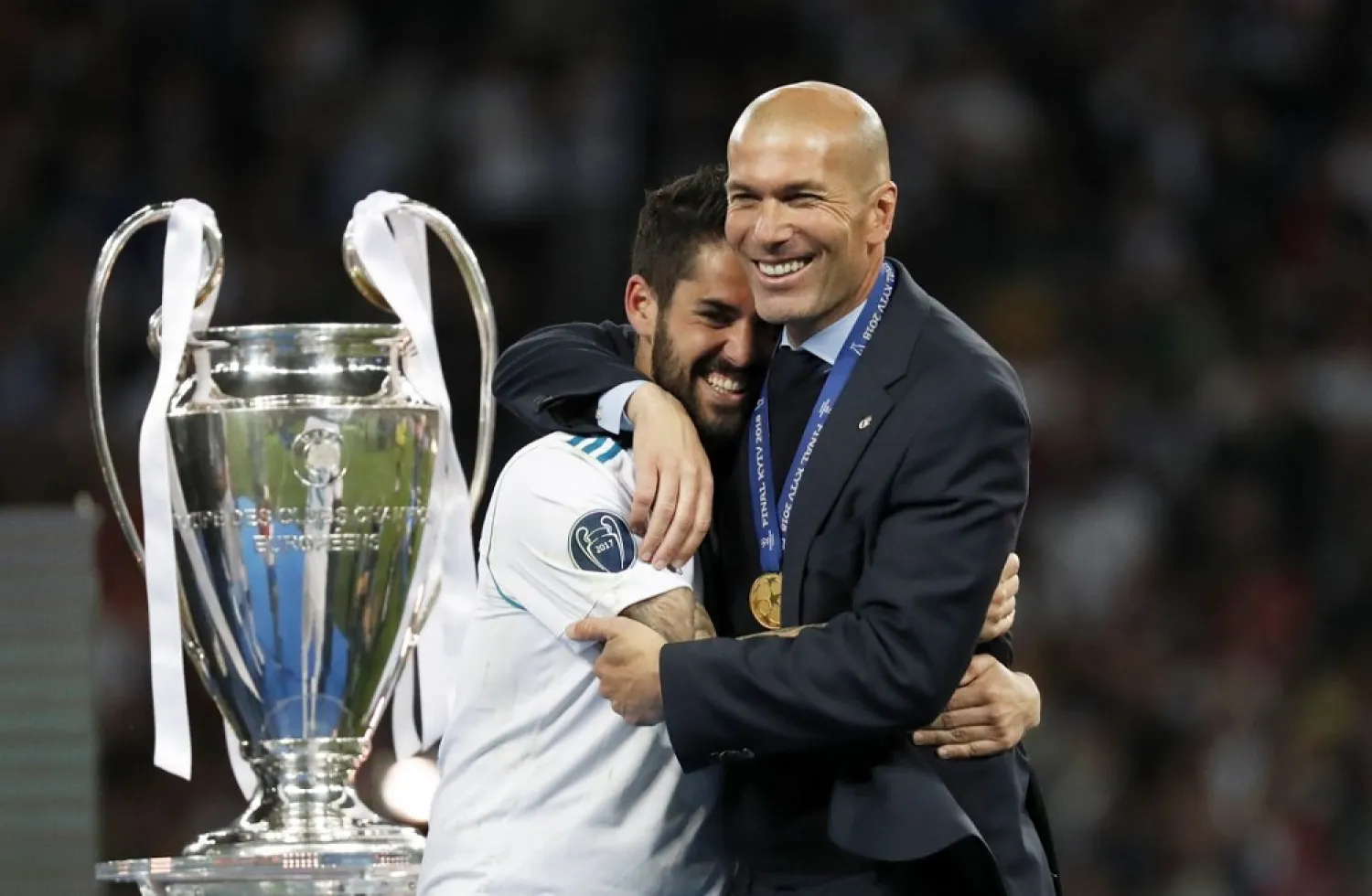
Real Madrid's Isco hugs coach Zinedine Zidane after winning the Champions League Final against Liverpool. (AP)
TT

Zidane is Latest Proof Coaching Spain's Super-Clubs Can be Intolerable

Real Madrid's Isco hugs coach Zinedine Zidane after winning the Champions League Final against Liverpool. (AP)

When Zinedine Zidane called time on his highly productive stint as the head of Real Madrid’s ego management department, it was interesting to reflect that this week marked the 20th anniversary of the sacking of Jupp Heynckes, eight days after he had steered the club to its seventh European Cup.

The celebrations had barely finished when Lorenzo Sanz, Real’s president at the time, observed that “this would have been one of the worst seasons in recent years” if Heynckes had not ended his debut campaign by beating Juventus in the Champions League final. The German’s crime was to finish fourth in La Liga, which passes for a crisis at the Bernabéu, and he would not be the last manager to suffer from Madrid’s ruthless self-regard.

Some illustrious names have fallen by the wayside. Vicente del Bosque was fired after delivering two Champions Leagues in four seasons, Carlo Ancelotti went a year after ending the quest for La Decima and Fabio Capello lasted only 11 days after winning La Liga in 2007. Perhaps that history has informed Zidane’s thinking.

“It’s not me,” Zidane might as well have said as he spoke about his break-up with Real. “It’s them.” This was a departure from the normal script. Not many coaches get to leave the Bernabéu on their own terms. Many dream of working there. Yet it is difficult to argue with Zidane’s decision to punch first, bearing in mind how suffocating the top of Spanish football has become. There is a precedent, after all, given that it is now six years since Pep Guardiola decided that four seasons as Barcelona’s manager had done quite enough damage to his hairline. “I’m drained,” he said after resigning. “I need to fill up.”

That was no one-off. Luis Enrique, who managed Barcelona between 2014 and 2017, also found the pressure too much to bear. He won the treble in his first season but doubts bubbled away and the criticism had risen to an intolerable pitch by the time he announced he needed a rest in March 2017.

Ernesto Valverde has won La Liga and the Copa Del Rey since replacing Enrique but not everyone is satisfied. There have been complaints about his caution and, having capitulated to Roma in their Champions League quarter-final, Barcelona’s hopes of becoming the first Spanish side to complete an unbeaten league campaign in 86 years went up in smoke when they lost their penultimate game of the season against Levante.

The problem for Enrique, Guardiola and Zidane is that keeping people happy has become a thankless task. That is true of a lot of big clubs, especially in the Premier League, but nowhere is it more pronounced than at Barcelona and Real, both of whom have dominated to such an extent at home and abroad that the lines between success and failure have become blurred. When you have been in eight consecutive Champions League semi-finals, as Real have, it is hard to feel satisfied. The contrast with their opponents in the Champions League final was telling: Liverpool were devastated by defeat but happy to have taken part.

It is unlikely Jürgen Klopp would be given time to build at Barcelona or Real. There is no room for a dip, making it impossible for managers to keep meeting stratospheric expectations. But sympathy is in short supply because they enjoy so many advantages over their rivals. Achievements become distorted and difficult to judge.

Guardiola replaced Heynckes at Bayern and looks ready for a long-term project at Manchester City, but critics point out he has not won the Champions League since leaving the Camp Nou. Enrique’s critics argue he had an attack of Messi, Neymar and Luis Suárez and that it would be more of a risk for Chelsea to appoint him than Maurizio Sarri, whose work at Napoli makes him seem a more progressive and imaginative option.

As for Zidane, the debate rages about whether he is a good manager or simply someone who was in the right place at the right time when Madrid fired Rafael Benítez in 2015. He has won three consecutive Champions League titles and has often made excellent substitutions in big matches. Yet he has Cristiano Ronaldo and it is easier to make tactical tweaks when Gareth Bale can come off the bench to score an overhead kick.

The only way for Zidane to silence the skeptics is for him to flourish in less favorable conditions. But, like Enrique and Guardiola, it is not difficult to appreciate why he wants a fresh start, away from an environment in which winning has managed to become essential and meaningless at the same time. That can make everything feel rather joyless and explains why the man who is tired with life at the top in Spain is simply, well, tired.

The Guardian Sport


Shakhtar Boss Pays Ukrainian Racer $200,000 After Games Disqualification

Ukrainian President Volodymyr Zelenskiy holds helmet as he meets with a Ukrainian skeleton racer Vladyslav Heraskevych , who was disqualified from the Olympic skeleton competition over his "helmet of remembrance" depicting athletes killed since Russia's invasion and his father and coach, Mykhailo Heraskevych, amid Russia's attack on Ukraine, in Munich, Germany February 13, 2026. (Ukrainian Presidential Press Service/Handout via Reuters)
TT

Shakhtar Boss Pays Ukrainian Racer $200,000 After Games Disqualification

Ukrainian President Volodymyr Zelenskiy holds helmet as he meets with a Ukrainian skeleton racer Vladyslav Heraskevych , who was disqualified from the Olympic skeleton competition over his "helmet of remembrance" depicting athletes killed since Russia's invasion and his father and coach, Mykhailo Heraskevych, amid Russia's attack on Ukraine, in Munich, Germany February 13, 2026. (Ukrainian Presidential Press Service/Handout via Reuters)

The owner of ‌Ukrainian football club Shakhtar Donetsk has donated more than $200,000 to skeleton racer Vladyslav Heraskevych after the athlete was disqualified from the Milano Cortina Winter Games before competing over the use of a helmet depicting Ukrainian athletes killed in the war with Russia, the club said on Tuesday.

The 27-year-old Heraskevych was disqualified last week when the International Bobsleigh and Skeleton Federation jury ruled that imagery on the helmet — depicting athletes killed since Russia invaded Ukraine in 2022 — breached rules on athletes' expression at ‌the Games.

He ‌then lost an appeal at the Court ‌of ⁠Arbitration for Sport hours ⁠before the final two runs of his competition, having missed the first two runs due to his disqualification.

Heraskevych had been allowed to train with the helmet that displayed the faces of 24 dead Ukrainian athletes for several days in Cortina d'Ampezzo where the sliding center is, but the International Olympic Committee then ⁠warned him a day before his competition ‌started that he could not wear ‌it there.

“Vlad Heraskevych was denied the opportunity to compete for victory ‌at the Olympic Games, yet he returns to Ukraine a ‌true winner," Shakhtar President Rinat Akhmetov said in a club statement.

"The respect and pride he has earned among Ukrainians through his actions are the highest reward. At the same time, I want him to ‌have enough energy and resources to continue his sporting career, as well as to fight ⁠for truth, freedom ⁠and the remembrance of those who gave their lives for Ukraine," he said.

The amount is equal to the prize money Ukraine pays athletes who win a gold medal at the Games.

The case dominated headlines early on at the Olympics, with IOC President Kirsty Coventry meeting Heraskevych on Thursday morning at the sliding venue in a failed last-minute attempt to broker a compromise.

The IOC suggested he wear a black armband and display the helmet before and after the race, but said using it in competition breached rules on keeping politics off fields of play. Heraskevych also earned praise from Ukraine President Volodymyr Zelenskiy.


Speed Skating-Italy Clinch Shock Men’s Team Pursuit Gold, Canada Successfully Defend Women’s Title

 Team Italy with Davide Ghiotto, Andrea Giovannini, Michele Malfatti, celebrate winning the gold medal on the podium of the men's team pursuit speed skating race at the 2026 Winter Olympics, in Milan, Italy, Tuesday, Feb. 17, 2026. (AP)
Team Italy with Davide Ghiotto, Andrea Giovannini, Michele Malfatti, celebrate winning the gold medal on the podium of the men's team pursuit speed skating race at the 2026 Winter Olympics, in Milan, Italy, Tuesday, Feb. 17, 2026. (AP)
TT

Speed Skating-Italy Clinch Shock Men’s Team Pursuit Gold, Canada Successfully Defend Women’s Title

 Team Italy with Davide Ghiotto, Andrea Giovannini, Michele Malfatti, celebrate winning the gold medal on the podium of the men's team pursuit speed skating race at the 2026 Winter Olympics, in Milan, Italy, Tuesday, Feb. 17, 2026. (AP)
Team Italy with Davide Ghiotto, Andrea Giovannini, Michele Malfatti, celebrate winning the gold medal on the podium of the men's team pursuit speed skating race at the 2026 Winter Olympics, in Milan, Italy, Tuesday, Feb. 17, 2026. (AP)

An inspired Italy delighted the home crowd with a stunning victory in the Olympic men's team pursuit final as

Canada's Ivanie Blondin, Valerie Maltais and Isabelle Weidemann delivered another seamless performance to beat the Netherlands in the women's event and retain their title ‌on Tuesday.

Italy's ‌men upset the US who ‌arrived ⁠at the Games ⁠as world champions and gold medal favorites.

Spurred on by double Olympic champion Francesca Lollobrigida, the Italian team of Davide Ghiotto, Andrea Giovannini and Michele Malfatti electrified a frenzied arena as they stormed ⁠to a time of three ‌minutes 39.20 seconds - ‌a commanding 4.51 seconds clear of the ‌Americans with China taking bronze.

The roar inside ‌the venue as Italy powered home was thunderous as the crowd rose to their feet, cheering the host nation to one ‌of their most special golds of a highly successful Games.

Canada's women ⁠crossed ⁠the line 0.96 seconds ahead of the Netherlands, stopping the clock at two minutes 55.81 seconds, and

Japan rounded out the women's podium by beating the US in the Final B.

It was only Canada's third gold medal of the Games, following Mikael Kingsbury's win in men's dual moguls and Megan Oldham's victory in women's freeski big air.


Lindsey Vonn Back in US Following Crash in Olympic Downhill 

Milano Cortina 2026 Olympics - Alpine Skiing - Women's Downhill 3rd Official Training - Tofane Alpine Skiing Centre, Belluno, Italy - February 07, 2026. Lindsey Vonn of United States in action during training. (Reuters)
TT

Lindsey Vonn Back in US Following Crash in Olympic Downhill 

Milano Cortina 2026 Olympics - Alpine Skiing - Women's Downhill 3rd Official Training - Tofane Alpine Skiing Centre, Belluno, Italy - February 07, 2026. Lindsey Vonn of United States in action during training. (Reuters)

Lindsey Vonn is back home in the US following a week of treatment at a hospital in Italy after breaking her left leg in the Olympic downhill at the Milan Cortina Games.

“Haven’t stood on my feet in over a week... been in a hospital bed immobile since my race. And although I’m not yet able to stand, being back on home soil feels amazing,” Vonn posted on X with an American flag emoji. “Huge thank you to everyone in Italy for taking good care of me.”

The 41-year-old Vonn suffered a complex tibia fracture that has already been operated on multiple times following her Feb. 8 crash. She has said she'll need more surgery in the US.

Nine days before her fall in Cortina d'Ampezzo, Italy, Vonn ruptured the ACL in her left knee in another crash in Switzerland.

Even before then, all eyes had been on her as the feel-good story heading into the Olympics for her comeback after nearly six years of retirement.