Mikel John Obi: ‘If Nigeria Were Organized We’d Have Won World Cup’

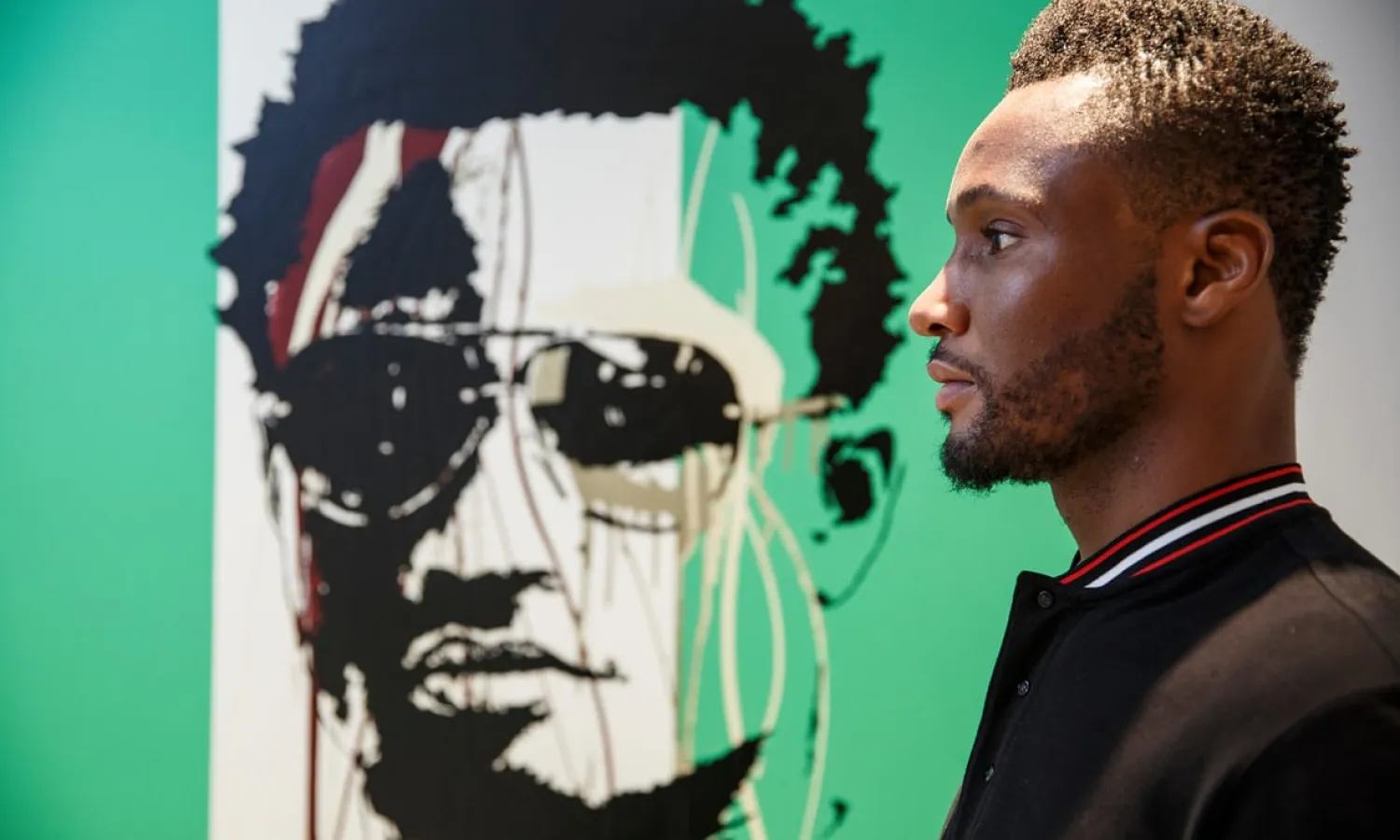
Mikel John Obi poses for a portrait next to a painting of himself in Nigeria colours at his house in Holland Park, west London. Nigeria play England at Wembley on Saturday. Photograph: Tom Jenkins/the Guardian
TT

Mikel John Obi: ‘If Nigeria Were Organized We’d Have Won World Cup’

Mikel John Obi poses for a portrait next to a painting of himself in Nigeria colours at his house in Holland Park, west London. Nigeria play England at Wembley on Saturday. Photograph: Tom Jenkins/the Guardian

For Mikel John Obi, it was the boyhood dream that soured. “It was a disaster,” the Nigeria midfielder says of the 2014 World Cup in Brazil – his first involvement at a finals.

From the outside looking in, there was a depressingly familiar undercurrent in the form of a pay dispute between the Nigeria Football Federation and the players. It led to a boycott of training from the latter days before the last-16 tie against France, which they lost 2-0. From the inside looking out, it was simply toxic.

“There were a lot of problems in the camp which a lot of people didn’t see, the media didn’t see – we kind of hid it under the table,” Mikel says. “The relationships between the players were not good and there was no discipline. There was no good feeling, no good vibe.

“It almost got to people being pinned up against dressing-room walls, although not quite. It was confrontation and arguments. Players wanted to do their own thing and they didn’t think about the team.”

Mikel is looking ahead to captaining Nigeria at the Russia World Cup and the preparations will ramp up on Saturday with the friendly against England at Wembley – the scene of some of Mikel’s most memorable triumphs from his 10 and a half seasons at Chelsea. The 31-year-old is now at Tianjin Teda in the Chinese Super League.

But the past is unavoidable for Nigeria and it has shaped what is a new era for them under the manager, Gernot Rohr – a disciplinarian German – and Mikel, whose status within the setup goes way beyond wearing the armband on match days.

The turmoil in Brazil had followed similar internal conflict at the 2010 World Cup in South Africa, when Nigeria departed at the group phase. Mikel missed the tournament through injury but he heard the stories and, afterwards, the then Nigeria president, Goodluck Jonathan, ruled that the national team should be suspended from competition for two years. The measure would be rescinded but it illustrated the depths of the despair; the sense that the squad had become ungovernable.

“There were massive problems in the camp and that’s why the president got upset,” Mikel says. “He said: ‘Until you guys fix yourselves up, that’s it. No more.’ The public were upset but they were in support of it because they also wanted whatever was going on to stop. We couldn’t keep going to tournaments and making a mockery of ourselves.”

It almost got to people being pinned against dressing-room walls, although not quite. It was confrontation and arguments
It was tempting to conclude that the shock therapy failed but, after Brazil, there remained the appetite for what Mikel describes as “radical change”. The squad has been purged and it says everything that Rohr will take only five survivors from the previous finals to Russia – Mikel, Victor Moses, Ahmed Musa, Ogenyi Onazi and Kenneth Omeruo.

The transition has been painful. Nigeria failed to qualify for the Africa Cup of Nations in 2015 and 2017 – a sentence that ought to finish with an exclamation mark. This is Nigeria – estimated population: 195 million; the largest African country, by far. They had won the 2013 Cup of Nations, in which Mikel was outstanding.

There had been trepidation when Rohr was appointed in August 2016 and Nigeria addressed a difficult World Cup qualifying group with Cameroon, Algeria and Zambia. Yet they would finish on top of it with a game to spare.

Mikel says that Rohr has driven the upturn through his attention to detail and his insistence upon certain standards, all of which come under the umbrella of putting the team first. He is forensic in his video-analysis sessions, his meetings, his work on set pieces, and that has added up to a change in the collective mentality.

Rohr’s squad is young and their inexperience is a worry. He has a group of 25 for the fixture against England; 14 of them are aged 25 or under. The young guns include Wilfred Ndidi, Alex Iwobi and Kelechi Iheanacho. But, crucially, Mikel says they are together; ready to fight for each other.

“The coach and myself, as captain, have tried to make these young players realize that we are a team, not individuals,” Mikel says. “If you don’t want to play together, you are welcome to leave. It’s amazing now to go to camp. You can feel the good feelings.

“I have been in the national team since 2005 and I haven’t seen this discipline before. It is meetings, being on time, the training. Sometimes a player has the hump because he knows he is not going to make the team and, before in the national team, he just strolls around. Now, you have to train properly. If you don’t, you are leaving the camp. The coach has changed the whole mentality.”

The warm-up game with England will stir the nostalgia in Mikel. He started in three FA Cup finals for Chelsea at Wembley and won them all, with the first – against Manchester United in 2007, at the end of his debut season – the most special. Mikel had chosen Chelsea over United when he moved from the Norwegian club Lyn Oslo in well-documented and acrimonious fashion.

“I thought I was going to get a punch from Sir Alex [Ferguson] in the tunnel,” Mikel says, with a laugh. “But that was a great game for me. Wembley is a very good ground for me.”

Mikel makes the reasonable point that he has nothing to prove to supporters in England, having won the lot at Chelsea – two Premier Leagues, four FA Cups (he got a medal in 2010, although he missed the final against Portsmouth because of injury), two League Cups, one Europa League and, most famously, one Champions League. Ever the big-game player, he starred in the final against Bayern Munich.

He is aware of the perception about top players who move to China – they are going there to retire; there is no way back into the leading European leagues. It needles him and it will give him extra edge against England.

“Look at Paulinho,” Mikel says, of the Brazil midfielder. “He went to Guangzhou Evergrande from Tottenham and then he got a move to Barcelona. You can still go back. It depends on how well you look after yourself. The players in China like Oscar, Ramires – we have offers, day in, day out, to come back to Europe.

“But if you make a decision, you need to stick by it. I have a contract [until next year] and I have to respect it. I like where I play. The culture is totally different and it’s something that I wanted to experience – and for my two little girls, as well.”

Mikel’s home remains in London. He lives in a fabulous Holland Park plot with his girlfriend, Olga Diyachenko, and their two-year-old twin daughters, Mia and Ava, although happily for him they are able to visit him in China for two- and three-month periods. The Premier League retains a pull for romantic and practical reasons. “Who knows where I am going to retire,” Mikel says. “Maybe I might come back here and retire.”

Mikel carries a lot of responsibility, not least in relation to his charity – the Mikel Obi Africa Children’s Sport Foundation. Mikel wants to set up sports academies across Africa with the goal of helping to alleviate poverty in the next generation of African children through sport.

It is the World Cup that preoccupies him and the question of how Nigeria will emerge from a group which contains Argentina, Croatia and Iceland. Mikel made his name as a holding midfielder at Chelsea but he plays as the No 10 for Nigeria, normally behind Odion Ighalo. The creative burden rests with him.

Above all Mikel – who was named as the captain by Rohr’s predecessor, Samson Siasia, in February 2016 – must embrace the role of senior statesman, diplomat and, essentially, the face of this Nigeria project. “African teams always tend to have problems inside the team,” Mikel says. “It might be bonuses, friendships, organization. If the Nigerian teams were as well organized as the Europeans, we would have won the World Cup by now. In Brazil, the financial aspect was a massive problem. Players didn’t want to train, they wanted to go on strike because they hadn’t received the bonus. This has to stop. We’ve stressed that it has to be sorted out this time.”

(The Guardian)


Irish Boxer Lee Reeves Dies at Age 31, Three Months after Dublin Title Fight Injury

Irish boxer Lee Reeves. Reuters
TT

Irish Boxer Lee Reeves Dies at Age 31, Three Months after Dublin Title Fight Injury

Irish boxer Lee Reeves. Reuters

Irish boxer Lee Reeves has died more than three months after being injured during a fight in Dublin, promoter Queensberry said Tuesday. He was 31.

"Everyone at Queensberry is devastated to learn of the passing of Lee Reeves," Queensberry Promotions said in a statement.

Reeves was hospitalized after being knocked out by compatriot Gary Cully in the 10th and final round of their Boxing Union of Ireland Celtic super-lightweight title fight on Aug. 1.

Reeves was carried from the ring on a stretcher after receiving initial treatment.

Queensberry had said after the fight that his condition was critical but stable.

“Lee was an immensely talented boxer, as well as a true role model and inspiration to his community,” the statement added Tuesday, according to The Associated Press. “Our deepest condolences go to Lee’s family, friends and all those who loved him. We ask that their privacy be respected at this incredibly difficult time. Rest in peace, Lee.”


Alonso to Enter Dakar Rally with Loeb and Aston Martin Team

November 5, 2026 Aston Martin's Fernando Alonso during a press conference ahead of the F1 Sao Paulo Grand Prix. (Reuters)
TT

Alonso to Enter Dakar Rally with Loeb and Aston Martin Team

November 5, 2026 Aston Martin's Fernando Alonso during a press conference ahead of the F1 Sao Paulo Grand Prix. (Reuters)

Double Formula One champion Fernando Alonso will compete in next January's Dakar Rally in an Aston Martin Dreadnought entry run by engineering partner Prodrive.

The 45-year-old Spaniard, a 32-time Grand Prix winner and two-time Le Mans 24 Hours winner, will be racing in the annual event for the second time after competing with Toyota in 2020, finishing 13th.

France's nine-time world rally champion Sebastien Loeb and Brazil's reigning world rally-raid champion Lucas Moraes will be his teammates in a three-car entry.

The 49th edition of the Dakar Rally will ‌be held in ‌Morocco from January 9 to 23, with a prologue and first ‌stage ⁠in Portugal, after ⁠being moved from Saudi Arabia due to security concerns.

The 24-round Formula One season is due to start in Bahrain in March after testing in late February.

Alonso, who will again have compatriot and five-time motorcycle Dakar winner Marc Coma as co-driver, is racing in the Las Vegas Grand Prix this weekend. He said he had turned his thoughts to Dakar after deciding to continue in Formula One with Aston Martin.

“In the end, the decision became simple. I wanted to embrace ⁠the challenge completely and take on both Formula One and the ‌Dakar Rally in the same year," he explained in ‌a statement.

"In 2020, Dakar was one of the most challenging and enjoyable experiences of my career. ‌I have enormous respect for this race and the specialists who have mastered it.

"Formula One ‌remains my priority. But I am a racing driver, and challenges like this are why I love competing. I’m looking forward to seeing what we can achieve."

LOEB CHASES FIRST DAKAR WIN

In October, Alonso told reporters at the Singapore Grand Prix that he felt the desert endurance race would be physically ‌incompatible with his Formula One commitments.

Loeb, 52, will also be chasing a first Dakar win after 10 previous attempts that have brought ⁠him 28 stage ⁠wins to date.

“Winning the Dakar is very important to me,” said the Frenchman, who will be partnered by Belgian Fabian Lurquin. “We have come close several times, and the motivation is there to keep working until we achieve it."

The Dreadnought is a digital-only tactical SUV created exclusively for gamers playing "Call of Duty: Modern Warfare 4" that will now be brought into the real world by Prodrive, Aston Martin's partners in endurance GT racing.

The Dakar will be Aston Martin Racing’s debut in the world rally-raid championship.

"Aston Martin's ambition for this program has been clear from the outset: to create a car capable of competing at the front of the world's toughest motorsport event," said Prodrive Chairman David Richards.

"By combining Aston Martin's vision with Prodrive's experience in rallying, endurance racing and Dakar competition, we have built a strong foundation. With an exceptional driver line-up and a highly capable engineering team, we look forward to seeing Dreadnought take on this remarkable challenge."


Owono Does Not Deserve 12-Match Ban Over De Miguel Death, Says Andorra Owner Pique

Equatorial Guinea's goalkeeper #01 Jesus Owono leaves the pitch at half time during the Africa Cup of Nations (CAN) Group E football match between Equatorial Guinea and Algeria at Moulay Hassan Stadium in Rabat on December 31, 2025. (AFP)
TT

Owono Does Not Deserve 12-Match Ban Over De Miguel Death, Says Andorra Owner Pique

Equatorial Guinea's goalkeeper #01 Jesus Owono leaves the pitch at half time during the Africa Cup of Nations (CAN) Group E football match between Equatorial Guinea and Algeria at Moulay Hassan Stadium in Rabat on December 31, 2025. (AFP)

FC Andorra owner Gerard ‌Pique said goalkeeper Jesus Owono did not deserve the 12-match suspension he received following the challenge that led to the death of Tenerife forward Jesus de Miguel.

Owono and De Miguel collided during a Spanish second-tier match on November 2. De Miguel was taken to intensive care and died the following day.

The disciplinary committee of the Spanish football federation (RFEF) banned Owono for violent conduct which resulted in serious ‌injury last week.

"Players, ‌former players, coaches, goalkeepers, everyone has ‌called ⁠it an accident," ⁠Pique said in a video posted on social media late on Monday.

"I truly believe that imposing the maximum sanction on Jesus for this action puts him in a situation he does not deserve, because he is not to blame for all of ⁠this having happened."

Former Barcelona player Pique ‌pointed to the three-match ‌ban handed to Albacete's Jose Corpas for accidentally kicking Sabadell ‌player Quadri Liameed in the head during a ‌recent match in Spain.

"Fortunately Quadri is fine, the consequences in this case were not fatal, and the committee decided to sanction Corpas with three matches," Pique added.

"With ‌all this, my reflection is: what is being sanctioned, the action or the ⁠consequences?"

The RFEF ⁠did not immediately respond to a request for comment outside regular business hours in Spain.

Owono, 25, has withdrawn from Equatorial Guinea's squad for Africa Cup of Nations qualifiers against Zimbabwe this month and Pique said it was unlikely the goalkeeper would return to action as soon as his suspension is up.

"Jesus is going to need far more than 12 matches before he is available and able to compete," he added. "No sanction is going to bring Demi (De Miguel) back to us."