Saudi ACWA Power Prepares to Run 2 Solar Plants in Moroccan Ouarzazate

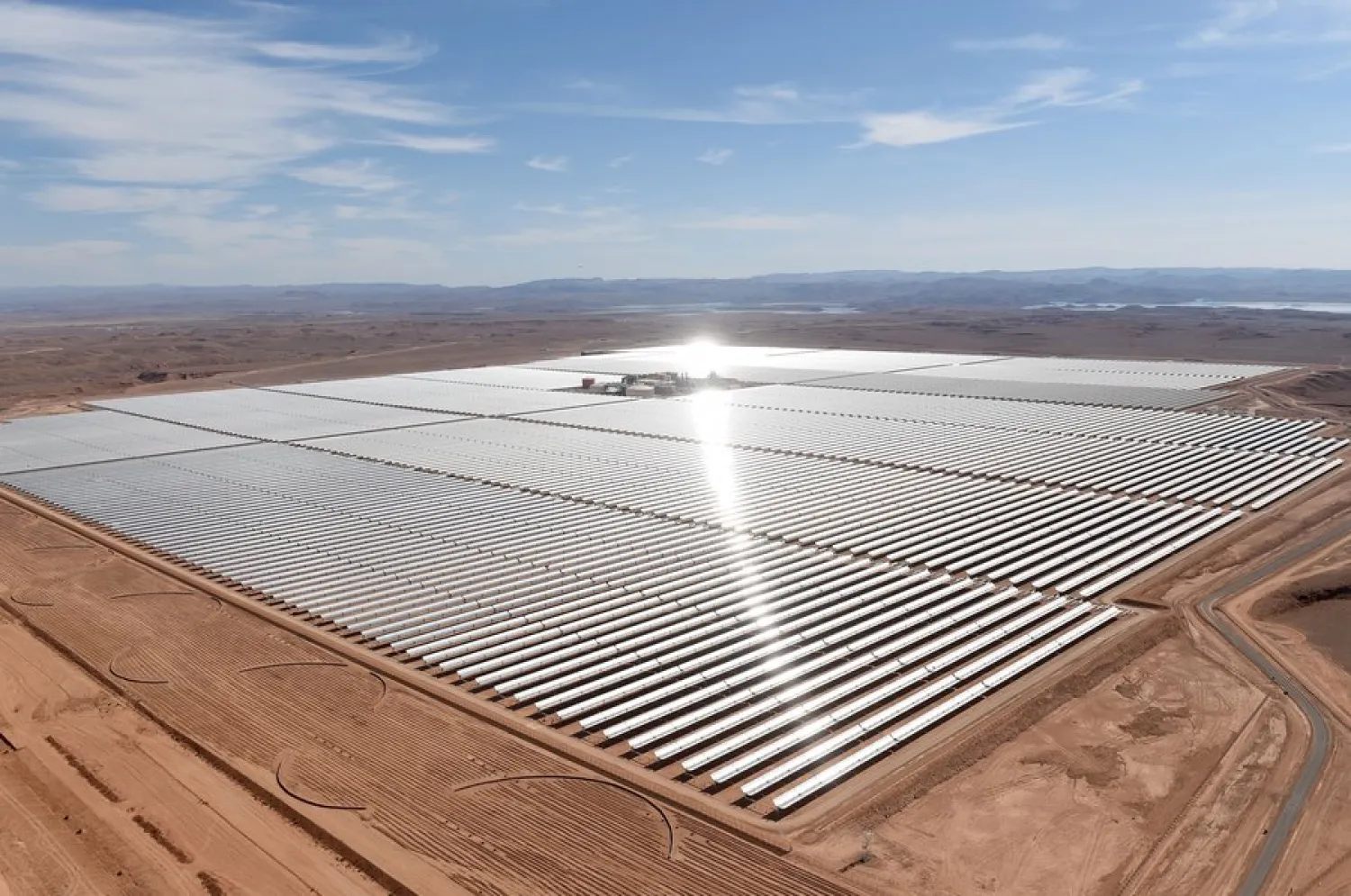
The Noor I Concentrated Solar Power plant in Morocco. (Getty Images)
TT

Saudi ACWA Power Prepares to Run 2 Solar Plants in Moroccan Ouarzazate

The Noor I Concentrated Solar Power plant in Morocco. (Getty Images)

Saudi Arabia's ACWA Power Group is putting the finishing touches on the second and fourth stations of the giant Noor Ouarzazate Solar Power Complex before they are officially run in the coming days.

When these two plants become officially operational, ACWA Power will have completed 74 percent of the world's largest solar park.

As part of the celebrations of the completion of the two new stations, a visit to the Noor Ouarzazate site will be organized for the participants of the Regional Solar Forum in North Africa and the Middle East.

It will be held in Marrakech from June 25 to 28 with the participation of figures from the Arab region, Europe, United States and Asia.

The Ouarzazate complex is set to develop into a 500MW solar park that incorporates several utility-scale solar power plants using various solar technologies.

Phase one of the project involved the construction of a 160MW concentrated solar power (CSP) plant named Noor I in 2015, while phase two involves the construction of the 200MW Noor II CSP plant and the 150MW Noor III CSP plant. Phase three will involve the construction of the Noor IV CSP plant.

Phase one construction works started in August 2013 and Noor I was officially commissioned in February 2016.

The project is being developed on a build, own, operate and transfer (BOOT) basis by ACWA Power Ouarzazate, a consortium of ACWA Power, the Moroccan Agency for Solar Energy (Masen), Aries and TSK.

Morocco has launched a series of large projects in different parts of the country, which rely on the exploitation of solar and wind energy in the production of electricity.


Türkiye Says Russia Gave It $9 Billion in New Financing for Akkuyu Nuclear Plant

Türkiye’s Energy Minister Alparslan Bayraktar talks during a meeting in Ankara, Türkiye, September 14, 2023. (Reuters)
TT

Türkiye Says Russia Gave It $9 Billion in New Financing for Akkuyu Nuclear Plant

Türkiye’s Energy Minister Alparslan Bayraktar talks during a meeting in Ankara, Türkiye, September 14, 2023. (Reuters)

Türkiye's energy minister said Russia had provided new financing worth $9 billion for the Akkuyu nuclear power plant being built by ​Moscow's state nuclear energy company Rosatom, adding Ankara expected the power plant to be operational in 2026.

Rosatom is building Türkiye's first nuclear power station at Akkuyu in the Mediterranean province of Mersin per a 2010 accord worth $20 billion. The plant was expected ‌to be operational ‌this year, but has been ‌delayed.

"This (financing) ⁠will ​most ‌likely be used in 2026-2027. There will be at least $4-5 billion from there for 2026 in terms of foreign financing," Alparslan Bayraktar told some local reporters at a briefing in Istanbul, according to a readout from his ministry.

He said ⁠Türkiye was in talks with South Korea, China, Russia, and ‌the United States on ‍nuclear projects in ‍the Sinop province and Thrace region, and added ‍Ankara wanted to receive "the most competitive offer".

Bayraktar said Türkiye wanted to generate nuclear power at home and aimed to provide clear figures on targets.


China Bets on Advanced Technologies to Revive Tepid Industrial Sector

A humanoid robot Tiangong by Beijing Innovation Center of Humanoid Robotics Co, moves an orange as a demonstration at its company, during an organized media tour to Beijing Robotics Industrial Park, in Beijing Economic-Technological Development Area, also known as Beijing E-Town, China May 16, 2025. (Reuters)
TT

China Bets on Advanced Technologies to Revive Tepid Industrial Sector

A humanoid robot Tiangong by Beijing Innovation Center of Humanoid Robotics Co, moves an orange as a demonstration at its company, during an organized media tour to Beijing Robotics Industrial Park, in Beijing Economic-Technological Development Area, also known as Beijing E-Town, China May 16, 2025. (Reuters)

China pledged on Friday to double down on upgrading its manufacturing base and ​promised capital to fund efforts targeting technological breakthroughs, after its industrial sector delivered an underwhelming performance this year.

China's industry ministry expects output of large industrial companies to have increased 5.9% in 2025 compared with 2024, state broadcaster CCTV said on Friday, almost unchanged from the 5.8% pace in 2024.

It would also be less than the ‌6% pace ‌of the first 11 months of ‌2025, ⁠based ​on ‌data released by the National Bureau of Statistics, as a weak Chinese economy suppressed domestic demand.

Industrial output, which covers industrial firms with annual revenue of at least 20 million yuan ($2.85 million), recorded growth of 4.8% in November, the weakest monthly year-on-year rise since August 2024.

Chinese policymakers have been looking ⁠to create new growth drivers in the economy by focusing on advancing ‌its industrial sector.

China has also vowed stronger ‍efforts to achieve technological self-reliance ‍amid intensifying rivalry with the United States over dominance ‍in advanced technology.

At the annual two-day national industrial work conference in Beijing that ended on Friday, officials pledged to deliver major breakthroughs in building a "modern industrial system" anchored by advanced manufacturing.

The ​focus will be on sectors such as integrated circuits, low-altitude economy, aerospace and biomedicine, an industry ministry ⁠statement showed.

The statement comes after China launched on Friday a national venture capital fund aimed at guiding billions of dollars of capital into "key hard technologies" such as quantum technology and brain-computer interfaces.

On artificial intelligence, the industry ministry said it will expand efforts to help small and medium-sized enterprises adopt the technology, while fostering new intelligent agents and AI-native companies in key industries.

Officials also vowed to "firmly curb" deflationary price wars, dubbed "involution", referring to excessive and low-return competition among ‌firms that erodes profits.


Japan Proposes Record Budget Spending While Curbing Fresh Debt

Year-end shoppers walk along at the Ameyoko shopping street ahead of the New Year in Tokyo, Japan, 26 December 2025. (EPA)
TT

Japan Proposes Record Budget Spending While Curbing Fresh Debt

Year-end shoppers walk along at the Ameyoko shopping street ahead of the New Year in Tokyo, Japan, 26 December 2025. (EPA)

Japan's government on Friday proposed record spending for next fiscal year while curbing debt issuance, underscoring Prime Minister Sanae Takaichi's challenge in boosting the ​economy while inflation remains above the central bank's target.

Her cabinet approved a draft budget of $783 billion that addresses market jitters by capping bond issuance and reducing the proportion of the budget financed by fresh debt to the lowest in almost three decades.

Also complicating Takaichi's policy challenge, core inflation in Tokyo stayed above the Bank of Japan's 2% target this month while the yen remains weak, bolstering the central bank's case to keep raising interest rates.

The record 122.3-trillion-yen budget for the year starting in April, a core part of Takaichi's "proactive" fiscal policy, will likely underpin consumption but could also accelerate inflation and further strain Japan's tattered finances.

DELICATE BALANCE OF BUDGET SUPPORT, DEBT RESTRAINT

Investor unease about fiscal expansion in an economy with the heaviest debt burden in the industrialized world has driven super-long government bond yields to record highs and weighed on the ‌yen.

"We believe we have ‌been able to draft a budget that not only increases allocations for key policy ‌measures ⁠but also takes ​fiscal discipline ‌into account, achieving both a strong economy and fiscal sustainability," said Finance Minister Satsuki Katayama.

She told a press conference the draft budget keeps new bond issuance below 30 trillion yen ($190 billion) for a second consecutive year, with the debt dependence ratio falling to 24.2%, the lowest since 1998.

The Takaichi government's efforts to reassure Japanese government bond investors were showing some success.

The 30-year JGB yield fell on Thursday from a record high 3.45% after Reuters reported the government will likely reduce new issuance of super-long JGBs next fiscal year to the lowest in 17 years. Yields slipped further on Friday on the administration's efforts at fiscal restraint.

The budget was not as large as initially feared, said Saisuke Sakai, senior economist at Mizuho Research & Technologies. "But political fragmentation raises ⁠the risk that Takaichi may resort to a large supplementary budget next year to secure opposition support, keeping alive market concerns that fiscal expansion could push the yen down and accelerate inflation," he ‌said.

"It's too optimistic to assume that the current environment will persist."

The proposed spending is ‍inflated by a jump in debt-servicing costs for interest payments and ‍debt redemption.

It also reflects a 3.8% rise in military spending to 9 trillion yen ($60 billion) as part of the assertive defense ‍policy of Takaichi, a conservative nationalist, and in line with a U.S. push for its allies to pay more for their own defense.

TOKYO INFLATION SLOWS BUT STILL POINTS TO RATE HIKES

The Tokyo core consumer price index, which excludes volatile costs of fresh food, rose 2.3% in December from a year earlier, less than market forecasts for a 2.5% gain and slowing from a 2.8% increase in November.

The data backs up the central bank's view that core inflation will ​slide below its 2% target in coming months on easing cost pressure, before resuming a more demand-led increase that justifies additional rate increases.

But some analysts warn of the risk renewed yen declines may prod firms to keep raising ⁠prices, leading to sticky, cost-led inflation that could quicken the pace of BOJ rate hikes.

"Today's data suggests food inflation may be peaking. But the weak yen may give firms an excuse to resume price hikes for food, which may keep inflation elevated," said Yoshiki Shinke, senior executive economist at Dai-ichi Life Research Institute.

An inflation index for the capital that strips away both fresh food and fuel costs - closely watched by the BOJ as a measure of demand-driven prices - rose 2.6% in December after a 2.8% increase in November.

Data on Friday also showed Japan's factory output fell 2.6% in November from the previous month, deeper than market forecasts for a 2.0% drop, due to cuts in automobile and lithium-ion battery production.

The BOJ raised its policy rate last week to a 30-year high of 0.75%, taking another landmark step in ending decades of huge monetary support, in a sign of its conviction Japan is progressing toward durably hitting its 2% inflation target.

With core inflation exceeding the BOJ's target for nearly four years, Governor Kazuo Ueda has signaled the BOJ's readiness to keep raising rates if the economy continues to improve, backed by solid wage gains.

Yen bears, however, have dumped ‌the Japanese currency in the belief that Ueda's rate hikes are too gradual, prompting Katayama last week to threaten yen-buying intervention, saying the government was "alarmed as we are clearly seeing one-sided, sharp moves" in the yen.