
Javier Mascherano: ‘I Hope Argentina Can Meet Lionel Messi’s Standards’

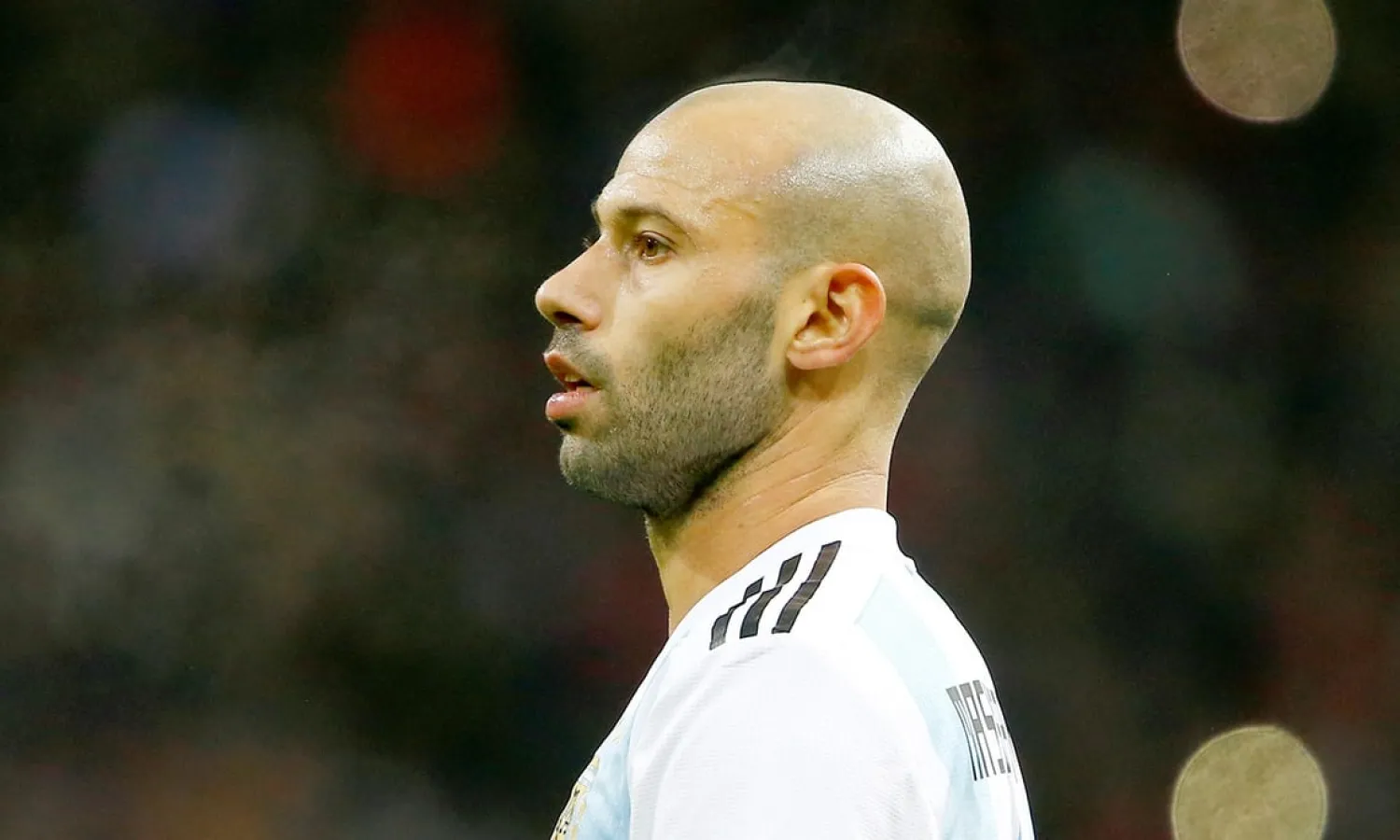
Javier Mascherano will be Argentina’s most capped player in Russia and still plays a pivotal role at the heart of their midfield. Photograph: Anadolu Agency/Getty Images
TT

Javier Mascherano: ‘I Hope Argentina Can Meet Lionel Messi’s Standards’

Javier Mascherano will be Argentina’s most capped player in Russia and still plays a pivotal role at the heart of their midfield. Photograph: Anadolu Agency/Getty Images

Four years ago, Argentina managed to play seven games at a World Cup for the first time since Italia 90, but lost the final to Germany in extra-time. For a country twice world champions, proud exporters of football talent, it was not without frustration that even staying in the tournament past the quarter-finals had become an elusive task. For a short while after the last World Cup, then, Argentina’s success in keeping the nation enthralled until the very last minute was praised, a cause for celebration. And one player in particular became the viral pin-up hero of the day: Javier Mascherano.

“It was a unique experience because we had never lived or experienced anything like what happened in 2014 – it was spectacular,” an older, wiser Mascherano tells me when we meet in Spain for Argentina’s warm-up tour. “The World Cup itself sets the pace and indicates what we can and can’t do: we changed the way we played, the system, as we went along, but always with total clarity about what we were doing. That was what led us to the final. The conviction of our idea, of doing things in a certain way, up to the very last minute. And if you look back I think it was Argentina’s best match in years.”

Mascherano was praised for his tactical intelligence and his face was Photoshopped on to the iconic Che Guevara beret image, with memes claiming he could do anything, solve any problem, doing the rounds. He found himself raised on a pedestal so high that the only way was going to be down.

Of that final loss to Germany, his memory of the game’s decisive moment remains vivid. “It was one of those isolated moves when you think nothing’s going on and football always ends up proving that every ball is important. The ball comes from the side and [André] Schürrle manages a cross between Pablo [Zabaleta] and me, it was actually the only space where it could have gone through … and we weren’t standing in the best position, and when [Mario] Götze gets it … It was unexpected, a moment in the game where it seemed nothing was happening but ends up giving them the advantage and crowning Germany world champions.”

Argentina followed 2014 up by reaching two Copa América finals, but lost both to Chile, on penalties. “When we thought we’d hit rock bottom with the famous three finals – not in terms of football, because I think the standard of our game was by far among the highest Argentina has displayed in recent years, but in terms of results and because of the frustration generated by one lost final after another – we realized that the bottom was much deeper than we had envisaged.”

As he shrugs and tuts about the passage of time, the toll the years have taken, the criticism, his sadness is clear. Speaking with just one other journalist present, the UK-based Argentinian broadcaster Christian Martín, no sponsored backdrops, no PR gatekeepers, he is relaxed and open. Of Argentina’s qualifying campaign, he says: “It’s hard to find high points. Mostly because throughout the qualifiers we were very inconsistent; we suffered a lot.

“It all started off really badly with a defeat to Ecuador at home, then we went to Paraguay and drew. When we thought we might be able to make the jump, in the matches against Brazil, Colombia and Chile, an actual team started to appear, that’s when we went to the other Copa América in the US [the 2016 Centenario edition, with the final staged in New Jersey], and ended up changing manager. After Tata [Martino] everything descended into chaos. Because we weren’t getting the results, because we were so needy, so lacking … because we changed manager again after that. There was such a sense of urgency.”

It was after that final in June 2016 that Argentina really did descend into chaos: Messi resigned from the squad pitch-side after missing a penalty in the shootout defeat by Chile, while the Argentina FA was placed under Fifa administration following a rigged election, internal disputes and accusations of corruption. Bankruptcy and violence plagued the domestic game. The bottom was much deeper than anyone envisaged.

“We were so close to the edge … one match away from not qualifying for the World Cup, it was a Calvary,” says Mascherano. “Those of us who have been around for some time have seen the good times and the bad, facing up to the task and doing what’s needed along the way … luckily we’ve come through.”

I first met Mascherano shortly after the 2006 World Cup, when he had just signed for West Ham. He was a midfielder back then, a traditional No 5, but he was already aware that his defensive potential might slowly shift him further back. “If you don’t watch out you’re going to end up in goal any minute,” his compatriot Carlos Tevez joked.

Since his move from Liverpool to Barcelona in 2010, he has come to occupy the defensive role more naturally, but also to understand the importance of the post. Argentina’s strength is often considered to be their forwards but Mascherano disagrees. “For years the talk has been of Argentina’s strong point being the offensive side, the attack,” he says. “And clearly we do have players with immense talent up front. But I think what has made these recent teams so competitive has been the ability to find a defensive equilibrium.”

Russia 2018 will be the 34-year‑old’s fourth World Cup. Argentina’s most capped player with 143 international games under his belt, he recalls his first World Cup now, fondly remembering the 24-pass goal against Serbia in 2006 with which José Pékerman’s team made history. “Things always develop according to the players you field. If I remember right in midfield we had Maxi, Cuchu [Cambiasso], myself, Román [Riquelme], [Javier] Saviola and then [Hernán] Crespo, no? It was a reflection of José’s feeling for football. It was a very Argentinian squad, evoking Argentinian football from earlier times … very similar to Maradona’s goal against Greece [at USA 94], lots of touches.

“That’s a bit what José preached. In the end I think we were all left feeling we could have gone further in that World Cup. It was a squad that could have aspired to more. Germany knocked us out in a penalty shootout, but in a match we arguably deserved to win.”

We met again when he was playing for Liverpool and was asked to captain Argentina by Maradona, an unlikely manager of the national team. He then decided to hand over the armband to Messi, adding to his sense of leadership. Defeat once again when facing Germany in the quarter-finals of the 2010 World Cup he describes as “an enormous sadness; our expectations were much higher”. By contrast, at club level it was a rewarding time: “Playing in England was a fantastic experience. In Liverpool I felt at home and really thoroughly enjoyed it. That’s the truth. The kudos and hierarchy of playing in the Premier League for a footballer is huge.”

The excellence of his tackles, interceptions and distribution were described by the Guardian’s Richard Williams as “sitting in front of the defence controlling the traffic with a calmness and technical excellence reminiscent of Barcelona’s Pep Guardiola”, a project he would later join and be a part of for eight years.

Although Mascherano became more entrenched in the center-back role under Guardiola, he remained for years the exemplar of a player able to play at the back, recover, save awkward situations and pass the ball forward at the highest level. He also gained experience of sharing the pitch with Messi, a plus for Argentina.

“One wishes for this coming World Cup that Leo can be the best version of himself, because the aspirations of the whole squad depend on this version. It’s clear Leo conditions our collective performance; I hope as his team‑mates we can meet his standards.”

Ready to kick off the World Cup with a raw squad and a manager, Jorge Sampaoli, parachuted in late in qualifying, Mascherano is conscious of the difficulties Argentina face. “There was such an urgency when Jorge stepped in – we have been varying and tweaking and now I believe our aim is to become a much more solid team, which is what we’re going to need.

“Take care to be defensively strong, which is what has made us go far in international competitions, and from there hope the quality starts to flow – because we do have quality players.”

He is keenly aware that Argentina have been drawn in a tough group. “Iceland are a new team in the sense that they maybe don’t have a long football tradition but they’re a generation of players that have made history recently, with spectacular success at Euro 16, and qualifying ahead of Croatia.

“Croatia are a first-class side with top players, especially in the midfield, such as Modric, Brozovic, Kovacic, Rakitic … Perisic; a team to watch out, quality squad. And Nigeria are quite well known to us, we’ve always met in the last World Cups. They’re tough, not just because of their physical power, but because their disorganisation has the effect of disorganising you as a rival. And that’s when teams like ours suffer the most – in disorder.”

Fully aware that for him and a few others, this World Cup presents the last chance of winning something big with Argentina, he stresses that the key is: “One step at a time. No need to rush things, the World Cup itself guides you, gives you signals on the go … it’s very important to start well because of the peace of mind, but we mustn’t look further than the first match.”

He is now facing the dusk of his playing career, ending the season in China, far from his family. Rather than proclaim Argentina will be victorious, he has a measured view of what can now be achieved in Russia. “This is football: one day you win, one day you lose and there’s a very fine line between them.” It is hard to argue with my colleague Christian Martín’s view: “Masche is our leader. The finest example of his generation. A warrior facing his last great stand.”

(The Guardian)


Sports Investment Forum Allocates Third Day to Women's Empowerment to Promote Sustainable Investment in Women’s Sports

Sports Investment Forum Allocates Third Day to Women's Empowerment to Promote Sustainable Investment in Women’s Sports
TT

Sports Investment Forum Allocates Third Day to Women's Empowerment to Promote Sustainable Investment in Women’s Sports

Sports Investment Forum Allocates Third Day to Women's Empowerment to Promote Sustainable Investment in Women’s Sports

The Sports Investment Forum announced that the third day of its 2026 edition will be dedicated to empowering women in the sports sector, in partnership with Princess Nourah bint Abdulrahman University. The move reflects the forum’s commitment to supporting the objectives of Saudi Vision 2030 and enhancing the role of women in the sports industry and sports investment.

This allocation comes as part of the forum’s program, scheduled to take place from April 20 to 22, at The Ritz-Carlton, Riyadh. The third day will feature a series of strategic sessions and specialized workshops focused on sustainable investment in women’s sports, the empowerment of female leadership, the development of inclusive sports cities, and support for research and studies in women’s sports, SPA reported.

Forum organizers emphasized that the partnership with Princess Nourah bint Abdulrahman University, recognized as the largest women’s university in the world, represents a model of integration between the academic and investment sectors. The partnership contributes to building a sustainable knowledge base that supports the growth of women’s sports and enhances investment opportunities at both local and international levels.

The dedicated day will address several strategic themes, including sustainable investment in women’s leagues and events, boosting scalable business models, empowering female leaders within federations, clubs, and sports institutions, and developing inclusive sports cities that ensure women’s participation in line with the highest international standards. It will also include the launch of research initiatives and academic partnerships to support future policies and strategies for the sector.

This approach aims to transform women’s empowerment in sports from a social framework into a sustainable investment and development pathway that enhances women’s contributions to the sports economy and reinforces Saudi Arabia’s position as a leading regional hub for advancing women’s sports.

The day is expected to attract prominent female leaders, decision-makers, investors, and local and international experts, in addition to the signing of several memoranda of understanding and joint initiatives supporting women’s empowerment in the sports sector.

The Sports Investment Forum reiterated that empowering women is a strategic pillar in developing the national sports ecosystem, contributing to economic growth objectives, enhancing quality of life, and building a more inclusive and sustainable sports community.


Liverpool Boss Slot Says Isak in 'Final Stages of Rehab'

Soccer Football -  FA Cup - Fourth Round - Liverpool v Brighton & Hove Albion - Anfield, Liverpool, Britain - February 14, 2026 Liverpool manager Arne Slot celebrates after the match REUTERS/Phil Noble
Soccer Football - FA Cup - Fourth Round - Liverpool v Brighton & Hove Albion - Anfield, Liverpool, Britain - February 14, 2026 Liverpool manager Arne Slot celebrates after the match REUTERS/Phil Noble
TT

Liverpool Boss Slot Says Isak in 'Final Stages of Rehab'

Soccer Football -  FA Cup - Fourth Round - Liverpool v Brighton & Hove Albion - Anfield, Liverpool, Britain - February 14, 2026 Liverpool manager Arne Slot celebrates after the match REUTERS/Phil Noble
Soccer Football - FA Cup - Fourth Round - Liverpool v Brighton & Hove Albion - Anfield, Liverpool, Britain - February 14, 2026 Liverpool manager Arne Slot celebrates after the match REUTERS/Phil Noble

Liverpool manager Arne Slot said on Thursday he believes striker Alexander Isak is in the "final stages of rehab" and could return by the end of next month to bolster the Reds' push for Champions League qualification.

The British record signing has been sidelined since mid-December when he fractured a bone in his lower leg and needed ankle surgery following a sliding tackle from Tottenham's Micky van de Ven.

His injury came just as 26-year-old Sweden international Isak, who joined Premier League champions Liverpool for £125 million ($169 million) from top-flight rivals Newcastle in September, was finding his form at Anfield with two goals in six matches.

"Alex has been on the pitch, not with his football boots but with his running shoes for the first time this week," Slot told reporters, according to AFP.

"The next step is doing work with the ball, which every player likes most, then the next step is to come into the group and then it takes a while before you're ready to play.

"It will be some time around there, end of March, start of April, where he is hopefully back with the group. That is not to say you are ready to play, let alone start a game.

"But it's nice that rehab goes well; that's a compliment to him and our medical staff.

"I think we all know the moment you go on the pitch it doesn't take three months but these final stages of rehab can also make it change."

Isak is one of five Liverpool first-team players currently sidelined, with only Jeremie Frimpong close to a return.

The right-back has been out since the end of last month with a hamstring injury but is expected to be available for next weekend's visit of West Ham.

Liverpool have had a rare week without a match ahead of Sunday's trip to Nottingham Forest.

"It is nice and useful as the players we are having, nine out of 10 go to the national team so for seven, eight, nine months they hardly have a time off," said Dutch boss Slot, who insisted he had no need of a rest himself.

"It was nice but I did not really need it. Last season I felt I needed it more in this period of time. I am enjoying the work I do here."

Liverpool, after a slow start to their title defense -- are now sixth and within three points of the top four with 12 games to go.

They next play three of the bottom four clubs as they look to get themselves into a Champions League position.

Premier League leaders Arsenal were left just five points clear of second-placed Manchester City after blowing a two-goal lead in a shock 2-2 draw away to rock-bottom Wolves on Wednesday.

Slot, however, said: "We didn't need yesterday to know how difficult it is to win a Premier League game. What has made the Premier League nicer this season than three, four, five, six years ago is it's more competitive."


Familiar Face Returns to Marseille where Habib Beye Takes Charge

(FILES) Rennes' French-Senegalese head coach Habib Beye looks on before the French L1 football match between Le Havre AC (HAC) and Rennes at the Oceane Stadium in Le Havre, Northwestern France, on April 13, 2025. (Photo by Lou BENOIST / AFP)
TT

Familiar Face Returns to Marseille where Habib Beye Takes Charge

(FILES) Rennes' French-Senegalese head coach Habib Beye looks on before the French L1 football match between Le Havre AC (HAC) and Rennes at the Oceane Stadium in Le Havre, Northwestern France, on April 13, 2025. (Photo by Lou BENOIST / AFP)

Marseille is looking to reignite its season with a new coach on board.

The nine-time French champion appointed Habib Beye to replace Roberto De Zerbi following a bad patch of form that saw the club exit the Champions League and drop 12 points behind Ligue 1 leader Lens.

Beye, a former Senegal international who played for Marseille, will be in charge of Friday's trip to Brest.

After leading Red Star to promotion to Ligue 2, Beye spent the last year and a half as the Rennes coach. The club sacked Beye this month.

Key matchups Marseille has failed to win its past three league games, badly damaging its title hopes. The results including a 5-0 mauling at PSG have left fans fuming. The club hopes Beye, a disciplinarian advocating ball possession and a strong attacking identity, will produce a jolt.

Beye's hiring "refocuses us on the challenges we still need to tackle between now and the end of the season,” The Associated Press quoted Marseille owner Frank McCourt as saying.

Since McCourt bought Marseille in 2016, the former powerhouse has failed to find any form of stability in a succession of coaches and crises. It hasn’t won the league title since 2010.

PSG abandoned the top spot to Lens after losing to Rennes 3-1 last week. Luis Enrique's team bounced back with a 3-2 win at Monaco in the first leg of their Champions League playoff and hosts last-placed Metz on Saturday. Lens welcomes Monaco the same day.

Third-placed Lyon, on a stunning 13-match winning run, plays at Strasbourg on Sunday.
Players to watch With the World Cup in his country looming, former Arsenal striker Folarin Balogun is hitting form at the right time. The American forward scored twice inside 18 minutes against PSG and has 10 goals and four assists this season.

At PSG, the man in form is Désiré Doué.

After his team quickly fell behind by two goals against Monaco midweek, Doué came to the rescue to turn things around. The France international was relentless and left his mark on the match after coming on as a replacement for Ousmane Dembélé. He first reduced the deficit, played a role in Achraf Hakimi’s equalizer then netted the winner.
Out of action Dembélé is expected to miss PSG's match against Metz because of an injured left calf.

Off the field PSG was sanctioned with the partial closure of the Auteuil stand for two matches and a 10,000 euros ($11,800) fine by the disciplinary committee of the French league following banners displayed and insults directed by supporters during the match against Marseille on Feb. 8. at the Parc des Princes. There were brief discriminatory chants about Marseille at the start of the game and the referee stopped play for about one minute around the 70th.