VAR: The Brave New World Bringing Distinct Echoes of Football’s Past

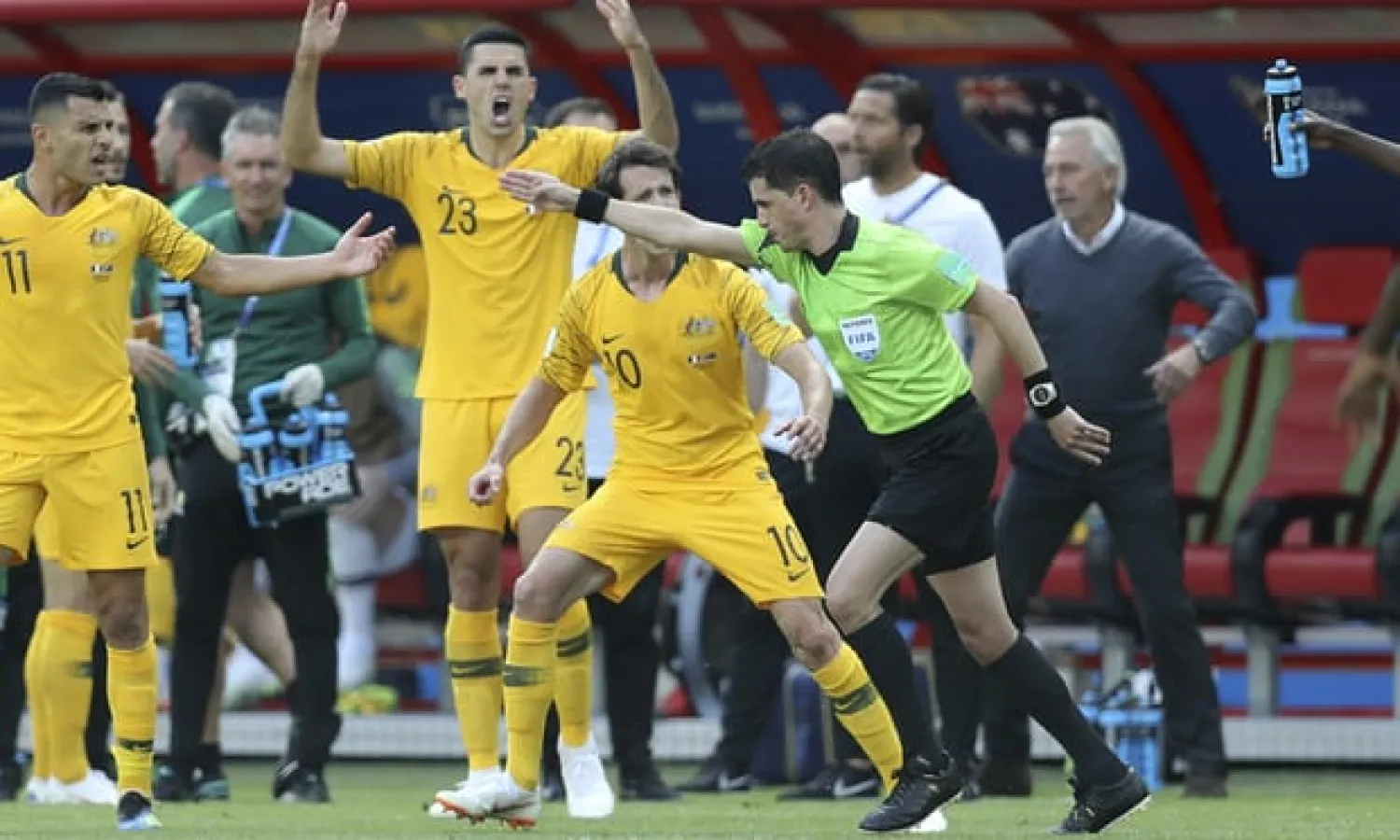
 Australian players react angrily as the Uruguayan referee, Andrés Cunha, awards France a penalty after consulting the VAR during the sides’ Group C match. Photograph: David Vincent/AP
Australian players react angrily as the Uruguayan referee, Andrés Cunha, awards France a penalty after consulting the VAR during the sides’ Group C match. Photograph: David Vincent/AP
TT

VAR: The Brave New World Bringing Distinct Echoes of Football’s Past

 Australian players react angrily as the Uruguayan referee, Andrés Cunha, awards France a penalty after consulting the VAR during the sides’ Group C match. Photograph: David Vincent/AP
Australian players react angrily as the Uruguayan referee, Andrés Cunha, awards France a penalty after consulting the VAR during the sides’ Group C match. Photograph: David Vincent/AP

Welcome, VAR, to the World Cup. Take a seat. We’ve been expecting you. On matchday three of Russia 2018, Fifa’s early-stage experiment with video technology stood briefly centre stage. This, finally, was the new world.

Although, in the event, the debate around two marginal penalty decisions for France and Argentina will be jarringly familiar to anyone with any experience of the previous 140 years or so of football refereeing. Plus ça change, plus c’est the same old story all over again: with the same argument, the same subjective calls, the same claims of injustice.

Saturday afternoon brought two games 650 miles apart. Both had similar incidents involving a trip in the area. Both saw two different applications of the process to two very similar scenarios.

In the early kick-off in Kazan, France were awarded a penalty shortly before the hour for a trip on Antoine Griezmann by the trailing leg of Josh Risdon. Initially no penalty was given by the on-field referee. Instantly the video assistant ref informed his colleague that the incident should be reviewed. A penalty was then awarded.

Three hours later in Moscow, Cristian Pavón went down in the Iceland penalty area after a challenge from Birkir Már Sævarsson. Once again play was waved on. This time there was no VAR interjection. Iceland took a goalkick and the game continued.

At which point enter, if not quite controversy, then evidence that a system designed to still the tedium of endless debate has its own potential for irresolvable differences of opinion.

The first point is that ultimately both refereeing decisions were correct, if only because neither was obviously wrong. Whatever one person with the right authority decides: that is correct. So far, so much the same.

The element of controversy comes because both incidents would seem to have the same level of claim on a video review, the second non-reviewed one arguably more so. Argentina’s fans will see a trip on Pavón. It is a matter of opinion, as ever. But replays suggest there was at least as much contact and/or reviewable grey area as in the Griezmann incident.

At the end of which VAR has offered us uncertainty and 50-50 judgment at one remove. We have simply kicked this endlessly tedious debate into some longer grass a little further off. The parameters have been narrowed. Obvious mistakes can be weeded out. But where once the subjectivity came on-field, now it comes in the VAR’s office.

Opponents of VAR will question whether it really is worth interrupting the game for this. Is it worth obsessing over the thoughts of the referees, incurring all the expense (financial and otherwise) of officials and screens, simply to introduce an incremental degree of semi-accuracy to an essentially random series of on-field collisions?

What we have learned from the first real VAR moment at this World Cup is that no two VARs are the same, that there will not be a uniform review standard. On top of this, as we always knew in a chaotic, always marginal game, that there is no objective truth to be rooted out. Papering as thickly as possible over the cracks is all that can be hoped for here.

At the end of which the VAR-flavoured universe looks not dissimilar to the previous one. Fans of both Australia and Argentina can leave their World Cup matches aggrieved over decisions made. The referees can claim to have made the correct decision simply by making one where one was required. The closest to a clear error is the decision by the VAR in Moscow not to seek a review of the Pavón trip. But even then his judgment call is simply that.

Debate. Matters of opinion. Hard luck stories. Football can’t help but provide this. No matter how finely we split the atom, its core will remain fluid and unstable. For now, with another VAR penalty awarded later in the day for Peru – correctly this time – it is simply time to buckle up and enjoy the ride with a technology that will always carry its own margins of uncertainty.

The Guardian Sport


Irish Boxer Lee Reeves Dies at Age 31, Three Months after Dublin Title Fight Injury

Irish boxer Lee Reeves. Reuters
TT

Irish Boxer Lee Reeves Dies at Age 31, Three Months after Dublin Title Fight Injury

Irish boxer Lee Reeves. Reuters

Irish boxer Lee Reeves has died more than three months after being injured during a fight in Dublin, promoter Queensberry said Tuesday. He was 31.

"Everyone at Queensberry is devastated to learn of the passing of Lee Reeves," Queensberry Promotions said in a statement.

Reeves was hospitalized after being knocked out by compatriot Gary Cully in the 10th and final round of their Boxing Union of Ireland Celtic super-lightweight title fight on Aug. 1.

Reeves was carried from the ring on a stretcher after receiving initial treatment.

Queensberry had said after the fight that his condition was critical but stable.

“Lee was an immensely talented boxer, as well as a true role model and inspiration to his community,” the statement added Tuesday, according to The Associated Press. “Our deepest condolences go to Lee’s family, friends and all those who loved him. We ask that their privacy be respected at this incredibly difficult time. Rest in peace, Lee.”


Alonso to Enter Dakar Rally with Loeb and Aston Martin Team

November 5, 2026 Aston Martin's Fernando Alonso during a press conference ahead of the F1 Sao Paulo Grand Prix. (Reuters)
TT

Alonso to Enter Dakar Rally with Loeb and Aston Martin Team

November 5, 2026 Aston Martin's Fernando Alonso during a press conference ahead of the F1 Sao Paulo Grand Prix. (Reuters)

Double Formula One champion Fernando Alonso will compete in next January's Dakar Rally in an Aston Martin Dreadnought entry run by engineering partner Prodrive.

The 45-year-old Spaniard, a 32-time Grand Prix winner and two-time Le Mans 24 Hours winner, will be racing in the annual event for the second time after competing with Toyota in 2020, finishing 13th.

France's nine-time world rally champion Sebastien Loeb and Brazil's reigning world rally-raid champion Lucas Moraes will be his teammates in a three-car entry.

The 49th edition of the Dakar Rally will ‌be held in ‌Morocco from January 9 to 23, with a prologue and first ‌stage ⁠in Portugal, after ⁠being moved from Saudi Arabia due to security concerns.

The 24-round Formula One season is due to start in Bahrain in March after testing in late February.

Alonso, who will again have compatriot and five-time motorcycle Dakar winner Marc Coma as co-driver, is racing in the Las Vegas Grand Prix this weekend. He said he had turned his thoughts to Dakar after deciding to continue in Formula One with Aston Martin.

“In the end, the decision became simple. I wanted to embrace ⁠the challenge completely and take on both Formula One and the ‌Dakar Rally in the same year," he explained in ‌a statement.

"In 2020, Dakar was one of the most challenging and enjoyable experiences of my career. ‌I have enormous respect for this race and the specialists who have mastered it.

"Formula One ‌remains my priority. But I am a racing driver, and challenges like this are why I love competing. I’m looking forward to seeing what we can achieve."

LOEB CHASES FIRST DAKAR WIN

In October, Alonso told reporters at the Singapore Grand Prix that he felt the desert endurance race would be physically ‌incompatible with his Formula One commitments.

Loeb, 52, will also be chasing a first Dakar win after 10 previous attempts that have brought ⁠him 28 stage ⁠wins to date.

“Winning the Dakar is very important to me,” said the Frenchman, who will be partnered by Belgian Fabian Lurquin. “We have come close several times, and the motivation is there to keep working until we achieve it."

The Dreadnought is a digital-only tactical SUV created exclusively for gamers playing "Call of Duty: Modern Warfare 4" that will now be brought into the real world by Prodrive, Aston Martin's partners in endurance GT racing.

The Dakar will be Aston Martin Racing’s debut in the world rally-raid championship.

"Aston Martin's ambition for this program has been clear from the outset: to create a car capable of competing at the front of the world's toughest motorsport event," said Prodrive Chairman David Richards.

"By combining Aston Martin's vision with Prodrive's experience in rallying, endurance racing and Dakar competition, we have built a strong foundation. With an exceptional driver line-up and a highly capable engineering team, we look forward to seeing Dreadnought take on this remarkable challenge."


Owono Does Not Deserve 12-Match Ban Over De Miguel Death, Says Andorra Owner Pique

Equatorial Guinea's goalkeeper #01 Jesus Owono leaves the pitch at half time during the Africa Cup of Nations (CAN) Group E football match between Equatorial Guinea and Algeria at Moulay Hassan Stadium in Rabat on December 31, 2025. (AFP)
TT

Owono Does Not Deserve 12-Match Ban Over De Miguel Death, Says Andorra Owner Pique

Equatorial Guinea's goalkeeper #01 Jesus Owono leaves the pitch at half time during the Africa Cup of Nations (CAN) Group E football match between Equatorial Guinea and Algeria at Moulay Hassan Stadium in Rabat on December 31, 2025. (AFP)

FC Andorra owner Gerard ‌Pique said goalkeeper Jesus Owono did not deserve the 12-match suspension he received following the challenge that led to the death of Tenerife forward Jesus de Miguel.

Owono and De Miguel collided during a Spanish second-tier match on November 2. De Miguel was taken to intensive care and died the following day.

The disciplinary committee of the Spanish football federation (RFEF) banned Owono for violent conduct which resulted in serious ‌injury last week.

"Players, ‌former players, coaches, goalkeepers, everyone has ‌called ⁠it an accident," ⁠Pique said in a video posted on social media late on Monday.

"I truly believe that imposing the maximum sanction on Jesus for this action puts him in a situation he does not deserve, because he is not to blame for all of ⁠this having happened."

Former Barcelona player Pique ‌pointed to the three-match ‌ban handed to Albacete's Jose Corpas for accidentally kicking Sabadell ‌player Quadri Liameed in the head during a ‌recent match in Spain.

"Fortunately Quadri is fine, the consequences in this case were not fatal, and the committee decided to sanction Corpas with three matches," Pique added.

"With ‌all this, my reflection is: what is being sanctioned, the action or the ⁠consequences?"

The RFEF ⁠did not immediately respond to a request for comment outside regular business hours in Spain.

Owono, 25, has withdrawn from Equatorial Guinea's squad for Africa Cup of Nations qualifiers against Zimbabwe this month and Pique said it was unlikely the goalkeeper would return to action as soon as his suspension is up.

"Jesus is going to need far more than 12 matches before he is available and able to compete," he added. "No sanction is going to bring Demi (De Miguel) back to us."