


Kuwait: Prison Sentences in 'Parliament Storming' Case

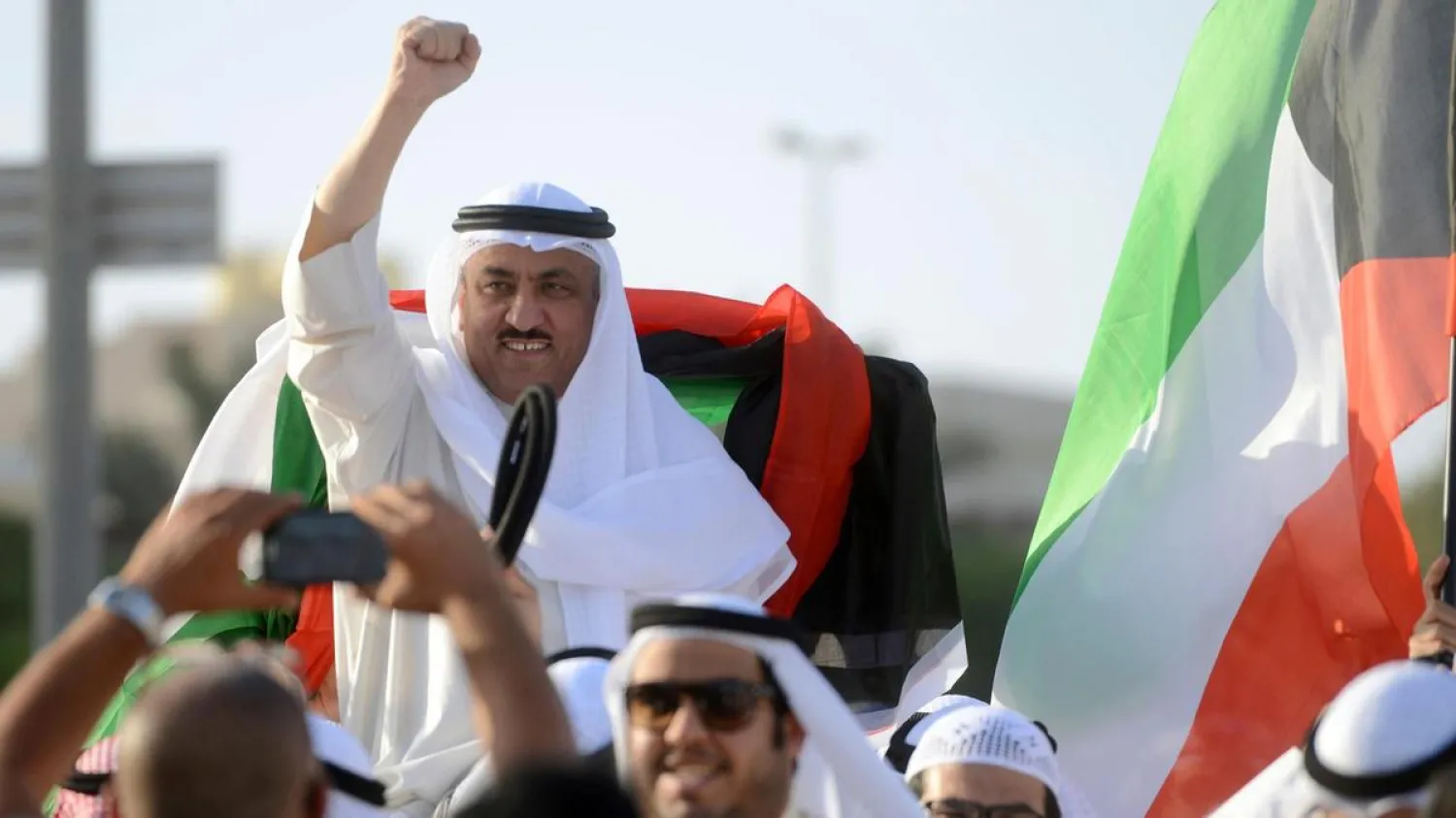
Supporters celebrate with opposition leader Musallam Al
Barrack in Kuwait City on April 20, 2015 after his release on bail
ahead of a final decision on charges he insulted the country's ruler.
AP
Supporters celebrate with opposition leader Musallam Al Barrack in Kuwait City on April 20, 2015 after his release on bail ahead of a final decision on charges he insulted the country's ruler. AP
TT

Kuwait: Prison Sentences in 'Parliament Storming' Case

Supporters celebrate with opposition leader Musallam Al
Barrack in Kuwait City on April 20, 2015 after his release on bail
ahead of a final decision on charges he insulted the country's ruler.
AP
Supporters celebrate with opposition leader Musallam Al Barrack in Kuwait City on April 20, 2015 after his release on bail ahead of a final decision on charges he insulted the country's ruler. AP

The Kuwaiti Court of Cassation sentenced on Sunday two current and six former MPs for three years and six months imprisonment and another former MP for two years in the “National Assembly” case related to the storming of the country's parliament in 2011.

The court issued a sentence to imprison five activists for three years and six months and another two activists for two years.

It also acquitted 17 suspects and abstained from a verdict against 34 others in the same case.

Former MP and opposition leader Musallam Al Barrak, in addition to current MPs Jumaan Al Harbash and Waleed Al-Tabtabai were among those sentenced on Sunday for their involvement in the storming case.

Al-Tabtabai said he would present a “petition opposing the verdict,” alluding to refer to the Constitutional Court in case his demand was rejected.

Parliament Speaker Marzouq Al-Ghanim brushed aside reports an extraordinary session would be held during the summer recess, following the court sentence against the current MPs, Kuwait’s news agency KUNA reported on Sunday.

It quoted Al-Ghanim as saying that he would await the official verdict of the Court of Cassation before deciding the relevant constitutional measures.

Speaking to reporters before leaving the house, the Speaker said he would be talk to the press about the measures when he receives the verdict.

“The measures would be adopted during the third regular term which would start next October,” he said.

On November 16, 2011, demonstrators and opposition MPs stormed Kuwait's parliament building demanding that the then prime minister step down. The MPs then occupied the main chamber and sang the national anthem before leaving a short time later.

Last November, around 66 defendants were sentenced to up to five years in jail for convictions related to the storming.



Muslim World League Affirms Support for Saudi Measures to Preserve Sovereignty

Muslim World League Affirms Support for Saudi Measures to Preserve Sovereignty
TT

Muslim World League Affirms Support for Saudi Measures to Preserve Sovereignty

Muslim World League Affirms Support for Saudi Measures to Preserve Sovereignty

The Muslim World League (MWL) has affirmed its full support for the supplementary statement issued by the Kingdom of Saudi Arabia regarding recent escalatory actions by the Southern Transitional Council in the Hadramout and Al-Mahara governorates.

The league also expressed its support for the statement from the Coalition to Restore Legitimacy in Yemen concerning the unauthorized movement of ships carrying weapons and heavy vehicles from the Port of Fujairah to the Port of Mukalla, SPA reported.

These shipments were reportedly transported without the necessary official permits from the coalition’s Joint Forces Command. The MWL emphasized its unwavering solidarity with the Kingdom and its support for all measures taken to safeguard its national security.

In an official statement released by the General Secretariat, MWL Secretary-General and Organization of Muslim Scholars Chairman Sheikh Dr. Mohammed bin Abdulkarim Al-Issa commended the decisive and wise content of the Saudi statement.

Speaking on behalf of the league’s global assemblies and councils, Al-Issa noted that these measures are vital to ensuring peace, security, and the unity of the Yemeni people under their internationally recognized leadership.

Al-Issa highlighted that the priority remains preserving stability in Yemen and the broader region. He noted that outstanding issues, including the Southern cause, must be resolved through dialogue within established legal and legitimate frameworks.

Furthermore, he warned that supporting illegitimate practices only deepens internal divisions and serves those who do not have Yemen’s best interests at heart. He cautioned that any further steps deviating from the legitimate path would only ignite sedition, the heavy cost of which would be borne by the Yemeni people.

Concluding the statement, Al-Issa called upon all Yemeni parties to prioritize wisdom and the national interest. He urged them to unite under their legitimate leadership to preserve the country's sovereignty, independence, and territorial integrity, paving the way for a secure and prosperous future for Yemen.


President of Yemeni Presidential Leadership Council Nullifies Joint Defense Agreement with UAE

Dr. Rashad Al-Alimi during his interview with Asharq Al-Awsat (Yemeni Presidency)
TT

President of Yemeni Presidential Leadership Council Nullifies Joint Defense Agreement with UAE

Dr. Rashad Al-Alimi during his interview with Asharq Al-Awsat (Yemeni Presidency)

President of the Presidential Leadership Council of the Republic of Yemen Dr. Rashad Mohammed Al-Alimi issued a presidential decree on Tuesday nullifying the joint defense agreement with the United Arab Emirates, based on the Constitution of the Republic of Yemen, the Gulf Cooperation Council Initiative and its implementation mechanism, the decision on the transfer of power, the formation of the Presidential Leadership Council, and the powers granted to it under the constitution, according to the Yemen News Agency (Saba).

Article Two of the decree mandates that all UAE forces and personnel withdraw from Yemeni territory within 24 hours, according to SPA.

Article Three instructs the Homeland Shield forces to assume control of all military camps in Hadramout and Al-Mahara governorates.


Yemeni Government Commends Saudi Historic Stance and Its Leadership of the Coalition to Restore Legitimacy

File photo of the Saudi flag/AAWSAT
TT

Yemeni Government Commends Saudi Historic Stance and Its Leadership of the Coalition to Restore Legitimacy

File photo of the Saudi flag/AAWSAT

The Yemeni government commended the Kingdom of Saudi Arabia's historic and steadfast stances, highlighting its crucial role in ensuring Yemen's security and stability.

The government acknowledged Saudi Arabia's leadership of the Coalition to Restore Legitimacy and its ongoing commitment to protecting civilians, de-escalating tensions, and preventing the eastern governorates from being drawn into conflicts that serve hostile agendas, SPA reported.

In an official statement, the government called on the Southern Transitional Council to withdraw immediately and unconditionally from the governorates of Hadramout and Al-Mahara. It urged the council to hand over all locations and camps to the Homeland Shield Forces and local authorities in these governorates, to adhere to the terms of reference of the transitional phase, and to cease all military or escalatory actions that threaten local security and undermine de-escalation efforts.

The statement, which was reported by the Yemen News Agency (Saba), expressed the government's full support for the decisions made by President of the Presidential Leadership Council of the Republic of Yemen Dr. Rashad Mohammed Al-Alimi, who is also Supreme Commander of the Armed Forces.

This includes declaring a state of emergency across Yemen and taking necessary sovereign measures to protect local security, preserve the unity and sovereignty of the state, and maintain its legal status in light of the dangerous developments in Yemen's eastern governorates.

The government stated: "The declaration of a state of emergency is grounded in the constitution and the references of the transitional phase, based on the recommendations of the National Defense Council.

It is a legitimate constitutional measure necessitated by our national duty to confront armed rebellion, protect civil peace, and prevent a descent into chaos that could undermine state institutions."