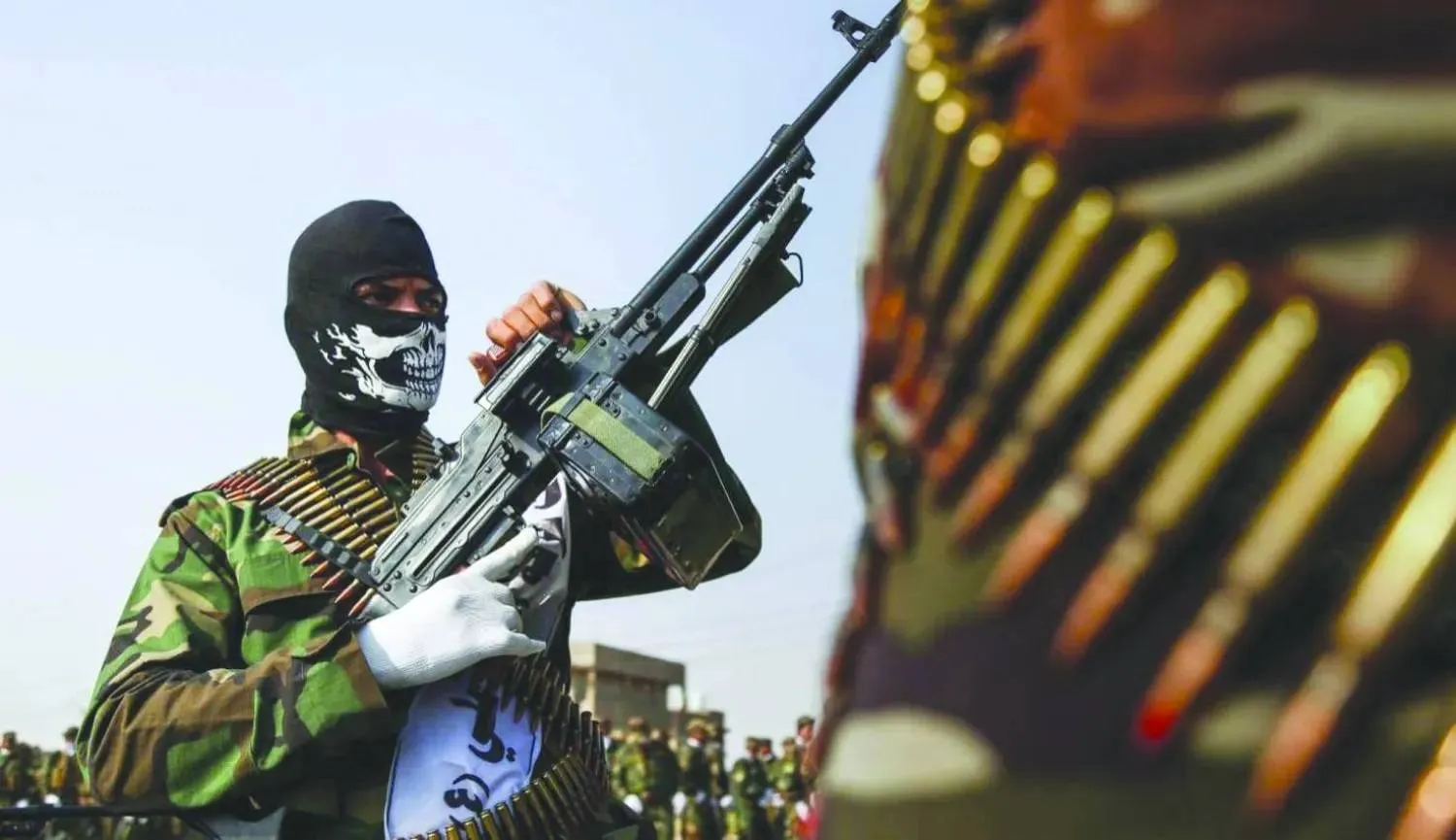
Iraq's government and parliament have threatened legal action against opponents of a plan to bring all weapons under state control, even as Türkiye ruled out withdrawing its troops from Iraq until regional and border security conditions are met.
Baghdad says the disarmament plan will take effect after the withdrawal of international coalition forces.
The ruling Coordination Framework alliance reaffirmed its commitment to resolving the issue of weapons outside state control by June 30, 2027, authorizing the government to "take steps to ensure compliance," according to a statement issued Monday evening.
The renewed push comes just days after a new cabinet was formed, with several political groups that maintain armed factions securing ministerial posts.
Among them is Asaib Ahl al-Haq, which landed the deputy prime minister's post, potentially reinforcing reports that Washington had given such groups a "green light" to join the government in exchange for laying down their arms.
Sources close to the armed factions said most now acknowledge the need for disarmament after securing influential positions in government and parliament. Kataib Hezbollah, however, remains opposed.
Criminal charges threatened
The government has ordered state institutions to enforce the law and pursue criminal complaints against anyone who incites opposition through the media or seeks to obstruct decisions to place weapons exclusively under state control.
In a statement, the prime minister's media office said freedom of expression and media activity, while guaranteed by the constitution and law, must operate within legal boundaries and respect public order and citizens' rights.
Such freedoms, it warned, cannot be used to incite violence or internal conflict, support weapons outside state control or back outlawed groups.
The warning appeared directed at armed faction spokespeople and supporters who have repeatedly mocked or rejected government disarmament announcements on television, in public statements and through online posts.
Activists close to Kataib Hezbollah have openly opposed disarmament, as has Kazem al-Fartousi, spokesman for Kataib Sayyid al-Shuhada. Their objections have frequently been accompanied by sharp criticism of Prime Minister Ali al-Zaidi.
The government said it had instructed all institutions to pursue criminal complaints against anyone involved in media incitement or efforts to derail state decisions on weapons control.
It cited Iraq's constitution and Articles 2 and 4 of Anti-Terrorism Law No. 13 of 2005 as the legal basis for the measures.
The statement also pointed to a Supreme Judicial Council position that using, supporting or threatening to use weapons outside state authority falls under the anti-terrorism law.
Parliament backs crackdown
Parliament Speaker Haibat al-Halbousi threw his support behind the government's legal measures, saying they were necessary to preserve civil peace, enforce the law and bring all weapons under state control.
Halbousi stressed that constitutionally protected freedoms of expression and media activity must be balanced against legal and professional obligations.
Those freedoms, he said, must not become a cover for inciting violence, fueling internal conflict or supporting weapons beyond state authority.
He backed holding accountable anyone proven to have incited violence or threatened public security and national stability, while emphasizing that enforcement must respect constitutional rights, legal safeguards and the principle of equal treatment under the law.
Security agencies step up scrutiny
Iraq's security agencies have identified cases of incitement and calls to obstruct disarmament decisions, according to Saad Maan, head of the country's Security Media Cell.
Speaking to the official Iraqi News Agency, Maan said specialized units within the office of the commander-in-chief of the armed forces, the Iraqi National Intelligence Service, the National Security Service and the Interior Ministry were monitoring and analyzing such activity.
He stressed that no action would be taken without judicial authorization.
Maan said directives from the commander-in-chief called for pursuing those who incite violence or support weapons outside state control, describing the measures as essential to maintaining long-term security amid regional and global turmoil.
Freedom of expression and media activity remain constitutionally protected, he said, but those protections do not extend to stirring chaos, tensions or unrest.
Asked where authorities draw the line between free expression and punishable media incitement, Maan said criminal liability depends on the applicable law and whether the elements of an offense are established.
Any prosecution, he added, must remain under judicial authority.
Türkiye stands firm on troop presence
Meanwhile, Turkish Defense Minister Yasar Guler said Ankara would keep its forces in Iraq and Syria until it was satisfied that security along its borders with both countries was fully guaranteed.
Türkiye "maintains its military presence in Iraq and Syria," Agence France-Presse quoted Guler as saying.
"Once we are certain that the necessary conditions regarding regional and border security have been met, the status of our deployments and presence in the region will be reviewed," he added.
The statement highlights a key obstacle to Iraq's disarmament plan: Iraqi armed factions had made the withdrawal of Turkish troops one of their conditions for agreeing to the initiative during negotiations with the Coordination Framework.
On October 14, Sabah al-Numan, spokesman for the commander-in-chief of Iraq's armed forces, suggested the issue of Turkish troops in northern Iraq could be resolved within three months.
Turkish forces are stationed at the Zilkan base in the mountainous Bashiqa district, about 30 kilometers (19 miles) northeast of Mosul, and at numerous other positions near the shared border.
Local reports put the number of Turkish checkpoints inside Iraqi territory and along the border at around 130.
In September, Iraqi Prime Minister Ali al-Zaidi met Turkish President Recep Tayyip Erdogan on the sidelines of the United Nations General Assembly in New York.
The talks produced an agreement for a "gradual evacuation" of Turkish forces from the Zilkan base, scheduled to begin officially on October 1, with control to pass to Baghdad under an agreed timetable and mechanism.
But Ankara has long tied any withdrawal to Baghdad's progress in securing Sinjar district in northern Nineveh province.
Türkiye demands that Iraqi authorities establish control over the district and expel armed groups, particularly wings of the Kurdistan Workers' Party (PKK) that have not complied with the decision to dissolve the party and surrender weapons, announced by its leader Abdullah Ocalan in late February 2025.