


Eritrea's Afwerki Ends 20 Years of Adversity on Historic Ethiopia Visit

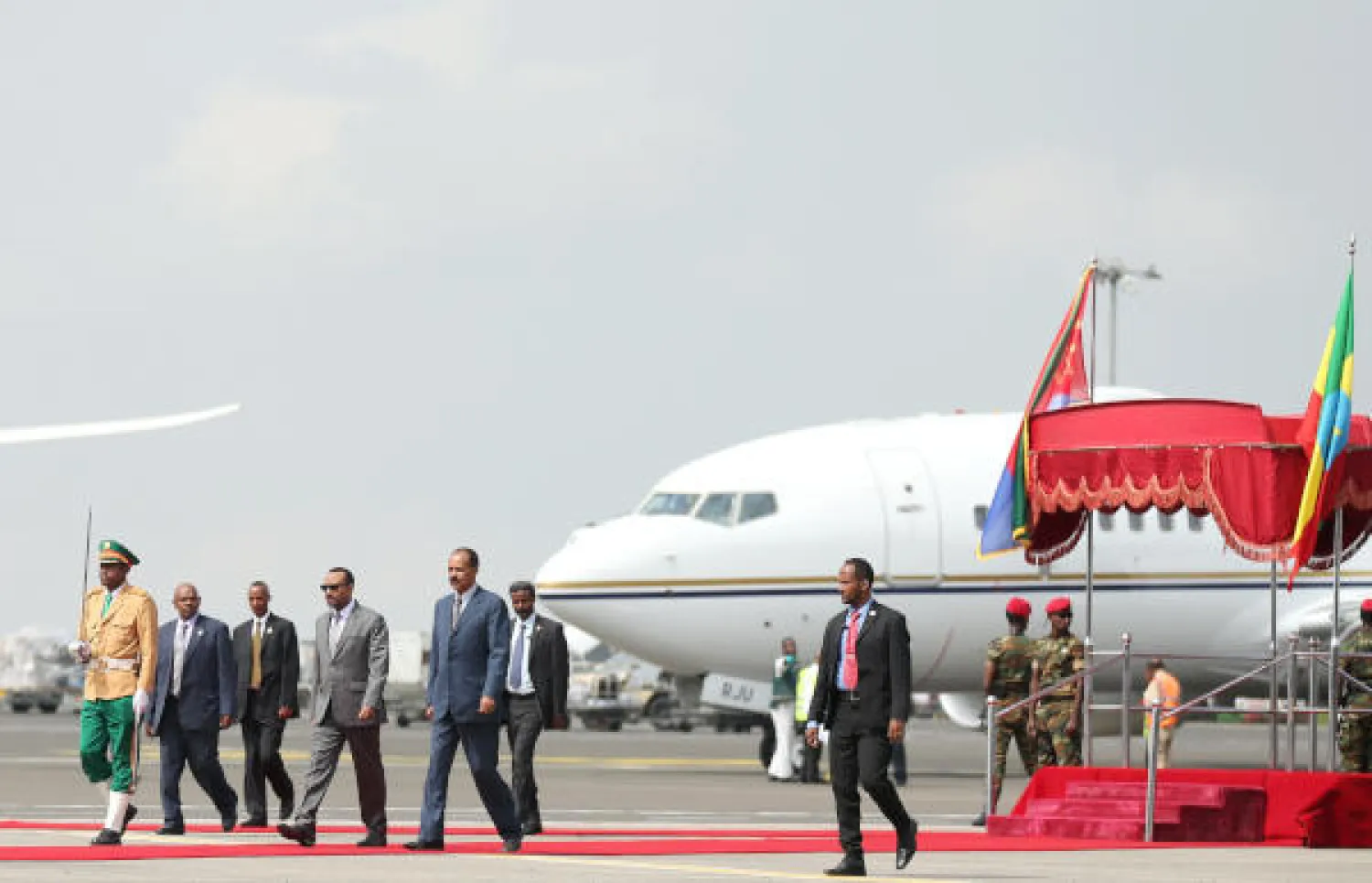
Eritrea's President Isaias Afwerki is welcomed by Ethiopian Prime Minister Abiy Ahmed upon arriving for a three-day visit, at the Bole international airport in Addis Ababa, Ethiopia July 14, 2018. REUTERS/Tiksa Negeri
TT

Eritrea's Afwerki Ends 20 Years of Adversity on Historic Ethiopia Visit

Eritrea's President Isaias Afwerki is welcomed by Ethiopian Prime Minister Abiy Ahmed upon arriving for a three-day visit, at the Bole international airport in Addis Ababa, Ethiopia July 14, 2018. REUTERS/Tiksa Negeri

Eritrean President Isaias Afwerki pledged to resolve his country’s dispute with Ethiopia on Saturday in a historic visit to Addis Ababa aimed at cementing peace less than a week after the nations declared an end to two decades of conflict.

Isaias arrived in the Ethiopian capital just five days after Ethiopian Prime Minister Abiy Ahmed visited Eritrea as part of a dizzying peace process aimed at ending years of violence and animosity between the neighbors who were once part of the same nation.

Abiy and Isaias shared laughs and hugs at an official lunch on Saturday as the Ethiopian leader said his counterpart was “beloved, respected and missed by the Ethiopian people.”

“We are no longer people of two countries. We are one,” Isaias told political and cultural figures gathered in a palace built during Ethiopia’s imperial days. “We’ll go forward together.”

Isaias started his three-day visit at Addis Ababa’s airport, where he and Abiy strode down a red carpet as a brass band played and traditional dancers cheered.

The leaders then drove into the city on a road lined with thousands of people dressed in white shawls and waving palm fronds as Ethiopian and Eritrean flags flew side-by-side from lampposts.

There were also banners and pictures of the two leaders who on Monday signed a declaration declaring an official end to the war.

“Welcome home President Isaias!!” Abiy’s chief of staff Fitsum Arega wrote on Twitter as the Eritrean leader arrived.

Later in the day, the two leaders flew to the southern city of Hawassa where Isaias toured an industrial park that’s key to Ethiopia’s economy.

Eritrea was once part of Ethiopia and comprised its entire coastline on the Red Sea until it voted for independence in 1993 after decades of bloody conflict.

The move left Ethiopia landlocked, and the deterioration of relations after the outbreak of the war in 1998 forced Addis Ababa to channel its foreign trade through Djibouti.

The two countries showed little sign of rapprochement since the signing of the Algiers peace agreement in 2000 after a conflict which left 80,000 people dead before settling into a bitter cold war.

Analysts say the surprisingly rapid burying of the hatchet was possible only because of Abiy’s ascension to the post of prime minister in April.

As part of a whirlwind set of reforms, Abiy announced last month that Ethiopia would abide by a 2002 UN-backed ruling and hand back disputed border territory to Eritrea, including the flashpoint town of Badme.

However Ethiopia has not announced the pull-out of troops from the area.

Abiy then paid a historic visit to Eritrea, where the two leaders announced the re-establishment of diplomatic and trade ties that could mean big benefits for both nations, and the wider Horn of Africa region, plagued by conflict and poverty.

The emotional reunion between the two countries has allowed residents to speak to each other by telephone for the first time in two decades as communication lines were re-opened.

Direct flights are due to start next week.

“Can one find appropriate words to describe the intensity of popular emotions that has gripped both countries; the depth and significance of the promising changes underway in the region!” Eritrean Information Minister Yemane Gebremeskel said on Twitter after Isaias arrived.

Ethiopia’s state-affiliated Fana Broadcasting Corporate said Isaias would also re-open the Eritrean embassy during his three-day stay.

A state dinner in his honor will be held on Sunday.

– Catalyst for change –

Eritrea and Ethiopia are both among Africa’s poorest nations.

However, Ethiopia has seen double-digit growth in recent years and is seeking wider options for importing goods and exporting from its nascent manufacturing industry by eyeing ports in Somalia and Eritrea.

Meanwhile Eritrea, one of the world’s most isolated nations, has pursued policies that have hamstrung the economy by scaring off investors, including an indefinite military conscription program the UN has likened to slavery.

Amnesty International said Saturday that the newfound peace should be a catalyst for change in Eritrea, where thousands of people, including rights activists and opposition politicians are “languishing in detention simply for expressing their views.”

“The end of hostilities with Ethiopia is a joyous moment for Eritreans, but it must be followed by tangible reforms that make a real difference in the daily lives of the people and put an end to decades of repression in the country,” said Seif Magango, AI’s deputy director for the region.

In a statement he said Eritrea was the biggest jailer of journalists on the continent, and that its last independent media house was shut down 17 years ago.

Amnesty also called for an end to forced military conscription, seen as a key driver of the departure of hundreds of thousands of Eritreans from their country.



China FM Tells Russia’s Lavrov Willing to Work to ‘De-Escalate’ Mideast War

 Russian Foreign Minister Sergei Lavrov speaks during a joint news conference with Egyptian Foreign Minister Badr Abdelatty following their meeting in Moscow, Russia April 3, 2026. (Pavel Bednyakov/Pool via Reuters)
Russian Foreign Minister Sergei Lavrov speaks during a joint news conference with Egyptian Foreign Minister Badr Abdelatty following their meeting in Moscow, Russia April 3, 2026. (Pavel Bednyakov/Pool via Reuters)
TT

China FM Tells Russia’s Lavrov Willing to Work to ‘De-Escalate’ Mideast War

 Russian Foreign Minister Sergei Lavrov speaks during a joint news conference with Egyptian Foreign Minister Badr Abdelatty following their meeting in Moscow, Russia April 3, 2026. (Pavel Bednyakov/Pool via Reuters)
Russian Foreign Minister Sergei Lavrov speaks during a joint news conference with Egyptian Foreign Minister Badr Abdelatty following their meeting in Moscow, Russia April 3, 2026. (Pavel Bednyakov/Pool via Reuters)

China's top diplomat told his Russian counterpart on Sunday that he is willing to work together to "de-escalate" the war in the Middle East, Beijing's state media reported.

Wang Yi told Russian Foreign Minister Sergei Lavrov in a phone call that "China and Russia should uphold fairness on major issues of principle", state news agency Xinhua said, noting that the call came at Lavrov's request.

Wang said that "the situation in the Middle East is still deteriorating and fighting is escalating", Xinhua reported.

He also reiterated China's call for an "immediate ceasefire" to the fighting triggered by US-Israeli strikes against Iran that began on February 28.

"China is willing to continue cooperating with Russia in the UN Security Council, communicating promptly on major issues and making efforts to de-escalate the situation and maintain regional peace and stability and global security," Xinhua quoted Wang as saying.

Beijing and Moscow are close economic and political partners, and the relationship has deepened further since Russia's 2022 invasion of Ukraine.


Migrants Missing after Mediterranean Capsize: NGOs

Hellenic coast guard performs SAR operation, following migrant's boat collision with coast guard off the Aegean island of Chios, near Mersinidi, Greece, February 4, 2026. REUTERS
TT

Migrants Missing after Mediterranean Capsize: NGOs

Hellenic coast guard performs SAR operation, following migrant's boat collision with coast guard off the Aegean island of Chios, near Mersinidi, Greece, February 4, 2026. REUTERS

Dozens of people are missing after a migrant boat capsized in the central Mediterranean, the NGOs Mediterranea Saving Humans and Sea-Watch said Sunday on social media.

Two people died and 32 were rescued from the boat, which had left Libya on Saturday afternoon with around 105 people on board, according to Mediterranea Saving Humans, AFP reported.

"Tragic Easter shipwreck. 32 survivors, two bodies recovered and more than 70 people missing," the NGO wrote on X, adding that the boat capsized in a search-and-rescue zone handled by Libyan authorities.

Sea-Watch said two commercial ships saved the survivors and took them to the Italian island of Lampedusa.

An aerial video it posted showed two men clinging to the hull of the capsized vessel, and the approach of one of the commercial ships.

Mediterranea Saving Humans said the accident was "the consequence of policies by European governments that refuse to open safe and legal pathways" for migrants.

Lampedusa is a key entry point for migrants crossing the Mediterranean from North Africa to Europe.

Since the start of 2026, at least 683 migrants have lost their lives or gone missing on attempts to cross the sea, according to the UN's migration agency IOM.

According to the Italian government, 6,175 migrants arrived on Italian territory over the same period.


Trump Vows Strikes on Iran’s Power Plants, Bridges if Strait of Hormuz isn't Reopened

ABD Başkanı Donald Trump (Reuters)
TT

Trump Vows Strikes on Iran’s Power Plants, Bridges if Strait of Hormuz isn't Reopened

ABD Başkanı Donald Trump (Reuters)

US President Donald Trump has promised strikes on Iran’s power plants and bridges on Tuesday, restating his threat to attack civilian infrastructure if the Strait of Hormuz isn’t reopened.

In an expletive-laden post Sunday morning, Trump promised the “crazy bastards” would be “living in Hell” if the waterway isn’t opened to marine traffic, The AP news reported.

Trump had previously threatened strikes two weeks ago, but extended the deadline for Iran to reopen the waterway twice, claiming there were positive signs in negotiations with the Iranians. But there have been few public signs of progress in a diplomatic off-ramp to the war.