7 Years after his Murder, Fate of Gaddafi’s Family Remains a Mystery

Muammar Gaddafi with wife Safia and sons: Saif al-Arab, Khamis and Muotasim Bellah (Getty Images)
TT

7 Years after his Murder, Fate of Gaddafi’s Family Remains a Mystery

Muammar Gaddafi with wife Safia and sons: Saif al-Arab, Khamis and Muotasim Bellah (Getty Images)

A recent court order banning Hannibal, son of late Libyan leader Muammar Gaddafi, from leaving Lebanon for a year, brought back the discussion of the “mysterious fate” of Gaddafi’s family.

Some want Hannibal released from prison, stressing that he should not be punished for his father’s crimes, while others demanded Libyan authorities intervene in this case and reveal the truth to the people.

Three of Gaddafi's nine children were killed during the "revolution" by the "rebels," including Muotasim Bellah, who served as national security adviser to the country. The remaining six survived but are in different countries: al-Saadi imprisoned in Tripoli, Hannibal detained in Lebanon, and Saif al-Islam whose whereabouts are not known. In addition, Gaddafi's wife, Safia Farkash, left for Algeria with her daughter Aisha, whereas, Mohammed, Gaddafi’s eldest son from his first wife Fathia, moved to Oman. Reports indicated that Hana, their adopted sister, most likely died during the US bombing of Tripoli in 1986, and was only 4-years-old back then.

A Lebanese judge has banned Hannibal, Gaddafi’s fifth son, from leaving Lebanon for a year after a case was filed in which a Lebanese citizen, Hussein Hbeish, accused him of "forming a terrorist organization, kidnapping and attempted murder”, Lebanon’s The Daily Star reported Monday.

The newspaper said that Judge Rita Ghantous decided on July 12 to prevent Hannibal from leaving Lebanon for a year, and sent a memorandum to General Security to implement the decision.

In his lawsuit, Hbeish indicated that during a visit to Libya in 2016, he was kidnapped by an armed group loyal to Hannibal. The group demanded the Lebanese government release Gaddafi's son in exchange for setting Hbeish free.

Hannibal is also serving a one and a half year sentence for insulting the Lebanese judiciary. In December 2015, Lebanese authorities detained him as part of an investigation into the disappearance of Imam Musa al-Sadr and two of his companions after a visit to Libya at the invitation of Muammar Gaddafi in 1978.

Member of Libya’s House of Representatives Mohammed al-Abani expressed his "respect" to the Lebanese judiciary, but said that blaming Hannibal for his father’s mistakes is “unjust and very arbitrary.”

In an interview with Asharq Al-Awsat, Abani wondered how a person can be punished for the crime of a political system. He pointed out that at the time of the crime, Hannibal was just a child.

As for al-Saadi, Gaddafi's family was informed by its lawyer that al-Saadi, who had been imprisoned in al-Hadabah since Niger handed him over in March 2014, has disappeared.

Yet, Sadiq al-Sour, head of investigations at the prosecutor's office, explained that al-Saadi did not leave the prison. On April 3, al-Saadi’s lawyer, Mubaraka al-Tawergi, said that the court had cleared al-Saadi of charges related to the murder of the former al-Ittihad player and coach Bashir al-Riyani.

Al-Saadi is still in prison even though the court had issued its verdict three months ago. Judicial sources say he is on trial for other misdemeanours like kidnapping, and financing armed groups.

Many Libyans are divided about the future of Gaddafi's sons and their presence inside the country, according to a political source from Tripoli.

“There are tribes and parties who do not mind their return and rather welcome their integration into the political system,” the source added.

The source, who declined to be named, told Asharq Al-Awsat that some politicians do not want Gaddafi's sons, especially Saif al-Islam, in Libya’s political life.

He spoke about "an uncertain future for the family itself amid Saif al-Islam’s disappearance” who is wanted internationally, his sister’s Aisha’s residence outside the country, and al-Saadi's imprisonment.

Khamis, Gaddafi's seventh son, worked in the United States when the Libyan "revolution" erupted, but returned to Libya and was killed in August 2011. Also, Saif al-Arab, Gaddafi's sixth son, was killed after returning from Munich on April 30, 2011.

Saif al-Islam had not been seen since Abu Bakr al-Siddiq Brigade, in control of al-Zintan town, released him on June 11, 2017. The brigade said at the time that it released the man at the request of the interim government.

However, some people who claim to be close to him, have maintained his presence in the political scene by speaking on his behalf or issuing statements attributed to him, saying that he intends to run for the upcoming presidential elections, before others denied such statements altogether.

Saif al-Islam is wanted by Libyan judicial authorities after he was sentenced to death in absentia in 2015 for his role in the "suppression of the 2011 revolution”. In addition, the International Criminal Court also requested Saif al-Islam be tried for crimes against humanity during his father's presidency.

Libyan politician Suleiman al-Bayoudi expressed regret for "the absence of any role for the Libyan government in the arrest of Hannibal in Lebanon and its circumstances."

Speaking to Asharq Al-Awsat, Bayoudi called on the Libyan authorities to clarify to Libyans about the Hannibal case, and “have a legal and diplomatic role to defend any Libyan citizen."

As for Aisha, she has been put on the EU list of Libyan personnel whose bank accounts had been frozen and are banned from travelling.

The European Union’s General Court lifted the sanctions on Aisha in March last year and a travel ban on her mother Safia was also lifted.


Libya PM Undergoes 'Successful' Treatment at Heart Hospital

Head of Libya's Government of National Unity (GNU) Abdulhamid Dbeibah. (GNU)
TT

Libya PM Undergoes 'Successful' Treatment at Heart Hospital

Head of Libya's Government of National Unity (GNU) Abdulhamid Dbeibah. (GNU)

Libya's Prime Minister Abdulhamid Dbeibah has undergone "successful" treatment at a heart hospital, his office said Saturday, but his specific ailment was not disclosed.

"I assure you that I am fine, by God's grace," said a statement posted on social media overnight.

The treatment was carried out at a facility in the northwestern Libyan city of Misrata on an undisclosed date, said AFP.

Dbeibah said he later travelled abroad for "additional medical checkups for reassurance", though this was not the primary reason for his trip.

Italian media outlets previously reported he had been admitted to a leading cardiac facility in Milan on Thursday for a general check-up.

"The matter is simply that I underwent some additional medical checkups for reassurance while I was abroad due to a prior external commitment," he said.

"The results confirmed the success of the treatment I received in Libya, praise be to God."

The prime minister leads a UN-recognized government based in Tripoli that controls western Libya, while the country's east is run by another administration backed by military strongman Khalifa Haftar.

Libya has remained divided since chaos erupted following the 2011 Arab Spring uprising that toppled longtime leader Muammar Gaddafi.


Eight Hezbollah Members Killed in Israel’s Friday Strikes on Lebanon

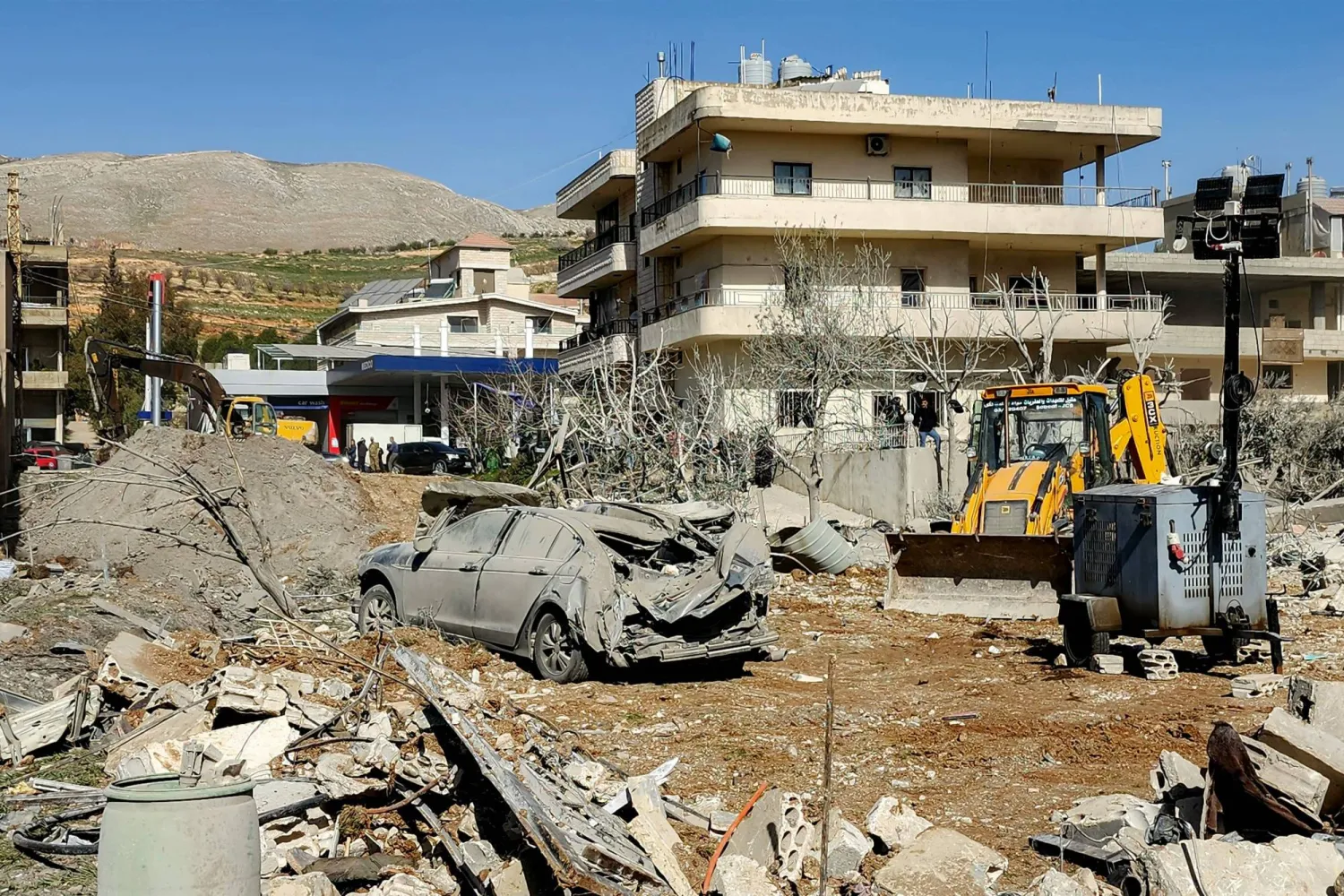
A bulldozer clears debris near heavily-damaged buildings in the village of Bednayel in Lebanon's eastern Bekaa Valley region on February 21, 2026, following Israeli strikes. (AFP)
TT

Eight Hezbollah Members Killed in Israel’s Friday Strikes on Lebanon

A bulldozer clears debris near heavily-damaged buildings in the village of Bednayel in Lebanon's eastern Bekaa Valley region on February 21, 2026, following Israeli strikes. (AFP)

Attacks carried out by Israel on Friday in eastern Lebanon killed eight members of Hezbollah, an official from the group told AFP on Saturday.

Lebanon's health ministry said Friday that a total of 10 people were killed in strikes that hit the eastern Bekaa region.

The Israeli military said it targeted "several terrorists of Hezbollah's missile array in three different command centers in the Baalbek area".

Lebanon's president on Saturday condemned the attacks, the latest despite a ceasefire with Hezbollah.

In a statement, Joseph Aoun called the attacks "a blatant act of aggression aimed at thwarting diplomatic efforts" by the United States and other nations to establish stability.

A lawmaker from Hezbollah called on Beirut to suspend meetings of a multinational committee tasked with monitoring the truce.

Washington is one of five members on the committee overseeing the ceasefire implemented in November 2024, with the body scheduled to meet again next week.

Israel has repeatedly bombed Lebanon despite the ceasefire, usually saying it is targeting Hezbollah but occasionally also the group's Palestinian ally Hamas.

The Friday attacks on southern and eastern Lebanon killed 12 people, according to the health ministry, 10 of them in the east of the country.

Israel's military said it struck "several terrorists of Hezbollah's missile array in three different command centers in the Baalbek area".

Hezbollah said a commander was killed in the raids. Its lawmaker Rami Abu Hamdan said on Saturday the group "will not accept the authorities acting as mere political analysts, dismissing these as Israeli strikes we have grown accustomed to before every meeting of the committee".

He called on Beirut to "suspend the committee's meetings until the enemy ceases its attacks".

Hezbollah, while weakened following war with Israel, remains a strong political force in Lebanon represented in parliament.

Lebanon's government last year committed to disarming the Iran-backed group, with the army saying last month it had completed the first phase of the plan covering the area near the Israeli border.

Israel, which accuses Hezbollah of rearming since the war, has called the Lebanese army's progress on disarming the group insufficient.


Ramadan’s First Friday Prayers Are Held at Jerusalem’s Al-Aqsa Mosque

Palestinians worshippers gather at Al-Aqsa Mosque compound for the first Friday prayers during the holy month of Ramadan, in the Old City of Jerusalem, 20 February 2026. (EPA)
TT

Ramadan’s First Friday Prayers Are Held at Jerusalem’s Al-Aqsa Mosque

Palestinians worshippers gather at Al-Aqsa Mosque compound for the first Friday prayers during the holy month of Ramadan, in the Old City of Jerusalem, 20 February 2026. (EPA)

Tens of thousands of Palestinians gathered under heavy Israeli restrictions at Jerusalem's Al-Aqsa Mosque compound for the first Friday prayers of the Muslim holy month of Ramadan, including some who were allowed to enter from the occupied West Bank.

The Ramadan prayers at Al-Aqsa took place for the first time since a shaky ceasefire deal between Israel and Hamas went into effect in October. It was the first opportunity many had to leave the West Bank and pray at the site in Jerusalem’s Old City since Ramadan last year.

Israel restricted the number of Palestinians allowed to enter from the West Bank to 10,000 on Friday, and only allowed men over 55 and women over 50 as well as children up to 12. It has imposed similar restrictions in the past, citing security concerns.

The hilltop, which Jews refer to as the Temple Mount, is the holiest site in Judaism and was home to the ancient biblical temples. Muslims call the site the Noble Sanctuary. Today it is home to Al-Aqsa Mosque, the third-holiest site in Islam.

It has frequently been a flashpoint in the Israeli-Palestinian conflict.

Israeli police said more than 3,000 police were deployed across Jerusalem. They said their presence was not meant to show aggression or force but was aimed at providing help in case of an emergency.

Many Palestinians view the heightened Israeli security presence, and increasing visits by religious and nationalist Israeli Jews, as a provocation. They fear that Israel intends to take over or partition the compound. The Israeli government denies having any such plans.

Jerusalem’s Islamic Waqf, the Jordanian religious authority that administers the compound, said there were 80,000 in attendance. In normal times, Ramadan Friday prayers at Al-Aqsa can draw up to 200,000.

Ezaldeen Mustafah, a Palestinian from the West Bank, was among those lamenting the restrictions.

“We need more people than this,” he said.

Some Palestinians from the West Bank on Friday said they were turned away from crossing into Jerusalem even though they had permits. Jihad Bisharat said he was told his permit had been canceled and was sent back. Israel's army didn't immediately respond to a request for comment.

The Old City, home to major religious sites sacred to Jews, Christians and Muslims, is in east Jerusalem, which Israel captured in the 1967 Mideast war, along with the West Bank and the Gaza Strip. The Palestinians want all three territories for a future state with its capital in east Jerusalem. Israel annexed east Jerusalem, a move not recognized by most of the international community, and considers the entire city to be its capital.

Ramadan in Gaza

Many Palestinians said the month’s typically festive spirit is eluding them as they struggle with grief and losses following two years of conflict in Gaza sparked by Hamas' Oct. 7, 2023, attack into Israel.

“All the mosques have been bombed,” said Ramiz Firwana, a Gaza resident who gathered with other worshippers for a Friday sermon and prayers held in schoolyard.

On Thursday evening, families sat amid the rubble and destruction for iftar, the meal held at the end of the daily dawn-to-dusk fast.

“Despite the displacement, the pain and the destruction, we want to rejoice and live,” said Mohammad Kollab, from Khan Younis. “We are not a people destined only for destruction and killing."

Israel’s military offensive has killed more than 72,000 Palestinians, according to Gaza’s Health Ministry, and caused widespread destruction and displaced most of the territory’s residents. Israel launched the offensive after Hamas-led militants killed some 1,200 people, mostly civilians, and took another 251 hostage in the initial attack.

The Oct. 10 US-brokered ceasefire deal has brought an end to major military operations and the release of the remaining hostages. But Palestinians, including many civilians, are still being killed in near-daily strikes that Israel says are aimed at militants who threaten or attack its forces.