


Exclusive – Mediterranean Tells Tales of Migrant Tragedy

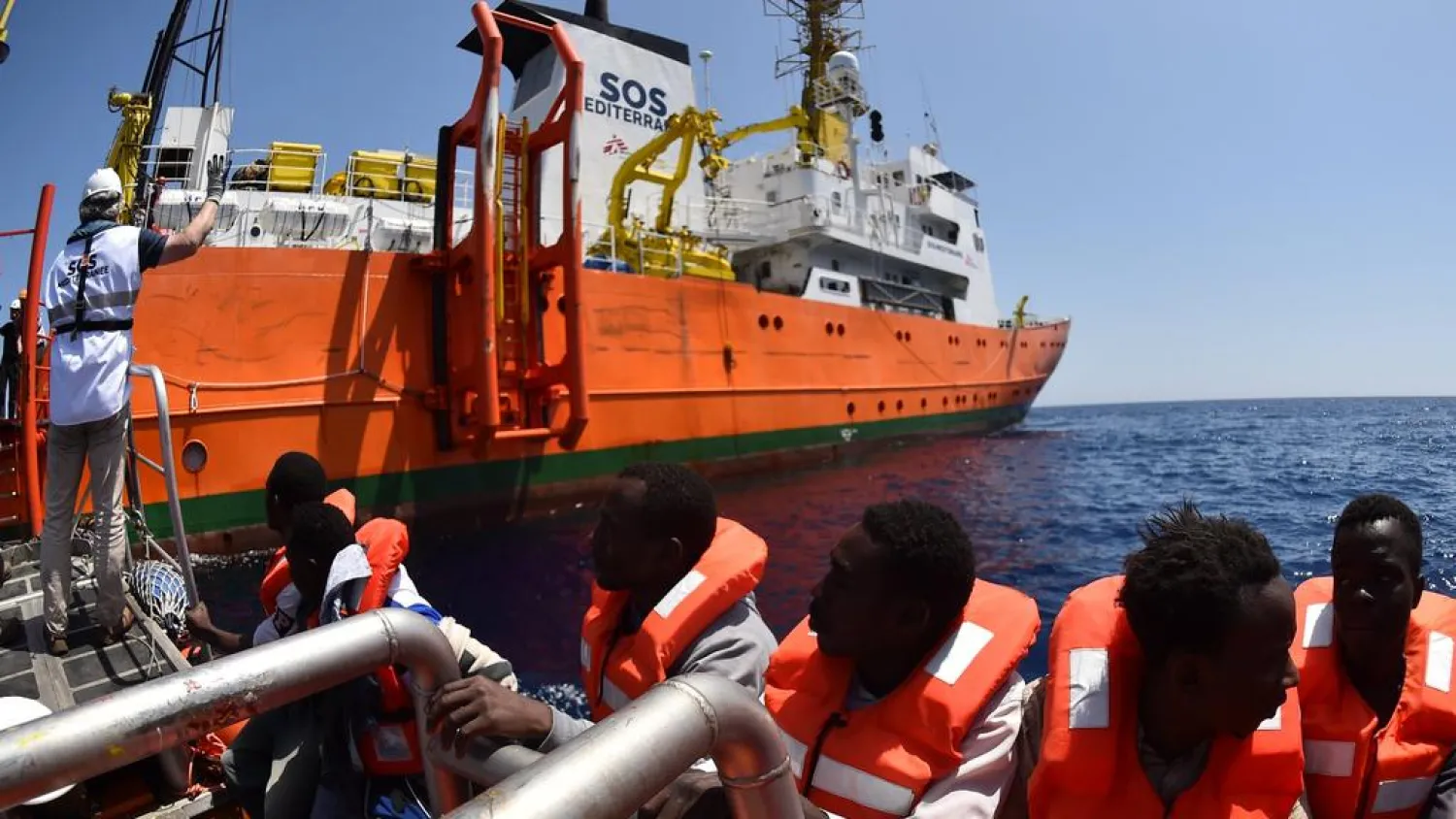
Refugees on a boat after being rescued by the Aquarius in the Mediterranean Sea. (AFP)
TT

Exclusive – Mediterranean Tells Tales of Migrant Tragedy

Refugees on a boat after being rescued by the Aquarius in the Mediterranean Sea. (AFP)

Two boxes, one red, the other blue, summarize the migration crisis in the Mediterranean. The first holds life-jackets and blankets, while the other holds a number of body bags for the victims.

Some 630 men, women and children of all ages stared death in the face and survived. They spent 48 hours on the MS Aquarius, a rescue ship operated since 2016 by SOS Mediterranee and Medecins Sans Frontieres (MSF), until a safe harbor agreed to receive them. As water and food supplies continued to drop, European pressure mounted and the Italian government continued to bar the ship from docking on its shores. Madrid finally announced that it was ready to receive the ship in Valencia.

Condemnations rose from both sides of the Mediterranean and many wondered what had happened to “European values.” The Aquarius has since then transformed into a symbol of a new European age, that of the plight of migrants. Asharq Al-Awsat spent a day on the Aquarius, which is currently docked in the French port city of Marseille, and met several members of its crew.

The vessel was built by the German navy in the 1970s and was, until 2009, operated as a fishery protection vessel in the North Atlantic. It was decommissioned in 2009 and picked up as a rescue ship in 2016 and it has eventually become one of the Mediterranean’s most famous vessels.

It has so far carried out 235 rescue operations, making up 20 percent of total rescues by non-government agencies and 6.4 percent of total operations since 2016. One day of operations costs some 11,000 euros (12,800 dollars), 90 percent of which are provided by donations. It is manned by dozens of sailors and professional rescuers. Some are volunteers, while others earn a salary for their work.

These figures may seem hefty, but they pale in comparison to the number of migrants and refugees that were saved by the Aquarius in two and a half years. It has saved a total of 29,318 people with the help of the Libyan and Italian navies, as well as 9,075 people transferred to the ship from other rescue vessels.

Clement, a French rescuer in his mid-20s, has been part of the Aquarius crew since the early months when it kicked off its operations. He wondered restlessly from the Marseille harbor: “What are we doing here? We cannot help save lives here.”

This dejection is shared by the majority of the crew. The vessel has since June 29 been forced to remain in the harbor after it was refused entry by each of Italy and Malta. Clement added, however, that “we are taking advantage of this time to update our equipment” before setting sail again in a few days.

Life or death trip

The Aquarius had since the early days of its operations worked closely with the Italian navy that used to provide it with the coordinates of migrant inflatables or vessels at sea. The new government, however, took a decision a few weeks ago to halt this assistance. The Aquarius crew spends an hour and a half a day in searching for migrants, whether by using marine radar or simply the naked eye.

Clement explained that the key to the success of any rescue mission at sea is maintaining the passenger calm.

“Once one passenger begins to panic, then others will follow and they may begin to throw themselves into the deep and cold water even if they do not know how to swim,” he added.

Once a vessel is reached, a “cultural mediator” approaches the migrants and asylum-seekers to calm them down and they are then given life-jackets. Rescue missions such as these could take up to an hour and a half. The longer it takes to complete a rescue, the higher the chances of death or hypothermia become.

Clement also spoke of burns the passengers may have suffered due to a mix of spilled fuel and seawater in their flimsy vessels. He said these burns were the most common injuries among the rescued. Once, on board, they receive the required treatment. Another common medical condition suffered by the migrants is hypothermia. The rescued are given blankets and hot tea to help their body temperature return to normal.

The birth of Miracle

With a broad smile, Amoin, an MSF midwife from the Ivory Coast, recounted how she took part in Aquarius’ last rescue off the Libyan coast. The operation saw the birth of a child, the sixth to be born on the vessel. He was named Miracle after all the suffering his mother had to endure to make it safely on to the Aquarius.

Amoin, who has worked for over three decades in the humanitarian field, takes care of all the women and children on the ship. They are accommodated in private rooms away from the men. Their chambers have signs in Arabic, English and French that provide a hot line for victims of sexual violence.

The Aquarius boasts two modest clinics for pregnant women or the wounded. It is not, however, equipped to carry out surgical operations or take out bullets from wounds. In very dangerous cases, said Clement, medical airlifts are called in to evacuate the wounded.

Halt in Italian coordination

The primary responsibility of any ship at sea, regardless of its nature, is to save people in distress and send them to safe shores.

In his map-strewn cabin, Italy’s Nico Stalla, spoke to Asharq Al-Awsat about the new challenges facing the Aquarius after Italy decided to stop helping rescue ships.

He started off his career at the ship in November 2016 as a sailor and rescuer. In March 2017, he became in charge of coordinating all search and rescue missions. His daily tasks include assigning missions to the crew, which is comprised of people from 17 countries.

The Aquarius’ last mission was particularly harsh for Stalla for in addition to the usual challenges that accompany any rescue, he had to contend with the Italian government’s decision to stop coordinating with rescue ships.

“We always had close ties with coordination center in Rome and Italy always considered the Aquarius a central part of rescue operations,” he said. He also condemned instructions for rescue ships to stay away from vessels in distress “until the Libyan coastguard arrives at the scene.” He deemed such a decision as a violation of all sea and international laws.

He said that Europe’s policy of backing Libyan rescue missions in international waters only helps the continent secure its borders at the expense of saving lives. Stalla added that the asylum-seekers are being forced to return to unsafe regions, namely Libya, which is suffering from its own armed conflict

This latest European policy has led to a spike in deaths in the Mediterranean, he revealed. June witnessed the greatest number of deaths in years, even though the number of asylum-seekers heading to Italy had dropped more than 70 percent compared to 2017.

SOS Mediterranee and other organizations have spoken against the Libyan coastguard assuming control of rescue missions for several reasons, he added, most important of which is that it is not properly equipped to carry out these operations.

The coastguard only boasts a couple of patrol boats. Italy donated four such boats in 2017, but only two are operational at a single time, said Stalla. Moreover, the methods used are not suitable for carrying out large-scaled rescues of dozens of people, let alone hundreds.




UK Foreign Minister to Meet Rubio amid Tensions over Joint Air Base

British Foreign Secretary Yvette Cooper, president of the United Nations Security Council for February speaks during a press conference before the Security Council meeting, at UN headquarters in New York City, US, February 19, 2026. REUTERS/Jeenah Moon
TT

UK Foreign Minister to Meet Rubio amid Tensions over Joint Air Base

British Foreign Secretary Yvette Cooper, president of the United Nations Security Council for February speaks during a press conference before the Security Council meeting, at UN headquarters in New York City, US, February 19, 2026. REUTERS/Jeenah Moon

Britain's foreign minister Yvette Cooper ‌will meet with US Secretary of State Marco Rubio on Friday, after President Donald Trump renewed his criticism of London for ceding sovereignty of ​the Chagos Islands, which is home to a US-UK air base.
Last year, British Prime Minister Keir Starmer agreed a deal to transfer sovereignty of the Indian Ocean islands to Mauritius, while keeping control of one - Diego Garcia - through a 99-year lease that preserved US operations at the base, Reuters said.
Washington last year gave its blessing to the agreement, but Trump has since ‌changed his mind ‌several times. In January, Trump described it ​as ‌an ⁠act ​of "great stupidity", ⁠but earlier this month said he understood the deal was the best Starmer could make, before then renewing his criticism this week.
Cooper is meeting Rubio to discuss defense and security issues in Washington as Trump also toughens his rhetoric on Iran, saying Tehran must make a deal over its nuclear program in the ⁠next 10 to 15 days, or "really bad ‌things" will happen.
The Diego Garcia ‌base has recently been used for ​operations in the Middle East against ‌Yemen's Houthis and in humanitarian aid to Gaza.
Although on Tuesday ‌Rubio's State Department said it backed the Chagos accord, the next day Trump said Britain was making a big mistake.
"DO NOT GIVE AWAY DIEGO GARCIA!" Trump wrote in a post on Truth Social, saying the ‌base could be called upon in any future military operation to "eradicate a potential attack" from ⁠Iran.
Under the ⁠conditions for using the joint base, Britain would need to agree in advance to any operations out of Diego Garcia.
On Thursday, Britain's The Times newspaper reported that Trump's latest criticism of the Chagos deal came because Britain was yet to give permission to use the bases for future strikes against Iran, owing to concerns they may breach international law.
Asked about The Times report, Britain's Ministry of Defence said on Thursday it does not comment on operational matters and that Britain supported ​the ongoing political process between ​the US and Iran.


Turkish Police Detain Deutsche Welle Journalist over Social Media Posts

19 February 2026, Canada: Deutsche Welle (DW) logo is seen displayed on a smartphone screen. Photo: Thomas Fuller/SOPA Images via ZUMA Press Wire/dpa
TT

Turkish Police Detain Deutsche Welle Journalist over Social Media Posts

19 February 2026, Canada: Deutsche Welle (DW) logo is seen displayed on a smartphone screen. Photo: Thomas Fuller/SOPA Images via ZUMA Press Wire/dpa

Turkish police have detained investigative journalist Alican Uludag on suspicion of insulting President Recep Tayyip Erdogan and spreading misinformation, sparking outrage among journalism groups.
Uludag, who works for German broadcaster Deutsche Welle’s Turkish service, was taken from his home in Ankara late Thursday as part of an investigation into social media posts. The Istanbul Chief Prosecutor’s Office said he is suspected of “insulting the president” and “disseminating misleading information.”
The journalist, whose reporting focuses mainly on the judiciary and on corruption cases, was later transferred to Istanbul for questioning.
His detention drew sharp condemnation from press freedom advocates, who described it as an attack on media independence and democratic norms, The Associated Press said.
Deutsche Welle’s director‑general, Barbara Massing, demanded his release, calling the arrest “a deliberate act of intimidation.”
On Friday, journalists gathered outside Istanbul’s Çaglayan Courthouse to protest Uludag’s detention and to call for his immediate release.
The advocacy group, Reporters Without Borders considers Türkiye to be one of the most repressive countries for journalists, nothing that most media organizations are under government control and journalists face frequent legal pressure or intimidation.
At least 14 journalists or media sector workers are currently in prison, according to the Turkish Journalists Syndicate.


South Korea’s Ex-President Yoon Apologizes After Life Sentence Over Martial Law 

South Korean President Yoon Suk Yeol  delivers a speech to declare martial law in Seoul, South Korea, December 3, 2024. (The Presidential Office/Handout via Reuters/File Photo)
South Korean President Yoon Suk Yeol delivers a speech to declare martial law in Seoul, South Korea, December 3, 2024. (The Presidential Office/Handout via Reuters/File Photo)
TT

South Korea’s Ex-President Yoon Apologizes After Life Sentence Over Martial Law 

South Korean President Yoon Suk Yeol  delivers a speech to declare martial law in Seoul, South Korea, December 3, 2024. (The Presidential Office/Handout via Reuters/File Photo)
South Korean President Yoon Suk Yeol delivers a speech to declare martial law in Seoul, South Korea, December 3, 2024. (The Presidential Office/Handout via Reuters/File Photo)

Former ‌South Korean President Yoon Suk Yeol apologized on Friday for his short-lived declaration of martial law in December 2024, a day after a Seoul court sentenced him to life in prison for masterminding an insurrection.

In a statement released by his lawyers, Yoon said that while he was sorry for the "frustration and hardship" brought upon the people by his martial law decree, he stood behind the "sincerity and purpose" behind his actions.

The Seoul Central District Court's decision ‌to hand him ‌a life sentence on Thursday was "predetermined," he ‌said, ⁠adding that the verdict ⁠against him was political retaliation.

"Forces that seek to smear a decision made to save the nation as an 'insurrection' and to use it beyond political attacks as an opportunity to purge and eliminate their opponents will only grow more rampant going forward," he said.

Yoon also questioned ⁠whether an appeal would have meaning ‌in what he described as an ‌environment where judicial independence could not be guaranteed, while telling ‌supporters to "unite and rise."

His lawyers separately said the statement ‌did not amount to an intention to forgo an appeal.

Yoon's martial law declaration lasted around six hours before being voted down by parliament, but it sent shockwaves through the country and ‌sparked street protests.

The court found Yoon guilty of subverting constitutional order by deploying troops ⁠to storm ⁠parliament and move to detain opponents, capping a dramatic fall that saw him stripped of office and end up behind bars.

Yoon, a former career prosecutor, denied the charges, arguing he had presidential authority to declare martial law and his action was aimed at sounding the alarm over opposition parties' obstruction of government.

A special prosecutor had sought the death penalty for Yoon, though South Korea has not carried out an execution since 1997.

A prosecutor said on Thursday the team had some "regret" over the sentencing, but declined to say whether they planned to appeal.