

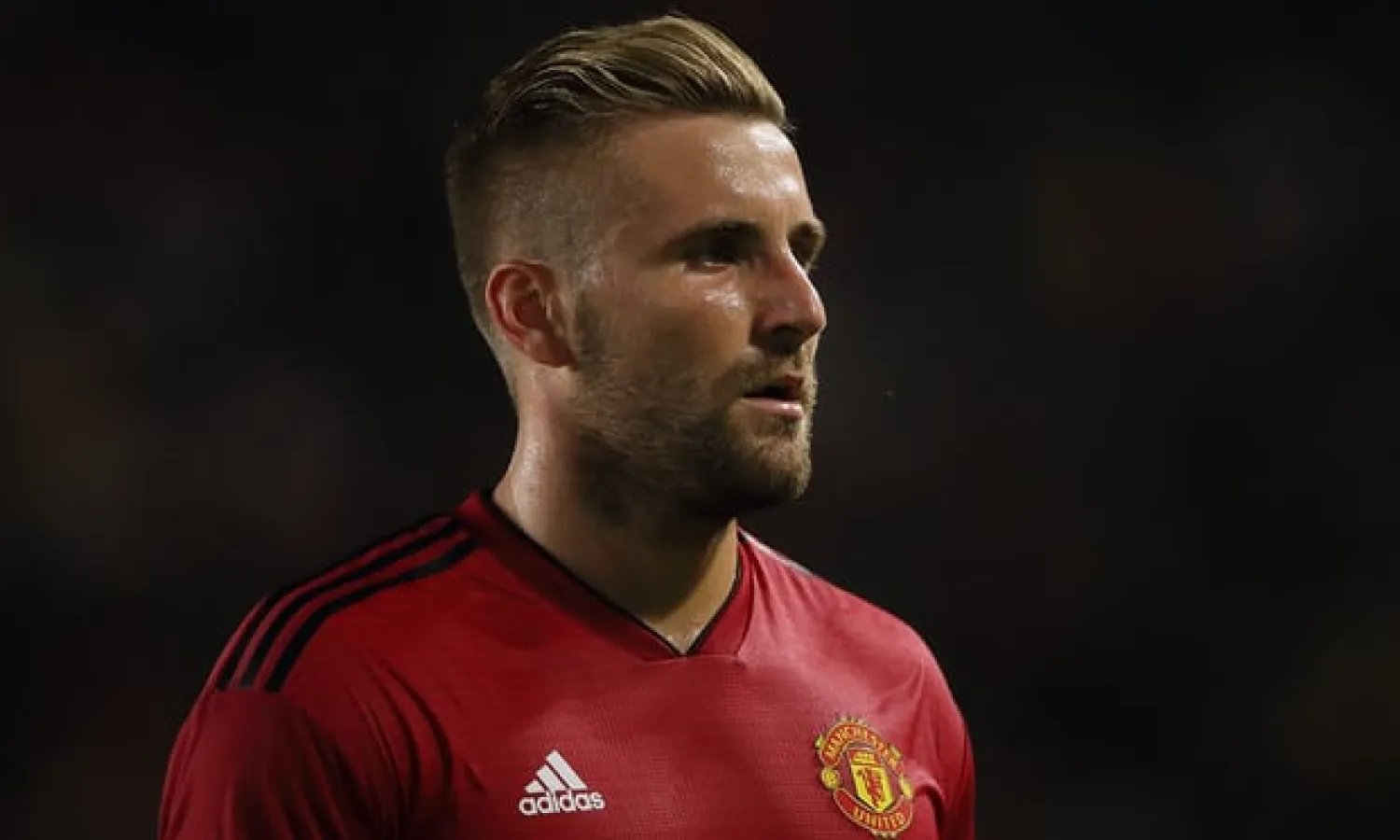

Luke Shaw: ‘People Can Say I’m Fat but I’ve Never Been Out of Shape’

 Luke Shaw is in the last year of his deal at Old Trafford. Photograph: Matthew Ashton - AMA/Getty Images
Luke Shaw is in the last year of his deal at Old Trafford. Photograph: Matthew Ashton - AMA/Getty Images
TT

Luke Shaw: ‘People Can Say I’m Fat but I’ve Never Been Out of Shape’

 Luke Shaw is in the last year of his deal at Old Trafford. Photograph: Matthew Ashton - AMA/Getty Images
Luke Shaw is in the last year of his deal at Old Trafford. Photograph: Matthew Ashton - AMA/Getty Images

Luke Shaw is honest regarding the criticism he attracts for perceived weight issues.

Speaking at the Montage hotel in Beverly Hills, where Manchester United are based for their US summer tour, Shaw is about to embark on a make-or-break year at Old Trafford. The defender is in great shape physically after a personal pre-season programme in Dubai this month but, more than anything, he would rather his physique was not constantly judged.

“I guess you’ve just got to take it because there is always going to be negative criticism and positive but both of them can make you stronger,” he says. “I’ve been unlucky because I’ve had a few ups and downs with different managers but I would say I’ve never been out of shape. Honestly, I feel really good and I’m raring to go, and the minutes [on tour] are only going to help me become fitter.”

Shaw, who has started all three of United’s games in the US, is entering the final year of a contract he signed in 2014, when he arrived at Old Trafford from Southampton for a fee in excess of £27m and with the then 18-year-old an England left‑back. He was expected to occupy the same position at United for a decade or more but his career there has yet to fire.

Shaw has endured injury, notably a broken leg in September 2015 that ended his season. And from the moment Louis van Gaal, José Mourinho’s predecessor, branded him overweight during the 2014 summer tour of the US, the charge has dogged him.

“People can say I’m fat but I know my own body,” Shaw says. “I always look big because I’m bigger built – I’ve got that Wayne Rooney type of body.”

The trip to Dubai illustrates the player’s determination to compete with Ashley Young for United’s starting left-back slot, and if a picture he posted on social media is anything to go by the 23-year-old has been doing all the right things.

“I worked hard and not just for them [critics],” says Shaw, who is likely to start United’s Premier League curtain-raiser with Leicester City on 10 August because of Young’s post-World Cup break. “I’m working harder than ever and in the first game I want to look 10 times better than in that picture.”

Like Van Gaal before him Mourinho has been critical of Shaw’s weight, leading to accusations of bullying on the Portuguese’s part and the player at one stage last year believing he had no future at United. But as Shaw reveals, the current United manager has been hugely supportive of his summer fitness regime, going as far as to send him encouraging text messages.

“I was in Dubai with my girlfriend. It was funny – I was on my phone flicking through stuff. I got the text and accidentally clicked straight away [to reveal he read it]. The manager was probably thinking: ‘Jesus Christ!’I said to my girlfriend: ‘I’ve just opened it and I must look so weird now.’ It was fine. I left it a little bit to reply because I didn’t want to look too eager. It was a breath of fresh air when he texted me. I wasn’t expecting it. I spoke to him and it was really positive.”

Shaw runs through his routine in Dubai. “We had to wake up early because it was hitting 45 degrees by 10 o’clock – it was quite painful the first day as we did do it in that heat. I would train and go in the gym. Then relax during the day and run on the beach and do core work in the evening before the sun went down.”

With Shaw’s deal ending next summer he could leave United on a free if the club do not offer him fresh terms. “That’s what’s most frustrating,” he says. “You don’t want to be in this situation but I know I have got the quality to [truly] become a Manchester United player. Because at the moment it would be easy to sort of give up, after what happened in the last year or so.”

Shaw is referencing Mourinho’s public admonishments regarding his approach to training and performances in matches. “It would be easy for me to quit and say: ‘I want to go.’ Of course, if the manager comes and says: ‘You’re not a player for Manchester United, you’re not a player for me,’ then I’ll accept that and find another place.

“I want to earn a contract. I don’t want a contract because in the next year I’m a free agent, so they might look to tie me down. I know the club believe me – I’ve spoken with them, the manager, I’ve had discussions, meetings. If they really wanted to they could’ve cashed in. I’m going to fight for it this year and I want to be in that starting team.”

Shaw appeared to hit a nadir in March when he was hauled off by Mourinho at half-time of the 2-0 victory against Brighton. It seemed his Old Trafford career may be over. Yet there were four further appearances. “There were no doubts but there has been emotion,” the player says. “I was very upset but he [Mourinho] only does stuff like that because he knows what I can do. We’ve had this conversation. He said he knows I can be the best but he sometimes feels frustrated that I’m not doing that.

“He knows what I can do. That was one of the texts he sent me in the off-season: ‘I know what you can do – you can be the best but you’ve just got to work on a couple of things.’ That’s why it pushes me on more. He says these things because he knows I can do it. He knows I can play for Manchester United.

“It’s horrible at times because people only see those things he says [in public]. That’s fine because I’m a grown man and I can take stuff like that. I’m used to it. But the stuff inside the training ground, no one sees apart from me. It still gives me confidence.”

The Guardian Sport



Deep-sea Fish Break the Mold with Novel Visual System

A close-up showing the shiny silver-green photophores (light organs) on the lower head of the deep-sea fish Maurolicus muelleri from the Red Sea, seen in this photograph released on February 11, 2026. Dr. Wen-Sung Chung/Handout via REUTERS
TT

Deep-sea Fish Break the Mold with Novel Visual System

A close-up showing the shiny silver-green photophores (light organs) on the lower head of the deep-sea fish Maurolicus muelleri from the Red Sea, seen in this photograph released on February 11, 2026. Dr. Wen-Sung Chung/Handout via REUTERS

For more than a century, biology textbooks have stated that vision among vertebrates - people included - is built from two clearly defined cell types: rods for processing dim light and cones for bright light and color. New research involving deep-sea fish shows this tidy division is, in reality, not so tidy.

Scientists have identified a new type of visual cell in deep-sea fish that blends the shape and form of rods with the molecular machinery and genes of cones. This hybrid type of cell, adapted for sight in gloomy light conditions, was found in larvae of three deep-sea fish species in the Red Sea, Reuters reported.

The species studied were: a hatchetfish, with the scientific name Maurolicus mucronatus; a lightfish, named Vinciguerria mabahiss; and a lanternfish, named Benthosema pterotum. The hatchetfish retained the hybrid cells throughout its life. The other two shifted to the usual rod-cone dichotomy in adulthood.

All three are small, with adults measuring roughly 1-3 inches (3-7 cm) long and the larvae much littler. They inhabit a marine realm of twilight conditions, with sunlight struggling to penetrate into the watery depths.

The vertebrate retina, a sensory membrane at the back of the eye that detects light and converts it into signals to the brain, possesses two main types of light-sensitive visual cells, called photoreceptors. They are named for their shape: rods and cones.

"The rods and cones slowly change position inside the retina when moving between dim and bright conditions, which is why our eyes take time to adjust when we flick on the light switch on our way to the restroom at night," said Lily Fogg, a postdoctoral researcher in marine biology at the University of Helsinki in Finland and lead author of the research published in the journal Science Advances.

"We found that, as larvae, these deep-sea fish mostly use a mix-and-match type of hybrid photoreceptor. These cells look like rods - long, cylindrical and optimized to catch as many light particles - photons - as possible. But they use the molecular machinery of cones, switching on genes usually found only in cones," Fogg said.

The researchers examined the retinas of fish larvae caught at depths from 65 to 650 feet (20 to 200 meters). In the type of dim environment they inhabit, rod and cone cells both are usually engaged in the vertebrate retina, but neither works very well. These fish display an evolutionary remedy.

"Our results challenge the longstanding idea that rods and cones are two fixed, clearly separated cell types. Instead, we show that photoreceptors can blend structural and molecular features in unexpected ways. This suggests that vertebrate visual systems are more flexible and evolutionarily adaptable than previously thought," Fogg said.

"It is a very cool finding that shows that biology does not fit neatly into boxes," said study senior author Fabio Cortesi, a marine biologist and neuroscientist at the University of Queensland in Australia. "I wouldn't be surprised if we find these cells are much more common across all vertebrates, including terrestrial species."

All three species emit bioluminescence using small light-emitting organs on their bodies, mostly located on the belly. They produce blue-green light that blends with the faint background light from the sun above. This strategy, called counterillumination, is a common form of camouflage in the deep sea to avoid predators.

"Small fish like these fuel the open ocean. They are plentiful and serve as food for many larger predatory fishes, including tuna and marlin, marine mammals such as dolphins and whales, and marine birds," Cortesi said.

These kinds of fish also engage in one of the biggest daily migrations in the animal kingdom. They swim near the surface at night to feed in plankton-rich waters, then return to the depths - 650 to 3,280 feet (200 to 1,000 meters) - during daytime to avoid predation.

"The deep sea remains a frontier for human exploration, a mystery box with the potential for significant discoveries," Cortesi said. "We should look after this habitat with the utmost care to make sure future generations can continue to marvel at its wonders."


King Salman Directs Disbursement of over SAR3 Billion as Ramadan Assistance for Social Security Beneficiaries

Custodian of the Two Holy Mosques King Salman bin Abdulaziz. (SPA)
TT

King Salman Directs Disbursement of over SAR3 Billion as Ramadan Assistance for Social Security Beneficiaries

Custodian of the Two Holy Mosques King Salman bin Abdulaziz. (SPA)

Custodian of the Two Holy Mosques King Salman bin Abdulaziz Al Saud, upon the recommendation of Prince Mohammed bin Salman bin Abdulaziz Al Saud, Crown Prince and Prime Minister, has directed the disbursement of more than SAR3 billion in Ramadan assistance to social security beneficiaries, SPA reported.

The directive reflects the leadership’s commitment to addressing the needs of beneficiary families and ensuring their requirements are met during the holy month of Ramadan.

The generous assistance includes SAR1,000 for the head of each household and SAR500 for each dependent. The amounts are expected to be deposited directly into the beneficiaries’ bank accounts within the coming hours.

Minister of Human Resources and Social Development Ahmed Al-Rajhi expressed his gratitude and appreciation to the Custodian of the Two Holy Mosques and the Crown Prince for this generous gesture toward social security beneficiaries and for their continued attention to citizens’ needs during Ramadan.


Sports Investment Forum Allocates Third Day to Women's Empowerment to Promote Sustainable Investment in Women’s Sports

Sports Investment Forum Allocates Third Day to Women's Empowerment to Promote Sustainable Investment in Women’s Sports
TT

Sports Investment Forum Allocates Third Day to Women's Empowerment to Promote Sustainable Investment in Women’s Sports

Sports Investment Forum Allocates Third Day to Women's Empowerment to Promote Sustainable Investment in Women’s Sports

The Sports Investment Forum announced that the third day of its 2026 edition will be dedicated to empowering women in the sports sector, in partnership with Princess Nourah bint Abdulrahman University. The move reflects the forum’s commitment to supporting the objectives of Saudi Vision 2030 and enhancing the role of women in the sports industry and sports investment.

This allocation comes as part of the forum’s program, scheduled to take place from April 20 to 22, at The Ritz-Carlton, Riyadh. The third day will feature a series of strategic sessions and specialized workshops focused on sustainable investment in women’s sports, the empowerment of female leadership, the development of inclusive sports cities, and support for research and studies in women’s sports, SPA reported.

Forum organizers emphasized that the partnership with Princess Nourah bint Abdulrahman University, recognized as the largest women’s university in the world, represents a model of integration between the academic and investment sectors. The partnership contributes to building a sustainable knowledge base that supports the growth of women’s sports and enhances investment opportunities at both local and international levels.

The dedicated day will address several strategic themes, including sustainable investment in women’s leagues and events, boosting scalable business models, empowering female leaders within federations, clubs, and sports institutions, and developing inclusive sports cities that ensure women’s participation in line with the highest international standards. It will also include the launch of research initiatives and academic partnerships to support future policies and strategies for the sector.

This approach aims to transform women’s empowerment in sports from a social framework into a sustainable investment and development pathway that enhances women’s contributions to the sports economy and reinforces Saudi Arabia’s position as a leading regional hub for advancing women’s sports.

The day is expected to attract prominent female leaders, decision-makers, investors, and local and international experts, in addition to the signing of several memoranda of understanding and joint initiatives supporting women’s empowerment in the sports sector.

The Sports Investment Forum reiterated that empowering women is a strategic pillar in developing the national sports ecosystem, contributing to economic growth objectives, enhancing quality of life, and building a more inclusive and sustainable sports community.