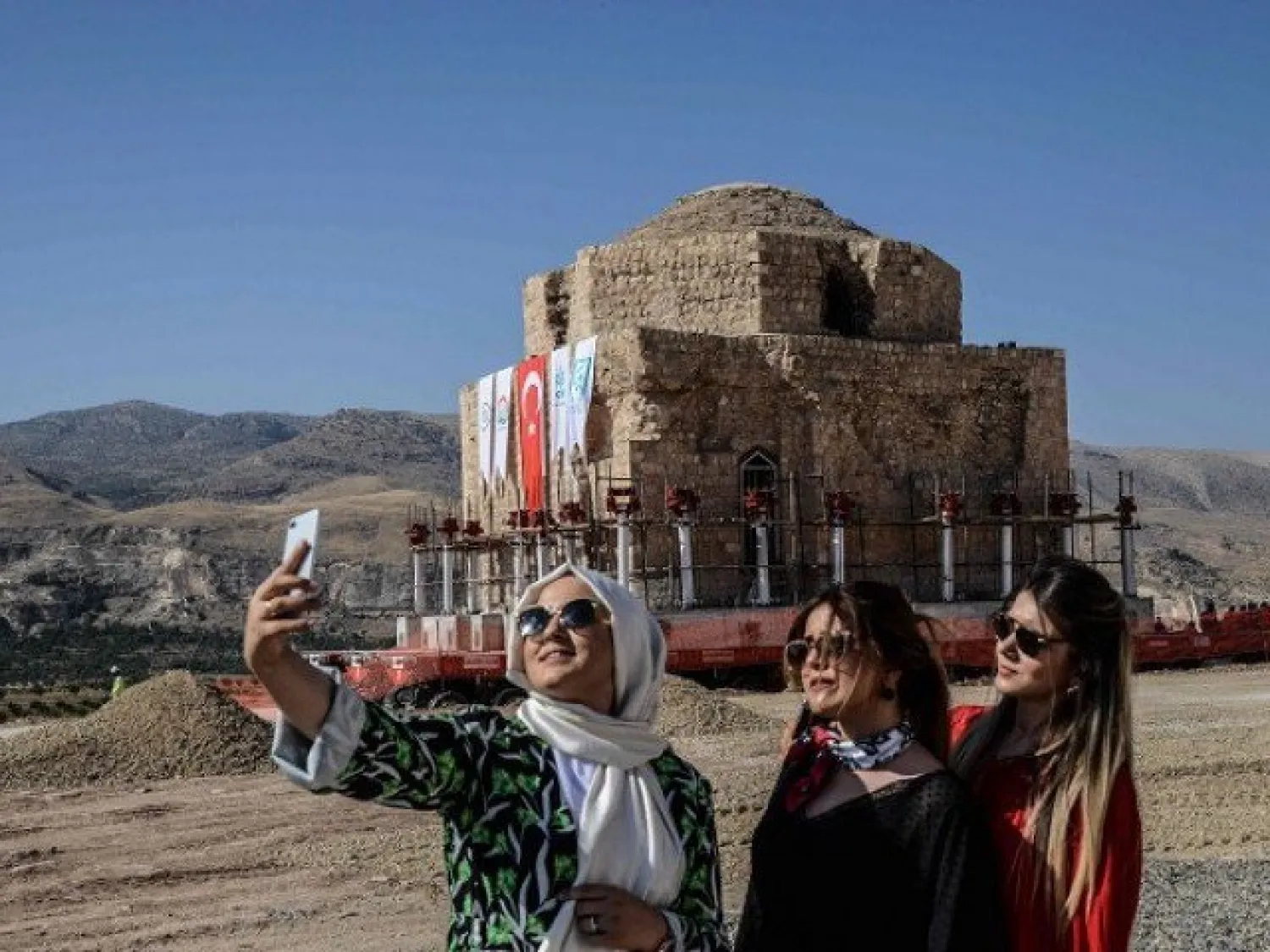
Historic Turkish Bath Relocated Away from New Dam Project

Women take a selfie picture with their mobile phone as the Artuklu Hamam is loaded onto a wheeled platform and moved down a specially constructed road, on August 6, 2018. AFP
TT

Historic Turkish Bath Relocated Away from New Dam Project

Women take a selfie picture with their mobile phone as the Artuklu Hamam is loaded onto a wheeled platform and moved down a specially constructed road, on August 6, 2018. AFP

The historic Turkish bath house (hamam) “Artuklu” in the southeastern town of Hasankeyf in Batman governorate has been relocated to a cultural park in the same town.

This move aims to protect the ancient monument from the construction work of the Ilisu Dam project on the Tigris River, which will completely submerge the village.

The ancient “hamam” weighs 1,500 tons, and its relocation required two hours and 15 minutes.

Batman Governor Ahmet Deniz said the process of moving the historic building was an example to the world.

He noted that after the Artuklu Hamam, six more monuments will be transferred, adding that Hasankeyf will truly keep its historic identity.

For his part, Murat Ajo, head of Turkey’s water department said the relocation of the bath that dates back to the 13th century, comes one year after the relocation of the 550-year-old Zeynel Bey tomb in the same region.

Zeynel Bey is the son of Uzun Hassan, head of a Turkic tribe that ruled Eastern Anatolia, Azerbaijan, Iraq, Afghanistan and areas in Central Asia between 1467 and 1502.

The tomb is the last trace of the tribe’s history. Zeynel Bey was killed in 1473 during a battle against the Ottoman Empire.

In May 2017, his tomb’s relocation was made upon a decision by the Ministry of Forest and Water Management to protect it from flooding.

The name of Hasankeyf village, which dates back about 10,000 years, was inspired by its houses sculpted in the rocks. Back then, the Syriacs called it Kiva, and Arabs later named it the fortress of Kiva.

In the late Ottoman Empire its name became Hasankeyf, which is still being used.


Super Typhoon Sinlaku Pounds Remote US Islands in the Pacific Ocean with Ferocious Winds

Trees sway in strong winds as Super Typhoon Sinlaku approaches, in Saipan, Northern Mariana Islands, US, April 14, 2026 in this screengrab obtained from a social media video. (Jhon Aaron Borinaga via Facebook/via Reuters)
TT

Super Typhoon Sinlaku Pounds Remote US Islands in the Pacific Ocean with Ferocious Winds

Trees sway in strong winds as Super Typhoon Sinlaku approaches, in Saipan, Northern Mariana Islands, US, April 14, 2026 in this screengrab obtained from a social media video. (Jhon Aaron Borinaga via Facebook/via Reuters)

A super typhoon steadily battered a pair of remote US islands in the Pacific Ocean with ferocious winds and relentless rains, shredding tin roofs and forcing residents to take cover from flying tree limbs.

Super Typhoon Sinlaku pounded the Northern Mariana Islands for hours before daybreak Wednesday, slowing just to inflict more damage across the islands of Tinian and Saipan, home to nearly 50,000 people.

In the village Susupe on Saipan, the wind tore the roof off a commercial building and broke tree branches. A blue sedan lay on its side.

Resident Dong Min Lee shot some video of a car sitting on top of two others in his apartment building’s parking lot below. The winds also tore off part of his balcony railing.

"I hope people will take an interest and help. The damage is really huge here," Lee said in a Facebook message.

Preliminary reports include a lot of flooding, uprooted trees and downed power lines, said Jaden Sanchez, spokesperson for the Saipan mayor’s office. There were no reports of deaths, he said.

Authorities were advising residents to remain indoors and away from strong winds, but Mayor Ramon "RB" Jose Blas Camacho was out in the community assessing the damage, Sanchez said.

The typhoon — the strongest tropical cyclone on Earth this year — was packing sustained winds of up to 150 mph (240 kph) when it made landfall on the islands, the National Weather Service said.

Tropical force winds and torrential rainfall also led to flash flooding on Guam, a US territory to the south with several US military installations and about 170,000 residents, the weather service said. Earlier, it hit the outer islands and atolls of Chuuk in the Federated States of Micronesia.

The American Red Cross and its partners were sheltering more than 1,000 residents across Guam and the Northern Marians, agency spokesperson Stephanie Fox said.

Winds at 75 mph (121 kph) or greater were expected to continue through Wednesday afternoon as the eye of the storm was moving northwest of Saipan and Tinian, said Ken Kleeschulte, acting science and operations officer for the National Weather Service on Guam.

Even as winds slowly subside to about 50 mph (80 kph), they will remain too strong for people to safely go outside for at least a day and a half, he said.

Sinlaku will start to curve toward sparsely populated volcanic islands in the far northern Marianas, he said.

Still recovering from a 2018 typhoon In Guam, where Typhoon Mawar knocked out power for days in 2023, US military officials warned personnel to shelter in place. The military controls about one-third of the land on Guam, a critical hub for US forces in the Pacific.

Tourism-dependent Saipan — the site of one of World War II’s bloodiest battles in the Pacific — was still recovering from 2018’s Super Typhoon Yutu when the COVID-19 pandemic hit, Hunter said. The economy has yet to rebound, he said.

Yutu destroyed 85% of the Saipan campus of Northern Marianas College, said the school's president, Galvin Deleon Guerrero. The institution secured $100 million in grant funding to rebuild.

"Just as we were finally beginning to recover and rebuild, we get hit with this," he said. "Climate change is real."

He said he worries about people still suffering from the post-traumatic stress of Yutu.

"We are an incredibly resilient people," he said, noting that he’s Chamorro, the Indigenous people of the Mariana Islands. "But just because we’re resilient doesn’t mean that we should be subjected to this on this frequent basis."

Disaster declaration President Donald Trump approved emergency disaster declarations ahead of the latest storm for Guam and the Mariana Islands. The Federal Emergency Management Agency said it was coordinating support across multiple agencies, dispatching nearly 100 FEMA staff as well as other personnel.

Super typhoons are the equivalent of Category 4 or 5 hurricanes in the Atlantic, with winds of at least 150 mph (240 kph). There have been more than 300 super typhoons identified over the past 80 years by the Joint Typhoon Warning Center in Guam.

Typhoons are "very common" in the Pacific, but the peak season is similar to the Atlantic hurricane season, which runs from summer to fall, said Jason Nicholls, AccuWeather’s lead international forecaster.

"As we’ve seen this year, you can get tropical systems in the West Pacific any time of year," Nicholls said. "But getting them in April is a little unusual."


Afghans Comb Riverbed in Search of Gold Dust

This photograph taken on April 13, 2026 shows an Afghan man scouring for gold using the traditional gold-panning technique, after sorting nuggets from mountainside stones excavated from the Kunar riverbed in the Kharwalu area of Naray district, Kunar province. (AFP)
TT

Afghans Comb Riverbed in Search of Gold Dust

This photograph taken on April 13, 2026 shows an Afghan man scouring for gold using the traditional gold-panning technique, after sorting nuggets from mountainside stones excavated from the Kunar riverbed in the Kharwalu area of Naray district, Kunar province. (AFP)

In the jagged Hindu Kush in eastern Afghanistan, hundreds of men dug into the rocky bed of the Kunar River searching for a few grams of gold dust as an alternative source of income.

At the foot of imposing peaks, some still covered in snow in April, they toiled near the border with Pakistan to find the valuable glinting specks in a country where wages are low.

Below a village of mud-brick houses and small terraced wheat plots in Kharwalu, Kunar province, they dug into a dry section of the riverbed before sifting through their piles of rocks using river water.

Fifty-year-old Shahzahdah Gollalah was among the gold prospectors, having abandoned construction work a seven-hour drive from his home in Kabul.

"There are not many job opportunities in the country, and in this way, we have created work for ourselves," said the father of eight.

But "the gold nuggets we find are usually smaller than a grain of wheat," he added.

Downstream, in Ghaziabad, hundreds of men hacked into the mountain with picks, then carried a sack down on their backs along a steep slope and emptied it onto a sieve to filter gold from the sand.

Others scooped river water into yellow jerrycans attached to long wooden handles, pouring it over the sieve so that the smaller stones, which may contain gold flakes, slid down onto a mat. A nugget would sometimes appear in a metal pan after two further rounds of sifting.

Gul Ahmad Jan, 35, said he can earn a substantial amount in just a week.

"We can get up to about one gram of gold," which can fetch up to 8,000 Afghanis ($125), he told AFP.

Afghanistan's resources were rarely exploited during years of conflict, although a Kunar official said gold panning has happened there for more than a decade.

Najibullah Hanif, the province's information chief, said residents learnt the techniques from miners who arrived from gold-rich provinces.

"Some started to dig with machines, an excavator; some locals came and asked the Islamic Emirate (of Afghanistan) to stop them because it destroys the river and the mountains," said Hanafi.

He estimated thousands of people in Kunar were gold panning, using the traditional method allowed by the authorities.

Afghanistan's resources have attracted domestic and international investors in recent years, with the Taliban authorities promoting mining in various parts of the country.


Remote Working, Prices Drive US Home Coffee Consumption to Highest in 14 Years

US coffee drinkers consume an average of 2.8 cups per day. (AFP)
TT

Remote Working, Prices Drive US Home Coffee Consumption to Highest in 14 Years

US coffee drinkers consume an average of 2.8 cups per day. (AFP)

Remote working and the need to save money are leading to an increase in coffee consumption at home in the United States, in a reversal of a pre-pandemic trend of increasing consumption at cafes, according to industry data and analysts.

A survey from the US National Coffee Association released on Tuesday showed 85% of the people in the country that said they drank coffee in the ‌past day did ‌it at home, the highest amount ‌on ⁠that classification since ⁠2012.

The survey also showed that among those declaring they drank coffee out-of-home, most said it was at their offices or in transit (drive-through), with a smaller part saying they walked into a coffee shop.

Hybrid lifestyles, with less commuting, and the economic pressure ⁠felt by part of the population ‌are two major ‌factors driving the increase in home consumption of coffee, said ‌Gerd Müller-Pfeiffer, a former Nestle executive and now ‌an adviser to the coffee industry.

Coffee prices in the US remain historically high after production shortfalls in major producing nations drove prices to record highs late last year.

A ‌third factor for increased home consumption, Müller-Pfeiffer said, is equipment quality.

"Home machines now ⁠deliver ⁠near out-of-home quality," he said.

Despite the changes in how coffee is consumed in the United States, the world's largest market for the beverage, the number of people that said they had coffee in the past day was stable at 66% of survey respondents, said the NCA, more than any other beverage including bottled water.

US coffee drinkers consume an average of 2.8 cups per day, resulting in more than 500 million cups of coffee served every day in the country.