


US Increases Reward for Information on Qaeda Leaders

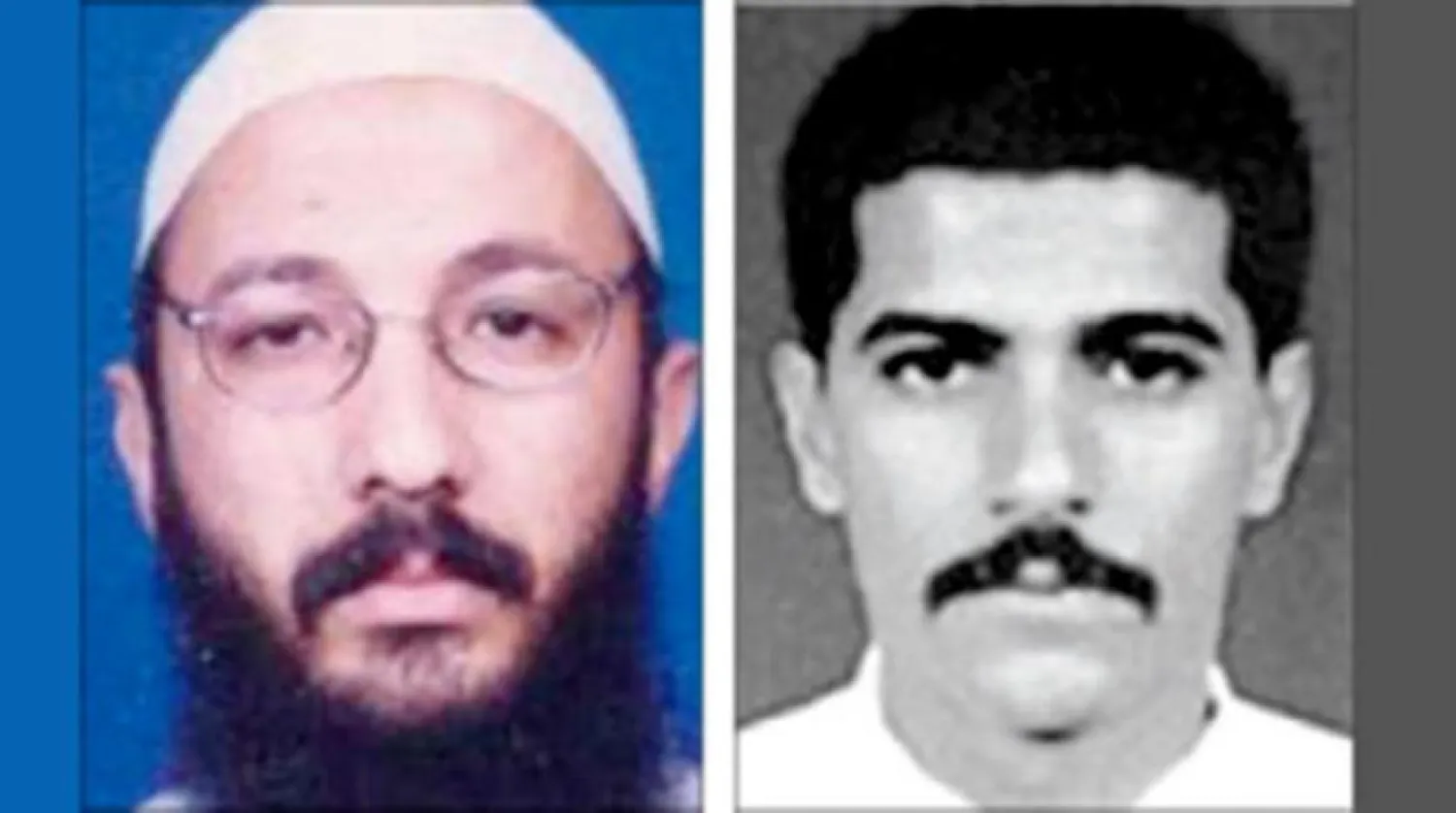
Abdullah Ahmed Abdullah (right) and Sayf al-Adl (left). Photo from CIA and FBI
TT

US Increases Reward for Information on Qaeda Leaders

Abdullah Ahmed Abdullah (right) and Sayf al-Adl (left). Photo from CIA and FBI

The US Department of State has said that it increased reward offers for information leading to the location, arrest, or conviction of al-Qaeda key leaders Abdullah Ahmed Abdullah and Sayf al-Adl to $10 million.

This represents a doubling of the previous reward offers of $5 million each announced in December 2000, it said in a statement.

Both individuals served as members of al-Qaeda’s leadership council, and al-Adl also served on the group’s military committee, it said.

They were charged by a federal grand jury in November 1998 for their role in the deadly August 7, 1998 bombings of the US embassies in Dar es Salaam, Tanzania, and Nairobi, Kenya, said the statement.

In 2001, Abdullah and al-Adl were added to the UN Security Council’s al-Qaeda Sanctions List as well as the US Treasury Department’s list of Specially Designated Nationals under Executive Order 13224 for their activities in support of the terrorist group, it added.

The State Department encouraged anyone with information about them to contact the Rewards for Justice office. “All information will be kept strictly confidential,” it said.

The Rewards for Justice Program is administered by the US Department of State’s Bureau of Diplomatic Security. Since its inception in 1984, the program has paid in excess of $145 million to more than 90 individuals who provided actionable information that helped bring terrorists to justice or prevented acts of international terrorism worldwide.

Al-Adl was a lieutenant colonel in the Egyptian Special Forces until his arrest in 1987. As early as 1990, al-Adl and other al-Qaeda operatives provided military and intelligence training in various countries, including Afghanistan, Pakistan and the Sudan, for the use of al-Qaeda and its affiliated groups, including the Egyptian Jihad.

In 1992 and 1993, he and Abdullah provided military training to al-Qaeda operatives as well as Somali tribesmen who fought against US forces in Mogadishu during Operation Restore Hope.

He and Abdullah have been charged by a federal grand jury in November 1998 for their role in the bombings of the US embassies in Dar es Salaam and Nairobi.

After the bombings, al-Adl moved to southeastern Iran and lived under the protection of Iran’s Revolutionary Guard Corps. In April 2003, Iranian authorities placed him, Abdullah, and other al-Qaeda leaders under house arrest.

In September 2015, al-Adl and four other senior al-Qaeda leaders were released from Iranian custody in exchange for an Iranian diplomat kidnapped by the terrorist group in Yemen.

Al-Adl also was a senior lieutenant to Abu Musab al Zarqawi, founder of al-Qaeda in Iraq which later became ISIS.

As for Abdullah, known as Abu Mohammed al-Masri, he is an experienced financial officer, facilitator, and operational planner for al-Qaeda.

He has been linked to the Riyadh attacks in 2003, which according to US intelligence reports were carried out following orders from al-Qaeda leaders in southern Iran.



Glitch Delays Restart of World's Biggest Nuclear Plant in Japan

Local Japanese authorities have approved the restart of the world's biggest nuclear power facility, the Kashiwazaki-Kariwa Nuclear Power Plant, for the first time since the 2011 Fukushima disaster. STR / JIJI Press/AFP
TT

Glitch Delays Restart of World's Biggest Nuclear Plant in Japan

Local Japanese authorities have approved the restart of the world's biggest nuclear power facility, the Kashiwazaki-Kariwa Nuclear Power Plant, for the first time since the 2011 Fukushima disaster. STR / JIJI Press/AFP

A technical glitch pushed back the restart of the world's biggest nuclear reactor in Japan, its operator said on Monday, a day before local media reported it would go online.

Tokyo Electric Power Company (TEPCO) said it would need another day of two to check the equipment at the Kashiwazaki-Kariwa plant, which media reports said was set to restart on Tuesday.

The plant was taken offline when Japan pulled the plug on nuclear power after a colossal earthquake and tsunami sent three reactors at the Fukushima plant into meltdown in 2011.

The Kashiwazaki-Kariwa facility would be the first nuclear plant that Fukushima operator TEPCO restarts since the disaster.

The company has never publicly announced a date to switch on the plant.

TEPCO has decided to run more checks after detecting a technical issue on Saturday related to an alarm linked to one of the reactors at Kashiwazaki-Kariwa, company spokesman Isao Ito told AFP.

The alarm issue had been fixed by Sunday, he added.

After the final checks, the utility will explain to nuclear authorities what had happened and proceed to restart the plant, the spokesman said, without providing an exact timeline.

More than a decade since the Fukushima accident, Japan now wants to revive atomic energy to reduce its dependence on fossil fuels, achieve carbon neutrality by 2050 and meet growing energy needs from artificial intelligence.

But it is a divisive issue, with many residents worried about nuclear safety.

About 50 people gathered Monday outside TEPCO's headquarters in the capital Tokyo, chanting "No to the restart of Kashiwazaki-Kariwa!"

"TEPCO only mentions a possible delay. But that's not enough," said Takeshi Sakagami, president of the Citizens' Nuclear Regulatory Watchdog Group.

"A full investigation is needed, and if a major flaw is confirmed, the reactor should be permanently shut down," he said at the rally.

The reactor has cleared the nation's nuclear safety standard.

Prime Minister Sanae Takaichi has voiced her support for the use of nuclear power.

Japan is the world's fifth-largest single-country emitter of carbon dioxide, and is heavily dependent on imported fossil fuels.


Trump Says 'World Is Not Secure' Unless US Controls Greenland

Danish soldiers walk in front of Joint Arctic Command in Nuuk, Greenland, January 16, 2026. REUTERS/Marko Djurica
TT

Trump Says 'World Is Not Secure' Unless US Controls Greenland

Danish soldiers walk in front of Joint Arctic Command in Nuuk, Greenland, January 16, 2026. REUTERS/Marko Djurica

President Donald Trump told the Norwegian prime minister in a message published Monday that the world would not be secure unless the US controlled the Danish autonomous territory of Greenland.

"The World is not secure unless we have Complete and Total Control of Greenland," Trump said in the message to Jonas Gahr Store.

The authenticity of the message was confirmed to AFP by Store's office.


Death Toll in Spanish Train Collision Rises to at Least 39 as Rescue Efforts Continue

Members of the Spanish Civil Guard, along with other emergency personnel, work next to one of the trains involved in the accident, at the site of a deadly derailment of two high-speed trains near Adamuz, in Cordoba, Spain, January 19, 2026. (Reuters)
TT

Death Toll in Spanish Train Collision Rises to at Least 39 as Rescue Efforts Continue

Members of the Spanish Civil Guard, along with other emergency personnel, work next to one of the trains involved in the accident, at the site of a deadly derailment of two high-speed trains near Adamuz, in Cordoba, Spain, January 19, 2026. (Reuters)

Spanish police said Monday that at least 39 people are confirmed dead in a high-speed train collision the previous night in the south of the country, and rescue efforts were continuing.

Video and photos showed twisted train cars lying on their sides under floodlights. Passengers reported climbing out of smashed windows, with some using emergency hammers to break the windows, according to Salvador Jiménez, a journalist for Spanish broadcaster RTVE, who was on board one of the derailed trains.

He told the network by phone Sunday that “there was a moment when it felt like an earthquake and the train had indeed derailed.”

The crash occurred when the tail end of a train carrying some 300 passengers on the route from Malaga to the capital, Madrid, went off the rails at 7:45 p.m. It slammed into an incoming train traveling from Madrid to Huelva, another southern Spanish city, according to rail operator Adif.

The collision took place near Adamuz, a town in the province of Cordoba, about 370 kilometers (about 230 miles) south of Madrid.

Spanish police said 159 people were injured, of whom five were in critical condition. A further 24 were in serious condition, authorities said. Transport Minister Óscar Puente said the death toll was not final.

In Adamuz, a sports center was turned into a makeshift hospital and the Spanish Red Cross set up a help center offering assistance to emergency services and people seeking information. Members of Spain’s civil guard and civil defense worked on site throughout the night.

Puente early Monday said the cause of the crash was unknown.

He called it “a truly strange” incident because it happened on a flat stretch of track that had been renovated in May. He also said the train that jumped the track was less than 4 years old. That train belonged to the private company Iryo, while the second train, which took the brunt of the impact, was part of Spain’s public train company, Renfe.

According to Puente, the back part of the first train derailed and crashed into the head of the other train, knocking its first two carriages off the track and down a 4-meter (13-foot) slope. He said the worst damage was to the front section of the Renfe train.

When asked by reporters how long an inquiry into the crash’s cause could take, he said it could be a month.

Spanish Prime Minister Pedro Sánchez expressed his condolences to the victims' families. “Tonight is a night of deep pain for our country,” he wrote on X.

Spain has the largest rail network in Europe for trains moving over 250 kph (155 mph), with more than 3,100 kilometers (1,900 miles) of track, according to the European Union.

The network is a popular, competitively priced and safe mode of transport. Renfe said more than 25 million passengers took one of its high-speed trains in 2024.

Train services Monday between Madrid and cities in Andalusia were canceled.

Spain’s worst train accident this century occurred in 2013, when 80 people died after a train derailed in the country’s northwest. An investigation concluded the train was traveling 179 kph (111 mph) on a stretch with an 80 kph (50 mph) speed limit when it left the tracks.