


Iran’s Ethnic, Religious Minorities Face Persecution, Sectarian Discrimination

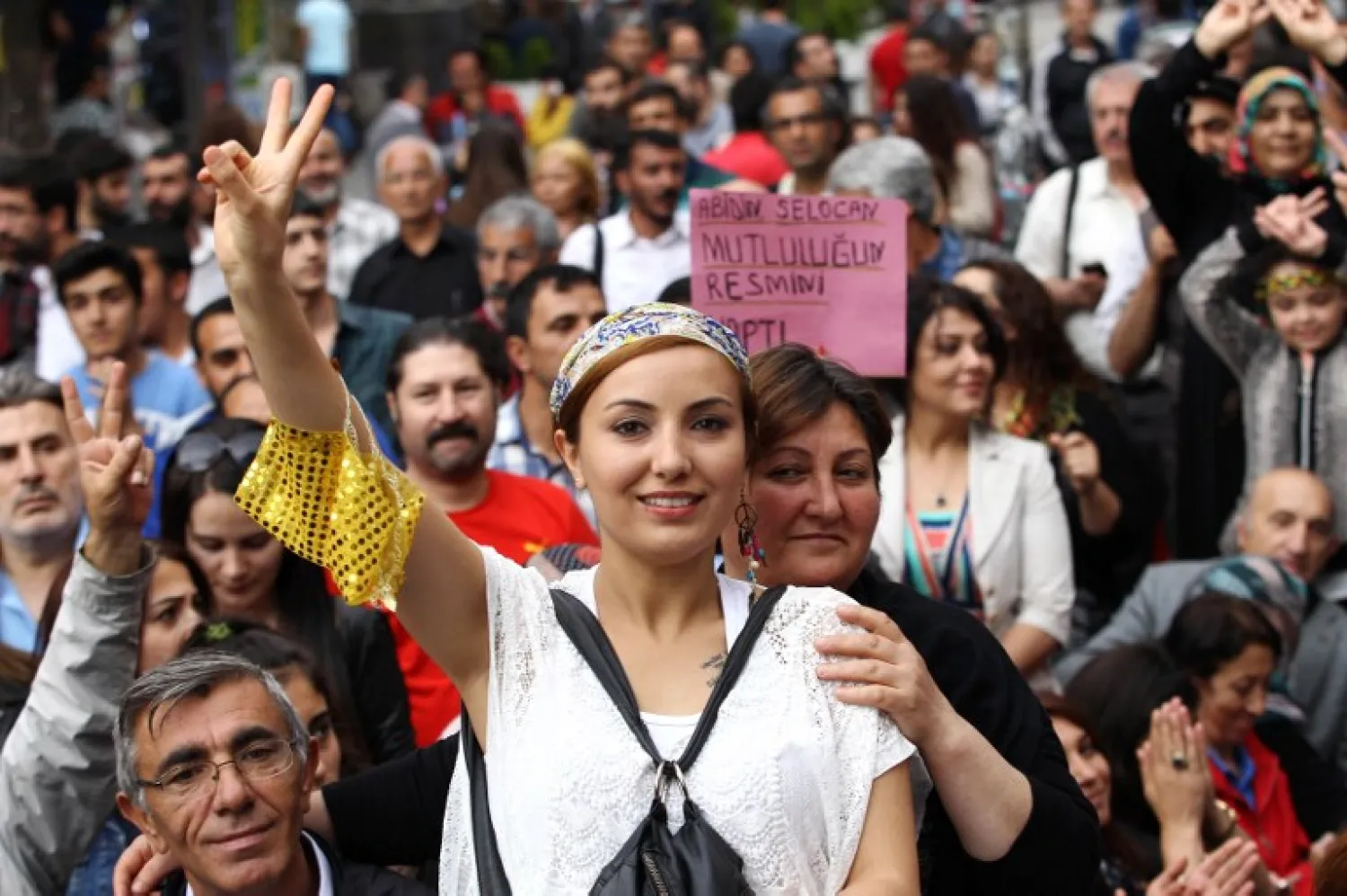
A supporter of pro-Kurdish People's Democracy Party (HDP) makes a victory sign as she celebrates the results of the HDP party as part of the legislative election in Ankara, on June 9, 2015. (AFP photo/Adem Altan)
TT

Iran’s Ethnic, Religious Minorities Face Persecution, Sectarian Discrimination

A supporter of pro-Kurdish People's Democracy Party (HDP) makes a victory sign as she celebrates the results of the HDP party as part of the legislative election in Ankara, on June 9, 2015. (AFP photo/Adem Altan)

The non-Persian population in Iran has faced many problems that were accumulated even before the establishment of the Iranian republic. The demands of the oppressed minorities surfaced immediately after the overthrow of the Shah regime in 1979.

The era of Shah Mohammad Reza Pahlavi, from 1926 till 1979, witnessed repression against national demands. Today, the current system continues with the same approach, treating the minorities with discrimination and humiliation.

Iran comprises six main ethnic groups: Persians, Turks, Kurds, Arabs, Baloch and Turkmens. They are spread throughout Iran, each with its own language, culture, customs and traditions.

There are no official statistics about the numbers of non-Persian people. Tehran authorities consider national affiliations as a threat to the country’s unity. Therefore, various governments have adopted security measures to counter national activities, and worked to obliterate ethnic minorities by changing the demographic fabric of their regions.

Early in the era of Mohammad Reza Pahlavi, the son of the founder of the Pahlavi state, Iran experienced a series of unrest in the non-Persian provinces after the new shah followed his father’s footsteps in establishing a national rule that did not recognize the rights of non-Persian minorities, under the pretext of strengthening unity in the country.

The provinces of Azerbaijan and Kurdistan witnessed the declaration of two independent republics. Following the exile of Shah Reza, non-Persian groups found the ground for the formation of communities and civil institutions on cultural and social bases, and quickly developed into political organizations and parties that took on the task of restoring their national rights.

But these demands were rejected by the central government in Tehran, which refused to communicate and respond to the telegrams of the Democratic Party of Azerbaijan. “I will pay no attention to these telegrams even if they were a hundred,” the Iranian prime minister said at the time.

Consequently, neglect and humiliation by Tehran led to the growing nationalist movement in Azerbaijan, leading to the formation of the National Government of Azerbaijan, which took over large parts of the region and formed a local administration. This happened with the support of the Soviets. Forces of the former Soviet Union had been deployed throughout Iran since World War II, especially following the British-Soviet invasion to overthrow the Shah.

In Kurdistan, a similar autonomous region was established in 1946 under the name of the "Republic of Mahabad" led by the head of the Kurdistan Democratic Party, Qazi Muhammad, with the support of Mullah Mustafa Barzani. However, the young republic lasted only 11 months; it was toppled by Iranian forces in conjunction with the departure of the Soviet forces. The Iranian authorities executed Qazi Muhammad and a group of his comrades, while Mullah Mustafa Barzani withdrew with his fighters from the area.

The Shah regime, after suppressing the nationalist movements in Azerbaijan and Kurdistan, established for a new phase of repression against national demands in Azerbaijan, Kurdistan, Baluchistan, Ahwaz and the Turkmen desert. Under these circumstances, the political activity of the oppressed during the reign of Reza went underground. Indeed, the Shah’s regime carried out public executions against many political activists.

Moreover, Shah Mohammad Reza turned his back on his Arab neighbors when he fully allied with Israel and opened an Israeli embassy in Tehran, establishing extensive relations with it, contrary to the desire of public opinion in Iran and the interests of neighboring countries.

These hostile positions paved the way for the formation of a ground for opponents of the Shah's regime in countries affected by his policies, especially Iraq and Syria.

The atmosphere of openness that Iran witnessed in the first year following the overthrow of the Shah led to the launch of a local debate and the formation of national organizations and committees. This strengthened the position of political activists, who demanded that the new government give them the rights they have been denied for many years.

The positions of the new leaders in Tehran ranged from absolute rejection to promises of achieving some national demands at a later stage.

But once the Khomeini regime tightened its grip on the country, it started suppressing the non-Persian provinces.

In Kurdistan, the Iranian Revolutionary Guards forces moved into the province and clashed with armed rebels in Kurdish cities. The clashes continued sporadically until 1983 and left more than 10,000 people dead.

With the start of the war between Iran and Iraq, the Khomeini authorities firmly confronted any activity opposed to the regime, which soon eliminated all the forces that participated in the revolution against the Shah.

Not only did the Khomeini regime confront opposition activists at home, but they pursued them in exile and carried out multiple political assassinations in different parts of the world, especially in France, Germany and Iraq.

After the war, especially after the reformists (led by Mohammad Khatami) came to power, non-Persian people took advantage of the relatively open atmosphere to submit their demands.

The authorities did not meet the basic demands of non-Persian peoples, and various governments continued to make mere promises.

With the arrival of President Hassan Rouhani to power, he appointed an assistant in the affairs of nationalities and minorities, former intelligence minister Ali Younesi. But Younesi does not seem interested in resolving the issues of the non-Persian communities, as he has come from the same security services that have long confronted national activists with executions, imprisonment, exile and assassinations.



Iranian Leaders Want to Talk, Says Trump

US President Donald Trump delivers remarks during an event at the Port of Corpus Christi in Corpus Christi, Texas, US, February 27, 2026. (Reuters)
TT

Iranian Leaders Want to Talk, Says Trump

US President Donald Trump delivers remarks during an event at the Port of Corpus Christi in Corpus Christi, Texas, US, February 27, 2026. (Reuters)

US President Donald Trump said on Sunday that Iran's new leadership wants to talk to him and that he has agreed, according to an interview with the Atlantic magazine.

"They want to talk, and I have agreed to talk, so I will be talking to ‌them. They ‌should have done it ‌sooner. ⁠They should have given what ⁠was very practical and easy to do sooner. They waited too long," Trump said in the interview from his Florida residence.

Trump did not specify who he would be speaking with or say whether ⁠it would occur on Sunday ‌or Monday.

Iranian ‌President Masoud Pezeshkian said a leadership council composed of ‌himself, the judiciary head and a ‌member of the powerful Guardians Council had temporarily assumed the duties of supreme leader following the death of Ali Khamenei.

Trump said some ‌of the people who were involved in recent talks with the ⁠US are ⁠no longer alive.

"Most of those people are gone. Some of the people we were dealing with are gone, because that was a big - that was a big hit," he was quoted as saying in the interview with Atlantic staff writer Michael Scherer.

"They should have done it sooner, Michael. They could have made a deal. They should've done it sooner. They played too cute."


Iran Insists ‘No Limit’ Its Right to Self-Defense, Says FM

Iran's Foreign Minister Abbas Araghchi addresses a special session of the Conference on Disarmament at the United Nations, aside of US-Iran talks in Geneva, Switzerland, February 17, 2026. (Reuters)
TT

Iran Insists ‘No Limit’ Its Right to Self-Defense, Says FM

Iran's Foreign Minister Abbas Araghchi addresses a special session of the Conference on Disarmament at the United Nations, aside of US-Iran talks in Geneva, Switzerland, February 17, 2026. (Reuters)

A top Iranian official on Sunday rejected President Donald Trump's warning not to retaliate against massive US-Israel bombardments, saying there would be "no limit" to the country's self-defense.

"Nobody can tell us that you don't have any right to defend yourselves. We are defending ourselves whatever it takes, and we see no limit for ourselves to defend our people, to protect our people," Foreign Minister Abbas Araghchi told ABC News.

"What the United States is doing is an act of aggression. What we are doing is the act of self-defense. There are huge differences between these two," he said.


Three US Military Members Killed in Iran Operation

Aircraft attached to Carrier Air Wing (CVW) 9 sit on the flight deck of the US Navy Nimitz-class aircraft carrier USS Abraham Lincoln in support of the Operation Epic Fury attack on Iran, February 28, 2026. (US Navy/Handout via Reuters)
TT

Three US Military Members Killed in Iran Operation

Aircraft attached to Carrier Air Wing (CVW) 9 sit on the flight deck of the US Navy Nimitz-class aircraft carrier USS Abraham Lincoln in support of the Operation Epic Fury attack on Iran, February 28, 2026. (US Navy/Handout via Reuters)

The US military Sunday said three service members have been killed and five seriously wounded in the operation against Iran -- the first casualties of any kind announced on the US side.

The United States launched massive bombardments against Iran and killed its supreme leader Saturday, with attacks ongoing Sunday.

"Three US service members have been killed in action and five are seriously wounded as part of Operation Epic Fury. Several others sustained minor shrapnel injuries and concussions -- and are in the process of being returned to duty," US Central Command (CENTCOM) said in a statement.

"Major combat operations continue and our response effort is ongoing. The situation is fluid, so out of respect for the families, we will withhold additional information, including the identities of our fallen warriors, until 24 hours after next of kin have been notified."

US air and naval forces, together with Israeli forces, are heavily bombarding Iran and President Donald Trump has said the goal is to destroy the country's military capacity.

In response, Iran has fired missiles at targets in Israel and at US military facilities around the region.

Earlier Sunday, Iran's Revolutionary Guards said they had successfully hit the aircraft carrier USS Abraham Lincoln in the Gulf with four ballistic missiles.

However, CENTCOM said the aircraft carrier "was not hit."

"The missiles launched didn't even come close. The Lincoln continues to launch aircraft in support of CENTCOM's relentless campaign to defend the American people by eliminating threats from the Iranian regime," a statement said.