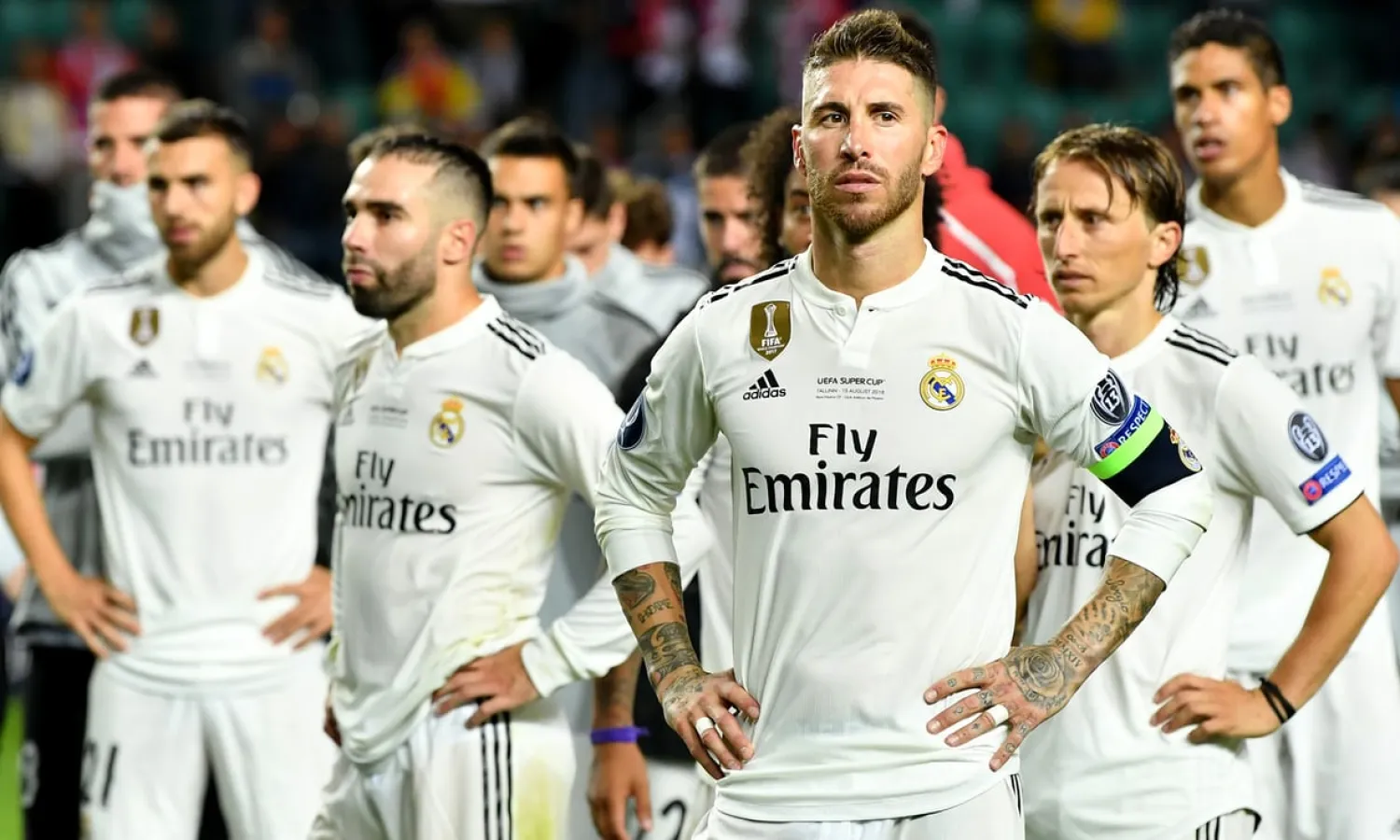
Super Cup Defeat Adds to Real Madrid’s Post-Ronaldo Narrative of Negativity

Real Madrid lost 4-2 to neighbors Atlético Madrid in the Uefa Super Cup – Julen Lopetegui’s first competitive game in charge after replacing Zinedine Zidane. Photograph: Harold Cunningham/Uefa via Getty Images
TT

Super Cup Defeat Adds to Real Madrid’s Post-Ronaldo Narrative of Negativity

Real Madrid lost 4-2 to neighbors Atlético Madrid in the Uefa Super Cup – Julen Lopetegui’s first competitive game in charge after replacing Zinedine Zidane. Photograph: Harold Cunningham/Uefa via Getty Images

It was only the Uefa Super Cup. It was only a defeat in extra time. Real Madrid won this competition last year and that meant very little for a disappointing league season which in turn meant very little for a triumphant Champions League campaign. The needle flickers, form fluctuates, priorities change and, when you are a club as stuffed with talent as Real Madrid, trophies usually follow.

And yet Wednesday’s game in Tallinn was not just another game, not even just another Super Cup. It was Real Madrid’s first competitive game after the departure of Cristiano Ronaldo – and it was lost. Perhaps they would have lost with Ronaldo. Perhaps the game would not even have gone to extra time. Perhaps he would not even have played (last season, against Manchester United in Skopje, he came off the bench with eight minutes remaining). Perhaps he would have done something stupid, as he did in the Spanish Super Cup against Barcelona last season and got himself banned for five games. But none of that matters: what matters is that Ronaldo has gone and Real Madrid lost.

Discussion of narrative in football tends to prompt a roll of the eyes but, much as with gods, even if narratives are false or nonexistent they can exert a powerful influence. They are a way of ordering thoughts, of making sense of often random events, and by generating moods they can shape events. And for Real Madrid defeat in Tallinn slipped all too neatly into a mounting narrative of negativity.

“For the most part we were better,” said Madrid’s new coach, Julen Lopetegui, “but we couldn’t take advantage of that fact and they made good use of all the chances they had.” That may not have been strictly accurate but it was broadly true and that adds to the sense of concern; something has changed. In the past few years, particularly in the Champions League, Real Madrid have often prevailed despite not being better, at times almost inexplicably so.

Except there has always been an explanation: Cristiano Ronaldo. There may have been times when he left Madrid vulnerable by failing to fulfil his defensive functions. There may have been times when his demand everything should orbit around him cost Madrid fluidity, but he averaged 50 goals a season for nine years. Get the ball somewhere near him in a dangerous position and the chances were he would score. That may be a method too haphazard to win many league titles – only two in those nine years – but in the knockout rounds of the Champions League it has proved devastatingly effective and is not easily replicated.

But there is a psychological dimension as well. Remove a star and a little darkness inevitably falls, particularly when there has been no compensatory signing of a galáctico. At most clubs the departure of a 33-year-old and the extra opportunities consequently afforded to young domestic talent such as Isco, Marco Asensio and Lucas Vázquez could be spun as a positive but Madrid are a club whose self-image is built on big signings and this season there have been none.

Perhaps that is a little unfair on Thibaut Courtois but in the modern world goalkeepers are rarely perceived as stars. The Belgian aside, the only arrivals have been the 18-year-old Brazilian Vinícius Júnior, completing a deal agreed last year, and the 22-year-old winger Álvaro Odriozola. Talk of Neymar, Kylian Mbappé and Eden Hazard has come to nothing. There is still time, of course, but for now there is a continuation of the downward drift that began with Ronaldo hinting at his departure in the bowels of the Olimpiyskiy in Kyiv minutes after the Champions League final and continued with the mistimed and misjudged announcement of the appointment of Lopetegui to succeed Zinedine Zidane on the eve of the World Cup.

On the pitch Madrid perhaps pressed with a little more purpose than they had – Lopetegui, after all, although he began his playing career at Madrid, was at Barcelona for the tail-end of Johan Cruyff’s reign – but were otherwise unremarkable.

Gareth Bale was threatening in the first half, and set up Karim Benzema’s goal but faded in the second. Benzema, so used to playing off Ronaldo, at times dropped deep in a way that, with neither Bale nor Asensio making runs beyond him, meant there was a lack of a target in the box. Sergio Ramos’s elbows remained as sharp as ever but both he and Raphaël Varane were oddly diffident at times. Marcelo demonstrated once again that he is a fine attacking full-back and an ordinary defensive one.

None of it was anything particularly out of the ordinary for a first game of the season and, but for some very fine finishing from Atlético, it might not even have meant defeat. But they did lose and so the narrative of negativity gathers pace. Madrid never conceded four in a game under Zidane. They had not lost in a continental final in 18 years. And they have lost Ronaldo. Lopetegui insisted defeat would not change transfer policy, and statement signings made without thought to the overall structure rarely work, but a big arrival may be the simplest way to shift Madrid out of the shadow of Ronaldo.

(The Guardian)


Irish Boxer Lee Reeves Dies at Age 31, Three Months after Dublin Title Fight Injury

Irish boxer Lee Reeves. Reuters
TT

Irish Boxer Lee Reeves Dies at Age 31, Three Months after Dublin Title Fight Injury

Irish boxer Lee Reeves. Reuters

Irish boxer Lee Reeves has died more than three months after being injured during a fight in Dublin, promoter Queensberry said Tuesday. He was 31.

"Everyone at Queensberry is devastated to learn of the passing of Lee Reeves," Queensberry Promotions said in a statement.

Reeves was hospitalized after being knocked out by compatriot Gary Cully in the 10th and final round of their Boxing Union of Ireland Celtic super-lightweight title fight on Aug. 1.

Reeves was carried from the ring on a stretcher after receiving initial treatment.

Queensberry had said after the fight that his condition was critical but stable.

“Lee was an immensely talented boxer, as well as a true role model and inspiration to his community,” the statement added Tuesday, according to The Associated Press. “Our deepest condolences go to Lee’s family, friends and all those who loved him. We ask that their privacy be respected at this incredibly difficult time. Rest in peace, Lee.”


Alonso to Enter Dakar Rally with Loeb and Aston Martin Team

November 5, 2026 Aston Martin's Fernando Alonso during a press conference ahead of the F1 Sao Paulo Grand Prix. (Reuters)
TT

Alonso to Enter Dakar Rally with Loeb and Aston Martin Team

November 5, 2026 Aston Martin's Fernando Alonso during a press conference ahead of the F1 Sao Paulo Grand Prix. (Reuters)

Double Formula One champion Fernando Alonso will compete in next January's Dakar Rally in an Aston Martin Dreadnought entry run by engineering partner Prodrive.

The 45-year-old Spaniard, a 32-time Grand Prix winner and two-time Le Mans 24 Hours winner, will be racing in the annual event for the second time after competing with Toyota in 2020, finishing 13th.

France's nine-time world rally champion Sebastien Loeb and Brazil's reigning world rally-raid champion Lucas Moraes will be his teammates in a three-car entry.

The 49th edition of the Dakar Rally will ‌be held in ‌Morocco from January 9 to 23, with a prologue and first ‌stage ⁠in Portugal, after ⁠being moved from Saudi Arabia due to security concerns.

The 24-round Formula One season is due to start in Bahrain in March after testing in late February.

Alonso, who will again have compatriot and five-time motorcycle Dakar winner Marc Coma as co-driver, is racing in the Las Vegas Grand Prix this weekend. He said he had turned his thoughts to Dakar after deciding to continue in Formula One with Aston Martin.

“In the end, the decision became simple. I wanted to embrace ⁠the challenge completely and take on both Formula One and the ‌Dakar Rally in the same year," he explained in ‌a statement.

"In 2020, Dakar was one of the most challenging and enjoyable experiences of my career. ‌I have enormous respect for this race and the specialists who have mastered it.

"Formula One ‌remains my priority. But I am a racing driver, and challenges like this are why I love competing. I’m looking forward to seeing what we can achieve."

LOEB CHASES FIRST DAKAR WIN

In October, Alonso told reporters at the Singapore Grand Prix that he felt the desert endurance race would be physically ‌incompatible with his Formula One commitments.

Loeb, 52, will also be chasing a first Dakar win after 10 previous attempts that have brought ⁠him 28 stage ⁠wins to date.

“Winning the Dakar is very important to me,” said the Frenchman, who will be partnered by Belgian Fabian Lurquin. “We have come close several times, and the motivation is there to keep working until we achieve it."

The Dreadnought is a digital-only tactical SUV created exclusively for gamers playing "Call of Duty: Modern Warfare 4" that will now be brought into the real world by Prodrive, Aston Martin's partners in endurance GT racing.

The Dakar will be Aston Martin Racing’s debut in the world rally-raid championship.

"Aston Martin's ambition for this program has been clear from the outset: to create a car capable of competing at the front of the world's toughest motorsport event," said Prodrive Chairman David Richards.

"By combining Aston Martin's vision with Prodrive's experience in rallying, endurance racing and Dakar competition, we have built a strong foundation. With an exceptional driver line-up and a highly capable engineering team, we look forward to seeing Dreadnought take on this remarkable challenge."


Owono Does Not Deserve 12-Match Ban Over De Miguel Death, Says Andorra Owner Pique

Equatorial Guinea's goalkeeper #01 Jesus Owono leaves the pitch at half time during the Africa Cup of Nations (CAN) Group E football match between Equatorial Guinea and Algeria at Moulay Hassan Stadium in Rabat on December 31, 2025. (AFP)
TT

Owono Does Not Deserve 12-Match Ban Over De Miguel Death, Says Andorra Owner Pique

Equatorial Guinea's goalkeeper #01 Jesus Owono leaves the pitch at half time during the Africa Cup of Nations (CAN) Group E football match between Equatorial Guinea and Algeria at Moulay Hassan Stadium in Rabat on December 31, 2025. (AFP)

FC Andorra owner Gerard ‌Pique said goalkeeper Jesus Owono did not deserve the 12-match suspension he received following the challenge that led to the death of Tenerife forward Jesus de Miguel.

Owono and De Miguel collided during a Spanish second-tier match on November 2. De Miguel was taken to intensive care and died the following day.

The disciplinary committee of the Spanish football federation (RFEF) banned Owono for violent conduct which resulted in serious ‌injury last week.

"Players, ‌former players, coaches, goalkeepers, everyone has ‌called ⁠it an accident," ⁠Pique said in a video posted on social media late on Monday.

"I truly believe that imposing the maximum sanction on Jesus for this action puts him in a situation he does not deserve, because he is not to blame for all of ⁠this having happened."

Former Barcelona player Pique ‌pointed to the three-match ‌ban handed to Albacete's Jose Corpas for accidentally kicking Sabadell ‌player Quadri Liameed in the head during a ‌recent match in Spain.

"Fortunately Quadri is fine, the consequences in this case were not fatal, and the committee decided to sanction Corpas with three matches," Pique added.

"With ‌all this, my reflection is: what is being sanctioned, the action or the ⁠consequences?"

The RFEF ⁠did not immediately respond to a request for comment outside regular business hours in Spain.

Owono, 25, has withdrawn from Equatorial Guinea's squad for Africa Cup of Nations qualifiers against Zimbabwe this month and Pique said it was unlikely the goalkeeper would return to action as soon as his suspension is up.

"Jesus is going to need far more than 12 matches before he is available and able to compete," he added. "No sanction is going to bring Demi (De Miguel) back to us."