


Exclusive: Iran at the Hague: Remembering America as a ‘Best Friend’

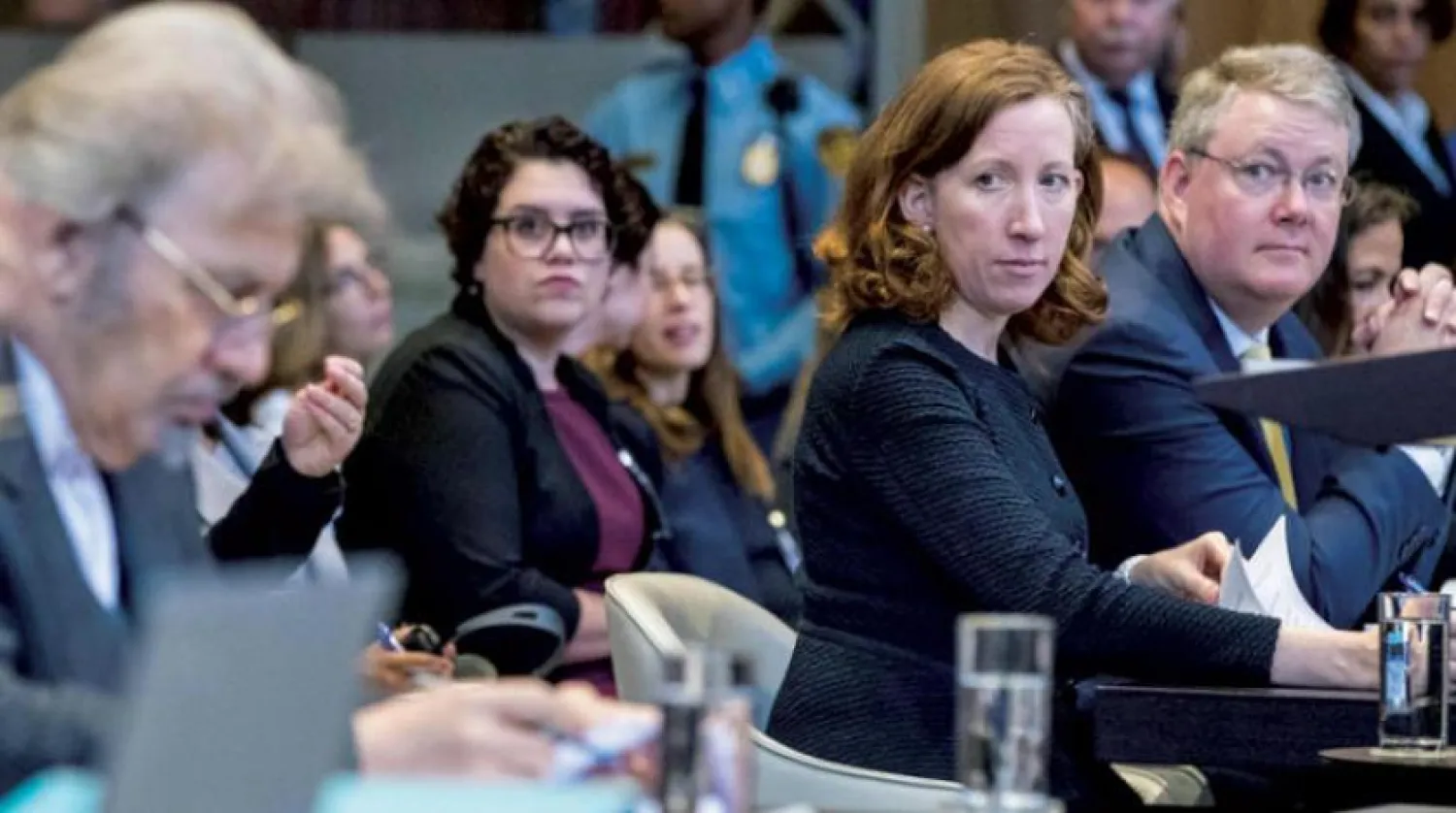
Jennifer G Newstead (C), lawyer of lawyer for the United States and representative of Iran Mohsen Mohebi (L) are pictured during the opening of case between Iran and the United States at the The International Court of Justice (ICJ) in the Hague, August 27, 2018. (AFP PHOTO / ANP / Jerry Lampen)
TT

Exclusive: Iran at the Hague: Remembering America as a ‘Best Friend’

Jennifer G Newstead (C), lawyer of lawyer for the United States and representative of Iran Mohsen Mohebi (L) are pictured during the opening of case between Iran and the United States at the The International Court of Justice (ICJ) in the Hague, August 27, 2018. (AFP PHOTO / ANP / Jerry Lampen)

More than six decades after Iran first filed a suit with the International Court at The Hague, the Islamic Republic has returned to “demand justice” from the 15 judges sitting on its benches.

Iran first went to the court in June 1951 when then Prime Minister Mohammad Mossadegh filed a suit to force Great Britain to accept Iran’s decision to nationalize its oil industry and dispossess the Anglo-Iranian Oil Company which was partly owned by the British government.

The Oil Nationalization Act had been passed by the Iranian National Assembly (Majlis) on 15 March and received the royal assent two days later. Six weeks later the Shah appointed Mossadegh as Prime Minister with the mission to carry out the nationalization act.

Taking the case to the International Court was part of Iran’s efforts to mobilize international support for nationalization. After months of deliberation, the court voted in favor of Iran, a decision that was disdainfully ignored by London.

On Monday, Iran returned to lodge another complaint, this time against the United States, for alleged breach of a treaty signed by the two nations in 1955. According to Iran’s lawyers in the first sessions of the court hearing, by re-imposing some sanctions on Iran President Donald Trump’s administration has violated at least six provisions of the treaty.

The lawyers have applied for “a temporary stay” on the sanctions pending a final judgment by the court, a judgment that might take years to be finalized.

“Tehran’s political aim is to obtain a few months of delay in the imposition of new sanctions by Trump,” says Mohsen Golara, an Iranian jurist. “The hope is that such a delay would last until after the mid-term elections in the United States in which President Trump’s Republican Party may lose its majorities in the Congress.

Iran’s sympathizers in the US, including former Secretary of State John Kerry, have privately advised Iranian leaders to play for time by sticking to the “nuke deal” made under President Barack Obama, pending a weakening of Trump’s position as president.

This is important because Trump intends to impose new sanctions through what is known as Executive Order, a constitutional instrument that allows the president to bypass the Congress in certain domains. In exchange, the Congress has the constitutional right to annul any executive order it might regard as “exceeding the president’s constitutional powers.”

Trump isn’t the first US president to use the executive order device to impose sanctions on Iran. The first such order, numbered 12170, was issued by President Jimmy Carter in 1980 to seize Iranian assets in the US. At the time Iran had some $22 billion of its oil revenues deposited in two major American banks.

Carter’s move came in response to the seizure of the US Embassy in Tehran and the holding of its diplomats as hostages. Technically, the seizure of the embassy and its diplomats was a 'casus belli' (an act of war) but Carter hoped to ensure the release of the hostages through diplomatic channels. An executive order imposing sanctions was regarded as a good compromise for a president who did not wish to use force.

In the end, direct and indirect talks did ensure the release of the hostages with the signature of the Algiers Agreement in January 1981. Iran promised to no longer seize American hostages, a promise it did not keep by proceeding to seize more than a dozen other hostages, this time through Hezbollah proxies in Lebanon. The Americans reciprocated the bad faith by delaying the release of Iran’s frozen assets for decades.

After Carter, all US presidents issued executive orders on relations with Iran, often to impose new and tougher sanctions.

Obama was the only exception in the context of his tacit support for the Islamic Republic.

The 1955 agreement now under discussion at The Hague is called “Treaty of Friendship, Economic Relations and Consular Rights”. Its signature gave Iran a place among nations enjoying a privileged position in relations with the United States. Negotiated by Iran’s Foreign Minister at the time Abdullah Entezam and his US counterpart John Foster Dulles the treaty gave Iran most favored nation access to the US market with export guarantees and credit facilities backed by the federal government.

More importantly, it opened the way for Iran to purchase military hardware from the US, starting a process at the end of which in the 1970s Iran had access to the most sophisticated American weaponry bar nuclear arms.

The 1955 treaty marked the beginning of growing US influence in Iran and led to the signing of 18 other treaties and agreements which established a firm alliance between the two nations. One such agreement, under the US Atoms for Peace Program, saw the installation of Iran’s first nuclear reactor, fully paid and for years managed by the US. (It started full operations in 1959). The US also offered scholarships for the first 20 Iranians who studied nuclear sciences in American universities.

Another adjunct accord provided for the training of Iranian military and intelligence personnel in the US, especially fighter pilots and technicians. Close cooperation between the CIA and SAVAK, Iran’s security service, began with that treaty.

The 1955 treaty also established a process of economic negotiations that in 1975 led to the $50 billion trade contract signed by Iran’s then Economy Minister Hushang Ansary and the US Secretary of State Henry Kissinger. At the time, the agreement was dubbed “the biggest trade deal in human history.”

Iran might find it hard to win a favorable decision at The Hague for two reasons.

The first is that the US could argue that the sanctions envisaged by Trump are related to the “nuke deal” which is not related to the 1955 treaty. And since “the nuke deal” has no legal status it would be hard for Iran to build a case around its alleged violation.

That point was highlighted by Seed Jalili, the former Secretary of Iran’s High Council of National Security, in his speech this week.

He said: “They {President Rouhani’s team} claim that the nuke deal {JCPOA} is a UN Security Council document and that anyone who violates it violates a UN decision. If that is the case, why don’t you take the issue to the Security Council?”

Jalili is being disingenuous.

Rouhani and his team often claim that the UN Security Council somehow endorsed JCPOA in one of its seven resolutions on the Iran nuclear issue. However, they also insist that Iran has never accepted any of those resolutions. In other words, they demand that everyone respect the JCPOA on the basis of a UN resolution that Tehran itself rejects.

The second reason why Iran’s chances of winning at The Hague are slim is that the 1955 treaty clearly states, in its Article II, that the signatories could take their complaints to the International Court of Justice only after negotiations between them have failed to produce a compromise.

Well, Trump says he is ready to enter negotiations with Iranians without any preconditions.

However, ” Supreme Guide” Ali Khamenei, the ultimate decision-maker in Tehran, has formally forbidden any talks with the US on any subject. Going to The Hague may be a ploy by Rouhani, now isolated and fighting for his political survival, to evoke the memory of Mossadegh and hide his inability to show a way out of the maze Iran finds itself.



Pakistan PM Sharif to Seek Clarity on Troops for Gaza in US Visit

US President Donald Trump looks at Pakistan's Prime Minister Shehbaz Sharif speaking following the official signing of the first phase of the Gaza ceasefire agreement between Israel and Hamas, during a world leaders' summit on ending the Gaza war, in Sharm El-Sheikh, Egypt, October 13, 2025. REUTERS/Evelyn Hockstein/File Photo
TT

Pakistan PM Sharif to Seek Clarity on Troops for Gaza in US Visit

US President Donald Trump looks at Pakistan's Prime Minister Shehbaz Sharif speaking following the official signing of the first phase of the Gaza ceasefire agreement between Israel and Hamas, during a world leaders' summit on ending the Gaza war, in Sharm El-Sheikh, Egypt, October 13, 2025. REUTERS/Evelyn Hockstein/File Photo

Before Pakistan commits to sending troops to Gaza as part of the International Stabilization Force it wants assurances from the United States that it will be a peacekeeping mission rather than tasked with disarming Hamas, three sources told Reuters.

Pakistan's Prime Minister Shehbaz Sharif is set to attend the first formal meeting of President Donald Trump's Board of Peace in Washington on Thursday, alongside delegations from at least 20 countries.

Trump, who will chair the meeting, is expected to announce a multi-billion dollar reconstruction plan for Gaza and detail plans for a UN-authorized stabilization force for the Palestinian enclave.

Three government sources said during the Washington visit Sharif wanted to better understand the goal of the ISF, what authority they were operating under and what the chain of command was before making a decision on deploying troops.

"We are ready to send troops. Let me make it clear that our troops could only be part of a peace mission in Gaza," said one of the sources, a close aide of Sharif.

"We will not be part of any other role, such as disarming Hamas. It is out of the question," he said.

Analysts say Pakistan would be an asset to the multinational force, with its experienced military that has gone to war with arch-rival India and tackled insurgencies.

"We can send initially a couple of thousand troops anytime, but we need to know what role they are going to play," the source added.

Two of the sources said it was likely Sharif, who has met Trump earlier this year in Davos and late last year at the White House, would either have an audience with him on the sidelines of the meeting or the following day at the White House.

Initially designed to cement Gaza's ceasefire, Trump sees the Board of Peace, launched in late January, taking a wider role in resolving global conflicts. Some countries have reacted cautiously, fearing it could become a rival to the United Nations.

While Pakistan has supported the establishment of the board, it has voiced concerns against the mission to demilitarize Gaza's militant group Hamas.


Türkiye Pleased with Alignment Steps by Syria, Kurdish Forces, Erdogan Says

Turkish President Tayyip Erdogan delivers a speech during the opening ceremony of male and female dormitories at Bogazici University, in Istanbul, Türkiye, February 13, 2026. REUTERS/Umit Bektas
TT

Türkiye Pleased with Alignment Steps by Syria, Kurdish Forces, Erdogan Says

Turkish President Tayyip Erdogan delivers a speech during the opening ceremony of male and female dormitories at Bogazici University, in Istanbul, Türkiye, February 13, 2026. REUTERS/Umit Bektas

Turkish President Tayyip Erdogan said he is pleased to see steps taken in neighbouring Syria to integrate the Kurdish-led Syrian Democratic Forces (SDF) into state structures, after a US-backed ceasefire deal late last month between the sides.

In a readout on Wednesday of his comments to reporters on a return flight from Ethiopia, Erdogan was cited as saying Ankara is closely monitoring the Syrian integration steps and providing guidance on implementing the agreement.

Meanwhile, a Turkish parliamentary commission voted overwhelmingly on Wednesday to approve a report envisaging legal reforms alongside the militant Kurdistan Workers Party's (PKK) disarmament, advancing a peace process meant to end decades of conflict.

The PKK - designated a terrorist organization by Türkiye, the United States and European Union - halted attacks last year and said it would disarm and disband, calling on Ankara to take steps to let its members participate in politics.

The roughly 60-page report proposes a roadmap for the parliament to enact laws, including a conditional legal framework that urges the judiciary to review legislation and comply with European Court of Human Rights and Constitutional Court rulings.

The pro-Kurdish DEM Party, which has been closely involved in the process and held several meetings with PKK leader Abdullah Ocalan in prison, objected to the report's presentation of the Kurdish issue as a terrorism problem but generally welcomed the report and called for rapid implementation.

“We believe legal regulations must be enacted quickly,” senior DEM lawmaker Gulistan Kilic Kocyigit told Reuters. Parts of the report offered “a very important roadmap for the advancement of this process," she said.

Erdogan signaled that the legislative process would begin straight away. “Now, discussions will begin in our parliament regarding the legal aspects of the process,” he said.


Turkish FM to Attend Trump’s Board of Peace Meeting in Washington, Italy as ‘Observer’ 

28 November 2025, Berlin: Turkish Foreign Minister Hakan Fidan during a joint press conference with German Foreign Minister Wadephul. (dpa)
TT

Turkish FM to Attend Trump’s Board of Peace Meeting in Washington, Italy as ‘Observer’ 

28 November 2025, Berlin: Turkish Foreign Minister Hakan Fidan during a joint press conference with German Foreign Minister Wadephul. (dpa)

‌Turkish Foreign Minister Hakan Fidan will travel to Washington in lieu of President Recep Tayyip Erdogan for the inaugural meeting of US President Donald Trump's "Board of Peace" on Thursday, the foreign ministry said on Wednesday.

A Turkish diplomatic source told Reuters ‌that Fidan, during the ‌talks, would call ‌for ⁠determined steps to ⁠resolve the Palestinian issue and emphasize that Israel must end actions to hinder the flow of aid into Gaza and stop its ceasefire violations.

Fidan ⁠will also reiterate Türkiye's ‌readiness ‌to contribute to Gaza's reconstruction and its ‌desire to help protect Palestinians ‌and ensure their security, the source said.

He will also call for urgent action against Israel's "illegal ‌settlement activities and settler violence in the West Bank", ⁠the ⁠source added.

According to a readout from Erdogan's office, the president separately told reporters on Wednesday that he hoped the Board of Peace would help achieve "the lasting stability, ceasefire, and eventually peace that Gaza has longed for", and would focus on bringing about a two-state solution.

The board, of which Trump is the chairman, was initially designed to oversee the Gaza truce and the territory's reconstruction after the war between Hamas and Israel.

Meanwhile, Italy will be present at the meeting as an "observer", Italian Foreign Minister Antonio Tajani said Wednesday.

"I will go to Washington to represent Italy as an observer to this first meeting of the Board of Peace, to be present when talks occur and decisions are made for the reconstruction of Gaza and the future of Palestine," Tajani said according to ANSA news agency.

Italy cannot be present as anything more than an observer as the country's constitutional rules do not allow it to join an organization led by a single foreign leader.

But Tajani said it was key for Rome to be "at the forefront, listening to what is being done".

Since Trump launched the Board of Peace at the World Economic Forum in Davos in January, at least 19 countries have signed its founding charter.