

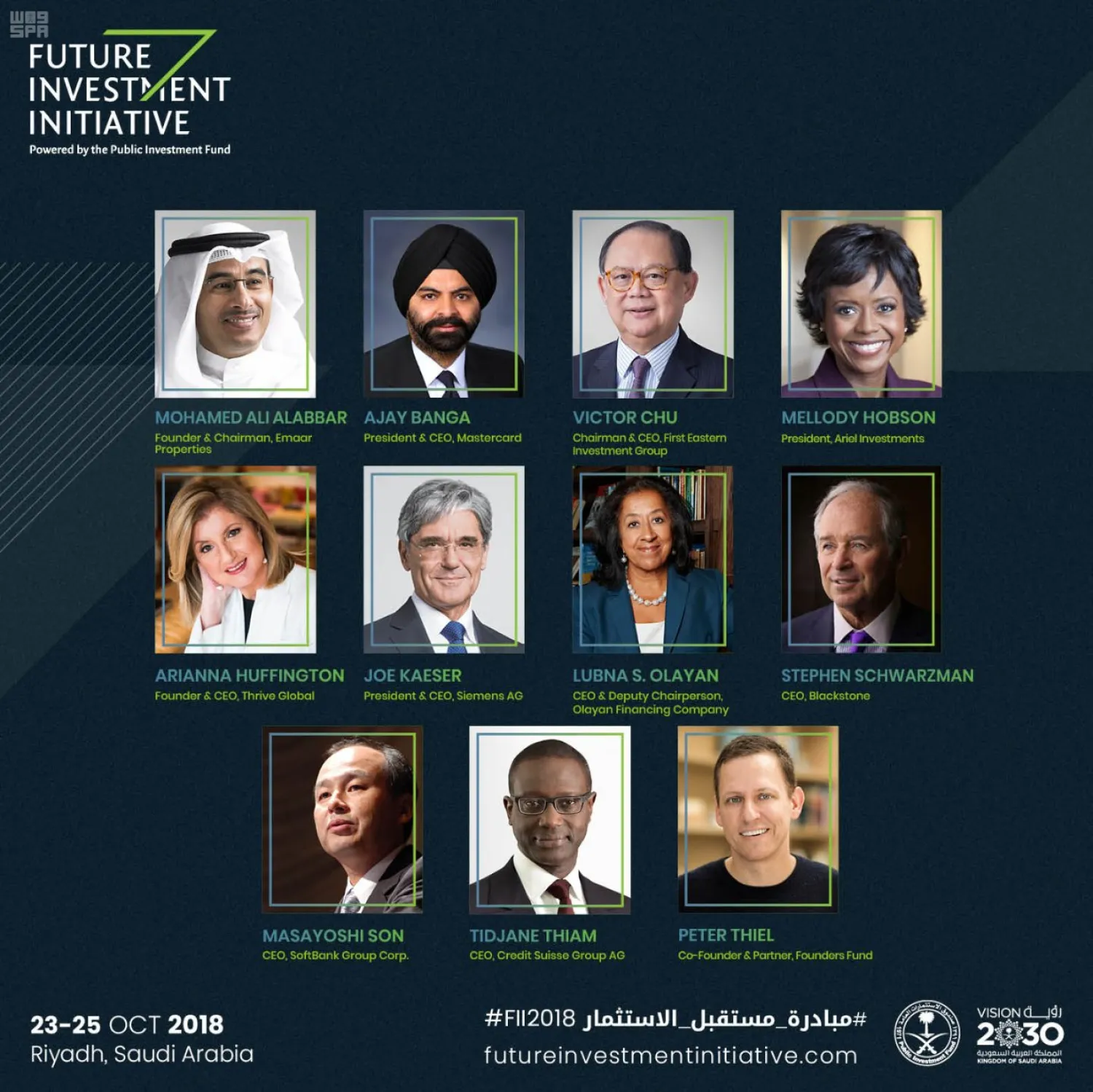

Saudi Public Investment Fund Announces Advisory Board for 2018 Future Investment Initiative

PIF announces the members of the advisory board for the 2018 Future Investment Initiative. (SPA)
TT

Saudi Public Investment Fund Announces Advisory Board for 2018 Future Investment Initiative

PIF announces the members of the advisory board for the 2018 Future Investment Initiative. (SPA)

The Public Investment Fund (PIF) of Saudi Arabia announced on Wednesday the formation of an advisory board, comprised of eleven of the most influential global executives from technology, finance and business, that will support the ongoing development of the program for the 2018 Future Investment Initiative (FII).

The second edition of FII is taking place in Riyadh from October 23rd-25th 2018 and will explore how investment can be used to drive growth opportunities, fuel innovation and shape future economies, said PIF in a statement carried by the Saudi Press Agency.

With a wealth of expertise across multiple sectors and geographies, the 2018 FII advisory board members possess unique insights that will ensure FII remains at the forefront of the global investment debate, unlocking exciting new growth opportunities.

The advisory board provides strategic guidance on all elements of FII. They will also be instrumental in advancing new strategic opportunities amongst the international thought leaders gathered by FII.

The advisory board members include Mohamed Ali Alabbar, Founder and Chairman, Emaar Properties, Ajay Banga, President and CEO, Mastercard, Victor Chu, Chairman and CEO, First Eastern Investment Group, Mellody Hobson, President, Ariel Investments, Arianna Huffington, Founder and CEO, Thrive Global, Joe Kaeser, President and CEO, Siemens AG, Lubna S. Olayan, CEO and Deputy Chairperson, Olayan Financing Company, Stephen Schwarzman, CEO, Blackstone, Masayoshi Son, CEO, SoftBank Group Corp., Tidjane Thiam, CEO, Credit Suisse Group AG and Peter Thiel, Co-Founder and Partner, Founders Fund.

Commenting on the announcement, Banga said: “Every day, businesses and governments explore how technology and partnerships can drive new innovation and new opportunities to benefit people economically and socially.

“The Future Investment Initiative has proven to be an important venue to bring together leaders to discuss the needs of our shared future. It’s events like this that sparks real action.”

Chu said: “The 2017 edition of the Future Investment Initiative was a great success in helping bridge the gap between East and West. It brought together thought and business leaders from around the world to share their views on current and future global issues.”

“This is now an unmissable event for those wishing to have a better understanding of our rapidly globalizing world.”

Huffington stated: "Last year's inaugural Future Investment Initiative made it clear that this is an essential stop on the global business calendar, particularly for anyone interested in a truly international perspective on innovations and forward thinking from all parts of the world.”

“Since then, the pace of change has only accelerated, making an even stronger case for how vital this unique gathering of leaders is for advancing our human potential. And I'm very much looking forward to working with the FII 2018 team to shape an agenda that not only showcases the best emerging ideas but helps us take meaningful action on a global scale.”

The program for FII 2018 will include expert-led debates and discussions to explore the world’s most important economic trends; three summits looking at new healthcare frontiers, immersive technologies and the urban future; 12 cross-sector taskforces designed to explore emerging business and investment trends, and early-stage growth opportunities.

Further updates on the 2018 program, partners and speakers will be announced over the coming months.



Most Gulf Markets Gain on Iran Deal

 Traders wait at the Bahrain Bourse in Manama_ Bahrain_ November 8_ 2020. REUTERS
Traders wait at the Bahrain Bourse in Manama_ Bahrain_ November 8_ 2020. REUTERS
TT

Most Gulf Markets Gain on Iran Deal

 Traders wait at the Bahrain Bourse in Manama_ Bahrain_ November 8_ 2020. REUTERS
Traders wait at the Bahrain Bourse in Manama_ Bahrain_ November 8_ 2020. REUTERS

Most ‌Gulf equities rose in early trade on Monday after the US and Iran announced a preliminary deal to end the war and restore traffic through the Strait of Hormuz.

Pakistan's prime minister said the two countries ‌are expected to ‌sign a memorandum ‌of ⁠understanding in Switzerland ⁠on Friday, following mediation by Islamabad.

Trump said on Sunday the waterway would reopen "toll free" and that the US blockade of Iranian ⁠ports would be lifted, while ‌Iran's ‌Mehr news agency reported the ‌draft deal envisages reopening it ‌within 30 days under Iranian arrangements.

Saudi Arabia's benchmark index gained 0.5%, with the country's biggest ‌lender by assets, Saudi National Bank.

However, oil giant ⁠Saudi ⁠Aramco slipped 1.1%.

Brent crude futures fell $3.65, or 4.2%, to $83.68 a barrel by 0630 GMT.

Qatar's benchmark index advanced 1%, with Qatar National Bank, the region's largest lender, jumped 1.9%.

UAE bourses were closed for a public holiday.


Musk Says SpaceX Could Bring $1 Trillion in Revenue by 2030

Founder, CEO, Chairman, and Chief Engineer of SpaceX, Elon Musk, speaks via videolink on the day of SpaceX's initial public offering (IPO) at the Nasdaq MarketSite in New York City, US, June 12, 2026. REUTERS/Brendan McDermid
TT

Musk Says SpaceX Could Bring $1 Trillion in Revenue by 2030

Founder, CEO, Chairman, and Chief Engineer of SpaceX, Elon Musk, speaks via videolink on the day of SpaceX's initial public offering (IPO) at the Nasdaq MarketSite in New York City, US, June 12, 2026. REUTERS/Brendan McDermid

Elon ‌Musk said on Sunday that his rocket company, SpaceX, could bring in $1 trillion in revenue by 2030, making the statement two days after the company went public, valuing it at over $2 trillion.

"And I would be surprised if revenue ‌is not greater ‌than $1T in 2031," he ‌wrote ⁠on his social ⁠media platform X, replying to journalist and financial commentator Jon Erlichman.

SpaceX on Friday became the sixth-largest US firm, cementing Musk's status as the ⁠world's first trillionaire.

However, the ‌company ‌still makes far less money than similarly ‌valued tech giants like ‌Broadcom and Amazon.com.

In 2025, SpaceX's revenue jumped to $18.67 billion from $14.02 billion a year earlier, but the ‌company swung to a net loss of $4.94 billion from ⁠a ⁠profit of $791 million.

Some Wall Street analysts are cautious about the company's growth.

Goldman had estimated that SpaceX's revenue would exceed $470 billion in 2030, while Morgan Stanley projected it would reach nearly $330 billion, according to a Wall Street Journal report from earlier this month.


Fitch Affirms China's Credit Rating at 'A'

 A woman walks past murals at a shopping center in Beijing on June 13, 2026. (AFP)
A woman walks past murals at a shopping center in Beijing on June 13, 2026. (AFP)
TT

Fitch Affirms China's Credit Rating at 'A'

 A woman walks past murals at a shopping center in Beijing on June 13, 2026. (AFP)
A woman walks past murals at a shopping center in Beijing on June 13, 2026. (AFP)

Global ratings agency Fitch on Monday affirmed China's long-term sovereign rating at "A" with a stable outlook, citing its large and diversified ‌economy, which supports ‌prospects for solid ‌GDP ⁠growth and the ⁠country's important role in global trade.

China, which faced high US tariff uncertainty last year, should see some relaxation after US President ⁠Donald Trump's visit, Fitch said, ‌even ‌as it warned of weak ‌household confidence weighing on goods ‌consumption.

Data from last month showed China's official manufacturing purchasing managers' index dropping to 50 from ‌50.3 in April, its lowest reading in three months ⁠as ⁠demand weakened. A level below 50 typically signals contraction.

"The energy price shock may pose a challenge, but large crude oil inventories, substantial refining capacity and diversified energy sources should cushion risks," the ratings agency said.