

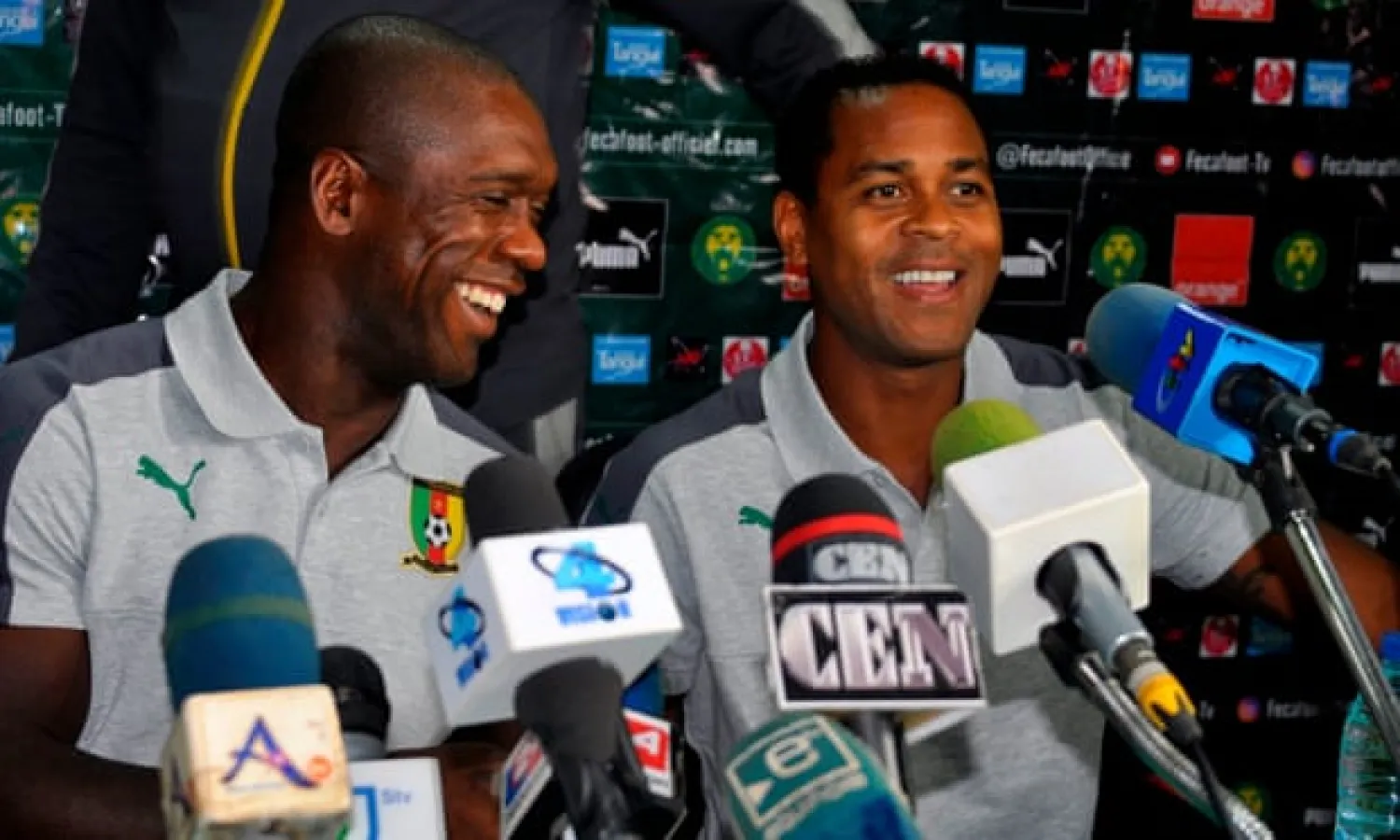

Seedorf, Kluivert Aim to Prove Doubters Wrong With Cameroon

 Clarence Seedorf and his assistant, Patrick Kluivert, are unveiled as Cameroon’s new management team in August. Photograph: Reinnier Kaze/AFP/Getty Images
Clarence Seedorf and his assistant, Patrick Kluivert, are unveiled as Cameroon’s new management team in August. Photograph: Reinnier Kaze/AFP/Getty Images
TT

Seedorf, Kluivert Aim to Prove Doubters Wrong With Cameroon

 Clarence Seedorf and his assistant, Patrick Kluivert, are unveiled as Cameroon’s new management team in August. Photograph: Reinnier Kaze/AFP/Getty Images
Clarence Seedorf and his assistant, Patrick Kluivert, are unveiled as Cameroon’s new management team in August. Photograph: Reinnier Kaze/AFP/Getty Images

Located at the tip of Grande Comore island in the Indian Ocean and surrounded by elegant palm trees that seem to look down on it like leafy floodlights, the Said Mohamed Cheikh Stadium is one of international football’s most picturesque venues. But when Comoros, ranked 149th in the world, host the champions of Africa on Saturday, all eyes will be on the visiting dugout, where Clarence Seedorf and his assistant manager, Patrick Kluivert, will oversee Cameroon for the first time.

Cameroon’s appointment of the Dutch duo last month, after negotiations with Sven-Göran Eriksson broke down, was hailed as a masterful coup by the officials who did the appointing but was more sceptically greeted by many other Cameroonians. The former national-team striker Patrick Mboma summed up the concerns when he said: “Seedorf has scant experience as a coach. He has never stayed on the bench of any team for more than six months, whether at Milan, Shenzhen or at Deportivo La Coruña, whom he was unable to save from relegation. And Kluivert … briefly managed Curaçao, which I do not think is enough to handle a big team like Cameroon.

“We are not disputing their fine careers as players but I’m surprised that with less than a year to the Afcon [the Africa Cup of Nations] that Cameroon is hosting we name two guys who have never worked in Africa and know nothing about African football.”

Aside from overlooking Kluivert’s role as the Netherlands’ assistant manager when they reached the 2014 World Cup semi-finals, Mboma’s summary sounded fair. And there was merit also in the suggestion – made by Cameroonians impressed by Aliou Cissé’s Senegal at the World Cup – that if leaps of faith were to be taken on people with little experience of successful management at the highest level, then why not give a Cameroonian coach an opportunity? But confronted with the fait accompli, Mboma said of the Dutch duo: “We have to give them a chance to prove what they can do.”

The pair’s lack of pedigree will certainly be raised again if Cameroon do not perform well on Saturday and beyond. Beating Comoros is considered to be a formality, even if the tiny island nation secured the greatest result of their short footballing history by holding Ghana to a 0-0 draw at home in 2015.

Seedorf and Kluivert have not shied away from contentious decisions. For their first squad they omitted two of the country’s most popular players, Benjamin Moukandjo and Christian Bassogog, both of whom were instrumental in last year’s continental triumph. That success earned them lucrative transfers to China, which have cost them their place under Seedorf. “Good young players don’t compete in China or in Asia,” he said, intimating he would give priority to Europe-based players. That was immediately criticised as an arrogant dogma that could not be sustained at a time when more and more Asian clubs are making irresistible offers for African players. Seedorf has a decent pool of players from which to select but not so deep that he can afford to discount players such as Moukandjo and Bassogog as a matter of policy. He seemed to relent a little in an interview on Cameroonian television, saying the pair were left out because there was no need for them to make such a long trip when their qualities were already well known. “We will definitely be engaging with them in the future.”

Seedorf could have pointed out that Moukandjo and Bassogog were also part of the squad that failed to reach the World Cup and that the previous manager, Hugo Broos, also dropped Bassogog, a thrilling winger on his day, after the victorious Afcon on the grounds that “he has to change his way of playing; it’s very predictable. If I were 40 years younger he would never go past me with the ball because everyone knows what he’s going to do. He emerged at the Afcon because teams did not know Bassogog but now they do.” Then again, for Seedorf to cite Broos might not have been shrewd given that the Belgian was sacked, 10 months after winning the Afcon, for falling out with several players as well as the ministry of sport.

In the credit column for Seedorf is the fact that Paul-Georges Ntep could make his debut on Saturday after accepting a call-up following several refusals. He made two appearances for France in friendlies before Euro 2016 but the forward has decided to pledge his international future to the country of his birth.

Seedorf has also given first call‑ups to the defenders Adrien Tameze of Nice and Jérôme Onguéné of Red Bull Salzburg. His squad also includes Carlos Kameni, Allan Nyom, Eric Maxim Choupo-Moting and André Onana, all of whom had declined selections in recent years because of differences with Broos or concerns about the mysterious workings of the Cameroon Football Federation (Fecafoot) and the ministry of sport.

Those two bodies’ feuding led last year to Fifa appointing a “normalisation committee” to oversee fresh elections of officials. That committee is still in place but football elections will not be held at least until after the country’s presidential election on 7 October, when the 85-year-old Paul Biya, ruler since 1982, will seek to extend his reign.

In the week before that election, as it happens, the Confederation of African Football is expected to give its verdict on the progress of preparations for the Afcon, having previously aired the possibility of stripping Cameroon of hosting rights if sufficient infrastructure improvement was not made. As hosts, Cameroon qualify automatically; if the tournament is assigned to somewhere else, then perhaps their group matches will count for more than fine-tuning, in which case the game against Comoros could turn out to be even more significant.

The coaching abilities of Kluivert and Seedorf are by no means the only factors of uncertainty affecting Cameroonian football right now.

The Guardian Sport


Lindsey Vonn Back in US Following Crash in Olympic Downhill 

Milano Cortina 2026 Olympics - Alpine Skiing - Women's Downhill 3rd Official Training - Tofane Alpine Skiing Centre, Belluno, Italy - February 07, 2026. Lindsey Vonn of United States in action during training. (Reuters)
TT

Lindsey Vonn Back in US Following Crash in Olympic Downhill 

Milano Cortina 2026 Olympics - Alpine Skiing - Women's Downhill 3rd Official Training - Tofane Alpine Skiing Centre, Belluno, Italy - February 07, 2026. Lindsey Vonn of United States in action during training. (Reuters)

Lindsey Vonn is back home in the US following a week of treatment at a hospital in Italy after breaking her left leg in the Olympic downhill at the Milan Cortina Games.

“Haven’t stood on my feet in over a week... been in a hospital bed immobile since my race. And although I’m not yet able to stand, being back on home soil feels amazing,” Vonn posted on X with an American flag emoji. “Huge thank you to everyone in Italy for taking good care of me.”

The 41-year-old Vonn suffered a complex tibia fracture that has already been operated on multiple times following her Feb. 8 crash. She has said she'll need more surgery in the US.

Nine days before her fall in Cortina d'Ampezzo, Italy, Vonn ruptured the ACL in her left knee in another crash in Switzerland.

Even before then, all eyes had been on her as the feel-good story heading into the Olympics for her comeback after nearly six years of retirement.


Japan Hails ‘New Chapter’ with First Olympic Pairs Skating Gold 

Gold medalists Japan's Riku Miura and Japan's Ryuichi Kihara pose after the figure skating pair skating free skating final during the Milano Cortina 2026 Winter Olympic Games at Milano Ice Skating Arena in Milan on February 16, 2026. (AFP)
TT

Japan Hails ‘New Chapter’ with First Olympic Pairs Skating Gold 

Gold medalists Japan's Riku Miura and Japan's Ryuichi Kihara pose after the figure skating pair skating free skating final during the Milano Cortina 2026 Winter Olympic Games at Milano Ice Skating Arena in Milan on February 16, 2026. (AFP)

Japan hailed a "new chapter" in the country's figure skating on Tuesday after Riku Miura and Ryuichi Kihara pulled off a stunning comeback to claim pairs gold at the Milan-Cortina Olympics.

Miura and Kihara won Japan's first Olympic pairs gold with the performance of their careers, coming from fifth overnight to land the title with personal best scores.

It was the first time Japan had won an Olympic figure skating pairs medal of any color.

The country's government spokesman Minoru Kihara said their achievement had "moved so many people".

"This triumph is a result of the completeness of their performance, their high technical skill, the expressive power born from their harmony, and above all the bond of trust between the two," the spokesman said.

"I feel it is a remarkable feat that opens a new chapter in the history of Japanese figure skating."

Newspapers rushed to print special editions commemorating the pair's achievement.

Miura and Kihara, popularly known collectively in Japan as "Rikuryu", went into the free skate trailing after errors in their short program.

Kihara said that he had been "feeling really down" and blamed himself for the slip-up, conceding: "We did not think we would win."

Instead, they spectacularly turned things around and topped the podium ahead of Georgia's Anastasiia Metelkina and Luka Berulava, who took silver ahead of overnight leaders Minerva Fabienne Hase and Nikita Volodin of Germany.

American gymnastics legend Simone Biles was in the arena in Milan to watch the action.

"I'm pretty sure that was perfection," Biles said, according to the official Games website.


Mourinho Says It Won’t Take ‘Miracle’ to Take Down ‘Wounded King’ Real Madrid in Champions League

Benfica's coach Jose Mourinho reacts during a press conference on the eve of their UEFA Champions League knockout round play-off first leg football match against Real Madrid at Benfica Campus in Seixal, outskirts of Lisbon, on February 16, 2026. (AFP)
TT

Mourinho Says It Won’t Take ‘Miracle’ to Take Down ‘Wounded King’ Real Madrid in Champions League

Benfica's coach Jose Mourinho reacts during a press conference on the eve of their UEFA Champions League knockout round play-off first leg football match against Real Madrid at Benfica Campus in Seixal, outskirts of Lisbon, on February 16, 2026. (AFP)

José Mourinho believes Real Madrid is "wounded" after the shock loss to Benfica and doesn't think it will take a miracle to stun the Spanish giant again in the Champions League.

Benfica defeated Madrid 4-2 in the final round of the league phase to grab the last spot in the playoffs, and in the process dropped the 15-time champion out of the eight automatic qualification places for the round of 16.

Coach Mourinho's Benfica and his former team meet again in Lisbon on Tuesday in the first leg of the knockout stage.

"They are wounded," Mourinho said Monday. "And a wounded king is dangerous. We will play the first leg with our heads, with ambition and confidence. We know what we did to the kings of the Champions League."

Mourinho acknowledged that Madrid remained heavily favored and it would take a near-perfect show for Benfica to advance.

"I don’t think it takes a miracle for Benfica to eliminate Real Madrid. I think we need to be at our highest level. I don’t even say high, I mean maximum, almost bordering on perfection, which does not exist. But not a miracle," he said.

"Real Madrid is Real Madrid, with history, knowledge, ambition. The only comparable thing is that we are two giants. Beyond that, there is nothing else. But football has this power and we can win."

Benfica's dramatic win in Lisbon three weeks ago came thanks to a last-minute header by goalkeeper Anatoliy Trubin, allowing the team to grab the 24th and final spot for the knockout stage on goal difference.

"Trubin won’t be in the attack this time," Mourinho joked.

"I’m very used to these kinds of ties, I’ve been doing it all my life," he said. "People often think you need a certain result in the first leg for this or that reason. I say there is no definitive result."
