


Real Madrid's Strategy of Signing World Cup Stars Goes Back 60 Years

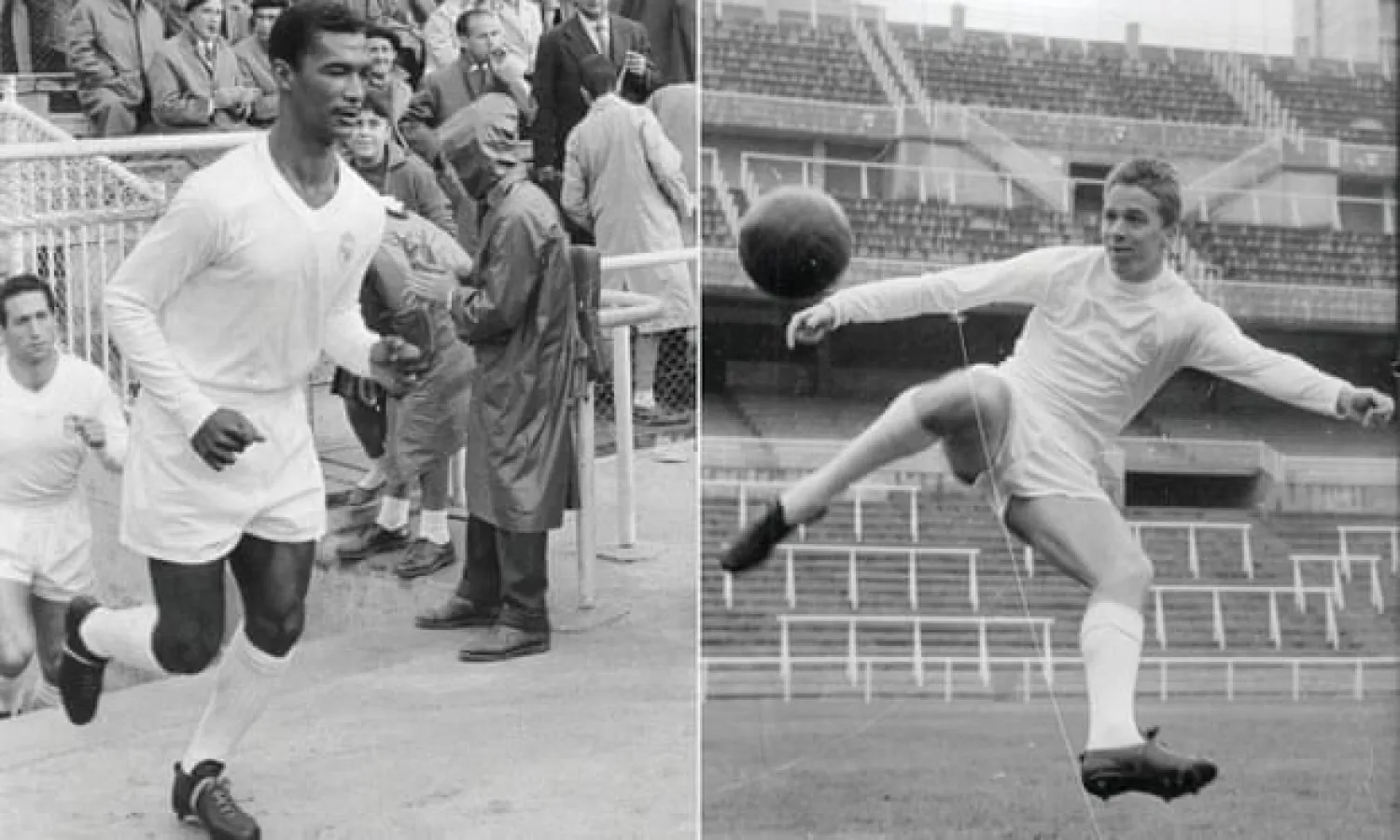
 Real Madrid signed Didi and Agne Simonsson after their fine performances at the 1958 World Cup. Composite: Ullstein Bild via Getty Images; Archive PL/Alamy Stock Photo
Real Madrid signed Didi and Agne Simonsson after their fine performances at the 1958 World Cup. Composite: Ullstein Bild via Getty Images; Archive PL/Alamy Stock Photo
TT

Real Madrid's Strategy of Signing World Cup Stars Goes Back 60 Years

 Real Madrid signed Didi and Agne Simonsson after their fine performances at the 1958 World Cup. Composite: Ullstein Bild via Getty Images; Archive PL/Alamy Stock Photo
Real Madrid signed Didi and Agne Simonsson after their fine performances at the 1958 World Cup. Composite: Ullstein Bild via Getty Images; Archive PL/Alamy Stock Photo

It is a quadrennial tradition that Real Madrid swoop for standout performers from the recent World Cup. West German left-back Paul Breitner was an early and successful example of this policy in action when he joined the club weeks after winning the World Cup on home soil in 1974. Gheorghe Hagi, Predrag Spasić, Fernando Redondo, Robert Jarni, the Brazilian Ronaldo, Fabio Cannavaro, Mesut Özil and Sami Khedira all arrived on the back of strong World Cup performances. Thibaut Courtois, the golden glove winner in Russia this summer, is just the latest player to turn up in Madrid after impressing at the World Cup.

Real Madrid’s two acquisitions after the 2014 World Cup – James Rodríguez and Toni Kroos – provide a curious parallel with the past. One was South American and the other European; one was a highly effective midfielder and sublime passer of the ball who had won the World Cup; and the other was a young, skilful goalscoring forward with an outstanding future ahead of him.

Real Madrid had first announced themselves as voracious consumers of World Cup stars in almost identical circumstances after the World Cup in 1958. Santiago Bernabéu, the club’s president, brought in two big-name signings: the Brazilian Didi and the Swede Agne Simonsson. One was South American and the other was European; one was a creative World Cup-winning midfield playmaker and the other was a gifted young forward. And then, like in 2014, the strategy was not wholly successful.

Projecting an illusion of glamour, grandiosity and power was as important for Real Madrid in 1958 as it is today, albeit for quite different reasons. Real Madrid now devour brilliant footballers for marketing-driven sustenance, which is at least an improvement on using them to improve the image of the Franco regime.

Sustaining regular success on the pitch, whether to fit bombastic publicity campaigns or to bring legitimacy to a backward regime, needs the same raw materials of world-class footballers. In a team that already featured stars such as Alfredo Di Stéfano, Ferenc Puskás, Héctor Rial, Raymond Kopa, Paco Gento and José Santamaría, only the most gifted of newcomers could stand a chance of flourishing.

Pelé was Brazil’s breakthrough player in Sweden – and Real Madrid repeatedly tried to sign him through the years – but their captain, Didi, had masterminded the Seleção’s triumph. A long-established star for both Botafogo and Brazil, Didi bent the tempo of matches to his will. A consummate passer of the ball, he was particularly renowned for his ability from set pieces and even boasted his own trademark dipping free-kick, the folha seca.

Bernabéu pressed ahead with the deal to sign him and, following the end of the Brazilian club season, Didi arrived in Spain in early 1959 to great fanfare. New player unveilings at Real Madrid then, as now, were extravagant events and Didi was introduced to fans as “a world champion and the world’s greatest player”. The Brazilian was 26 years old and, significantly, six years younger than Di Stéfano, who he was expected to initially complement then ultimately replace.

Di Stéfano was unimpressed by the succession policy. A fiercely proud and obstinate man still playing at the peak of his considerable powers, Di Stéfano bristled at the idea he might be eased towards the exit. On Didi’s first day at the club a photographer asked the two South American midfielders to shake hands for the camera. Di Stéfano took Didi’s hand and, without the remotest flicker of a smile, said quietly: “I hear you’re my successor. Well, you’re too old and you’re not good enough.”

Kopa and Puskás had prospered in Madrid because they were willing to curb their natural tendencies and defer to the seniority of Di Stéfano but Didi struggled to adapt to Madrid’s complex team hierarchy. Didi had normally been the fulcrum of his teams, with his teammates selected based on how they dovetailed with his distinctive style, but he either did not realise he would have to adapt or just wasn’t capable of doing so.

The pace and the physicality of the Spanish game appeared problematic for him and his confidence wasn’t helped by Di Stéfano repeatedly grumbling at him for slowing Madrid’s build-up. When the Argentinian started to contemptuously take the ball off the foot of his Brazilian teammate during games, it was clear there was a major problem. This was a war that could have only one winner.

After just 19 appearances, Madrid’s management concluded Didi couldn’t flourish in a team cast in Di Stéfano’s image. The Brazilian was loaned to Valencia and started to show some of his World Cup form while playing again for a team that was happy for him to take a creative lead. Valencia seemed enthusiastic to sign Didi permanently, but Madrid would only sanction a return to Botafogo. His time in Spain lasted less than 12 months but Didi wasn’t scarred by the experience. He prospered back home and would remain a key figure for Brazil when they retained the World Cup in 1962.

Real Madrid’s second big signing from the 1958 World Cup was Agne Simonsson, a clever centre-forward who was as adept at creating goals as he was scoring them. Simonsson had caught the eye with fine form and goals all the way through to the final against Brazil but, with Didi taking the available foreigner slot, the Swede would have to wait before his Madrid move was finalised. That wait did not take as long as he might have expected.

While Didi’s career with Madrid was floundering, the 23-year-old forward’s career was going from strength to strength. The highlight of his season came at Wembley with two well taken goals and an outstanding performance for Sweden as they outclassed England. Simonsson finally joined up with Madrid early in 1960, earning a sizeable £14,000 signing-on fee with his first professional contract, but soon faced the same daunting obstacle that had reduced Didi to irrelevance. The intention had been for Simonsson to become Madrid’s main attacking focus and allow Di Stéfano to concentrate on playing a deeper role to preserve his ageing legs, but this was given short shrift by a player who remained Madrid’s best forward and best midfielder.

While not actively hostile to Simonsson, Di Stéfano still rendered him a peripheral figure by making runs into the same areas of the pitch the Swede occupied. Simonsson made just three appearances before dropping to the bench and spending the following season on loan at Real Sociedad. By 1963 he too, like Didi, was back in his homeland at his former club with only his bank account richer for the experience.

Madrid’s impulsive and ultimately ill-judged spree in 1958 cost £150,000 in transfer fees and wages, a vast sum for players who managed just 22 first-team appearances between them. Fast forward 56 years and Rodríguez, one of the purchases from the 2014 World Cup, endured a very similar Madrid career. Courtois will be hoping his time with Real Madrid is more like that of Kroos and less like Didi, Simonsson and Rodríguez.

The Guardian Sport


Saudi Crown Prince Meets FIFA President

Saudi Crown Prince and Prime Minister Prince Mohammed bin Salman bin Abdulaziz Al Saud met with FIFA president Gianni Infantino. (SPA)
TT

Saudi Crown Prince Meets FIFA President

Saudi Crown Prince and Prime Minister Prince Mohammed bin Salman bin Abdulaziz Al Saud met with FIFA president Gianni Infantino. (SPA)

Saudi Crown Prince and Prime Minister, Prince Mohammed bin Salman bin Abdulaziz Al Saud, met with FIFA president Gianni Infantino in Jeddah on Friday to review areas of mutual sports cooperation and explore promising opportunities for further development, the Saudi Press Agency reported on Saturday.

Saudi Minister of Sport Prince Abdulaziz bin Turki bin Faisal and President of the Saudi Arabian Football Federation Yasser Al-Misehal attended the meeting.


Gattuso Out as Italy’s Coach After Team Failed to Qualify for World Cup

Italy's head coach Gennaro Gattuso greets supporters after winning the playoff FIFA World Cup 2026 European qualification semifinal football match between Italy and North Ireland at the Gewiss stadium in Bergamo, on March 26, 2026. (AFP)
TT

Gattuso Out as Italy’s Coach After Team Failed to Qualify for World Cup

Italy's head coach Gennaro Gattuso greets supporters after winning the playoff FIFA World Cup 2026 European qualification semifinal football match between Italy and North Ireland at the Gewiss stadium in Bergamo, on March 26, 2026. (AFP)

Italy coach Gennaro Gattuso left his role by mutual consent on Friday, three days after the national team failed to qualify for a third consecutive World Cup.

The Italian football federation announced the news in a statement thanking Gattuso "for the dedication and passion" during his nine months in charge.

Italy’s chances of reaching this year’s tournament in North America ended on Tuesday after a penalty shootout loss to Bosnia and Herzegovina in a qualifying playoff.

"With pain in my heart, not having achieved the goal we had set ourselves, I consider my experience on the national team bench to be over," Gattuso said.

Gattuso’s departure comes a day after Italy’s football federation president Gabriele Gravina resigned along with Gianluigi Buffon, who was the national team’s delegation chief.

The defeat to Bosnia added more misery for four-time champion Italy after being eliminated by Sweden and North Macedonia, respectively, in the qualifying playoffs for the last two World Cups.

Gattuso took over from the fired Luciano Spalletti in June with the squad already in crisis mode following a defeat at Norway in its opening qualifier.

Spalletti had also overseen a disappointing European Championship campaign in 2024, when titleholder Italy was knocked out in the round of 16 by Switzerland.

"I would like to thank Gattuso once again," Gravina said. "Because, in addition to being a special person, as a coach he has offered a valuable contribution, managing to bring enthusiasm back to the national team in just a few months.

"He has conveyed great pride in the national team jersey to the players and to the whole country."

Under Gattuso, Italy went on a six-match winning streak before another loss to Norway in November to finish second in their group and end up in the playoffs again.

Gattuso had been given a contract until the end of this summer’s World Cup, with an automatic renewal until 2028 if Italy returned to football’s biggest stage.

"The Azzurri shirt is the most precious asset that exists in soccer, which is why it is right to immediately facilitate future coaching staff decisions," Gattuso said.

"It was an honor to be able to lead the national team and do so also with a group of boys who have shown commitment and attachment to the shirt. The biggest thanks go to the fans, to all the Italians who have never failed to show their love and support for the national team in recent months."

Among those being mentioned to replace Gattuso are Roberto Mancini, Simone Inzaghi, Antonio Conte and Massimiliano Allegri.

Mancini coached Italy to the European Championship title in 2021 then failed to get the Azzurri to the next year’s World Cup before bolting to take over Saudi Arabia’s national team. He left that role in October 2024 and is currently coach at Al-Sadd in Qatar.

Inzaghi steered Inter Milan to the Serie A title in 2024 and now manages Saudi club Al-Hilal.

Conte coached Italy at the 2016 European Championship and is currently at Napoli.

Allegri is coach at AC Milan.

Italy will play two friendly matches in June but is unlikely to have a new coach by then, given that the election for a new FIGC president won't take place until June 22.


Liverpool’s Alisson to Miss Man City, PSG Matches, Says Slot

Liverpool goalkeeper Alisson Becker. (Getty Images)
TT

Liverpool’s Alisson to Miss Man City, PSG Matches, Says Slot

Liverpool goalkeeper Alisson Becker. (Getty Images)

Liverpool goalkeeper Alisson Becker will miss their FA Cup quarter-final against Manchester City and both legs of the Champions League tie with Paris Saint-Germain, manager Arne Slot said Friday.

The Brazilian suffered an injury during Liverpool's win over Galatasaray in the Champions League last-16 second leg last month.

The Reds visit Man City on Saturday before taking on reigning European champions PSG at the Parc des Princes on Wednesday, with the quarter-final return leg six days later.

"He will not be part of the Paris Saint-Germain games as well," Slot told reporters.

"He will be out for a bit longer. Towards the end of the season, we expect him to be fit again."

Alexander Isak may be fit to play a part against City, though, having returned to training after breaking his leg in December.

"It will take a bit of time to give him a lot of minutes," Slot said of Isak.

"We will make sure we do the right thing in terms of building him up in minutes, but it's a very good thing to have him on the training ground again.

"It would be even better to have him available for games, that's for sure."

Mohamed Salah is ready to play after hobbling off against Galatasaray and then missing Liverpool's loss at Brighton before the international break.

The Egyptian announced last week he will leave Anfield at the end of the season.

Liverpool have endured a tough campaign in the Premier League after winning the title last season and sit in fifth place, battling for a spot in next season's Champions League.

But they remain in the hunt for a seventh European crown, facing a rematch against PSG after a last-16 penalty shoot-out defeat by the French champions last year.

Alisson starred in that tie with a spectacular display in Liverpool's 1-0 first-leg victory in Paris.

Georgia goalkeeper Giorgi Mamardashvili is set to deputize for Alisson at the Etihad against City on Saturday, as Liverpool bid to reach the FA Cup semi-finals for the first time since lifting the trophy in 2022.
