


Baghdadi Reportedly Reached Afghanistan Via Iran

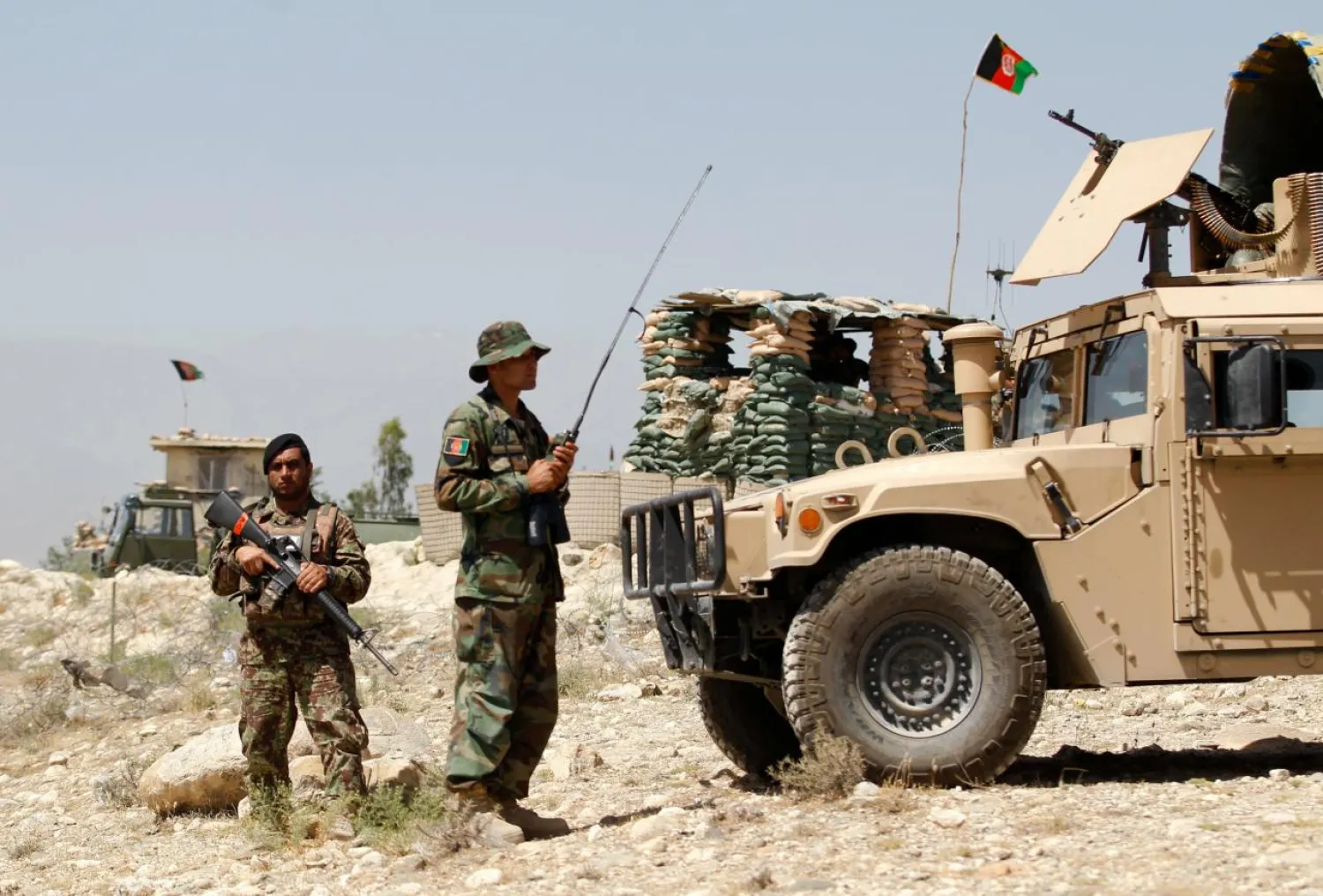
Afghan National Army (ANA) keep watch at a check post in Chaparhar district of Nangarhar province, Afghanistan May 24, 2017. REUTERS/Parwiz
TT

Baghdadi Reportedly Reached Afghanistan Via Iran

Afghan National Army (ANA) keep watch at a check post in Chaparhar district of Nangarhar province, Afghanistan May 24, 2017. REUTERS/Parwiz

The leader of ISIS terrorist group, Abu Bakr al-Baghdadi, has reached eastern Afghanistan via Iran, Pakistani security and other extremist group sources said.

Baghdadi arrived in Nangarhar Province after crossing Iranian territories in eastern Iran’s Zahedan city, said the sources, who spoke on condition of anonymity.

According to the sources, ISIS manages a location to host its fighters in Zahedan in cooperation with the Revolutionary Guard Corps (IRGC).

News of Baghdadi’s arrival in Afghanistan comes as the US-backed Kurdish-Arab alliance launched Operation Roundup last week, the third phase of a year-old operation to clear southeastern Syria of its last ISIS holdouts, in an area around the Euphrates extending around 50 kilometers into Syria.

Meanwhile, the deaths of Afghan journalist Samim Faramarz and his cameraman Ramiz Ahmadi on September 5 took the number of journalists and media workers killed in Afghanistan this year to 14, making the country the deadliest in the world for the media. 

Moments after Faramarz wrapped up his live report on a suicide attack in Kabul, a car bomb exploded just meters away, killing him and Ahmadi.

Their colleagues at Tolo News choked back tears as they reported the deaths live on air -- cracking open a divisive debate on how Afghan journalists should operate in such a dangerous environment. 

The losses have devastated the tight-knit community that faces the real prospect of tragedy every time they go to work. 

"When we leave our homes we don't know whether we will go back alive," said 1TV reporter Hamid Haidary, who keeps a photo shrine of fallen journalists on a shelf above his desk.
 
Haidary had gone to the scene of the explosion that killed Faramarz and Ahmadi, but returned to his office minutes before the second bomb detonated.

"It is already too much for us," agreed Lotfullah Najafizada, director of Tolo, which is Afghanistan's largest private broadcaster. 

As security in Afghanistan continues to deteriorate, the fear and anxiety is ever-present, he added.

"It is not just about the blast site, it is going to a province, it is coming to the office or being in the office -- they all are attached to risks and it is difficult sometimes to minimize all of them to zero."

Sixty journalists and media workers have been killed in Afghanistan since the US-led invasion in 2001 that toppled the Taliban regime and enabled independent media to blossom in its wake -- an average of around three a year, according to Reporters Without Borders (RSF).

Afghan media support group NAI gave an even higher toll of 95. 

But the departure of NATO combat troops at the end of 2014 marked a turning point, RSF figures show: 39 journalists and media workers -- over half of the total -- have been killed since then as a resurgent Taliban and the newly-emerged ISIS terrorize the country.

Media outlets have already scaled back coverage on the battlefield. But until this year, suicide attacks in urban centers remained a staple for newsrooms. 

A double bomb attack in the Afghan capital on April 30 changed that.  

Nine journalists, including Agence France-Presse chief photographer Shah Marai, were killed in the twin blasts -- the most lethal attack on the media since the fall of the Taliban.

Much of the blame for the journalist deaths has been heaped on the Afghan government and its beleaguered security forces for failing to protect them. 

But media outlets also have been criticized for repeatedly putting their staff in danger.  

"Losing journalists in similar events one after another and not learning from the mistakes is bad management both on the part of the media organizations and the government," said Sayed Ikram Afzali, executive director of Afghan advocacy group Integrity Watch.

Militants make headlines for killing civilians, security forces and first responders, including journalists.

But a total ban on covering suicide attacks "would be disrespecting the fallen", said BBC bureau chief Shoaib Sharifi.

The British broadcaster goes to great lengths to minimize the risks. "We literally evaluate and monitor every step outside the office," he said.

For now Afghan broadcaster 1TV, which has had several people killed or wounded in this year's bombings, will continue to go to the scene of suicide attacks, said head of news and current affairs Abdullah Khenjani.

"I think people deserve to know what is happening in their country," he added.

But they no longer rush to be the first at the scene, and wearing flak jackets and helmets is mandatory.



Trump Set to Expand Immigration Crackdown in 2026 despite Brewing Backlash

A woman holds a poster as immigrants rights activists stage a traditional Mexican posada, reenacting Mary and Joseph’s search for shelter, to symbolize immigrants seeking refuge from Immigration and Customs Enforcement (ICE) agents during the ongoing immigration operation "Catahoula Crunch", in New Orleans, Louisiana, US, December 18, 2025. REUTERS/Seth Herald
TT

Trump Set to Expand Immigration Crackdown in 2026 despite Brewing Backlash

A woman holds a poster as immigrants rights activists stage a traditional Mexican posada, reenacting Mary and Joseph’s search for shelter, to symbolize immigrants seeking refuge from Immigration and Customs Enforcement (ICE) agents during the ongoing immigration operation "Catahoula Crunch", in New Orleans, Louisiana, US, December 18, 2025. REUTERS/Seth Herald

US President Donald Trump is preparing for a more aggressive immigration crackdown in 2026 with billions in new funding, including by raiding more workplaces — even as backlash builds ahead of next year’s midterm elections.

Trump has already surged immigration agents into major US cities, where they swept through neighborhoods and clashed with residents. While federal agents this year conducted some high-profile raids on businesses, they largely avoided raiding farms, factories and other businesses that are economically important but known to employ immigrants without legal status.

ICE and Border Patrol will get $170 billion in additional funds through September 2029 - a huge surge of funding over their existing annual budgets of about $19 billion after the Republican-controlled Congress passed a massive spending package in July.

Administration officials say they plan to hire thousands more agents, open new detention centers, pick up more immigrants in local jails and partner with outside companies to track down people without legal status, Reuters reported.

The expanded deportation plans come despite growing signs of political backlash ahead of next year’s midterm elections.

Miami, one of the cities most affected by Trump’s crackdown because of its large immigrant population, elected its first Democratic mayor in nearly three decades last week in what the mayor-elect said was, in part, a reaction to the president.

Other local elections and polling ‌have suggested rising concern among ‌voters wary of aggressive immigration tactics. "People are beginning to see this not as an immigration question anymore ‌as ⁠much as it ‌is a violation of rights, a violation of due process and militarizing neighborhoods extraconstitutionally," said Mike Madrid, a moderate Republican political strategist.

"There is no question that is a problem for the president and Republicans." Trump’s overall approval rating on immigration policy fell from 50% in March, before he launched crackdowns in several major US cities, to 41% in mid-December, for what had been his strongest issue.

Rising public unease has focused on masked federal agents using aggressive tactics such as deploying tear gas in residential neighborhoods and detaining US citizens.

'NUMBERS WILL EXPLODE'

In addition to expanding enforcement actions, Trump has stripped hundreds of thousands of Haitian, Venezuelan and Afghan immigrants of temporary legal status, expanding the pool of people who could be deported as the president promises to remove 1 million immigrants each year – a goal he almost certainly will miss this year. So far, some 622,000 immigrants ⁠have been deported since Trump took office in January.

White House border czar Tom Homan told Reuters Trump had delivered on his promise of a historic deportation operation and removing criminals while shutting down illegal immigration across ‌the US-Mexico border. Homan said the number of arrests will increase sharply as ICE hires more ‍officers and expands detention capacity with the new funding.

“I think you're going to ‍see the numbers explode greatly next year,” Homan said.

Homan said the plans “absolutely” include more enforcement actions at workplaces.

Sarah Pierce, director of social policy at the ‍center-left group Third Way, said US businesses have been reluctant to push back on Trump's immigration crackdown in the past year but could be prompted to speak up if the focus turns to employers.

Pierce said it will be interesting to see "whether or not businesses finally stand up to this administration."

Trump, a Republican, recaptured the White House promising record levels of deportations, saying it was needed after years of high levels of illegal immigration under his Democratic predecessor, Joe Biden. He kicked off a campaign that dispatched federal agents to US cities in search of possible immigration offenders, sparking protests and lawsuits over racial profiling and violent tactics.

Some businesses shut down to avoid raids or because of a lack of customers. Parents vulnerable to arrest kept their children home from school or had neighbors ⁠walk them. Some US citizens started carrying passports. Despite the focus on criminals in its public statements, government data shows that the Trump administration has been arresting more people who have not been charged with any crimes beyond their alleged immigration violations than previous administrations.

Some 41% of the roughly 54,000 people arrested by ICE and detained by late November had no criminal record beyond a suspected immigration violation, agency figures show.

In the first few weeks in January, before Trump took office, just 6% of those arrested and detained by ICE were not facing charges for other crimes or previously convicted.

The Trump administration has taken aim at legal immigrants as well. Agents have arrested spouses of US citizens at their green card interviews, pulled people from certain countries out of their naturalization ceremonies, moments before they were to become citizens, and revoked thousands of student visas.

PLANS TO TARGET EMPLOYERS

The administration’s planned focus on job sites in the coming year could generate many more arrests and affect the US economy and Republican-leaning business owners.

Replacing immigrants arrested during workplace raids could lead to higher labor costs, undermining Trump’s fight against inflation, which analysts expect to be a major issue in the closely watched November elections, determining control of Congress. Administration officials earlier this year exempted such businesses from enforcement on Trump’s orders, then quickly reversed, Reuters reported at the time.

Some immigration hardliners have ‌called for more workplace enforcement.

"Eventually you’re going to have to go after these employers,” said Jessica Vaughan, policy director for the Center for Immigration Studies, which backs lower levels of immigration. “When that starts happening the employers will start cleaning up their acts on their own.”


At Least 16 Files Have Disappeared from the DOJ Webpage for Documents Related to Jeffrey Epstein

Ghislaine Maxwell and Jeffrey Epstein are seen in this image released by the Department of Justice in Washington, D.C., US, on December 19, 2025 as part of a new trove of documents from its investigations into the late financier and convicted sex offender Jeffrey Epstein. US Justice Department/Handout via REUTERS
TT

At Least 16 Files Have Disappeared from the DOJ Webpage for Documents Related to Jeffrey Epstein

Ghislaine Maxwell and Jeffrey Epstein are seen in this image released by the Department of Justice in Washington, D.C., US, on December 19, 2025 as part of a new trove of documents from its investigations into the late financier and convicted sex offender Jeffrey Epstein. US Justice Department/Handout via REUTERS

At least 16 files disappeared from the Justice Department’s public webpage for documents related to Jeffrey Epstein — including a photograph showing President Donald Trump — less than a day after they were posted, with no explanation from the government and no notice to the public.

The missing files, which were available Friday and no longer accessible by Saturday, included images of paintings depicting nude women, and one showing a series of photographs along a credenza and in drawers. In that image, inside a drawer among other photos, was a photograph of Trump, alongside Epstein, Melania Trump and Epstein's longtime associate Ghislaine Maxwell.

The Justice Department did not say why the files were removed or whether their disappearance was intentional. A spokesperson for the department did not immediately respond to a request for comment.

Online, the unexplained missing files fueled speculation about what was taken down and why the public was not notified, compounding long-standing intrigue about Epstein and the powerful figures who surrounded him. Democrats on the House Oversight Committee pointed to the missing image featuring a Trump photo in a post on X, writing: “What else is being covered up? We need transparency for the American public.”

The episode deepened concerns that had already emerged from the Justice Department’s much-anticipated document release. The tens of thousands of pages made public offered little new insight into Epstein’s crimes or the prosecutorial decisions that allowed him to avoid serious federal charges for years, while omitting some of the most closely watched materials, including FBI interviews with victims and internal Justice Department memos on charging decisions.

Scant new insight in the initial disclosures

Some of the most consequential records expected about Epstein are nowhere to be found in the Justice Department's initial disclosures, which span tens of thousands of pages.

Missing are FBI interviews with survivors and internal Justice Department memos examining charging decisions — records that could have helped explain how investigators viewed the case and why Epstein was allowed in 2008 to plead guilty to a relatively minor state-level prostitution charge.

The gaps go further.

The records, required to be released under a recent law passed by Congress, hardly reference several powerful figures long associated with Epstein, including Britain’s former Prince Andrew, renewing questions about who was scrutinized, who was not, and how much the disclosures truly advance public accountability

Among the fresh nuggets: insight into the Justice Department’s decision to abandon an investigation into Epstein in the 2000s, which enabled him to plead guilty to that state-level charge, and a previously unseen 1996 complaint accusing Epstein of stealing photographs of children.

The releases so far have been heavy on images of Epstein’s homes in New York City and the US Virgin Islands, with some photos of celebrities and politicians.

There was a series of never-before-seen photos of former President Bill Clinton but fleetingly few of Trump. Both have been associated with Epstein, but both have since disowned those friendships. Neither has been accused of any wrongdoing in connection with Epstein and there was no indication the photos played a role in the criminal cases brought against him.

Despite a Friday deadline set by Congress to make everything public, the Justice Department said it plans to release records on a rolling basis. It blamed the delay on the time-consuming process of obscuring survivors' names and other identifying information. The department has not given any notice when more records might arrive.

That approach angered some Epstein accusers and members of Congress who fought to pass the law forced the department to act. Instead of marking the end of a yearslong battle for transparency, the document release Friday was merely the beginning of an indefinite wait for a complete picture of Epstein’s crimes and the steps taken to investigate them.

“I feel like again the DOJ, the justice system is failing us,” said Marina Lacerda, who alleges Epstein started sexually abusing her at his New York City mansion when she was 14.

Many of the long-anticipated records were redacted or lacked context Federal prosecutors in New York brought sex trafficking charges against Epstein in 2019, but he killed himself in jail after his arrest.

The documents just made public were a sliver of potentially millions of pages records in the department’s possession. In one example, Deputy Attorney General Todd Blanche said Manhattan federal prosecutors had more than 3.6 million records from sex trafficking investigations into Epstein and Maxwell, though many duplicated material already turned over by the FBI.

Many of the records released so far had been made public in court filings, congressional releases or freedom of information requests, though, for the first time, they were all in one place and available for the public to search for free.

Ones that were new were often lacking necessary context or heavily blacked out. A 119-page document marked “Grand Jury-NY," likely from one of the federal sex trafficking investigations that led to the charges against Epstein in 2019 or Maxwell in 2021, was entirely blacked out.

Trump’s Republican allies seized on the Clinton images, including photos of the Democrat with singers Michael Jackson and Diana Ross. There were also photos of Epstein with actors Chris Tucker and Kevin Spacey, and even Epstein with TV newscaster Walter Cronkite. But none of the photos had captions and was no explanation given for why any of them were together.

The meatiest records released so far showed that federal prosecutors had what appeared to be a strong case against Epstein in 2007 yet never charged him.

Transcripts of grand jury proceedings, released publicly for the first time, included testimony from FBI agents who described interviews they had with several girls and young women who described being paid to perform sex acts for Epstein. The youngest was 14 and in ninth grade.

One had told investigators about being sexually assaulted by Epstein when she initially resisted his advances during a massage.

Another, then 21, testified before the grand jury about how Epstein had hired her when she was 16 to perform a sexual massage and how she had gone on to recruit other girls to do the same.

“For every girl that I brought to the table he would give me $200,” she said. They were mostly people she knew from high school, she said. “I also told them that if they are under age, just lie about it and tell him that you are 18.”

The documents also contain a transcript of an interview Justice Department lawyers did more than a decade later with the US attorney who oversaw the case, Alexander Acosta, about his ultimate decision not to bring federal charges.

Acosta, who was labor secretary during Trump’s first term, cited concerns about whether a jury would believe Epstein’s accusers.

He also said the Justice Department might have been more reluctant to make a federal prosecution out of a case that straddled the legal border between sex trafficking and soliciting prostitution, something more commonly handled by state prosecutors.

“I’m not saying it was the right view,” Acosta added. He also said that the public today would likely view the survivors differently.

“There’s been a lot of changes in victim shaming,” Acosta said.


Kremlin Says Chances of Peace Not Improved by European and Ukrainian Changes to US Proposals

Russian President Vladimir Putin, right, and Russian Presidential foreign policy adviser Yuri Ushakov, left, attend talks with US special envoy Steve Witkoff, back to a camera, at the Senate Palace of the Kremlin in Moscow, Russia, Tuesday, Dec. 2, 2025. (Alexander Kazakov, Sputnik, Kremlin Pool Photo via AP)
TT

Kremlin Says Chances of Peace Not Improved by European and Ukrainian Changes to US Proposals

Russian President Vladimir Putin, right, and Russian Presidential foreign policy adviser Yuri Ushakov, left, attend talks with US special envoy Steve Witkoff, back to a camera, at the Senate Palace of the Kremlin in Moscow, Russia, Tuesday, Dec. 2, 2025. (Alexander Kazakov, Sputnik, Kremlin Pool Photo via AP)

Russian President Vladimir Putin's top foreign policy aide said on Sunday that he was sure the chances of peace in Ukraine were not improved by changes to US proposals made by the Europeans and Ukraine, ‌Interfax news agency ‌reported. 

"This is ‌not ⁠a forecast," ‌Kremlin foreign policy aide Yuri Ushakov told reporters. 

"I am sure that the proposals that the Europeans and Ukrainians have made or are trying to make definitely ⁠do not improve the document and do ‌not improve the possibility ‍of achieving long-term ‍peace." 

European and Ukrainian negotiators have ‍been discussing changes to a US set of proposals for an agreement to end the nearly four-year-old war, though it is unclear exactly what changes have been ⁠made to the original US proposals. 

US negotiators met Russian officials in Florida on Saturday. 

Putin's special envoy Kirill Dmitriev told reporters after meeting US special envoy Steve Witkoff and President Donald Trump’s son-in-law, Jared Kushner, that the talks were constructive and would continue ‌on Sunday.