Óscar Tabárez: Unbowed by Illness and Adding Beauty to Uruguay’s Grit

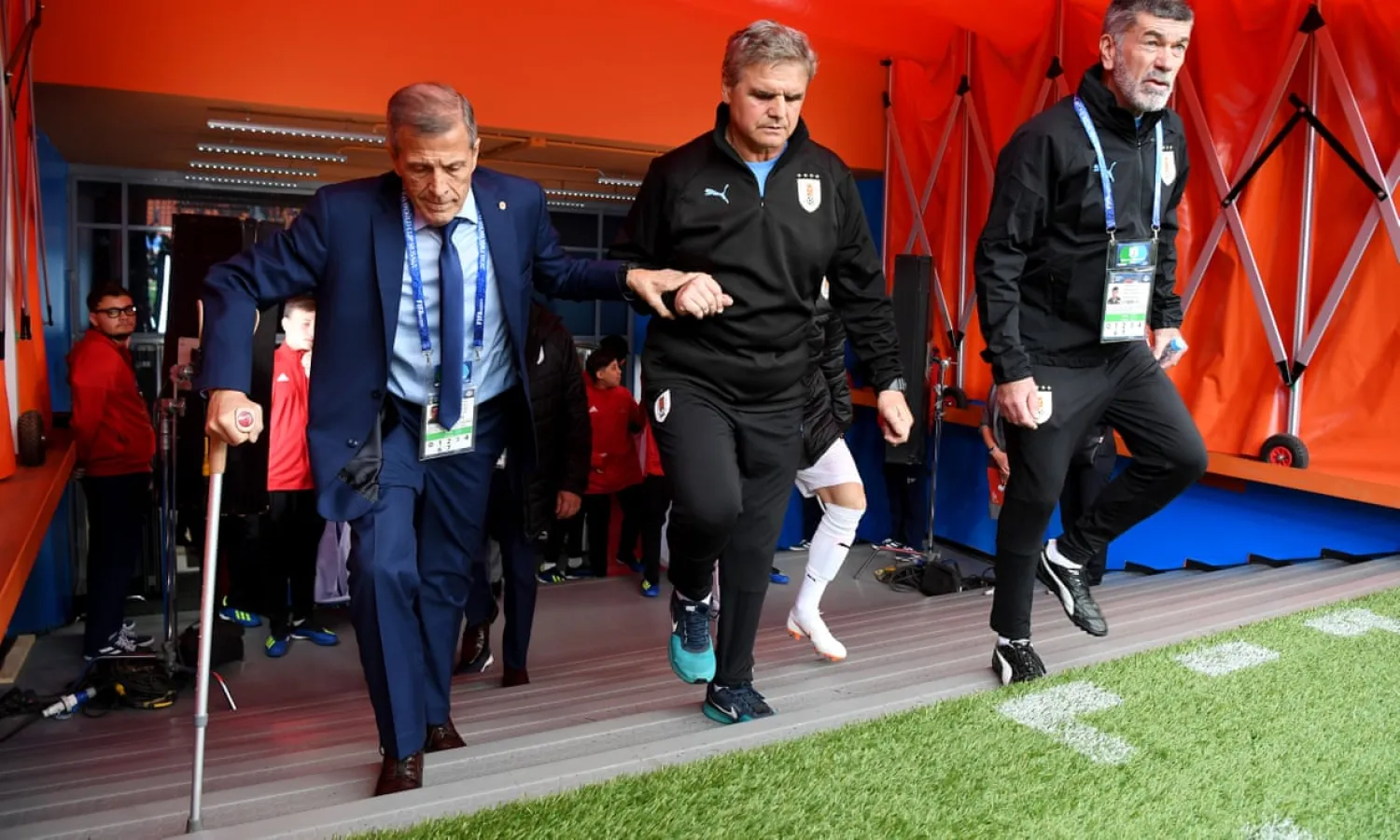
Óscar Tabárez, in his second spell as Uruguay manager, is helped to the pitchside for his team’s opening World Cup game against Egypt. Photograph: Mike Hewitt/Fifa via Getty Images
TT

Óscar Tabárez: Unbowed by Illness and Adding Beauty to Uruguay’s Grit

Óscar Tabárez, in his second spell as Uruguay manager, is helped to the pitchside for his team’s opening World Cup game against Egypt. Photograph: Mike Hewitt/Fifa via Getty Images

The head cocked to one side, the patient expression, the pause while an answer is considered: in some ways this is the same Óscar Tabárez he has always been. His answers in press conferences still ring with intelligence and clarity. He is still the impeccably dressed police chief he always was, a man who somehow includes on his CV both being a primary school teacher and holding a raging Gabriel Batistuta back by the nipple during a riot in Santiago while bleeding from a wound to the cheek and all without it seeming remotely surprising.

But Tabárez is older now. The hair is not quite so steely, and thinning so his parting is not as rigid as it once was. And then there is what he describes as “a chronic neuropathy” which means he walks with at least a stick and sometimes with crutches or even, as at the Copa América Centenario two years ago, gets about using an electric cart. He has consistently refused to talk about it in any detail, repeating only that it does not impinge on his work with the players.

That work has come to seem increasingly extraordinary. When Tabárez was first appointed Uruguay manager in 1988 it was with a specific brief to improve the image of the national side after the disgrace of 1986 in which a brutal approach had reached its apogee with the red card shown to José Batista against Scotland after 56 seconds. Progress to the last 16 in 1990 just about achieved that, and Tabárez, reputation enhanced, moved to Boca Juniors and that apocalyptic Copa Libertadores semi-final against the Chilean champions Colo Colo in 1991.

The battle raged for 17 minutes, with players, coaches, fans, journalists and police involved. Tabárez sustained two cuts from the lens of a camera swung into his face, the violence coming to an end only when a police dog called Ron bit the Boca keeper Navarro “el Mono” [the Monkey] Montoya and left him with a bloody wound to his thigh. Ron, “the dog who bit a monkey”, became a national hero while Boca, having lost 3-2 on aggregate, returned home in disgrace and were fined 98m pesos.

Tabárez’s role was characteristic. He was outraged but defended his players to the hilt – a contradiction that flared again after Luis Suárez was banned for biting Giorgio Chiellini at the last World Cup and he railed weirdly against an English media conspiracy. His sense of integrity is clear but there are times when it must wrestle with his sense of loyalty.

There was a league title with Boca, to add to the Libertadores he had won with Peñarol in 1987, but the 90s were largely a period of drift: two spells with Cagliari, a short time with Milan, a season at Oviedo and a return to Argentina with Vélez Sarsfield and Boca again. For four years after that Tabárez did not work.

Perhaps he would not have come back but when Uruguay lost to Australia in a qualifying play-off for 2006, it became clear that his country needed him. This was the ultimate job: not merely to qualify for a tournament or challenge for honors but also to transform his nation’s football.

For 12 years Tabárez has overseen everything, from youth development to the senior side. He led his side to the semi-final of the 2010 World Cup and then to Copa América success a year later. Uruguay have not missed a tournament in his reign. And slowly he has begun to transform Uruguayan football. The central midfield that lined up against Egypt in their opening game, Rodrigo Bentancur and Matías Vecino, would have been unthinkable a decade ago: both are modern, passing, progressive players, the result of the systems Tabárez, now 71, has put in place. They are expected to feature against Saudi Arabia on Wednesday, too.

And yet there is still a hardness to Uruguay – “la garra charrua” of national myth. As a recent editorial in the Montevideo newspaper El País put it, Uruguayans cling to the idea of a hero who is “more warrior than technician, more gutsy then elegant”. On the wall of his house in Montevideo Tabárez has printed a line attributed to Che Guevara: “You must toughen yourself without losing tenderness.” The Tabárez revolution still believes in winning, still believes in grit and determination and doing what it takes; he just believes it is more efficient to do that by passing than spoiling. This Uruguay still has its flinty core, its Godín, its Giménez, its Cáceres.

But it now has more than that. Gerardo Caetano and Ricardo Piñeyrúa, in their book on Uruguay at World Cups, argue that the Maracanazo, when Uruguay beat Brazil to win the 1950 tournament in Rio de Janeiro, has been misinterpreted, portrayed as a victory over courage not ability, when actually it was about both. Their book includes a lengthy interview with Tabárez in which he discusses talking in the late 80s with veterans of that triumph and becoming convinced of the necessity of shifting the balance from warrior to technician.

To do that takes time and faith and must be achieved without losing sight of Uruguayan football’s defining features. What happens to them in this tournament is only part of a much wider process but Tabárez, if he succeeds, will have achieved the opposite of the Guevara quote and made the game in his homeland more tender without losing its toughness.

(The Guardian)


Irish Boxer Lee Reeves Dies at Age 31, Three Months after Dublin Title Fight Injury

Irish boxer Lee Reeves. Reuters
TT

Irish Boxer Lee Reeves Dies at Age 31, Three Months after Dublin Title Fight Injury

Irish boxer Lee Reeves. Reuters

Irish boxer Lee Reeves has died more than three months after being injured during a fight in Dublin, promoter Queensberry said Tuesday. He was 31.

"Everyone at Queensberry is devastated to learn of the passing of Lee Reeves," Queensberry Promotions said in a statement.

Reeves was hospitalized after being knocked out by compatriot Gary Cully in the 10th and final round of their Boxing Union of Ireland Celtic super-lightweight title fight on Aug. 1.

Reeves was carried from the ring on a stretcher after receiving initial treatment.

Queensberry had said after the fight that his condition was critical but stable.

“Lee was an immensely talented boxer, as well as a true role model and inspiration to his community,” the statement added Tuesday, according to The Associated Press. “Our deepest condolences go to Lee’s family, friends and all those who loved him. We ask that their privacy be respected at this incredibly difficult time. Rest in peace, Lee.”


Alonso to Enter Dakar Rally with Loeb and Aston Martin Team

November 5, 2026 Aston Martin's Fernando Alonso during a press conference ahead of the F1 Sao Paulo Grand Prix. (Reuters)
TT

Alonso to Enter Dakar Rally with Loeb and Aston Martin Team

November 5, 2026 Aston Martin's Fernando Alonso during a press conference ahead of the F1 Sao Paulo Grand Prix. (Reuters)

Double Formula One champion Fernando Alonso will compete in next January's Dakar Rally in an Aston Martin Dreadnought entry run by engineering partner Prodrive.

The 45-year-old Spaniard, a 32-time Grand Prix winner and two-time Le Mans 24 Hours winner, will be racing in the annual event for the second time after competing with Toyota in 2020, finishing 13th.

France's nine-time world rally champion Sebastien Loeb and Brazil's reigning world rally-raid champion Lucas Moraes will be his teammates in a three-car entry.

The 49th edition of the Dakar Rally will ‌be held in ‌Morocco from January 9 to 23, with a prologue and first ‌stage ⁠in Portugal, after ⁠being moved from Saudi Arabia due to security concerns.

The 24-round Formula One season is due to start in Bahrain in March after testing in late February.

Alonso, who will again have compatriot and five-time motorcycle Dakar winner Marc Coma as co-driver, is racing in the Las Vegas Grand Prix this weekend. He said he had turned his thoughts to Dakar after deciding to continue in Formula One with Aston Martin.

“In the end, the decision became simple. I wanted to embrace ⁠the challenge completely and take on both Formula One and the ‌Dakar Rally in the same year," he explained in ‌a statement.

"In 2020, Dakar was one of the most challenging and enjoyable experiences of my career. ‌I have enormous respect for this race and the specialists who have mastered it.

"Formula One ‌remains my priority. But I am a racing driver, and challenges like this are why I love competing. I’m looking forward to seeing what we can achieve."

LOEB CHASES FIRST DAKAR WIN

In October, Alonso told reporters at the Singapore Grand Prix that he felt the desert endurance race would be physically ‌incompatible with his Formula One commitments.

Loeb, 52, will also be chasing a first Dakar win after 10 previous attempts that have brought ⁠him 28 stage ⁠wins to date.

“Winning the Dakar is very important to me,” said the Frenchman, who will be partnered by Belgian Fabian Lurquin. “We have come close several times, and the motivation is there to keep working until we achieve it."

The Dreadnought is a digital-only tactical SUV created exclusively for gamers playing "Call of Duty: Modern Warfare 4" that will now be brought into the real world by Prodrive, Aston Martin's partners in endurance GT racing.

The Dakar will be Aston Martin Racing’s debut in the world rally-raid championship.

"Aston Martin's ambition for this program has been clear from the outset: to create a car capable of competing at the front of the world's toughest motorsport event," said Prodrive Chairman David Richards.

"By combining Aston Martin's vision with Prodrive's experience in rallying, endurance racing and Dakar competition, we have built a strong foundation. With an exceptional driver line-up and a highly capable engineering team, we look forward to seeing Dreadnought take on this remarkable challenge."


Owono Does Not Deserve 12-Match Ban Over De Miguel Death, Says Andorra Owner Pique

Equatorial Guinea's goalkeeper #01 Jesus Owono leaves the pitch at half time during the Africa Cup of Nations (CAN) Group E football match between Equatorial Guinea and Algeria at Moulay Hassan Stadium in Rabat on December 31, 2025. (AFP)
TT

Owono Does Not Deserve 12-Match Ban Over De Miguel Death, Says Andorra Owner Pique

Equatorial Guinea's goalkeeper #01 Jesus Owono leaves the pitch at half time during the Africa Cup of Nations (CAN) Group E football match between Equatorial Guinea and Algeria at Moulay Hassan Stadium in Rabat on December 31, 2025. (AFP)

FC Andorra owner Gerard ‌Pique said goalkeeper Jesus Owono did not deserve the 12-match suspension he received following the challenge that led to the death of Tenerife forward Jesus de Miguel.

Owono and De Miguel collided during a Spanish second-tier match on November 2. De Miguel was taken to intensive care and died the following day.

The disciplinary committee of the Spanish football federation (RFEF) banned Owono for violent conduct which resulted in serious ‌injury last week.

"Players, ‌former players, coaches, goalkeepers, everyone has ‌called ⁠it an accident," ⁠Pique said in a video posted on social media late on Monday.

"I truly believe that imposing the maximum sanction on Jesus for this action puts him in a situation he does not deserve, because he is not to blame for all of ⁠this having happened."

Former Barcelona player Pique ‌pointed to the three-match ‌ban handed to Albacete's Jose Corpas for accidentally kicking Sabadell ‌player Quadri Liameed in the head during a ‌recent match in Spain.

"Fortunately Quadri is fine, the consequences in this case were not fatal, and the committee decided to sanction Corpas with three matches," Pique added.

"With ‌all this, my reflection is: what is being sanctioned, the action or the ⁠consequences?"

The RFEF ⁠did not immediately respond to a request for comment outside regular business hours in Spain.

Owono, 25, has withdrawn from Equatorial Guinea's squad for Africa Cup of Nations qualifiers against Zimbabwe this month and Pique said it was unlikely the goalkeeper would return to action as soon as his suspension is up.

"Jesus is going to need far more than 12 matches before he is available and able to compete," he added. "No sanction is going to bring Demi (De Miguel) back to us."