


Kevin Beattie Obituary

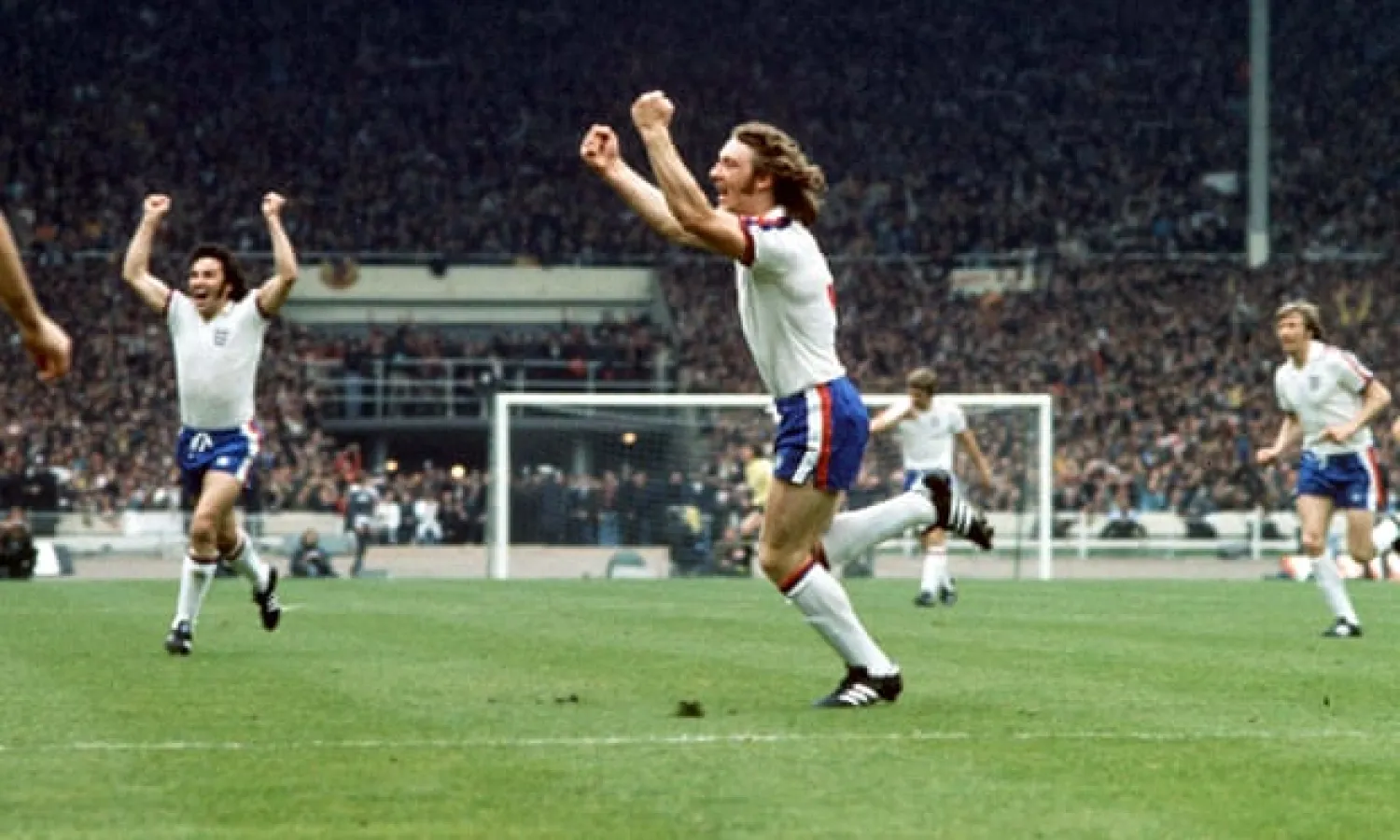
 Kevin Beattie celebrates a goal for England during a 5-1 win against Scotland at Wembley in the British Home Championship, 1975. Photograph: Colorsport/Rex/Shutterstock
Kevin Beattie celebrates a goal for England during a 5-1 win against Scotland at Wembley in the British Home Championship, 1975. Photograph: Colorsport/Rex/Shutterstock
TT

Kevin Beattie Obituary

 Kevin Beattie celebrates a goal for England during a 5-1 win against Scotland at Wembley in the British Home Championship, 1975. Photograph: Colorsport/Rex/Shutterstock
Kevin Beattie celebrates a goal for England during a 5-1 win against Scotland at Wembley in the British Home Championship, 1975. Photograph: Colorsport/Rex/Shutterstock

When Ipswich Town were a footballing power in the late 1970s and early 80s, Kevin Beattie was at the core of their success. A central defender of unusual poise and class, he was the best player in a team that not only won the FA and Uefa cups but gave the great Liverpool side of that era a run for their money in the league.

Beattie, who has died aged 64 of a heart attack, was hailed by Ipswich fans as the club’s greatest ever player. But a greater measure of his standing was the universal respect he generated among his peers, who recognised not just his great technical prowess but the courage, strength and application that went with it. His ability to win the ball and then distribute it with calm precision drew comparisons with Bobby Moore, and of his generation there were few English footballers more highly rated within the game.

Yet given the level of acclaim that came his way, Beattie played a surprisingly small number of games for England – nine in total. Injuries were mostly to blame; he was often forced to withdraw after being selected, and at 28 had to make an early retirement with a longstanding and serious knee problem. What he failed to achieve on the international stage, however, he made up for on the domestic front with Ipswich, in 225 league appearances across a highly successful decade for the side. He remained close to the club for the rest of his life, including for a number of years as a football analyst on BBC Radio Suffolk.

Despite his long affiliation with Ipswich, Beattie was born in Carlisle. His background was a poor one – his father, a coalman, and his mother, a cleaner, had nine children, and his father’s heavy drinking took up much of the household income, often meaning Kevin did not eat for two or three days running. He left St Patrick’s Roman Catholic senior school, where he occasionally played truant because he had no shoes to wear, at 14 to work in factory and warehouse jobs.

Spotted by a scout playing in local leagues, at 15 Beattie was invited to talks with the Liverpool manager Bill Shankly, but when he arrived in the city the club had forgotten to send anyone to meet him, and with no money to get to the ground he returned on the first train home. Shortly afterwards Ipswich jumped in to exploit Liverpool’s missed opportunity and their manager, Bobby Robson, is said to have told his chief scout that he would lose his job if he failed to rendezvous with the youngster. Beattie turned up at the interview wearing his father’s shoes, and when Ipswich signed him as an apprentice in 1970, Robson’s first act was to make sure he was properly shod.

Beattie turned professional in 1971 and the following year made his debut, aged 18, in a 2-1 win against Manchester United. He was the inaugural winner of the Professional Footballers’ Association (PFA) Young Player of the Year award in 1974, and was playing for England – in a 5-0 win against Cyprus – by 1975.

Immensely strong, athletic, and extremely quick over the first 10 yards, Beattie was a superb tackler, could spring impressively high when heading the ball, and had a powerful left-footed shot. “He was quite annoying, really, because everything came so easy for him,” said his Ipswich colleague Roger Osborne. “He was just stronger, fitter and better than anyone else. He didn’t have to try.”In the season before Beattie’s debut, Ipswich were placed 13th in the First Division, but in all but one of the nine campaigns in which he featured, the club finished no worse than sixth, including runners-up to Aston Villa in 1980-81. With Beattie in the side they also won the FA Cup final in 1978 – a 1-0 victory against Arsenal, courtesy of an Osborne goal – and while he did not play in the two legs of the 5-4 Uefa Cup final victory over the Dutch club AZ Alkmaar three years later, he was eventually awarded a medal by Uefa to recognise his contributions earlier in the competition.

He had played in what turned out to be his last match for Ipswich shortly before that final, when he broke his arm in an FA Cup semi-final against Manchester City. By then, years of problems with his knees had already taken their toll, ending his England career in 1977 and increasingly interfering with his club availability. After the fifth in a series of unsuccessful operations in 1981 Beattie was forced to call time with Ipswich at the end of the year.

He tried short-lived comebacks in lower leagues with Colchester United and Middlesbrough during 1982-83, then moved into non-league football in the mid-80s, interspersed with brief periods at three minor teams in Scandinavia.

Despite having received £50,000 from a testimonial match with Ipswich and a fee for acting as Michael Caine’s body double in the football sequences of the 1981 film Escape to Victory, Beattie lived for much of the rest of his life in straitened circumstances. In recent years, however, he had received financial help from the PFA and had put his life on a more even keel, acting as a full-time carer to his wife, Margaret, as her multiple sclerosis worsened.

Affable and down to earth even at the height of his fame, Beattie remained a popular figure in Ipswich, and returned to the public eye through his matchday work on local radio from 2008 onwards. In 2012 he was given a 12-week curfew as punishment for benefit fraud, having failed to declare his modest radio earnings for fear that he would lose income support.

He is survived by Margaret (nee Boldy), whom he married in the early 70s, and by their three daughters, Emma, Sarah and Louise.

The Guardian Sport


Romania Great Gheorghe Hagi Returns for Second Stint as National Team Coach After Lucescu’s Death

Gheorghe Hagi attends a press conference after being appointed as the new manager of the Romanian national team, in Bucharest, Romania, April 20, 2026. (EPA)
TT

Romania Great Gheorghe Hagi Returns for Second Stint as National Team Coach After Lucescu’s Death

Gheorghe Hagi attends a press conference after being appointed as the new manager of the Romanian national team, in Bucharest, Romania, April 20, 2026. (EPA)

Romania great Gheorghe Hagi has been hired as national team coach for the second time. He was appointed to replace Mircea Lucescu, who died two weeks ago.

The 61-year-old Hagi is widely regarded as Romania’s greatest ever football player, having led the country to the World Cup quarterfinals in 1994. He also played for Barcelona and Real Madrid as a creative attacking midfielder.

His first stint as Romania coach was in 2001 and lasted three months, ending after failing to get the team through the playoffs for the 2002 World Cup.

Hagi has since coached clubs in Romania and Türkiye, including Galatasaray and Steaua Bucharest, but is back in charge of the No. 56-ranked national team, which will not be at the World Cup in the United States, Canada and Mexico.

The Romanians lost to Türkiye in the playoffs, after which Lucescu fell ill and stepped down as coach. He died April 7, at the age of 80.

“It is an honor and a great responsibility to represent Romania once again, as I did as a player,” Hagi said in a statement released by Romania’s football federation.

“I am convinced,” he added, “that we can achieve beautiful things. I hope that the performances I had as a player, I will also have as a coach. I am convinced that we can become the best.”

Romania last played at the World Cup in 1998. It reached the round of 16 at the European Championship in 2024, losing to the Netherlands.

Hagi’s first games in charge will be friendlies against Georgia and Wales in June. Romania is in a Nations League group with Sweden, Bosnia and Herzegovina, and Poland starting in September.

He has signed a contract through to the 2030 World Cup, with the task of “bringing the national team back into the elite of world football,” the federation said.

Federation president Răzvan Burleanu said his organization has made “several attempts over time” to get Hagi to become coach again.


Di Matteo Says ‘Vital’ for Faltering Chelsea to Add Experience

Football - Premier League - Chelsea v Manchester United - Stamford Bridge, London, Britain - April 18, 2026 Chelsea's Marc Cucurella and Moises Caicedo react. (Reuters)
TT

Di Matteo Says ‘Vital’ for Faltering Chelsea to Add Experience

Football - Premier League - Chelsea v Manchester United - Stamford Bridge, London, Britain - April 18, 2026 Chelsea's Marc Cucurella and Moises Caicedo react. (Reuters)

Chelsea great Roberto Di Matteo told AFP on Tuesday it was "vital" that the faltering Premier League side add experienced players and backed Liam Rosenior to still be in charge next season.

The London club are in the midst of an alarming slump, sixth in the table after four defeats in a row and in serious danger of missing out on Champions League football.

Boos greeted the full-time whistle following Saturday's 1-0 defeat to Manchester United at Stamford Bridge after some supporters staged a street protest against owners BlueCo ahead of kick-off.

Former midfielder Di Matteo, who guided Chelsea to Champions League glory as manager in 2012, said "inconsistency" was understandable given the young age of the squad.

"I think the owner just said it last week. On the weekend he said that they're probably going to look at changing the transfer policy a little bit," Di Matteo said at the launch of the "Hong Kong Football Festival" featuring Manchester City, Chelsea, Inter Milan and Juventus in August.

"I think it's vital. If you want to have a little bit more consistency, if you want to be able to challenge, maybe for the Premier League, you need to have a good balance.

"You need very good, young, talented players, but you also need a little bit of experience within the team."

The 55-year-old Italian, who was a mainstay of the Chelsea team from 1996 to 2002, said allowances needed to be made for under-pressure Rosenior given he only replaced Enzo Maresca in January.

"You take over a team that was built for a different coach, with a different system," he said.

"It's always hard to be able to put your print on the team during mid-season. Everybody expects you to get it going straight away.

He added: "I guess next season we'll be able to see his team make some adjustments to the way the team (plays) or (bring in) the players to play his system."

Chelsea co-owner Behdad Eghbali last week said the club were still behind Rosenior and remained optimistic about long-term success under his management.


Alcaraz Awaiting Test Results with French Open Defense at Risk

 Laureus World Sports Awards - Palacio de Cibeles, Madrid, Spain - April 20, 2026 Spain's Carlos Alcaraz poses on the red carpet ahead of the awards ceremony (Reuters)
Laureus World Sports Awards - Palacio de Cibeles, Madrid, Spain - April 20, 2026 Spain's Carlos Alcaraz poses on the red carpet ahead of the awards ceremony (Reuters)
TT

Alcaraz Awaiting Test Results with French Open Defense at Risk

 Laureus World Sports Awards - Palacio de Cibeles, Madrid, Spain - April 20, 2026 Spain's Carlos Alcaraz poses on the red carpet ahead of the awards ceremony (Reuters)
Laureus World Sports Awards - Palacio de Cibeles, Madrid, Spain - April 20, 2026 Spain's Carlos Alcaraz poses on the red carpet ahead of the awards ceremony (Reuters)

Carlos Alcaraz ‌is awaiting the results of tests on his injured wrist before making a decision about defending his French Open title next month, the world number two said.

The seven-times Grand Slam champion picked up the injury in the first round of the Barcelona Open earlier this month ‌before withdrawing from ‌the tournament.

Scans showed the ‌issue ⁠was more serious ⁠than initially thought and he then skipped the Madrid Open.

"The next test will be crucial," Alcaraz told Spanish television channel TVE.

"We've been trying to do everything we can ⁠do to make sure that ‌this test ‌goes well. I'm trying to be very ‌patient. But we are good, we ‌are just waiting a little bit.

"We have a few tests in the next few days and then we will ‌see how the injury is, and what the next steps ⁠will ⁠be," the 22-year-old added.

Alcaraz, who was crowned Sportsman of the Year at the Laureus Awards on Monday, surrendered the world number one ranking to Jannik Sinner after losing to the Italian in the Monte Carlo Masters final days before his Barcelona opener.

The French Open will start from May 24 in Paris.
