Eden Hazard and the Virtue of Staying Put Rather than Going for the Sake of it

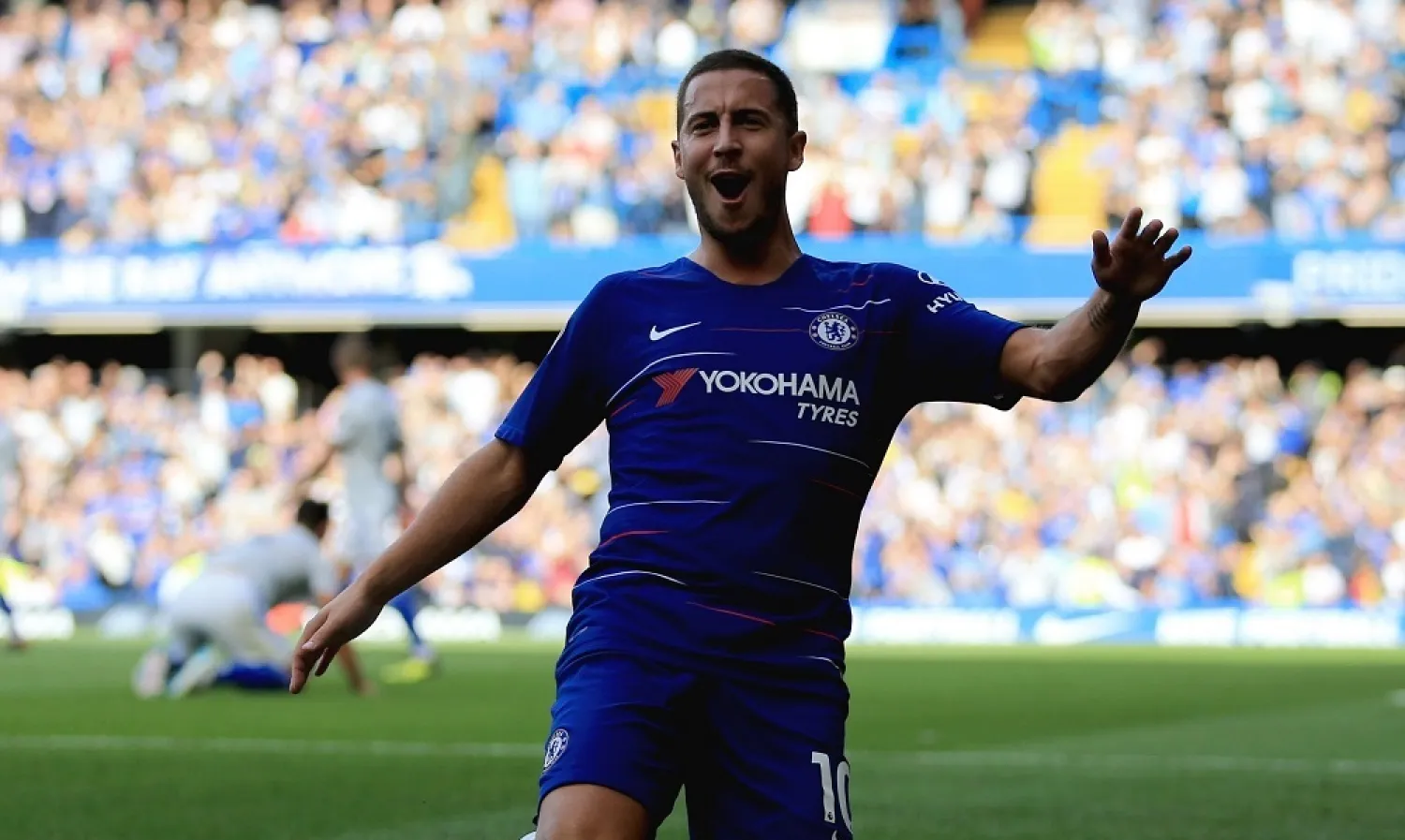
Chelsea's Eden Hazard celebrates after scoring a goal. (Getty Images)
TT

Eden Hazard and the Virtue of Staying Put Rather than Going for the Sake of it

Chelsea's Eden Hazard celebrates after scoring a goal. (Getty Images)

Almost all of the world’s problems, from daily irritations to long-term catastrophe models, are caused by people doing things. It’s not hard to trace the line of cause and effect. Growth, progress, reaching out, growing as a person: these are invariably the areas where things start to go awry, distractions from the safety of idleness, entropy and generally not doing much.

This is not a new idea. The Ten Commandments in the book of Exodus aren’t really commandments in the active sense. They’re prohibitions, warnings against the ancient menace of doing things. As much as you might want to hold an adulterous ass-coveting party in the house of your recently murdered neighbor, the Bible explicitly forbids all of these activities. And for me, Clive, rightly so.

All of which leads naturally on to Eden Hazard, who was brilliant once again for Chelsea in midweek, scoring a winning goal against Liverpool that was both dizzying in its range of skills and also not that surprising for Chelsea fans who watch him a lot. He gave a similar performance on Saturday in his club’s 1-1 tie against Liverpool in the Premier League on Saturday. It has become a commonplace this season to declare Hazard the best player in the league right now. It is also probably true.

But then Hazard has been the best player in the Premier League for years, just not always the most consistent or the most effective on the numbers, a footballer of unsurpassable skill and technique still in the process of becoming fully himself. Watching him from close to the pitch at Stamford Bridge there has been a temptation to laugh at times at his outrageous skill at taking the ball and turning at speed, legs whirring, chest puffed, scorching left and right at extraordinary angles, like a cartoon mouse whizzing along the skirting board.

The only question was why Hazard wasn’t constantly unstoppable, why he didn’t destroy the opposition every week. Instead it has been a process of incremental improvement. To a point where Hazard’s story is now in danger of becoming a narrative of departure. He has become so good that to simply stay where he is would be an aberration, a move to Real Madrid or Barcelona flagged up as a sporting inevitability.

Whereas in fact the opposite is true. Hazard is instead the perfect advert for the power of staying, for the virtues of stasis. There has already been some talk this week of a new Chelsea contract and this is to be applauded. Because Hazard tells us something else, that change, the menace of doing things, is not always the best path.

At Chelsea his highs have been cherished, his troughs forgiven or worried over in private. Development has come from sticking it out, and in part from the challenges posed with each managerial sacking. For now Hazard seems to have found the right man at the right time. Maurizio Sarri is an attacking cavalier, but he is also furiously detailed in what he wants from his attackers, meticulous on things like movement and pressing, this despite mooching around the touchline looking like he’s en route to a six-day fishing trip on a canal off the A40 and it’s an effort of will not to sit on the bench with his special inflatable pillow around his neck.

If Hazard’s steady bloom tells us anything it is that the orthodoxies of transfer culture should be resisted, or at least questioned and treated with skepticism. Most sane, disinterested bodies involved in football – plus also Fifa – accept that transfers need to be reformed. What isn’t said enough is that transfers are a menace generally, are consistently disruptive to teams, players and fans. Instead the view has arisen, unchallenged, that the only way to succeed is to acquire constantly, to bolt on chunks of pre-stressed talent.

This has never been the case, and it isn’t the case now. Even among the wealthiest clubs successful teams invariably arise from team-building, perseverance and consistent tactics. Whereas in practice most transfers fail in some form, inhibiting rather than encouraging player development, confusing or degrading the team dynamic at both ends. There are of course plenty of good ones too. But these generally involve a move to a club where these two factors, development and stability, are already in place, players signed as key pieces in a jigsaw.

Instead transfers are too often a brutal process, geared towards monetizing a player’s status rather than nurturing their talent. Danny Drinkwater went from a perfect fit at the perfect level at Leicester City to his current role as a sad-looking, well-paid man in a blue tracksuit who spends his Saturdays watching other men play football. Renato Sanches has been transformed by the power of the ill-timed big-money move from the most promising hometown talent in Europe to someone who looks like he’s been trying to play football on LSD for the last two years.

Hazard’s five years at Chelsea have at least pushed against this a little. He is, by all accounts, a slightly different kind of person, talent without rapacious ambition, and guided by his father rather than an industry super-agent. By staying he has become something else, an emblem of his team, a page in his club’s modern history. And a player who, aged 27, seems to be reaching into the outer fringes of his own talent.

It still seems likely Hazard will move on at some point. But his refusal so far is a minor blow in favor of something else, a vote for team-building, for football as something rooted in geographical place; and for the idea that even the rarest talent can be allowed to stay and bloom where it falls.

The Guardian Sport


Irish Boxer Lee Reeves Dies at Age 31, Three Months after Dublin Title Fight Injury

Irish boxer Lee Reeves. Reuters
TT

Irish Boxer Lee Reeves Dies at Age 31, Three Months after Dublin Title Fight Injury

Irish boxer Lee Reeves. Reuters

Irish boxer Lee Reeves has died more than three months after being injured during a fight in Dublin, promoter Queensberry said Tuesday. He was 31.

"Everyone at Queensberry is devastated to learn of the passing of Lee Reeves," Queensberry Promotions said in a statement.

Reeves was hospitalized after being knocked out by compatriot Gary Cully in the 10th and final round of their Boxing Union of Ireland Celtic super-lightweight title fight on Aug. 1.

Reeves was carried from the ring on a stretcher after receiving initial treatment.

Queensberry had said after the fight that his condition was critical but stable.

“Lee was an immensely talented boxer, as well as a true role model and inspiration to his community,” the statement added Tuesday, according to The Associated Press. “Our deepest condolences go to Lee’s family, friends and all those who loved him. We ask that their privacy be respected at this incredibly difficult time. Rest in peace, Lee.”


Alonso to Enter Dakar Rally with Loeb and Aston Martin Team

November 5, 2026 Aston Martin's Fernando Alonso during a press conference ahead of the F1 Sao Paulo Grand Prix. (Reuters)
TT

Alonso to Enter Dakar Rally with Loeb and Aston Martin Team

November 5, 2026 Aston Martin's Fernando Alonso during a press conference ahead of the F1 Sao Paulo Grand Prix. (Reuters)

Double Formula One champion Fernando Alonso will compete in next January's Dakar Rally in an Aston Martin Dreadnought entry run by engineering partner Prodrive.

The 45-year-old Spaniard, a 32-time Grand Prix winner and two-time Le Mans 24 Hours winner, will be racing in the annual event for the second time after competing with Toyota in 2020, finishing 13th.

France's nine-time world rally champion Sebastien Loeb and Brazil's reigning world rally-raid champion Lucas Moraes will be his teammates in a three-car entry.

The 49th edition of the Dakar Rally will ‌be held in ‌Morocco from January 9 to 23, with a prologue and first ‌stage ⁠in Portugal, after ⁠being moved from Saudi Arabia due to security concerns.

The 24-round Formula One season is due to start in Bahrain in March after testing in late February.

Alonso, who will again have compatriot and five-time motorcycle Dakar winner Marc Coma as co-driver, is racing in the Las Vegas Grand Prix this weekend. He said he had turned his thoughts to Dakar after deciding to continue in Formula One with Aston Martin.

“In the end, the decision became simple. I wanted to embrace ⁠the challenge completely and take on both Formula One and the ‌Dakar Rally in the same year," he explained in ‌a statement.

"In 2020, Dakar was one of the most challenging and enjoyable experiences of my career. ‌I have enormous respect for this race and the specialists who have mastered it.

"Formula One ‌remains my priority. But I am a racing driver, and challenges like this are why I love competing. I’m looking forward to seeing what we can achieve."

LOEB CHASES FIRST DAKAR WIN

In October, Alonso told reporters at the Singapore Grand Prix that he felt the desert endurance race would be physically ‌incompatible with his Formula One commitments.

Loeb, 52, will also be chasing a first Dakar win after 10 previous attempts that have brought ⁠him 28 stage ⁠wins to date.

“Winning the Dakar is very important to me,” said the Frenchman, who will be partnered by Belgian Fabian Lurquin. “We have come close several times, and the motivation is there to keep working until we achieve it."

The Dreadnought is a digital-only tactical SUV created exclusively for gamers playing "Call of Duty: Modern Warfare 4" that will now be brought into the real world by Prodrive, Aston Martin's partners in endurance GT racing.

The Dakar will be Aston Martin Racing’s debut in the world rally-raid championship.

"Aston Martin's ambition for this program has been clear from the outset: to create a car capable of competing at the front of the world's toughest motorsport event," said Prodrive Chairman David Richards.

"By combining Aston Martin's vision with Prodrive's experience in rallying, endurance racing and Dakar competition, we have built a strong foundation. With an exceptional driver line-up and a highly capable engineering team, we look forward to seeing Dreadnought take on this remarkable challenge."


Owono Does Not Deserve 12-Match Ban Over De Miguel Death, Says Andorra Owner Pique

Equatorial Guinea's goalkeeper #01 Jesus Owono leaves the pitch at half time during the Africa Cup of Nations (CAN) Group E football match between Equatorial Guinea and Algeria at Moulay Hassan Stadium in Rabat on December 31, 2025. (AFP)
TT

Owono Does Not Deserve 12-Match Ban Over De Miguel Death, Says Andorra Owner Pique

Equatorial Guinea's goalkeeper #01 Jesus Owono leaves the pitch at half time during the Africa Cup of Nations (CAN) Group E football match between Equatorial Guinea and Algeria at Moulay Hassan Stadium in Rabat on December 31, 2025. (AFP)

FC Andorra owner Gerard ‌Pique said goalkeeper Jesus Owono did not deserve the 12-match suspension he received following the challenge that led to the death of Tenerife forward Jesus de Miguel.

Owono and De Miguel collided during a Spanish second-tier match on November 2. De Miguel was taken to intensive care and died the following day.

The disciplinary committee of the Spanish football federation (RFEF) banned Owono for violent conduct which resulted in serious ‌injury last week.

"Players, ‌former players, coaches, goalkeepers, everyone has ‌called ⁠it an accident," ⁠Pique said in a video posted on social media late on Monday.

"I truly believe that imposing the maximum sanction on Jesus for this action puts him in a situation he does not deserve, because he is not to blame for all of ⁠this having happened."

Former Barcelona player Pique ‌pointed to the three-match ‌ban handed to Albacete's Jose Corpas for accidentally kicking Sabadell ‌player Quadri Liameed in the head during a ‌recent match in Spain.

"Fortunately Quadri is fine, the consequences in this case were not fatal, and the committee decided to sanction Corpas with three matches," Pique added.

"With ‌all this, my reflection is: what is being sanctioned, the action or the ⁠consequences?"

The RFEF ⁠did not immediately respond to a request for comment outside regular business hours in Spain.

Owono, 25, has withdrawn from Equatorial Guinea's squad for Africa Cup of Nations qualifiers against Zimbabwe this month and Pique said it was unlikely the goalkeeper would return to action as soon as his suspension is up.

"Jesus is going to need far more than 12 matches before he is available and able to compete," he added. "No sanction is going to bring Demi (De Miguel) back to us."