


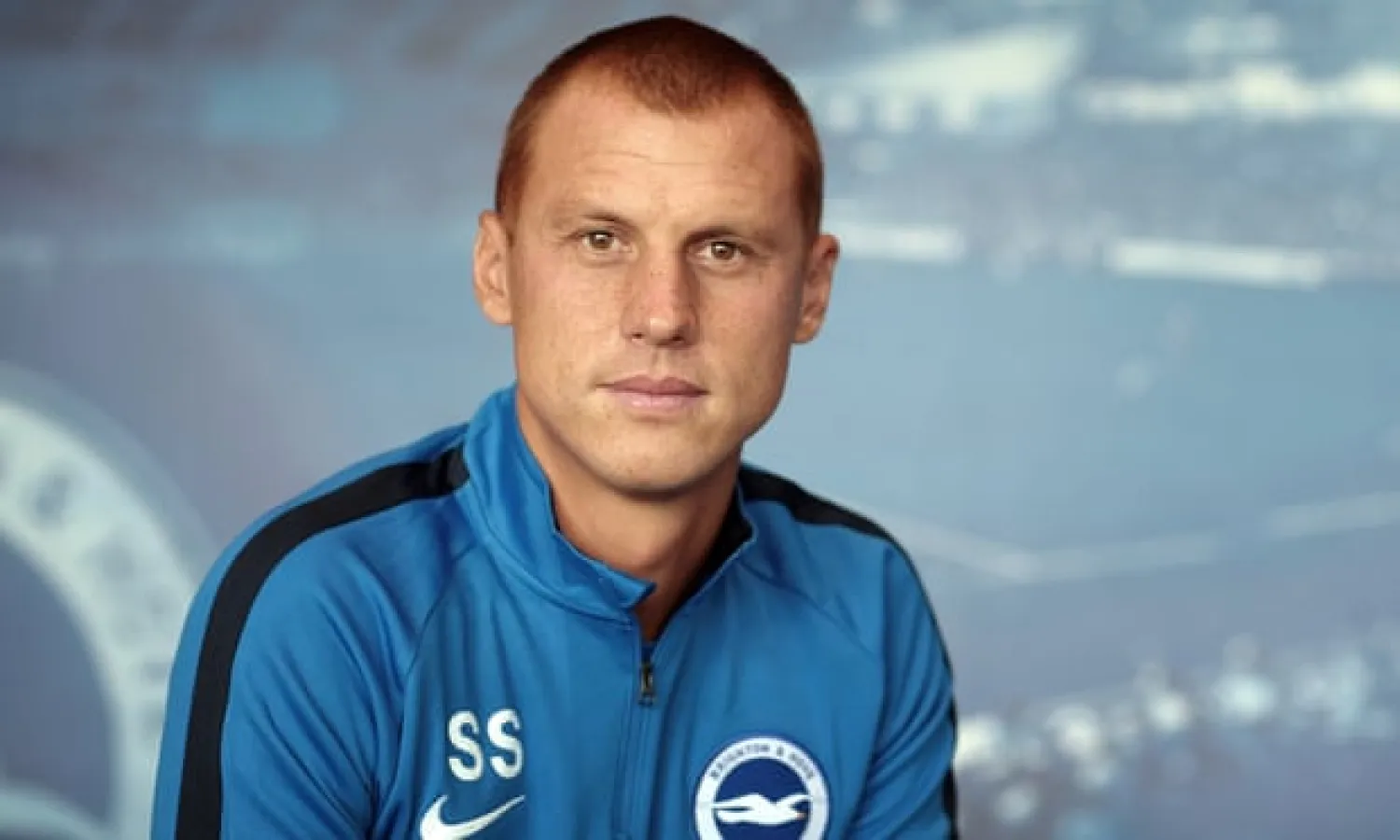

“I’ve been with my wife since we were kids at school and she had never seen me cry, ever,” Steve Sidwell says as he remembers the spring evening this year when he sat next to her on their bathroom floor. Sidwell cried for a long time, his tears leaving little marks wherever he looked, as he finally accepted that his career as a professional footballer was over.
He had joined the Arsenal academy 26 years before, aged nine, and played in the Premier League for Reading, Chelsea, Aston Villa, Fulham and Stoke before joining Brighton in 2016. Sidwell helped Brighton gain promotion to the Premier League last year but he had been injured for the whole of their first season back in the top flight. A varied career, which saw him work under managers as different as Arsène Wenger and José Mourinho, had ended and Sidwell felt overwhelmed.
“We’ve had my wedding day and four kids,” Sidwell says. “Big moments when I felt a real buildup of emotion but kept it all in. But that evening there was no stopping it. It was near the end of the season and [his wife] Krystell was in the bath. I sat on the floor next to the bath. We’d locked the door because we didn’t want the kids coming in. The conversation got going and it all opened up.”
A small smile drifts across his previously serious face. “In a way I wanted the tears to happen. It was good, it was a real relief. Once it happened I accepted it. That was it. I was done as a player.”
On an autumn morning at Brighton’s training ground, where Sidwell will coach the under-16 squad an hour from now, the 35-year-old reflects on the pain of letting go and the anticipation of a new life. He may fulfil his ambition of becoming a high-level coach or carve out a different path as a pundit as Sidwell is bright and perceptive. The former midfielder is also honest when he considers the divide that separates most footballers from mainstream society – while capturing the insecurities inside the Premier League bubble.
“The year I’d had without playing because of injuries [back surgery was followed by a broken ankle] was tough. You feel disabled in a way because you can’t express the stuff you’ve done for 20 years. I’m lucky I’ve got a very strong family so I didn’t go down the road of depression. But sportsmen close to me have slipped into depression. You need someone to get you back into the real world because it’s a dark and lonely place.”
Did he avoid showing emotion as a footballer? “Yeah. You grow up not wanting to show weakness in a dressing room because the other players will have a different opinion of you. You don’t want to show the gaffer that either because you might not be selected. So you build up a front.”
That front disappeared once he decided to retire. “There was a honeymoon period where you’re telling people and it’s all new. But then you reach the stage of ‘I’m crossing the line’. So I was nervous, excited, scared. It’s every emotion you can imagine – an out-of-body experience. It’s similar to scoring a goal. You can’t really describe it. Football is something I’ve always done so I’ve had that structure and been given instructions day in, day out.
“I’m really close to my wife but others aren’t so lucky. You see how the divorce rate goes up for former footballers. You’ve been doing something you love for so long and then it’s gone. It can be a bereavement and you take it out on the ones nearest to you.”
Sidwell describes the jolt footballers feel when cut free from their high-pressured but numbingly cosseted world. “Football is about instant results. Yes, footballers live a luxurious life and we get given everything. If you split a pair of boots you get a new pair that same afternoon. If you’ve got a cough you see the club doctor. And you get a prescription that’s filled straightaway. Everything’s given to you instantly.
“You’re a commodity to the club, and they want you to have no stress. So you lose a little touch with reality. I’ve never had a GP because I’ve never needed to go outside my club but in the big world you need to pay accounts, sort out your MOT. People outside football won’t always grasp this but not doing these little things can mean you lose touch with society.”
It also means that some footballers don’t develop many social skills. “One hundred per cent,” Sidwell says. “It’s even more so for the top players. They get criticised if they go out or if they stay in. They can’t win so in the end they build up a barrier. Now when your career finishes you’re not really used to talking to people. And you obviously need that skill in the real world.”
Sidwell is different because, as he explains, “throughout my career I’ve been very grounded and that’s come from mum and dad. My dad had a scaffolding company in south London and he had me working as a kid – even on my days off when I was a pro at Arsenal. He’d come into my room at half-six and get me up for work.
“My kids are very fortunate, they can get most things but I’m having the same thing with my 12-year-old son. He smashed his iPhone and said: ‘Dad, can I have another one?’ I said: ‘Well, give me £600.’ He only had £150 in his savings. I said: ‘OK, earn it.’ My brother’s now taken on my dad’s company so my eldest son has been working there in the holidays.”
His three sons play football and, as Sidwell says, “sometimes they think: ‘Dad’s a footballer, I can be one too.’ But they’re slowly grasping it’s a brutal and relentless road.”
Sidwell expresses concern that, despite admiring the way in which Gareth Southgate helped his England World Cup squad reconnect with the public, the gap between Premier League footballers and ordinary people is deepening. “More so than ever now. The Premier League, PFA and clubs do a lot in terms of trying to interact with fans and local communities. That’s great but there’s a big gap now. How many times do you see teams get off the coach and they can’t go near the barriers? They can’t sign autographs, so that connection is lost. We need to get it back quickly. Football should be about enjoyment but the business side is taking over.”
Did Sidwell ever feel guilty about the money he earned as a footballer? “I’ve never been one to buy ridiculous things or waste money. Obviously I’ve done nice things. I’ve been fortunate enough to take my whole family to Florida. First class, paid for everything. But when I was at Aston Villa [from 2008 to 2011] I was on the most money in my career. But that was when I was at my unhappiest. I was living in Birmingham away from my wife and family. My middle son caught meningitis and was in hospital. The football never really took off and me and Martin O’Neill clashed. So it was a combination of things. But some people would say: ‘Wow, if you’re earning that much how can you be unhappy?’”
Mourinho signed him for Chelsea, in 2007, and he struggled to break into the first team, making 15 appearances in his one season at the club. Sidwell’s personal experience with Mourinho, however, stands in stark contrast to his impressions of the manager’s troubles at Manchester United. “He was brilliant with me even though I came in the year he left. It was that third-season syndrome for him. But his player management was unreal then. He told me two weeks before my starting debut: ‘You’re training really well. You’re not playing this Saturday but you’re starting at the Bridge, against Blackburn, the following Saturday. Get mentally prepared.’ He had brilliant little touches then.
“I’m not sure what’s going on now. He doesn’t seem the person he was. Something has changed. Back then his key skill was getting everyone on side. Yeah, there were times when he showed that other side. Against Fulham he brought off [Arjen] Robben and [Shaun] Wright-Phillips after 20 minutes because they weren’t doing their jobs. That’s harsh.”
Steve Coppell is Sidwell’s favourite manager, after they forged such a close bond at Reading, but his respect for Brighton’s Chris Hughton runs deep and he believes “the gaffer is right up there and I’ve worked with some of the best in the game”.
As well as being an assistant coach of Brighton’s under-16s Sidwell is a club ambassador. “Brighton have been fantastic and allowed me to adjust. I had a summer holiday in August which was my first in 20 years. I’m now loving the coaching. I’ve got my B coaching badges and I’m in the final stages of getting my A licence. You need to earn your stripes, learn the trade, and your coaching career could swiftly take off – or come crashing down. But I’d rather do it, and fail, than not try.
“In six months I might say: ‘This is not for me’ and the media side might take off. I would’ve liked to have done TV and media to start but look at Stevie Gerrard and Frank Lampard. They could’ve done media work permanently but they’re competitive. The competitive edge draws us back in. I’m spinning plates and we’ll see what takes off.
“But I’m happy with my decision to retire. The toughest thing was admitting it – because of injuries I didn’t go on my terms. But there’s nothing I would change. I did everything with purpose and intent. If it worked out, or didn’t, I knew I’d tried my best.”
Sidwell looks up, nods and smiles with the certainty that, after the pain of retirement, he will apply the same principles in his new life.
The Guardian Sport


