

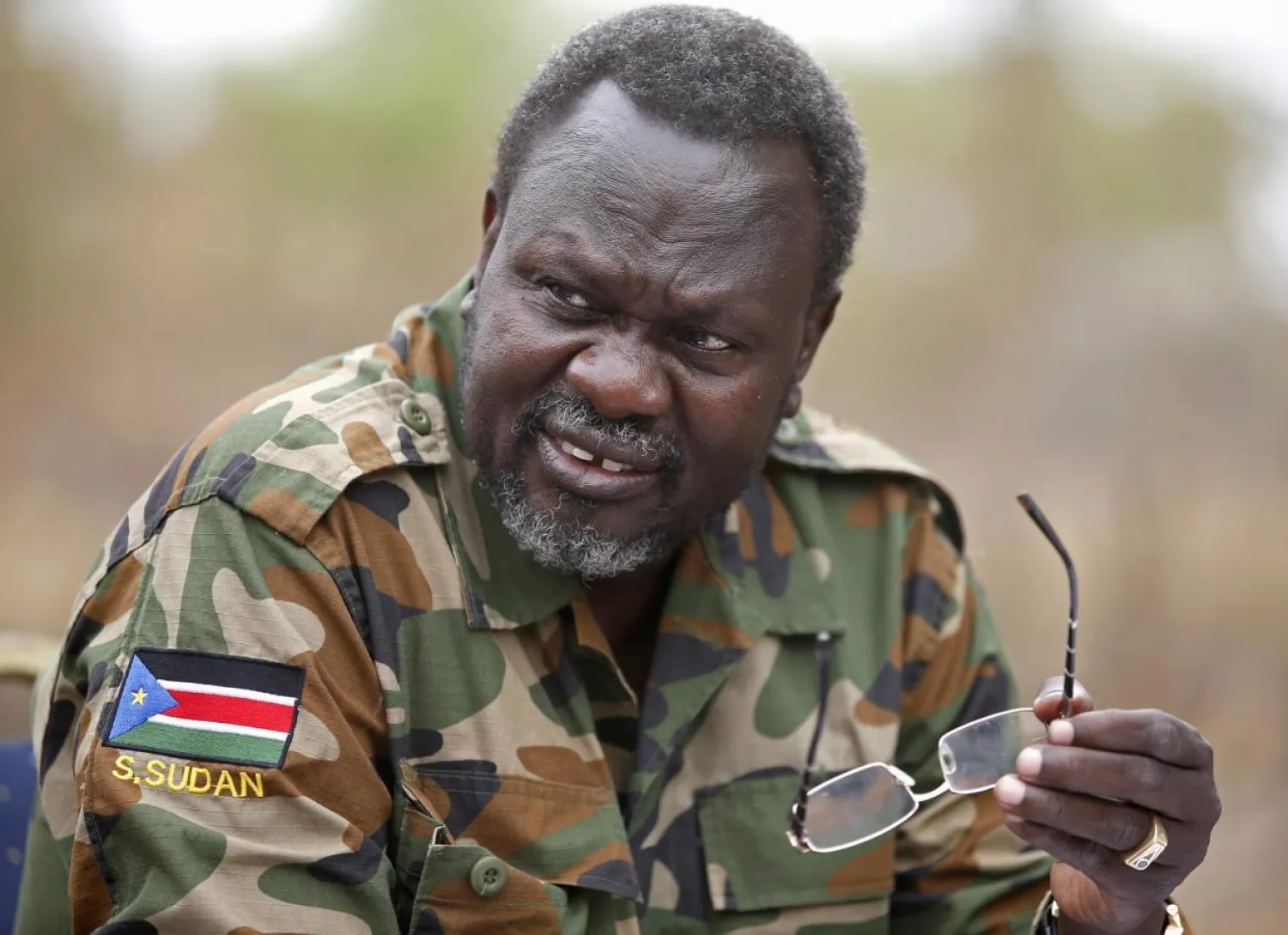

UN Accuses Machar’s South Sudan Rebel Group of Crimes against Humanity

South Sudan's rebel leader Riek Machar. (Reuters)
TT

UN Accuses Machar’s South Sudan Rebel Group of Crimes against Humanity

South Sudan's rebel leader Riek Machar. (Reuters)

The United Nations has accused South Sudan armed opposition group, led by Riek Machar, of committing crimes against humanity in the Western Equatoria region. The accusations are the first-ever charges by the UN against Machar’s movement.

According to the UN, in April 2018 before the peace agreement signed in August, Sudan People’s Liberation Army- in Opposition (SPLA-IO) forcefully took 900 people including children and women.

Meanwhile, the International Committee of the Red Cross (ICRC) said it has facilitated the release of 24 persons detained in relation to the conflict in South Sudan, including 16 detainees released earlier on Friday.

This week marks the first releases of prisoners supervised by the ICRC following the signing of the latest peace agreement in which parties to the conflict agreed to free detainees.

The ICRC statement, a copy of which was obtained by Asharq Al-Awsat, confirmed the release of the war captives to be the first batch since the agreement signing on September 12. However, the organization refused to release the names of those released.

UN charges facing the SPLA-IO included killings, rape, slavery, forced recruitment, destruction of more than 28 villages and the targeting of civilians.

The UN said that other than kidnapping 900 people, the rebel movement forced more than 2,000 people to flee their homes between April and August.

United Nations High Commissioner for Human Rights Michelle Bachelet appealed to the rebel movement to release nearly 1,000 civilians allegedly abducted from the Western Equatoria region.

The Special Representative of the Secretary-General and Head of UNMISS, David Shearer, said it was disappointing that the spike in violence took place while warring parties were negotiating a new peace agreement and despite positive reconciliation efforts in the affected community at the time.

“A new peace agreement has been signed which puts the onus and responsibility on the warring parties to ensure that no atrocities are committed in the future. UNMISS will be closely monitoring any potential violations and abuses,” said Shearer.

However, SPLA-IO deputy spokesman Paul Lam Kabriel denied that his movement committed any of the claimed atrocities.



Washington Says US and Iran Pausing Strikes, Talks to Proceed

Vessels at the Strait of Hormuz, as seen from Musandam, Oman, June 26, 2026. REUTERS/Stringer
TT

Washington Says US and Iran Pausing Strikes, Talks to Proceed

Vessels at the Strait of Hormuz, as seen from Musandam, Oman, June 26, 2026. REUTERS/Stringer

A US official said Sunday that Washington and Tehran agreed to halt attacks after new tit-for-tat strikes strained their interim deal, with the sides planning to renew talks aimed at ending the Middle East war.

The exchanges have underscored the fragility of a Pakistan-brokered agreement to end the conflict that has killed thousands and snarled the flow of oil shipments through the vital Strait of Hormuz.

Although a ceasefire took effect in April, sporadic violence has flared up in the Gulf region, with traffic in the strait serving as a regular flashpoint.

"Technical talks are slated to continue on all areas of the MOU," a US official told AFP in an email late Sunday, referring to the memorandum of understanding struck between Washington and Tehran.

"Both sides will stand down for now and vessels can move freely" in and around the Strait of Hormuz, the official added.

Iran has not immediately commented on the US statement, and the US official did not confirm a US media report that talks would resume Tuesday in Qatar.

Tehran has insisted on controlling passage through the vital strait, through which about a fifth of the world's oil and liquefied natural gas travel in peacetime. It did not have that control before the war.

Iran's top diplomat warned Sunday that any attempt by ships to bypass its preferred route through Hormuz would "increase tensions" in the Middle East.

Tehran's enforcement of its control has sparked repeated flare-ups with Washington, the latest of which came early Sunday, when US Central Command said it had attacked 10 Iranian military targets over "continued Iranian aggression against commercial shipping.”

Iran said it retaliated with strikes against US bases in Kuwait and Bahrain. Both Kuwait and Bahrain denounced the Iranian attacks.

Iran presently insists ships transiting the strait pass through a corridor near its own shores, though this week dozens of vessels have travelled along the opposite side of the waterway, hugging the Omani coast.

"Any attempt to adopt new or separate arrangements compared to what is underway by the Islamic Republic of Iran, will only lead to more complicated situations and delays in the reopening of the Strait of Hormuz, and will increase the tensions," Iranian Foreign Minister Abbas Araghchi said.


Pakistan: Ground Operation and Strikes Along Afghan Border Killed 29 Militants

Army soldiers leave the Mosamiat Chowrangi area after security forces completed a clearance operation after a militant attack on Pakistan's Security Rangers compound in Karachi on June 28, 2026. (Photo by Asif HASSAN / AFP)
TT

Pakistan: Ground Operation and Strikes Along Afghan Border Killed 29 Militants

Army soldiers leave the Mosamiat Chowrangi area after security forces completed a clearance operation after a militant attack on Pakistan's Security Rangers compound in Karachi on June 28, 2026. (Photo by Asif HASSAN / AFP)

Pakistani security forces Sunday carried out a ground operation along the Pakistan-Afghanistan border, followed by “calibrated strikes” against militant hideouts and safe havens, killing 29 fighters, officials said.

In a post on X, Information Minister Attaullah Tarar said the operation was launched in response to multiple militant attacks across the country.

In Afghanistan, government spokesperson Zabihullah Mujahid said Pakistan's attacks resulted in the deaths and injuries of dozens of civilians, including women and children.

“We strongly condemn this cowardly act of aggression and consider it a crime and an act of brutality,” The Associated Press quoted him as saying.

Pakistan has witnessed a surge in militant attacks targeting police and security forces in recent years. Authorities have blamed the Pakistani Taliban, known as Tehrik-e-Taliban Pakistan, or TTP, and allied militant groups for most of the violence.

The security operation took place a day after militants armed with guns and explosives targeted the regional headquarters of the paramilitary Rangers in the southern port city of Karachi, killing three soldiers. Security forces killed three attackers and arrested another assailant, whom the military identified as an Afghan national in wounded condition.

Jamaat-ul-Ahrar, a breakaway faction of the Pakistani Taliban, claimed responsibility for the Karachi attack in a statement Saturday night.

Tarar said Pakistan’s latest operation along the Afghan border targeted hideouts and safe havens of the Pakistani Taliban. The Pakistani Taliban are a separate militant group from the Afghan Taliban, although the two are allies.

The Afghan Taliban returned to power in neighboring Afghanistan in 2021.

The latest operations are likely to further strain already tense relations between Islamabad and Kabul.

Sunday’s cross-border strikes and ground operation came less than three weeks after Pakistan's military launched airstrikes on what it said were militant hideouts in Afghanistan. They ended about a month of relative calm following what Islamabad had described as an “open war” between the neighboring countries, despite international efforts to broker a lasting peace.

The escalation follows months of tit-for-tat military action between the two countries. Hundreds of people have been killed in cross-border fighting since February, when Afghanistan launched retaliatory strikes after Pakistan carried out airstrikes inside Afghan territory.

Multiple rounds of talks have failed to secure a lasting ceasefire. China also hosted the two sides in April and Beijing later said Pakistan and Afghanistan had agreed not to escalate their conflict and to explore a solution.

Pakistan since last year has carried out multiple strikes along the border and inside Afghanistan, targeting alleged hideouts of TTP and other militants. Pakistan accuses Afghanistan’s Afghan Taliban government of harboring militants who carry out deadly attacks inside Pakistan, especially the TTP. Kabul denies the charge.


Calls for Ocalan’s Release Spark Street Rallies in Türkiye

Kurds participate in a rally organized by the Peoples' Equality and Democracy Party in Mersin (south) on Saturday, demanding Öcalan's release (The party's X account)
TT

Calls for Ocalan’s Release Spark Street Rallies in Türkiye

Kurds participate in a rally organized by the Peoples' Equality and Democracy Party in Mersin (south) on Saturday, demanding Öcalan's release (The party's X account)

Several thousand people rallied Sunday in the Kurdish-majority city of Diyarbakir in southeast Türkiye calling for the release of jailed Kurdistan Workers' Party (PKK) leader Abdullah Ocalan, an AFP journalist reported.

Protesters gathered in a central square in Diyarbakir, chanting slogans in Kurdish, including "Serok Apo" (Leader Apo), in a show of support for the 77-year-old, held on Imrali prison island since 1999.

The rally comes after the PKK last year formally renounced its armed struggle against the Turkish state, ending a conflict spanning four decades that has claimed at least 50,000 lives.

Following Ocalan's call for the group to lay down its weapons, the PKK announced its dissolution, staged a symbolic arms-burning ceremony, and withdrew its fighters from Turkish territory.

Addressing the crowd in Diyarbakir, Veysi Aktas, a former inmate once held with Ocalan on Imrali, warned that lasting peace would not be possible while the leader remained in isolation.

"There can be no peace through isolation," he said.

"Through isolation, the leadership is being distanced from the people. Peace means recognition of the people, respect for identity, and respect for the will of the people".

Despite repeated calls from supporters and pro-Kurdish politicians to ease Ocalan's detention conditions, his situation remains largely unchanged.

He has however recently been granted increased access to family members, lawyers and a small number of lawmakers from the pro-Kurdish DEM party involved in ongoing peace efforts.